The dirty secret about backchannel calls and emails after the Match is simple: they help far less than you think, and when they do work, it’s usually because the groundwork was laid long before Match Week.
You’re looking for a miracle. Program directors are looking to protect themselves. Those two goals do not align.
Let me walk you through what actually happens on the other side of the Zoom window and the call schedule once the dust settles on Monday of Match Week.
What “Backchannel” Really Means to Programs
When we say “backchannel,” we are not talking about the official SOAP submission, ERAS filters, or NRMP lists. Those are formal.
Backchannel is:
- The text from your mentor to their friend who’s an APD.
- The “quick call” from your med school dean to a PD asking them to “give this student a look.”
- The email from an attending you worked with on away rotation saying, “This is a strong candidate, would you consider them?”
- The resident DM’ing their chief, “Hey, my buddy just unmatched. Can we help them?”
Some of this is tolerated. Some of it is quietly influential. Some of it is instantly ignored. And a little of it will get someone in trouble if they are too blatant, especially if it looks like NRMP rules are being skirted.
Programs see waves of this during Match Week. By Tuesday at noon, bigger IM and FM programs can have dozens of “please look at this applicant” pings. You are not the only emergency on their radar.
So let’s separate myth from actual leverage.
The Harsh Reality: What Helps You and Why
Backchannel help only moves the needle when at least one of three things is true:
- You are already competitive on paper for that specific program and specialty.
- The recommender has real relational capital with that PD or department.
- The program has an urgent need or vulnerability that your profile actually addresses.
If you don’t hit any of those, the call becomes background noise.
1. Your paper app still has to clear the bar
I’ve watched this more times than I can count. Faculty walks into the PD office on Tuesday afternoon:
“Hey, can you look at this student from my med school? Really solid, just had some bad luck in the Match.”
PD pulls up the ERAS file. The verdict happens in under 90 seconds.
- Step scores? Board status?
- Any failed attempts?
- Specialty switches?
- Visa needs?
- Major professionalism flags?
If your metrics are way below what they’d ever touch for a categorical spot, no amount of “he’s such a hard worker” fixes that. At best, you might get considered for a prelim year or a non-categorical slot if those exist.
There’s a brutal line many PDs use behind closed doors:
“I’m not going to create a problem I can’t fix later just because someone’s dean is calling.”
So a call helps in two scenarios:
- You’re solid on paper, but buried in the SOAP chaos. The call makes them actually open and really read your file.
- You’re borderline, but your red flag is explainable, and the recommender directly addresses it with credibility.
If you failed Step 1 or Step 2 and the PD has sworn off interviewing failures, your favorite attending calling does not override that policy. They may do you the courtesy of a quick review and a polite “no.”
2. Who calls matters more than how strongly they gush
This part people hate hearing. The source of the call is more important than the emotional intensity of the endorsement.
Here’s how PDs actually triage incoming “please help this student” messages during Match Week. Think of it as an unspoken hierarchy:
| Recommender Type | Typical Impact Level |
|---|---|
| Trusted PD/APD peer at same tier | Very High |
| Well-known subspecialist with history | High |
| Dean with personal relationship | Moderate |
| Random dean with no history | Low |
| Faculty with no connection to PD | Very Low |
A 3-line text from a PD they know and trust beats a glowing two-page advocacy letter from someone they’ve never heard of.
Concrete example I’ve seen:
- Candidate: Unmatched US grad in IM, decent scores, some research, no major red flags.
- Recommender: Former fellow of the PD, now faculty at candidate’s home institution.
- Message: “We trained together. This kid is in our top 10% of grads; I’d take them in my own program if we had spots.”
That candidate moved from “random SOAP applicant in a stack of 600” to “call them this afternoon” in under 10 minutes.
Compare that with:
- Candidate: Similar stats.
- Recommender: Home institution clerkship director unknown to PD.
- Message: Polite, detailed, formal email.
Result? The file gets skimmed, maybe bookmarked… and usually lost in the flood.
3. Programs respond to their own pain, not your panic
PDs are not sitting around thinking, “Whose crisis can I solve today?” They’re thinking:
- “Do we have enough warm bodies to cover the ICU in July?”
- “We just lost our only Spanish-speaking intern, we need someone who can communicate with our patient base.”
- “Our PGY‑2 class has two people going part-time; we’re exposed on night float.”
If your profile intersects with a program’s specific vulnerability, that’s when a backchannel message suddenly gets traction.
Examples where it works:
- You speak a language that’s critical for their population and it’s on your app.
- You’re local, with family in the area, and they’re tired of losing out-of-region interns after a year.
- They’ve had trouble filling a particular track (rural, primary care, research), and you’re exactly that niche.
I’ve literally heard PDs say:
“We need someone who already knows this city and won’t freak out on night shifts. Oh, this kid is from here and rotated here twice? I’ll call them.”
The call from your dean helps only because it places that fact directly in front of them when they’re making a decision under time pressure.
What Absolutely Does Not Help (But Everyone Tries Anyway)
Now the part you actually need to hear: the common “backchannel moves” that are a waste of time or actively harmful.
1. You cold-emailing PDs directly with pleas
Ninety percent of these get deleted without a full read. The other ten percent get skimmed for any glaring professionalism flags.
The logic from the PD side is brutal:
- If you’re in SOAP, they’re already drowning in official applications.
- If you’re post-SOAP and still unmatched, any available spots are extremely limited and tightly controlled.
- Direct pleas signal desperation, and occasionally a lack of understanding of process and hierarchy.
I’ve watched PDs open an email like this:
“Dear Dr. X, I did not match this year and I am extremely passionate about your program. I would be honored if you could consider me for any open positions…”
They sigh. Close it. Move on.
The only time your direct email isn’t instantly dismissed is when:
- You already have a preexisting connection to that program (rotated there, they interviewed you).
- You are following up on an introduction made by someone they trust.
“Dr. Smith from your cardiology division suggested I reach out to you directly…”
Without those, you’re one of 100 similar messages.
2. Mass-blast emails from your med school
Some schools think they’re being helpful by compiling a list of their unmatched grads and sending a single email to “all program directors in X specialty.”
PD reaction: garbage. Straight to the mental trash bin, sometimes the actual one.
They know it’s not targeted, they know no one vouches specifically for you, and they know half the students on that list are nowhere near their bar. The lack of discernment kills the value.
3. Weak, generic “advocacy” letters
Faculty sometimes think volume helps. “I’ll write three different people at that institution.”
If all three messages read like watered-down versions of:
“X is a hard-working student who would be an asset to your program”
…you’ve just wasted everyone’s time. PDs can smell boilerplate from a mile away.
They want specifics that actually alter perceived risk:
- “Rotated with us for 8 weeks, zero professionalism concerns, showed up early every day.”
- “Failed Step 1 once, then scored 238 on Step 2 after serious remediation; I oversaw that process personally.”
- “Handled a personal crisis during MS3 without impacting patient care; I’m comfortable with their resilience.”
If your advocate won’t get specific and a little vulnerable in what they share, the message barely registers.
4. Pressure or guilt tactics
Some deans or senior faculty still try this: “We’ve always sent good residents to your program, you should take another one of ours.”
PDs hate that. Quietly. Deeply.
You cannot guilt a program into taking someone they think will hurt their service or their board pass rates. All you do is sour the relationship for the next actually strong student from your school.
The Calls and Emails That Actually Move the Needle
Let’s talk about the backchannel communication that does work. Because there is a pattern.
1. A targeted, honest call from someone with history
Best case scenario:
Your mentor trained at, worked at, or frequently refers to that program. They’ve sent residents there before who turned out well. They pick up the phone during Match Week and say:
“Look, I know you’re swamped. I’ve got one unmatched candidate who is genuinely in your usual range. I wouldn’t bother you otherwise. Here’s the honest profile…”
Then they give both the strengths and the warts in 90 seconds. PDs trust that.
Because on the back end, PDs have a mental scoreboard:
“Last three times Dr. Y called me, those residents worked out. I’ll take this seriously.”
A single such call can move you from “no interview” to “phone interview this afternoon.”
2. The “explain the red flag” email
Sometimes the most powerful thing a recommender can do is contextualize a red flag that programs are terrified of misreading.
Things like:
- A leave of absence.
- A failed clerkship.
- A Step failure.
PDs are constantly asking themselves: “Is this a one-time event or a pattern?” If a respected faculty member writes:
“Yes, she failed surgery. It happened right after a major family loss; she repeated the clerkship and honored, and I personally observed her performance the second time.”
That can downgrade a “hard no” to a “maybe.”
Without that email? Your app goes in the “too risky under time pressure” pile.
3. Intra-institution pushes from subspecialists
You’d be shocked how much weight an internal subspecialist can have in an IM or surgery program.
Imagine you did a research year with a big-name cardiologist at Hospital X. They walk down the hall to the IM PD and say:
“I know we are only taking one extra SOAP candidate this year. If you have to spend that slot, I want it used on this person. They’ve worked with our team for a year; we know exactly who we’re getting.”
That’s not just a polite endorsement. That’s political cover. If you turn out mediocre, the PD can say, “Cardiology really wanted them.”
Programs worry about blame when an emergency fill goes bad. An advocacy call that implicitly shares the risk is much more persuasive.
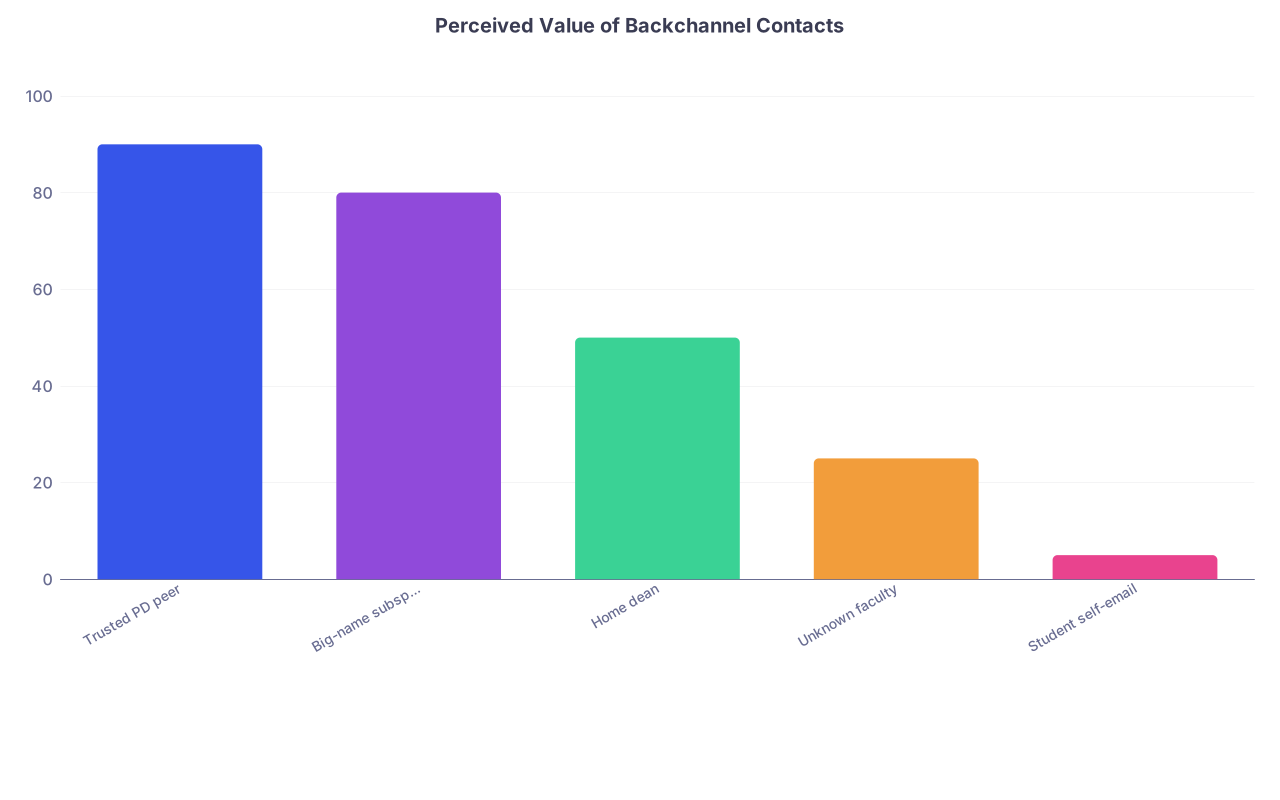
| Category | Value |
|---|---|
| Trusted PD peer | 90 |
| Big-name subspecialist | 80 |
| Home dean | 50 |
| Unknown faculty | 25 |
| Student self-email | 5 |
Timing: When Backchannel Matters and When It’s Too Late
Most applicants misunderstand the timeline.
There are really three distinct phases after you realize you’re unmatched or under-matched.
Phase 1: Monday noon – Wednesday SOAP chaos
This is when programs are building their SOAP interview lists. They’re overwhelmed, moving fast, and leaning heavily on filters.
Backchannel during this time:
- Works best if your recommender reaches out before or right as programs are selecting interviews.
- Is mostly about getting you looked at, not automatically chosen.
If your mentor calls Thursday after the first round of SOAP offers… the ship is largely sailing away.
Phase 2: Late SOAP – Thursday/Friday gap filling
Here, programs are patching holes from candidates who declined or vanished. They may do surgery with their list, pull in someone they initially passed on, or tap a backchannel candidate they already heard about.
This is when a “second call” sometimes works:
- “Hey, I know you were full on Tuesday, but if anything opened up, my student is still available and very interested.”
If your name is familiar and your file is already in their system, this can bump you into a last-minute offer.
Phase 3: Post-SOAP – scramble for off-cycle and unadvertised spots
This is the Wild West. Unfilled prelim positions, late-created funded spots, off-cycle PGY‑2 entries when a resident quits in June.
Now backchannel is no longer fighting a formal process; it’s competing against complete chaos and inertia.
You win here when:
- Someone in the department hears first that a spot will open.
- That someone immediately says your name.
- They convince the PD and GME to move faster than HR bureaucracy usually allows.
This is how people quietly slide into July 1 start dates no one saw advertised.
But understand: these are rare, and they go to candidates who already have deep, pre-existing relationships with that institution or division.
How to Use Backchannel Without Embarrassing Yourself
Here’s the part nobody tells you: PDs absolutely notice which students handle this with maturity and which students spray and pray.
A few practical rules that keep you on the right side of the line.
1. You do not script your recommender
You can say, “If you feel comfortable, I’d be grateful if you could reach out to X or Y.”
You do not send them a drafted email saying, “Please send this.”
Good faculty will ignore that anyway. Bad faculty might send it, and then you both look cheap.
Tell them:
- Which programs are realistic for you.
- Which ones you’ve had prior contact with.
- What you perceive as your main risks (so they can address them).
Then back off and let them advocate in their own language.
2. You choose your battles
Asking every attending you’ve ever met to “put in a good word” is amateur hour. PDs see when six weak, overlapping emails arrive from people you barely know.
Better: pick 2–3 people with the most influence and the deepest knowledge of your work and let them target 3–5 programs each that are truly in range.
Quality and fit beat volume.
3. You keep your own communication professional and brief
If you’re introduced by email to a PD or APD, your job is:
- To attach your application/CV.
- To express interest in one or two sentences, not ten.
- To shut up and wait.
Something like:
Dear Dr. X,
Thank you for taking the time to review my application. I’ve attached my CV and ERAS ID as Dr. Y suggested. I remain very interested in a position in your program and would be grateful for any consideration.
Best,
[Name], [School]
That’s it. No life story. No “this has been my dream since childhood.” PDs are triaging, not reading essays.
The Uncomfortable Truth: Backchannel is a Multiplier, Not a Rescue
You cannot backchannel your way out of:
- Chronically poor performance.
- Major professionalism issues.
- A complete mismatch between your record and the competitiveness of your target specialty.
What backchannel can do is:
- Make a borderline program actually open your file.
- Recast a red flag as a one-time, contextualized event.
- Tip a PD toward you when they’re deciding between two similar candidates.
- Surface you quickly when an unadvertised opening appears.
Think of it as an amplifier. If your underlying signal is strong, it can push it above the noise. If your signal is weak or distorted, the amplifier just makes that more obvious.

What You Should Actually Be Doing Post-Match
While everyone else is chasing miracle emails, here’s what the residents who eventually land in decent spots usually do.
They’re realistic. They pivot when needed.
- The unmatched derm applicant who does a strong transitional year in medicine, crushes it, gets genuine advocates, and then slides into a PGY‑2 spot two years later.
- The unmatched surgeon who takes a solid prelim spot, becomes the intern everyone depends on, and when a categorical in that program opens unexpectedly, three attendings are in the PD’s office saying, “If you don’t give it to them, we’re idiots.”
You can’t brute-force that with one phone call during Match Week. That’s a year of consistent performance and relationship-building.
Short term (Match Week + 1–2 months), your time is better spent:
- Maximizing any SOAP or prelim opportunity you do get.
- Locking down a meaningful clinical or research role that keeps you close to residents and attendings in your target specialty.
- Being honest, early, and professional with your mentors, so they’re willing to stick their necks out when it really counts.
Long term, that’s the “backchannel” that matters most: your reputation.
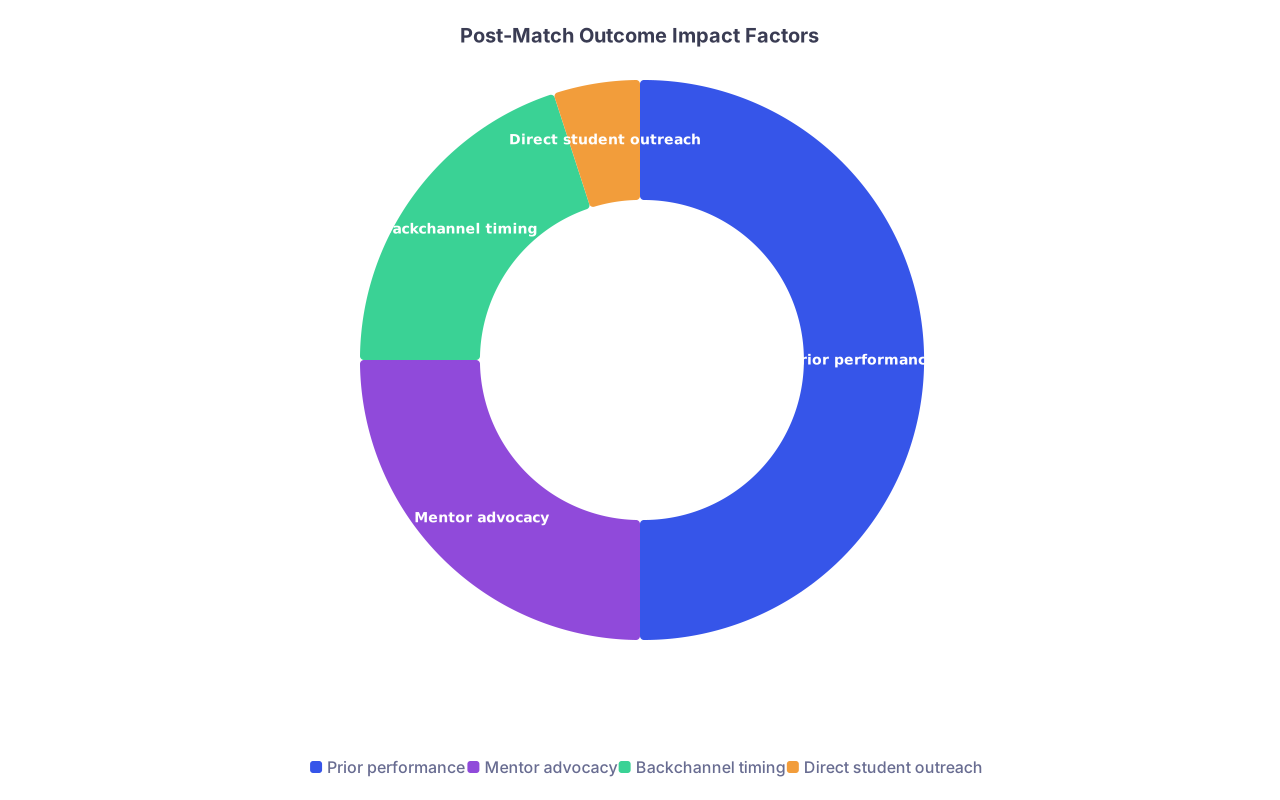
| Category | Value |
|---|---|
| Prior performance | 50 |
| Mentor advocacy | 25 |
| Backchannel timing | 20 |
| Direct student outreach | 5 |
If You Remember Nothing Else
Three truths from the other side of the table:
- Backchannel calls and emails can help, but only when your file is already in range and the person advocating for you has real, earned credibility with that program.
- Most student-initiated backchannel attempts (cold emails, mass pleas, generic letters) are noise. They rarely help and sometimes hurt.
- Your long-term reputation, work ethic, and relationships create far more powerful backchannel influence than any frantic push during Match Week. The best “miracles” are usually built a year before you need them.