You absolutely cannot recycle the same personal statement when you reapply. That’s the blunt answer. If you’re a reapplicant, submitting the same essay is one of the fastest ways to tell programs: “Nothing has changed since last year.”
But that doesn’t mean you have to burn it all down and start from a blank page every time. The trick is knowing what must change, what can stay, and how to show growth without sounding defensive or desperate.
Let’s break this down like someone who’s actually read hundreds of reapplicant files. Because I have.
The Core Rule: Same Applicant, Different Story
Here’s the rule I’d tattoo on every reapplicant’s forehead if I could:
Your second-cycle personal statement must clearly show that you are not the same applicant they rejected last year.
Programs are looking for two things with reapplicants:
- Did you improve?
- Do you understand why you didn’t match or didn’t get interviews?
If your new personal statement:
- Uses the same opening anecdote
- Has the same core paragraphs
- Ends with the same generic “I look forward to the opportunity to…”
…you’re telling them the answer is no.
Does that mean you can’t reuse anything? No. The underlying reasons you chose the specialty usually don’t change. But your evidence should. The “supporting documents” for your story must show growth.
Think of it this way:
- Same thesis? Fine.
- Same supporting paragraphs and examples? Not fine.
How Much Do I Need to Change as a Reapplicant?
Let me give you a usable percent breakdown, because vague advice is useless.
For a reapplicant to the same specialty, I’d aim for roughly this:
| Component | How Much Should Change? |
|---|---|
| Opening paragraph | 80–100% |
| Middle content/examples | 60–80% |
| Specialty motivation | 30–50% |
| Closing paragraph | 70–100% |
Why?
- Opening sets the tone. If they read the first paragraph and think “I’ve read this before,” you’ve lost them.
- Middle should reflect new rotations, responsibilities, feedback, and improvements.
- Specialty motivation can keep the same core reasons, but they need to be framed with fresh, specific experiences.
- Closing must look forward with a clearer understanding of who you are now, not who you were last year.
If you’re switching specialties, you start at essentially 0%. Your old statement is background material at best. You’re writing a new essay with a few lines that may reference how/why you changed course.
What Absolutely Must Be Different?
There are five non-negotiables that must change when you reapply.
1. Your Narrative Arc
If last year’s statement was:
“I’ve always loved [Specialty]. Here’s a touching story from M3. Here’s a generic line about teamwork. Please rank me.”
Your new arc needs to be:
“I applied last year. I’ve grown. Here’s how my experiences since then have deepened and sharpened why I belong in [Specialty]. This is what I now bring to a program.”
No, you don’t need to say “I didn’t match” explicitly in the personal statement (and usually you shouldn’t). But the subtext must be: I’ve done work since then.
Your story must live in the current version of you, not the pre‑first‑application version.
2. Your Clinical Examples
If your stories are all:
- M3 core rotations
- One big “life-changing” patient
- A preclinical or pre‑med anecdote
You’re signaling: no new meaningful experiences this year.
You should be including, where possible:
- A sub‑I you crushed
- Time as a prelim / transitional year / research year
- Additional electives in the specialty
- Volunteer or clinical work you picked up in your gap year
- Specific feedback that shaped your growth
If they can line your old and new essays side by side and highlight the same patient stories and same paragraphs? That’s a problem.
3. Your Understanding of the Specialty
First-cycle statements are often dreamy and vague:
- “I love continuity of care.”
- “I enjoy procedures and problem‑solving.”
- “I want to work with underserved patients.”
Second-cycle statements need more teeth.
You want lines like:
- “During my year as a research fellow in GI, I learned how crucial meticulous documentation and follow‑up are for patients with chronic liver disease.”
- “Serving as a medicine prelim, I saw how hospital throughput and transitions of care affect readmissions in very real ways.”
You’re showing: I’ve seen the unsexy parts of this specialty and I’m still in.
4. Your Voice About Growth
This is where most reapplicants blow it. They either:
- Ignore the fact they re‑applied and sound frozen in time, or
- Over‑explain, apologize, or dump their emotional processing onto the reader
Your personal statement is not your therapy note.
You don’t need a paragraph that starts, “After failing to match…” That usually belongs in your reapplicant letter or an advising note, not the PS.
What you do need is language that implies growth:
- “Over the past year, I’ve focused on strengthening my clinical reasoning through…”
- “Supervising junior students on the wards this year helped me realize…”
- “My additional time in [setting] has reinforced that I’m most energized by…”
Programs want persistence plus insight. Not just “I’m trying again.”
5. Your Closing Pitch
The worst closing lines are interchangeable between cycles. If I can copy‑paste last year’s closing paragraph into this year’s and nothing feels off, you haven’t grown on paper.
A strong reapplicant closing should:
- Anchor specific strengths you demonstrated recently
- Name what kind of resident you’ll be in concrete terms
- Show clarity, not desperation
Something like:
“Having taken this additional year to deepen my clinical skills in internal medicine, refine my communication with patients and teams, and confirm that [Specialty] is where I can do my best work, I’m ready to contribute as a hardworking, coachable intern who elevates those around me.”
That sounds like someone who has done the work, not just waited around.
How to Rework Your Personal Statement Without Starting from Zero
Here’s a simple, no‑nonsense process that works.
Step 1: Print Your Old Statement and Brutally Mark It Up
Literally print it. Pen in hand.
Circle anything that is:
- Only true about “old you”
- Overly generic
- Fluff or cliché
- Focused heavily on M3 or earlier
Cross out anything that:
- Could apply to any specialty
- Sounds like you copy‑pasted it from a template
- Feels like filler (“I have always wanted to be a doctor…” etc.)
Keep anything that:
- Still feels 100% true
- Reflects your core motivation for the specialty
- Sounds uniquely like your voice
This gives you the skeleton you’re allowed to keep.
Step 2: List What’s Actually Different This Cycle
Grab a fresh page and write down:
- New rotations and what you learned
- Roles you took on (chief sub‑I, research coordinator, prelim, tutor, etc.)
- Specific feedback you’ve acted on
- Any real shifts in your understanding of the specialty
- Concrete skills you’ve improved (handoffs, progress notes, procedures, time management, communication with nurses, etc.)
You’re not looking for perfection. You’re looking for proof of motion.
Then match those items to spots in your old essay you can upgrade.
Step 3: Rewrite Your Opening and Closing First
Do not start in the middle.
- New opening: choose an experience or reflection from the most recent year if possible.
- New closing: write from the perspective of “here’s who I am walking into residency interviews this time.”
Once those bookends are new, filling the middle with updated examples is much easier.
Step 4: Sweat the “Reapplicant Red Flags” in Your Language
Avoid:
- Over‑explaining your unmatched status
- Blaming systems, schools, or specific people
- Sounding like you’re writing a legal defense
- Vague praise of programs without specifics (“I’m excited to join a program that values education and teamwork” – that’s everybody)
Use language that shows:
- Ownership: “I’ve worked on…” not “I was a victim of…”
- Specificity: real settings, roles, and moments
- Humility with competence: “I’m still learning” and “here’s what I already bring”
Should I Mention That I’m a Reapplicant in the Personal Statement?
Most of the time: no, not directly in the PS.
Programs can obviously see you’re a reapplicant from ERAS. The personal statement is limited real estate. You use it to show:
- Fit for specialty
- Your story and motivations
- Your current strengths and growth
The “what happened last time?” explanation usually belongs in:
- A dedicated reapplicant letter or “experiences since last application” note
- An advisor‑reviewed paragraph in an addendum if truly needed
- Interview conversations when they ask
The exception: if your gap year experiences are central to your case, you should say something like:
“Since my previous application cycle, I’ve taken the opportunity to…”
Then describe what you did. Don’t spend more than 1–2 sentences acknowledging the reapplication itself.
If I’m Applying to Different Types of Programs, Do I Need Different Statements?
If you’re applying to:
Categorical + Prelim in the same specialty:
You can usually use the same core personal statement, maybe with a small tweak to one line that mentions your long‑term goals.One main specialty + a true backup in a different field:
Yes, you need different personal statements. A “universal” PS that could be read by IM, FM, psych, and anesthesia is usually weak for all of them.
If the question is: “Can I use the same reworked statement everywhere within the same specialty?”
Usually yes, unless:
- You’re applying to a mix of community / academic / highly research‑heavy programs
- You have a very niche career goal that doesn’t make sense for certain places
In that case, consider:
- One main personal statement
- Small tweaks for truly different program types in 1–2 sentences (research‑heavy, underserved focus, etc.)
Quick Reality Check: What Programs Actually Think When They See a Reapplicant
Here’s the internal monologue I’ve heard MANY times in committee meetings:
- “Did this person learn anything from last year?”
- “Do they just look the same on paper?”
- “Are they actually stronger now, or just older?”
Your new personal statement should help them answer:
- Yes, this applicant clearly improved.
- They’ve done more than just wait out a year.
- Their voice is clearer, more mature, more grounded in the day‑to‑day reality of residency.
If your second‑cycle personal statement feels like a “rerun episode,” you’re asking them to change their decision without giving them a new reason.
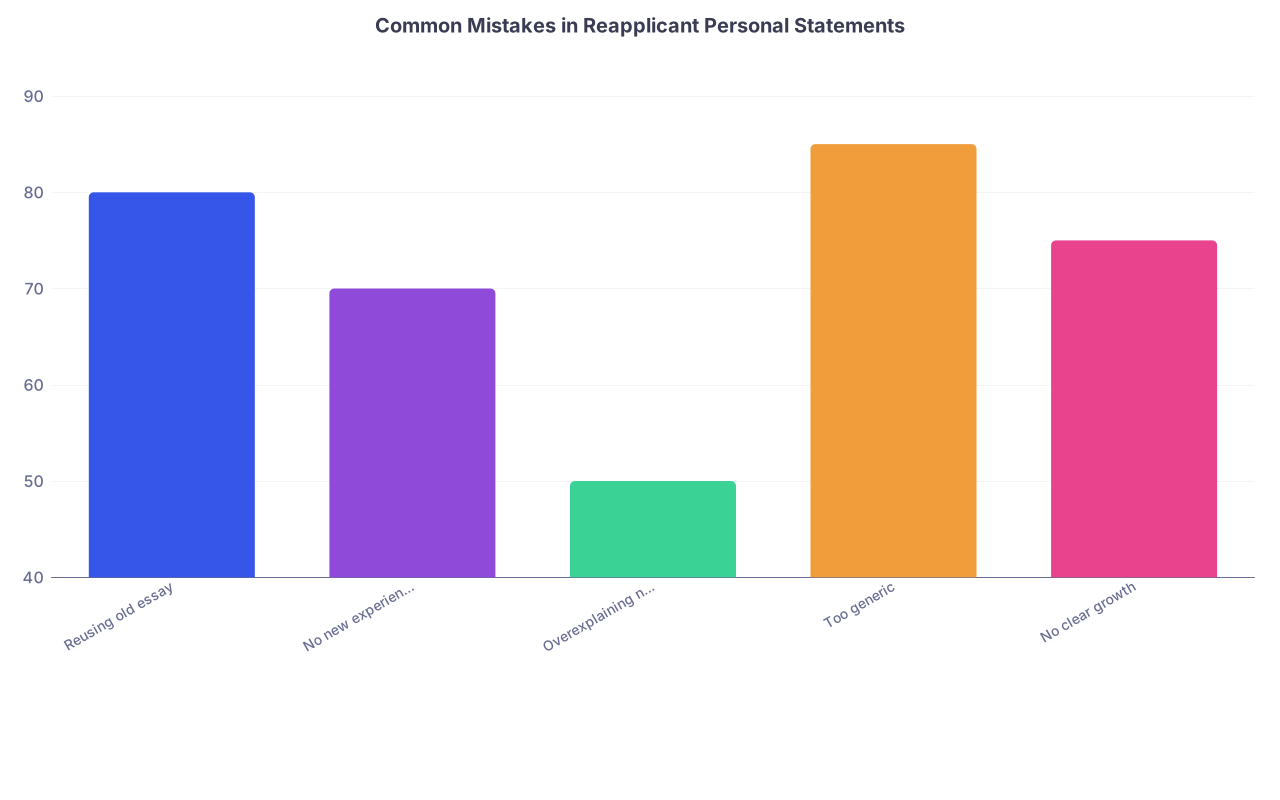
| Category | Value |
|---|---|
| Reusing old essay | 80 |
| No new experiences | 70 |
| Overexplaining not matching | 50 |
| Too generic | 85 |
| No clear growth | 75 |
Example: What a Reapplicant Change Actually Looks Like
Here’s a rough side‑by‑side idea. Not perfect prose, just to show the level of change.
Last cycle:
“During my third‑year internal medicine rotation, I cared for a patient with decompensated cirrhosis. Working with the team to manage his ascites, encephalopathy, and social challenges showed me the complexity of internal medicine and confirmed my desire to pursue this field.”
Reapplication cycle:
“This past year, as a medicine prelim on the hepatology service, I followed several patients with advanced cirrhosis across multiple admissions. Coordinating their care with social work, transplant teams, and outpatient follow‑up taught me how fragile the safety net can be. I learned to anticipate barriers—like transportation, medication access, and health literacy—rather than simply react to repeated decompensations. That shift in thinking has shaped the kind of intern I aim to be.”
Same broad theme (liver disease, complexity of IM). Totally different maturity and time frame. That’s what you should be aiming for.

| Step | Description |
|---|---|
| Step 1 | Print old PS |
| Step 2 | Mark keep vs cut |
| Step 3 | List new experiences |
| Step 4 | Write new opening and closing |
| Step 5 | Replace old examples with new |
| Step 6 | Add growth focused language |
| Step 7 | Get feedback and revise |
FAQ: Reapplicant Personal Statement Questions
1. Can I keep the same opening story if it’s really good?
You can, but I usually tell people not to. If you insist on keeping it, you must:
- Shorten it
- Reframe it with new reflection
- Add more recent experiences later that clearly move beyond that story
But if programs read the first 5 lines and think, “Didn’t we see this last year?” that’s not helping you.
2. Do programs actually compare my old and new personal statements?
They don’t line them up side‑by‑side in every case, but:
- Faculty and PDs have good memories, especially at smaller programs
- If you rotated there or applied before, someone might remember your essay
- The feel of “this is familiar” is enough to hurt you
Assume they could compare. Write like you respect their time and intelligence.
3. What if I don’t have big new experiences this year?
Then you lean into:
- Small but real growth (better notes, more responsibility, teaching students, consistent volunteering)
- Specific feedback you acted on
- Deeper insight into the specialty from watching residents/attendings work
Don’t pretend you did something huge if you didn’t. Programs can smell that. But don’t undersell the real work you have done.
4. Should I mention why I think I didn’t match?
Usually not in the personal statement. That belongs in:
- A targeted reapplicant letter
- Conversations at interviews if they ask
- A brief advisor‑guided note if there’s something major (e.g., a failed exam you’ve since passed)
Your PS is mostly for “who I am now and why I fit your specialty,” not “postmortem of last cycle.”
5. How long should my reapplicant personal statement be?
Standard residency length: around 650–750 words. Don’t write a 1,200‑word epic. You’re not trying to make up for last year with volume. You’re trying to show:
- Clarity
- Focus
- Growth
If you can do that in 650–700 tight, well‑chosen words, you’re ahead of most reapplicants.
Bottom line:
- Yes, you need to substantially change your personal statement as a reapplicant—especially your opening, examples, and closing.
- Your new essay must prove you’re a stronger, more self‑aware candidate now, not just a repeat submit.
- You don’t need to erase your story; you need to update it to match the version of you who’s truly ready for residency this time.