
You probably do need at least one new letter of recommendation after going unmatched. And if your previous letters were weak, outdated, or misaligned with your new strategy, you may need to overhaul the whole set.
Let me walk you through this without sugarcoating it.
The Core Answer: Do You Need New Letters After Not Matching?
Here’s the blunt truth:
- If you’re reapplying in the same specialty and your last application was reasonably strong:
You can usually reuse 1–2 strong letters and add 1–2 new ones. - If you’re reapplying in the same specialty but your application had obvious weaknesses or you got almost no interviews:
You probably need a new anchor letter set—aim for at least 2 new letters, maybe 3. - If you’re switching specialties:
You absolutely need new specialty-specific letters. Older letters from a different specialty become secondary at best. - If your letters are >1–2 years old and you haven’t worked with those writers since:
Programs start wondering if anyone will vouch for who you are now.
Programs remember this: going unmatched isn’t an automatic red flag. But reapplying with the exact same file screams stagnation. New letters are one of the clearest, easiest ways to show growth.
How Programs Actually Look at Your Letters After an Unmatched Cycle
I’ve seen this play out on selection committees more than once. The conversation sounds like:
“Same personal statement, same letters, same CV… what’s changed?”
That’s the problem you have to solve.
Program directors and selection committees look for three things in a reapplicant:
- Evidence of growth since the last cycle
New responsibilities, better performance, stronger clinical evaluations, more maturity. - Specialty fit
Letters that specifically say: “This person is suited for [X specialty] and will make a strong [type of resident].” - Endorsement from recent supervisors
They want to know who you are now, not who you were two years ago as a student they barely remember.
If your letters don’t do those three things, you’re handicapping yourself before they even get to your personal statement.
When You Can Reuse Letters (And When You Shouldn’t)
You don’t automatically need to throw everything out. Some letters age well. Others don’t.
Reuse a Letter If:
- It’s less than 1–2 years old
- It’s from someone who:
- supervised you closely (not just a name-brand department chair who barely knows you)
- mentions specific cases or examples of your performance
- comments on your clinical judgment, work ethic, and professionalism
- It clearly supports your target specialty
(e.g., “I strongly recommend [Name] for internal medicine residency” — not just “for residency training.”) - It was part of an application that at least got you a reasonable number of interviews for your competitiveness level
In that case, you can probably reuse 1–2 letters and surround them with new material that reflects your recent work.
Replace or Avoid Reusing a Letter If:
- The writer barely knew you and wrote a generic note
- It doesn’t mention your target specialty
- It’s vague or lukewarm
(“[Name] did what was required on the rotation” is death.) - You never actually saw the letter, but your dean pulled you aside and hinted it might not be strong
- Your last cycle got very few or no interviews, and this letter was a big part of your app
If you’re not sure whether a letter is strong, assume it’s average or weak. Competitive applicants don’t get in with “average” letters if anything else in the file is borderline.
How Many New Letters Do You Actually Need?
Let’s put some numbers on it.
Most programs want 3–4 letters. Your strategy as a reapplicant usually looks like this:
| Scenario | New Letters | Reused Letters | Total Letters |
|---|---|---|---|
| Same specialty, decent cycle | 1–2 | 1–2 | 3–4 |
| Same specialty, weak cycle | 2–3 | 0–1 | 3–4 |
| Switching specialties | 2–3 (new) | 0–1 (old field) | 3–4 |
| >2 years since graduation | 2–3 | 0–1 | 3–4 |
Here’s the principle:
At least half of your letter set should be newly written or significantly updated for this cycle.
If you’re changing specialties or had a catastrophically bad first cycle, aim for a mostly new set.
Special Case: Switching Specialties After Not Matching
This is where people screw it up the most.
If you applied to orthopedic surgery, didn’t match, and now want to apply to internal medicine, your ortho letters are not doing the heavy lifting anymore.
You need letters that explicitly say:
- This person is a great fit for internal medicine (or psych, or FM, etc.)
- They’ve demonstrated skills relevant to that specialty
- The letter writer would personally take you into their own program (or something close to that)
Your prior specialty letters can still be useful for:
- Showing you worked hard and were well-liked in a high-demand field
- Filling gaps if you’re short on writers
But they cannot be the backbone of your new specialty application.
How To Get New Letters If You’re Out of Medical School
This is the real pain point for a lot of unmatched applicants:
You’re done with med school, you’re not in residency, so… who’s supposed to write these new letters?
You have several options, and you should probably mix more than one:
1. A Postgraduate Clinical Year (Prelim, Transitional, or Repeating)
If you’re doing a prelim year in medicine or surgery, or an intern year:
- Your program director is a high-yield letter writer
- Any attending who’s worked with you for at least 4 weeks and has seen:
- your notes
- your signouts
- you on call can write a solid, specific letter
If you do a prelim year and don’t get a letter from your PD, that raises eyebrows. Get one.
2. A Dedicated Research Year With Clinical Exposure
If you’re in a research position:
- Ideal: a research mentor who also sees you in clinic or on the wards
- If the role is purely bench or desk-based, the letter is supportive but secondary; you’ll still want something clinical
You can fix this by asking to join:
- clinic days
- inpatient consult service
- teaching rounds
…even part-time, so the writer can comment on your clinical work.
3. Observerships / Extended Shadowing
Yes, these can still yield letters, but only if:
- You’re actually doing something meaningful: presenting patients, drafting notes (even if not in the chart), reading imaging alongside them, etc.
- You stay long enough: 4–8 weeks is much stronger than 1–2 weeks
You’ll need to be clear up front:
“I’m reapplying to [specialty] this year and need at least one updated letter from recent clinical work. If I do well and stay for [X] weeks, would you be open to writing one?”
Ask this early, not at the end when they barely remember your name.
4. Re-engaging Old Mentors the Right Way
If you had a strong prior letter writer, you can sometimes convert that into an updated letter that counts as “new.”
The move is:
- Email them with:
- a brief update on what happened last cycle
- what you’ve done since (jobs, research, rotations, exams)
- your new target specialty or refined plan
- Attach:
- updated CV
- personal statement draft
- summary of what you did with them (“On your service, I worked… we saw… I presented…”)
- Ask specifically:
- “Would you be willing to write an updated letter for this application cycle reflecting my growth since we last worked together?”
If they say yes and actually update it, that counts as a new letter from the perspective of most programs.
Timing: When To Secure New Letters as a Reapplicant
Don’t wait until ERAS opens to start thinking about this. Back-scheduling matters.
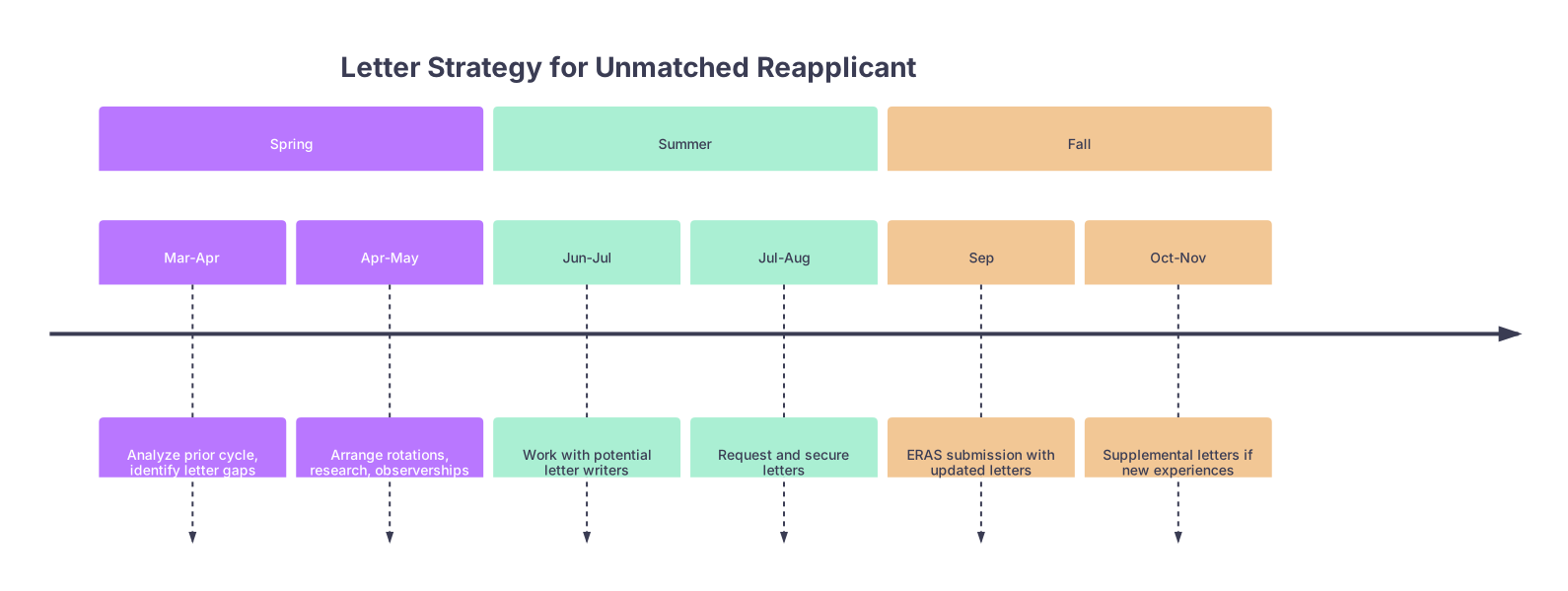
| Period | Event |
|---|---|
| Spring - Mar-Apr | Analyze prior cycle, identify letter gaps |
| Spring - Apr-May | Arrange rotations, research, observerships |
| Summer - Jun-Jul | Work with potential letter writers |
| Summer - Jul-Aug | Request and secure letters |
| Fall - Sep | ERAS submission with updated letters |
| Fall - Oct-Nov | Supplemental letters if new experiences |
Try to secure your new anchor letters by late summer. Then, if you start a new strong clinical role in July or August (like a new prelim job), you can add one more in October/November as a supplemental upload if someone got to see you shine.
How To Ask for a Strong Letter After an Unmatched Cycle
You can’t just say, “Can you write me a letter?” and hope for the best. That’s how you get bland junk.
What you want to say (or email) is closer to this:
“I’m reapplying this cycle after not matching last year. I’ve worked hard to strengthen my application, especially in [X, Y]. I’m applying to [specialty] and would really appreciate a strong letter of recommendation that comments on my clinical skills, reliability, and suitability for [specialty].
If you don’t feel you know my work well enough to write a strong letter, I completely understand—please let me know.”
Two outcomes:
- They say yes and actually write what you need.
- They hesitate or decline → good, that saved you from a weak letter.
You also want to gently signal to them that you went unmatched, but you’re not hiding from it—you’re doing something about it.
What If You Truly Can’t Get New Letters?
Worst-case scenario: you’re out of school, not in a clinical role, can’t secure observerships, and have no one new to write for you.
That’s not ideal, but here’s how to limit the damage:
- Update your old writers and ask for revised letters that:
- mention your unmatched year
- endorse your persistence and growth
- Add non-traditional letters as a 4th extra:
- employer (if medically related: scribe, MA, clinical research coordinator)
- volunteer supervisor in a clinical setting
- Use your personal statement and experiences section to hammer home:
- what you did with the unmatched year
- what’s improved since then
But be honest: if you truly can’t find anyone new willing to vouch for you clinically, the underlying problem may not be ERAS—it may be a lack of recent clinical engagement. Sometimes the right move is to take a structured role (research, prelim, observership) for a year, then reapply properly.
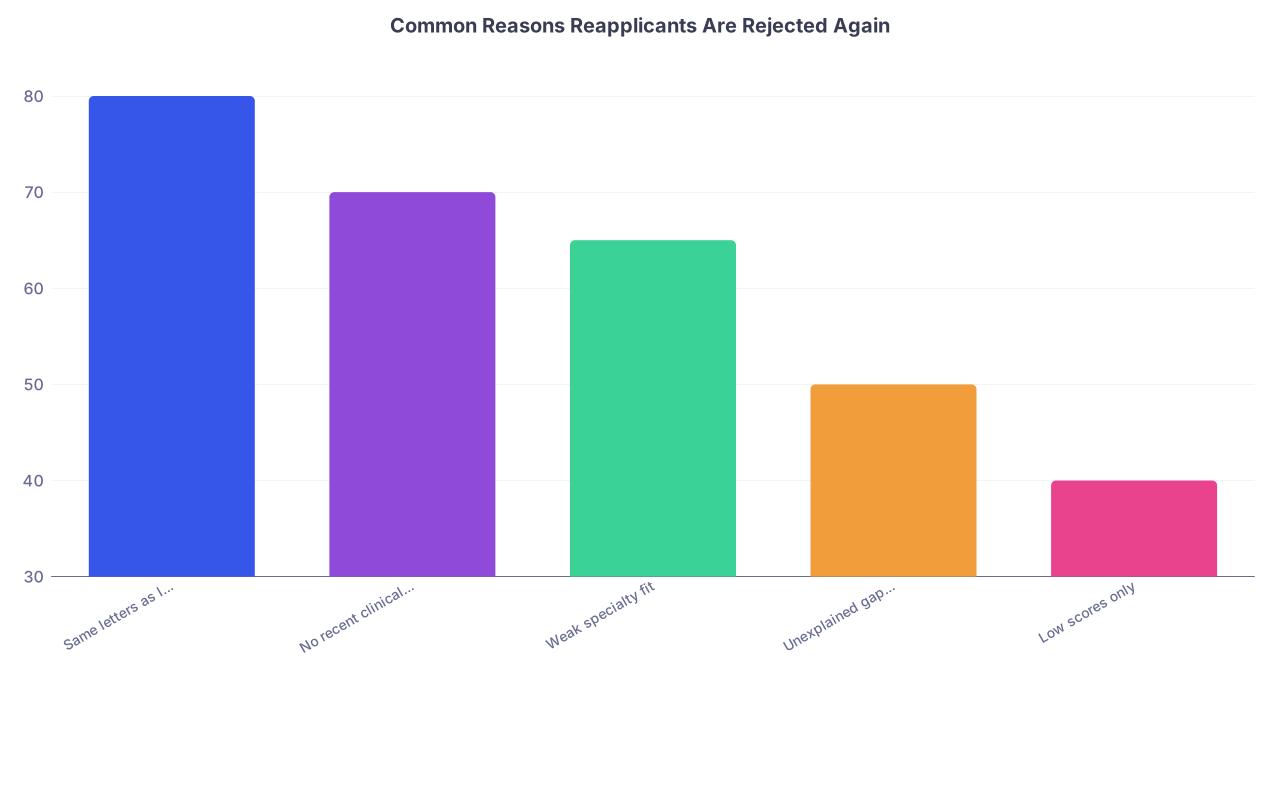
| Category | Value |
|---|---|
| Same letters as last year | 80 |
| No recent clinical work | 70 |
| Weak specialty fit | 65 |
| Unexplained gap year | 50 |
| Low scores only | 40 |
FAQs: Letters of Recommendation After an Unmatched Cycle
1. Can programs actually tell if my letters are the same as last year?
Yes. They see your graduation year. They see letter dates. They see the same names and titles. If your letters are all timestamped from two years ago and nothing new appears, they’ll notice. You don’t have to replace every letter, but at least some need to be clearly updated.
2. Is it bad to reuse a very strong letter from last cycle?
Not at all. A genuinely strong, specific, specialty-focused letter from someone who knows you well is still valuable. Reuse it as part of your set, then surround it with newer letters that demonstrate ongoing growth and recent performance.
3. I’m doing a prelim year in a different specialty than I’m applying to. Do I still need letters from my current residency?
Yes. A strong letter from your current PD or an attending—saying you’re hardworking, safe, reliable, and a good team member—is powerful, even if the specialty is different. Pair that with at least 2 letters from your target specialty (from med school or observerships).
4. How old is “too old” for a letter of recommendation?
Once a letter is >2 years old and you have no continued relationship with that writer, it starts to look stale. Programs start wondering why no one has written about you since. If that’s your situation, either get the letter updated or prioritize newer writers.
5. Do I need a “chairman’s letter” or just people who know me well?
The hierarchy flex is overrated. A short, generic letter from a department chair who barely knows you is worse than a detailed, specific letter from an associate professor or community attending who actually supervised you. If you can get both “big name” and “actually knows you,” great. If you have to choose, pick the one who knows you.
6. What if my previous application had a bad or suspicious letter—can I get it removed?
You can’t “remove” a letter from ERAS history retroactively, but you control what you assign this cycle. If you suspect a letter was weak or harmful:
- Don’t reuse it.
- Replace it with 2 strong, new letters if possible. You can also ask your dean’s office if they ever received negative feedback about any letter, but not all schools will share that.
7. Should I explain that I went unmatched in my letter requests?
Yes, briefly and maturely. Writers don’t like surprises, and many will respect your honesty. Frame it as: you went unmatched, you reflected on why, you spent the year strengthening specific aspects (clinical work, research, communication, etc.), and you’re reapplying with a clearer sense of fit. That story, plus their endorsement, is more convincing than pretending it never happened.
Key takeaways:
- Most reapplicants should have at least one new letter, and many need a mostly new set—especially if switching specialties or coming off a weak cycle.
- Your letters must show growth, specialty fit, and recent supervision; old or generic letters won’t save a borderline application.
- If you’re unmatched, don’t just re-send last year’s file. Use new letters as visible proof that you’ve actually moved forward.