

You’re not crazy for thinking your backup specialty might ruin your life.
Everyone pretends they’re being “open-minded” about alternatives, but you and I both know what’s actually running through your head:
What if I end up stuck in a specialty I hate? For years. With no escape. And I blew my shot at what I really wanted because I panicked.
Let’s say it bluntly: the fear that your backup will trap you is one of the biggest, most paralyzing Match anxieties. And it makes you second-guess everything—your rank list, your backup plan, even whether you should apply at all.
I’m going to walk through this the way I wish someone had done with me: no sugarcoating, no “everything will work out,” but also no doom fantasy left unchallenged.
First: Yes, Your Fear Is Rational. But It’s Not The Whole Story.
You’re not being dramatic.
You trained for years with one image in your head: you in that specialty. Maybe you imagined yourself in the OR, or in clinic long-term with “your” patients, or doing a specific type of procedures. And now people are telling you things like:
“Just rank some prelim medicine and you’ll figure it out later.”
“You can always switch.”
“You might end up loving it.”
Meanwhile your brain is screaming: What if I don’t? What if I hate it and I’m stuck?
Here’s the ugly-but-true middle ground:
- You can end up in a specialty you dislike.
- You are not instantly trapped there for life.
- The path out is possible, but it’s not painless, automatic, or guaranteed.
All three of those things are true at the same time.
Let’s anchor this in something concrete.
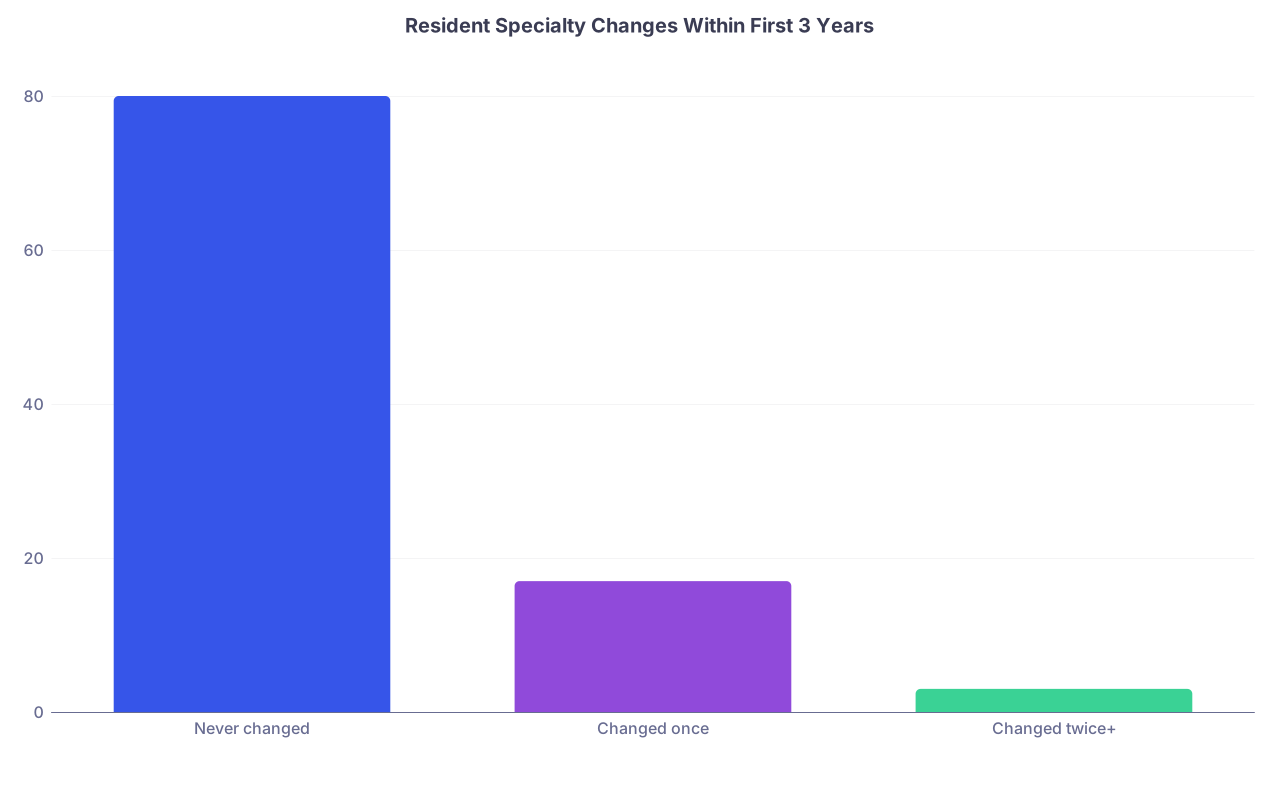
| Category | Value |
|---|---|
| Never changed | 80 |
| Changed once | 17 |
| Changed twice+ | 3 |
The majority don’t switch. Some do. A small group change more than once. Translation: switching is very real, but not something programs casually expect everyone to do.
So your fear that you might hate your backup? Completely valid.
Your fear that you’d have zero options if that happens? Not accurate.
Types of “Backup” – And How Trapped You’d Actually Be
The word “backup” gets thrown around like it’s one thing. It’s not. How bad it would be if you hate it depends a lot on what kind of backup you’re considering.
1. Categorical Backup in a Different Field (e.g., IM instead of Derm)
This is the classic: “If I don’t match my dream (say, ortho, derm, ENT), I’ll go into internal medicine / peds / family / psych as a backup.”
Reality if you end up hating it:
- You’ll be in a multi-year program with a clear endpoint.
- You can try to switch after PGY-1 or PGY-2, but it’ll take work: letters, maybe a research year, networking, timing.
But even if you never switch, you’re not professionally dead. You still:
- Can subspecialize (cards, GI, heme/onc in IM; child in psych; sports in FM, etc.).
- Can shape your job to avoid certain things (clinic-heavy vs inpatient-heavy, procedures vs no procedures).
- Can eventually shift into admin, informatics, education, urgent care, hospitalist, etc.
I’ve seen many people go: “I hate general IM,” then fall in love with cards or pulm/crit and suddenly their life is… not terrible. Not what they originally imagined, sure. But not misery.
2. Prelim Year Backup (Medicine or Surgery Prelim)
This feels extra scary because everyone whispers: “Prelim is a dead end if you don’t match your advanced spot.”
Here’s the nuance:
- If you match only to a prelim and don’t have an advanced spot, you’re not doomed, but you’re in a very high-stress, very transitional situation.
- If you hate your prelim year (brutal schedules, malignant culture), that doesn’t mean you hate the entire specialty forever—just that specific place and role.
Options from there:
- Re-apply to categorical positions in that same field (many prelim surgery people end up in categorical general surgery somewhere after PGY-1).
- Switch fields entirely and apply into IM, FM, psych, anesthesia, etc., often with advanced credit for the year.
Is it fun? No. It’s a second application cycle plus a stressful year. But it’s a bridge, not a prison.
3. “I Just Threw This On My List” Backup
These are dangerous: specialty you barely rotated in, kind of random, but you added it because someone told you to “keep options open.”
This is where the “what if I hate it” panic is loudest, and honestly? Sometimes justified.
If you can barely articulate why you’d do that field other than “it’s less competitive,” you need to pause and reassess. There are worse outcomes than going unmatched once. Being locked into a 3–5 year training path you resent, in a field you never wanted, is one of them.
If that’s the kind of backup you’re considering, you don’t need reassurance. You need a different plan.
What Actually Happens If You Start Residency and Hate It?
Let’s play through the scenario you’re probably quietly replaying at 2 a.m.
You match your backup. July hits. You start. Six weeks in, you’re thinking, “Oh no. This is not just adjustment. I genuinely hate this.”
Here’s how this usually unfolds in real life, not in your fear-brain:
The first 3–4 months are unreliable data.
Everyone hates life on some days intern year. You’re sleep-deprived, constantly wrong about something, and you don’t feel competent at anything. Hating the experience doesn’t automatically mean you hate the specialty.Once that initial shock calms down a bit, you notice patterns.
Do you hate the hours but love the patient problems?
Or do you hate the entire nature of the work—thinking, pace, cases, conversations—regardless of how tired you are?You start talking quietly to people you trust.
Chief resident. Program director. A mentor from med school.
You say the thing out loud: “I’m not sure this specialty is right for me long term.”And then one of a few paths opens:
- You adjust, refine your interests, and stay.
- You stay in the specialty but shift your future (e.g., less ICU, more outpatient; more psych, less primary care; etc.).
- You start the process of officially exploring a transfer.
This is where people massively overestimate and underestimate different pieces.
You’re overestimating:
“I’ll never be allowed to leave. PDs will hate me. No one will help.”
You’re underestimating:
“How much paperwork, coordination, and timeline juggling it actually takes to change specialties or programs.”
But both scenarios are survivable. I’ve watched interns break down in call rooms saying, “I chose the wrong life,” and two years later, they’re thriving in an entirely different field.
How Hard Is It To Switch If You Hate Your Backup?
Not impossible. Not guaranteed. Somewhere in the painful middle.
The big variables:
Competitiveness of where you want to go.
Going from IM to derm, ENT, plastics? Brutal, not impossible, but realistically very, very hard.
Going from IM to anesthesia, FM, psych, pathology? Much more feasible.How early you realize the mismatch.
The earlier you know, the more cycles you can catch and the easier it is to plan. But you also don’t want to label something “hate” in your second week.How strong your PD and faculty support are.
PDs do help residents transfer. Not all, but many. Because a miserable resident is a liability.
But they’re more likely to help if you’re professional, honest, and not burning everything down on the way out.Your performance.
This one hurts. If you’re flailing clinically, getting written up, or constantly late, it’s far harder to convince another specialty to invest in you. If you’re solid but just misaligned, that’s easier to work with.
Here’s what a very rough timeline can look like:

| Step | Description |
|---|---|
| Step 1 | Start PGY1 |
| Step 2 | Realize poor fit |
| Step 3 | Talk to mentor or PD |
| Step 4 | Decide stay or explore switch |
| Step 5 | Find target specialty |
| Step 6 | Contact programs |
| Step 7 | Interview for open PGY spots |
| Step 8 | Transfer or reapply next cycle |
Is that emotionally exhausting? Yes.
Does it happen every single year for a subset of residents? Also yes.
How To Decide If a “Hated Backup” Is Still Better Than No Match
This is the real decision you’re staring at when you make your rank list or choose what to apply to:
Is a potentially disliked backup better or worse than going unmatched and trying again?
There isn’t a universal right answer. But here’s the actual, unfiltered way I’d think through it if my anxiety brain and rational brain were in a room fighting.
Ask yourself:
Is the backup something I could realistically see myself doing for 5–10 years while I figure out what’s next, even if it’s not my dream?
Not “love,” just “tolerate without wanting to scream every day.”Does the backup give me a widely useful skill set?
IM, FM, EM, psych, anesthesia, peds—these are flexible. You can practice clinically in many settings, pick subspecialties, and pivot away from direct clinical work later if needed.Is my dream specialty ultra-competitive with mediocre odds (think derm, plastics, ENT, ophtho, ortho, neurosurg) and my application is mid-tier?
If yes, a realistic backup can prevent years of reapplying and rejections.Could I handle emotionally going through another application season after not matching?
Some people absolutely can and do. Others would crumble. Be honest about your own reserves. There’s no shame either way.
Here’s a blunt comparison:
| Factor | Backup Specialty You Might Hate | Going Unmatched Once |
|---|---|---|
| Immediate income | Yes, resident salary | No, unless gap job |
| Clinical training | Starts right away | Delayed by at least 1 year |
| Ability to switch later | Difficult but possible | Reapply fresh, but still hard |
| Emotional hit | Chronic “wrong fit” discomfort | Acute shame, then recovery |
| Future options | Still many | Depends on reapplication success |
Neither option is painless. You’re choosing which type of pain you can tolerate.
How To Build a Backup That You Don’t Completely Dread
Let’s assume you’re not ditching backups entirely (which is sometimes a terrible idea, especially for ultra-competitive fields). The goal is to choose a backup that doesn’t make you feel sick to your stomach.
Here’s what I’d actually do, sitting at my laptop, freaking out:
List what you actually like about medicine.
Procedures? Long-term relationships? ICU? Fast-paced resus? Calm reading time? Kids? Adults only? Mental health? Systems-level thinking?List the absolute dealbreakers.
Nights forever. Constant phone calls. Chronic exposure to trauma cases. Zero procedures. Or the opposite: all procedures, no thinking time.Compare those lists with realistic, non-hype views of each potential backup.
This is where talking to actual residents matters way more than watching TikToks about “Day in the life of a [whatever] doctor.” Ask them: What sucks? What’s actually good?Force yourself to imagine 2 futures:
- Future A: You’re in your dream specialty, but you didn’t match the first time and had to scramble, research year, whatever.
- Future B: You matched a backup. It’s not what you wanted. But you have a job, a path, and a door that can still open to other things.
Which future makes your chest tighter? Which one feels like regret turned into resentment?
If your stomach drops harder at the idea of being locked long-term in a backup you fundamentally don’t respect or enjoy, you may need fewer or different backups. If your stomach drops more at the idea of no match email and explaining that to everyone in your life, a backup is protective.
Very Specific Reassurances You’re Probably Needing
Let me answer the silent questions that sit under the main one: “What if I hate my backup?”
No, matching a backup does not mean you “failed at life.”
Programs know some residents didn’t get their first choice. They care what you do with the opportunity you do have.You will not be the only one in your program who’s not 100% in love with the specialty.
You’ll meet PGY-2s quietly considering switching, PGY-3s who picked the field for lifestyle or geography, others who fell into it late.You are allowed to change your mind without being a traitor to your past self.
The version of you who chose the backup did the best they could with incomplete information and too much pressure. You’re allowed to update based on reality.You are still a physician. Your degree and training are not wasted.
Even if you never love your specialty, you can still do good, be competent, and end up in a job that’s “fine” while you build a life outside work that’s actually great.People absolutely recover from “wrong specialty” decisions.
I’ve seen: EM → psych, surgery → anesthesia, peds → radiology, IM → pathology, and more. Not all easy. But real.
What You Can Do Right Now To Make This Less Terrifying
You can’t fix the entire Match system. You can’t guarantee you’ll never hate anything. But you can make your backup plan less like a horror story and more like a calculated risk.
Here’s how to use the anxiety productively this week—not someday, not “when things calm down,” but now.
Write down 3 backup options you’re actually considering.
Not theoretical. The real ones on your list.For each one, answer in writing (not in your head):
- What parts of this field would probably suit me?
- What parts would probably drive me nuts?
- If I ended up here for 10 years, could I build a life that’s at least okay?
- If I truly hated it, what realistic exit paths exist from this specialty?
Schedule 2 conversations in the next 7 days:
- One with a resident in your dream specialty.
- One with a resident in your top backup.
Ask both bluntly: “If someone matched here as a backup and realized it wasn’t right, what have you seen them do?”
Decide one thing you are absolutely not willing to do as a backup.
Maybe that’s prelim surgery at a place known for crushing people. Maybe it’s a field you’ve never rotated in. Draw one hard line. It’s okay to say “I’d rather go unmatched than do X.”
That single line in the sand can actually calm a ton of the background panic. Because at least you’ve told yourself: “No matter what happens, I won’t abandon myself completely.”
FAQ (Exactly 5 Questions)
1. If I match my backup and hate it, will programs in my dream specialty hold that against me if I try to switch?
They’ll definitely ask about it, but it’s not an automatic red flag. What they care about is your story: why you chose the backup, what you learned, how you performed, and why you’re certain about switching now. If you’re performing well, have strong evaluations, and can articulate a coherent narrative, it can actually show maturity. If you’re floundering, bad evaluations, complaining constantly, that’s more of an issue than the fact that it was a backup.
2. How long should I give a new residency before deciding I “hate” the specialty?
Intern year is rough for almost everyone, even those in their dream field. I wouldn’t trust any conclusion made in the first 4–6 weeks. After 3–6 months, patterns start to emerge. If, even when you’re reasonably rested and on decent rotations, you still feel deep dread about the nature of the work (not just the hours), that’s when it’s fair to start questioning fit and quietly exploring options.
3. Is it ever better to go unmatched than to match a backup I’m pretty sure I’ll hate?
Yes, sometimes. If the backup is a field you viscerally dislike, don’t respect, or can’t imagine even tolerating, and if matching there would almost guarantee long-term resentment and burnout, then not ranking it (and accepting the risk of going unmatched) can be the healthier choice. Especially if your dream specialty is extremely competitive and there are reasonable, structured ways to strengthen your application for a future cycle.
4. If I end up stuck in a specialty I don’t like, am I just doomed to a miserable career?
No. You might not love the core clinical work, but you still have a medical license and a recognized residency. That lets you pivot into things like admin, quality improvement, informatics, consulting, telehealth-heavy work, part-time clinical plus education, or even non-clinical paths down the line. It’s not the dream you started with, but it’s also not a life sentence to 60-hour weeks of misery unless you choose jobs that keep you there.
5. What should I do today if I’m paralyzed about my backup options?
Pick one concrete action: either (1) email a resident in your top backup specialty and ask for 15 minutes to talk honestly about their day-to-day and how people who dislike it handle that, or (2) open your rank list or specialty list and delete one backup option that you already know you absolutely don’t want. Do one small thing that makes your plan 5% more aligned with reality and 5% less driven by pure fear. That momentum matters.
Open your current specialty list or draft rank list right now and mark each backup with one of three labels: “could live with,” “only if desperate,” or “absolutely not.” Then remove the “absolutely nots.” Don’t wait for courage—you’ll feel a little sick doing it. Do it anyway.


