
The idea that failing to match once kills your chances at a competitive field is a lie that survives because nobody wants to talk about their failure publicly.
Let me just say the quiet part out loud: you are not the first person to fail to match and still end up in a “competitive” specialty. Not even close. You just don’t see those stories on Instagram.
The Fear You’re Too Afraid to Say Out Loud
You’re probably thinking something like:
“I didn’t match once. Why would ortho/derm/ENT/EM/anesthesia/rads ever take a risk on me when there are fresh, clean, never-failed applicants out there?”
Or maybe:
“Did I just brand myself as damaged goods forever?”
Here’s the brutal truth and then the hopeful one.
Brutal: yes, failing to match once does put a mark on your application. Programs see it. They talk about it. It becomes a topic in your interview.
Hopeful: it’s not an automatic death sentence to competitive fields. But the path is narrower, messier, and way more deliberate than what people with a smooth, first-try match experience face.
The difference between “no chance” and “possible” is what you do in the 12–24 months after that first miss.
And no, I don’t mean just reapply with a “better personal statement.”
What “Competitive After Not Matching” Actually Looks Like
Let’s make this concrete. This is the part nobody is honest about.
I’ve watched:
- An unmatched EM applicant do a prelim medicine year, crush it, get a ton of letters, then match EM on the second try.
- A would‑be ortho who failed to match, did a research year, then a prelim surgery spot, then finally matched ortho at a mid-tier program.
- An anesthesia hopeful who didn’t match anywhere, did a transitional year + strong Step 3 + tons of networking, then slid into an open CA‑1 spot off-cycle.
Are these common? No. Are they unicorn rare? Also no.
The question is less “Is it possible?” and more “What will it cost me and what am I willing to pay?”
Because it will cost you time, ego, money, and comfort. And you have to decide if this specialty is worth that.
| Path Option | Realistic Chance to Stay Competitive | Time Cost |
|---|---|---|
| Reapply same year with no changes | Very low | 0 years |
| Research year then reapply same field | Moderate if done well | 1 year |
| Prelim year + strong letters then reapply | Moderate to good | 1 year |
| Pivot to less competitive specialty | High | 0–1 years |
| SOAP into prelim and drift without plan | Low | 1+ years |
If your brain just latched onto “moderate to good,” that’s normal. But read the next part before you get falsely reassured.
How Programs Actually See You After a Failed Match
This is the part that keeps people up at night, so let’s be brutally precise.
Program directors don’t see “unmatched” and think “garbage.” They see a question mark:
- Was it your scores?
- Your letters?
- Your interview skills?
- Your rank list strategy?
- Your professionalism?
- Your personality in person?
And you have to answer that question for them. With receipts.
They’re basically asking: “If we take this person, are we inheriting someone else’s problem… or did other programs just miss out?”
Here’s roughly how their mental calculator works (yes, this is oversimplified, but it’s emotionally accurate):
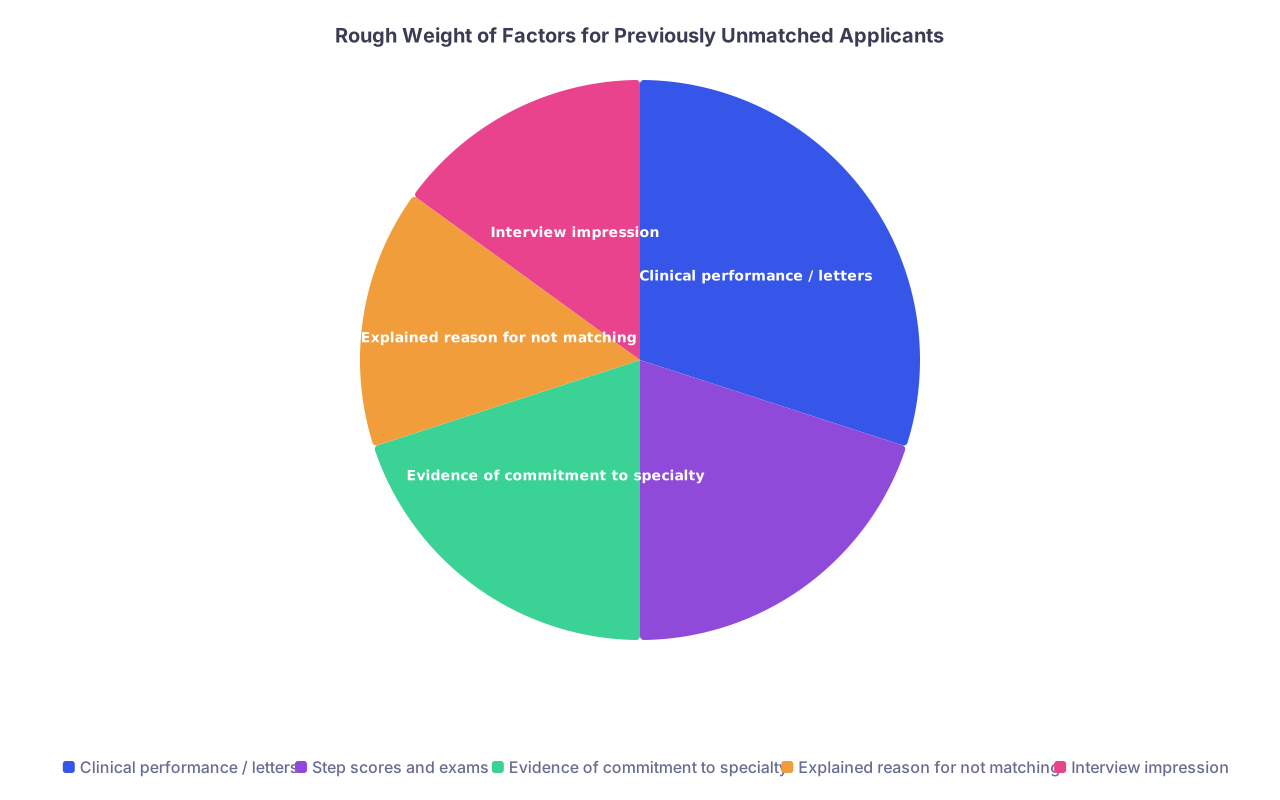
| Category | Value |
|---|---|
| Clinical performance / letters | 30 |
| Step scores and exams | 20 |
| Evidence of commitment to specialty | 20 |
| Explained reason for not matching | 15 |
| Interview impression | 15 |
If you’re going back into a competitive field after failing to match, you need to overperform on at least three of those categories. Not just be “fine.”
The biggest red flags they quietly worry about:
- You didn’t change anything from last cycle and are just “hoping” this time will be different.
- You can’t clearly explain what went wrong the first time.
- Your story doesn’t show growth, just desperation.
- You look like you’re chasing a prestige field more than a real passion.
That last one hurts, but it’s real.
Two Hard Questions You Have to Answer First
Before you make a master plan to still get into ortho/derm/ENT/EM/whatever, you have to brutally answer two questions. For yourself. Not for programs. For you.
1. Why did you not match?
Not your “personal statement” answer. The actual answer.
Was it:
- Too few programs applied to?
- Terrible timing on exams?
- Weak or generic letters?
- No home rotation or away rotations in the specialty?
- One awful interview season (anxiety, poor social skills, weird vibe)?
- Red flags (leave of absence, professionalism concerns, failed exam)?
If you say “I have no idea,” you’re not ready to reapply. Talk to honest people:
- Your dean’s office (not the one who gives you the polished MSPE line—someone who’ll actually tell you what they heard).
- A program director you trust.
- A faculty mentor in your field.
You need one unpleasant, specific sentence like:
“I didn’t match EM because I had a low Step 1, late Step 2, and weak specialty-specific letters.”
Now you know what to attack.
2. Do you want this field, or do you want not-to-feel-like-a-failure?
Harsh? Yes. But this is the quiet driver for so many reapplications.
If the real reason you want to push for a competitive field is “I already said I’d be a dermatologist” or “My classmates know I wanted ortho,” then you’re about to burn a year or two of your life defending your ego.
You need to be willing to want the field even if it takes longer, even if you end up at a program nobody posts on TikTok, even if your path looks messy when people ask.
If the answer is yes, then we can talk strategy.
Three Main Paths If You Still Want a Competitive Field
I’m going to assume you’re post‑Match with no spot (or in a prelim you’re not thrilled with) and you still want to go after a competitive specialty.
Here are the three paths I’ve watched actually work. Not often. But enough that I believe in them.
1. The Research Year + Heavy Specialty Integration
This is classic for derm, radiology, ortho, ENT, neurosurg, competitive IM subspecialty tracks.
What it actually looks like (not the Instagram version):
- 1–2 years as a research fellow in that department, ideally at a place that has a residency.
- You show up like a resident: on time, dependable, low drama.
- You get your name on papers, but more importantly, on people’s radar.
- You go to their conferences, cases, journal clubs, and become part of the furniture.
- You collect 2–3 very strong letters from people residency programs listen to.
This works best when:
- Your scores are decent.
- Your red flags are limited or explainable.
- Your main missing piece was specialty-specific strength or visibility.
It does not work well if:
- You’re hoping publications will magically erase a failed exam or professionalism concern.
- You plan to stay socially invisible and “let my work speak for itself.” It won’t. You need humans advocating for you.
2. The Prelim/Transitional Year → Reapply with Fire Letters
This is more common for EM, anesthesia, rads, some surgical specialties, and even IM applicants targeting stronger programs.
Reality version:
- You SOAP or later scramble into a prelim medicine, prelim surgery, or transitional year.
- You treat that year like a nonstop audition.
- You tell your PD early, clearly, and respectfully what your goal is.
- You volunteer for work. You show up. You make residents’ lives easier, not harder.
- You aim for “top 5% of interns I’ve ever worked with” type comments in your letters.
Where people blow this path:
- They sulk all year because “this isn’t what I wanted.”
- They hide their true specialty goals and then spring it late, so nobody has time or incentive to help them.
- They stay average. Average doesn’t get people to take a risk on a previously unmatched applicant.
The programs that eventually take you see a story they like:
“Didn’t match, took the hit, did a rough year, showed up like a star, no attitude, clear commitment.”
That’s the opposite of damaged goods.
3. The Opportunistic Off‑Cycle Spot (High‑Risk, High‑Stress)
This one’s chaotic but it absolutely happens.
You:
- Keep working (research, prelim, maybe even a different residency)
- Watch for openings: off‑cycle CA‑1 anesthesia spots, EM PGY‑2 positions, rads PGY‑2 “advanced” spots that suddenly open.
- Email PDs the second those positions appear. Like, same day.
This path is messy because:
- You may have to move on short notice.
- You may have to burn a bridge or at least strain a relationship with your current program.
- You might end up with mismatched timing of training.
But if your main barrier is “there just weren’t enough spots last time” and not “I’m a weak applicant,” this path can save you.

| Step | Description |
|---|---|
| Step 1 | Unmatched once |
| Step 2 | Pivot to other specialty |
| Step 3 | Analyze why you did not match |
| Step 4 | Research year with department |
| Step 5 | Prelim or transitional year |
| Step 6 | Watch for off cycle spots |
| Step 7 | Reapply with strong letters |
| Step 8 | Still want competitive field |
| Step 9 | Main gap |
When Pivoting Is Not Giving Up (Even If It Feels Like It)
You knew this part was coming.
There are absolutely situations where chasing a competitive field after failing to match once is not just low probability—it’s self‑destructive.
Some examples I’ve seen:
- Multiple exam failures with no clear improvement.
- A major professionalism event that programs will definitely ask about.
- Being geographically locked and unwilling to move to where the chances actually are.
- Severe burnout or mental health strain already hanging by a thread.
In those cases, sometimes the bravest move isn’t “try again.” It’s “take a similar but more realistic path.”
Like:
- Wanted ortho? Consider PM&R, anesthesia, or sports medicine through FM or IM.
- Wanted derm? Consider medicine with a strong derm connection, allergy/immunology later, or rheumatology.
- Wanted EM? Consider IM or FM with hospitalist + urgent care/ED coverage.
I know that feels like settling. But I’ve also seen people get happier in fields they didn’t originally plan—because the daily work, lifestyle, or team culture fit them more than their fantasy specialty did.
There’s a difference between abandoning yourself and adjusting your route to something sustainable.
How to Talk About Your Failed Match Without Sounding Doomed
You will have to talk about this. On ERAS. In emails. In interviews.
The worst way to do it: long, vague, tearful explanations where you keep saying “I don’t know why it happened.”
A better framework (tight, direct, not dramatic):
- Briefly name what happened.
- Identify 1–2 concrete reasons.
- Show what you did to fix those things.
- End on how this solidified your commitment and resilience.
Something like:
“I applied to anesthesia last cycle and did not match. Looking back with my advisors, my biggest weaknesses were a late Step 2 CK score and too few programs on my list. Since then, I’ve completed a prelim medicine year where I’ve gotten strong evaluations, passed Step 3, and done two additional anesthesia rotations that confirmed this is the right field for me. This experience was humbling, but it forced me to grow in ways I probably wouldn’t have if I’d matched the first time.”
Short. Owning it. Showing growth. Not begging.

The Ugly Middle: While You’re Waiting for a Second Chance
Here’s the part nobody posts about: the months between failing to match and having a real plan.
You’ll see classmates posting Match Day photos. Then new resident photos. Then “first day in the OR” photos. Meanwhile you’re refreshing your email, doing research, covering wards as a prelim, feeling like you’re behind and broken.
You are not.
But you also can’t just emotionally hibernate and expect your future self to fix everything. Here’s what actually helps:
- Get one or two brutally honest mentors who know your field and your situation.
- Decide on a plan within 4–6 weeks post‑Match. Don’t spend 6 months “considering options” while doing nothing.
- Build an actual weekly schedule: clinical work, research, Step 3 or OET/IELTS/to‑do exams, networking emails, department events.
- Give yourself a time limit: “I will chase [field] hard for one more cycle. If not, I’ll pivot with intention to [backup field], not as a consolation prize but as a committed new direction.”
That last part quiets a lot of 3 a.m. anxiety. You’re not stuck in endless limbo that way.
FAQ: The Stuff You’re Probably Still Worried About
1. Is one unmatched cycle a permanent stain on my record?
It’s a mark, not a stain. Programs see it. They will ask. But if the rest of your application is strong and your story shows growth and maturity, it becomes “context,” not “verdict.” Multiple unmatched cycles are harder to explain; one is survivable.
2. Do I have to explain exactly why I didn’t match if I’m not totally sure?
You need a plausible, concrete explanation, even if you’re not 100% certain. Work with your advisors to identify the most likely issues (too few applications, weak letters, timing, scores) and focus on those. “I don’t know” is the only truly wrong answer.
3. Are my chances basically zero for things like derm, ortho, ENT after not matching once?
Not zero, but very small without a targeted, high‑effort plan. For ultra‑competitive fields, a strong research year in that specialty + clear institutional support + excellent letters is almost mandatory after an unmatched cycle. Plenty of people still choose to pivot instead because the odds and time cost are real.
4. Will doing a prelim year hurt me if I plan to reapply to another specialty?
It can actually help you a lot—if you perform at a high level and secure strong letters. Where it hurts is if you’re visibly disengaged, complain about not being in your “real” field, or end up with mediocre or negative evaluations. Programs care far more about how you used the prelim year than the mere fact that you did one.
5. How long should I realistically keep chasing a competitive field before pivoting?
Most people I’ve seen who ultimately land in a competitive field do so within 1–2 additional cycles. Past that, each extra unmatched or partial year raises questions, drains your energy, and closes other doors. A fair rule: go all‑in for one more well‑planned cycle; if it doesn’t work, pivot intentionally rather than drifting.
If you remember nothing else, remember this:
Failing to match once doesn’t automatically kill your chances at a competitive field—but it does force you to be smarter, more deliberate, and more honest than your first‑time‑match classmates.
You’re not ruined. You’re at a fork.
Pick a path on purpose, and then commit to it like your future self is watching.


