

It’s late. The NRMP email is old news now, but you’re still refreshing your inbox like something might magically change. You see words like “SOAP,” “reapply,” “gap year,” but the thought that keeps punching you in the gut is simpler and way worse:
“I’m now officially That Person Who Didn’t Match. Are programs going to blacklist me forever for this?”
Let me say it out loud, because I know you’re thinking it:
You’re afraid that every PD, every APD, every coordinator has a private mental list labeled “Red Flags Forever” and your name just got added.
Let’s go through what’s actually true, what’s exaggerated, and what you can do so this doesn’t follow you like a tattoo on your forehead.
Do Programs Secretly Hold Being Unmatched Against You Forever?
Short answer: no, not forever. But yes, they notice. And they absolutely judge how you handled it.
Being unmatched is a data point, not a permanent scarlet letter. Programs will ask:
“What happened?” and “What did this person do next?”
Here’s the uncomfortable reality:
- Programs do care that you went unmatched.
- Programs care more about:
- Whether your explanation is honest and coherent
- What you’ve done since then
- Whether you learned anything or just repeated your mistakes
I’ve literally heard PDs say both of these sentences in the same afternoon:
- “Being unmatched once is not a dealbreaker if they’ve grown.”
- “What kills an unmatched applicant is no insight and no change.”
So no, you’re not doomed. But if you pretend it didn’t happen, or you can’t own it, that’s when it becomes a long-term problem.
How Programs Actually Look at an “Unmatched Once” Applicant

Let’s walk through what’s really happening in their heads when they see you reapplying.
They pull up ERAS. They see:
- Grad year: last year (or older)
- Prior NRMP participation: yes
- Maybe a SOAP placement. Maybe not.
They do not immediately click “reject.” They do something way more dangerous: they start asking questions.
Here’s the silent interrogation your file goes through:
Why didn’t they match?
They look for obvious stuff:- Scores below the usual range
- Very competitive specialty with average stats
- No home letter in that specialty
- Weird list of programs that doesn’t match your profile
- Very few or very strong programs only
Did they do anything about it in the meantime?
They check:- Did you get a prelim spot?
- Did you do a research year?
- Any new publications, new LORs, away rotations?
- Did Step 2/Level 2 improve?
Is the story different this time, or is this a copy-paste application?
If your new application looks like last year’s plus one sad extra paragraph, that’s bad.
If your application screams “I used this year to level up and fix the issues,” that’s much better.
Programs don’t resent you for being unmatched. They get nervous if you’re the exact same applicant who already proved that strategy didn’t work.
What Actually Counts as a “Red Flag” vs Normal Setback
| Scenario | How Programs Often See It |
|---|---|
| Unmatched once, strong improvement year | Concern but open-minded |
| Unmatched once, no real changes | High risk / likely reject |
| Unmatched twice, minimal changes | Major red flag |
| Unmatched once, now in prelim TY | More reassuring |
| Unmatched, then SOAP into unrelated prelim with weak evals | Depends on evals and story |
So where does “unmatched once” fall?
If we’re being brutally honest:
- Unmatched once + clear improvement = “OK, something went wrong, but they got it together.”
- Unmatched once + same stats, same application, same strategy = “Why would this year be different?”
Programs think in probabilities. Not morality. Not shame. They’re asking:
“If this person couldn’t match with profile X last time, what’s different now that makes them more likely to succeed if we rank them?”
They’re not sitting around saying, “They failed once, so never again.” That’s the catastrophizing your brain is doing at 2 a.m., not their actual process.
What You Should Be Ready to Explain (Without Sounding Desperate)
You will be asked about being unmatched. In interviews. In emails. Sometimes directly. Sometimes in a vague “Tell me about your journey” way.
You need a 60–90 second answer that:
- Owns what happened
- Doesn’t throw everyone else under the bus
- Shows insight
- Shows action
Here’s roughly the structure that works:
Brief, calm statement of fact
“I applied last year to [specialty] and didn’t match.”What you think went wrong (no drama, just analysis)
Example:
“Looking back, I applied too narrowly and didn’t have strong home institution letters in [specialty]. My Step 1 was borderline for the programs I targeted.”What you did during the off-cycle or gap
“This year, I’ve been doing a [research year/prelim year] in [field], working with [mentor], gaining more clinical exposure and stronger letters. I also completed [Step 2/COMLEX 2] with a [score/improvement].”What you learned / how you’re different
“It taught me to seek more direct feedback earlier and be strategic instead of just ‘hoping for the best.’ That’s why I applied more broadly this cycle and prioritized programs where my interests and background really fit.”
Do not:
- Blame the Match as “random.” They hate that.
- Blame your school entirely.
- Sound like you still don’t understand what happened.
You’re not on trial. But they are trying to see if you live in reality.
What Actually Helps Undo the “Unmatched Once” Stigma
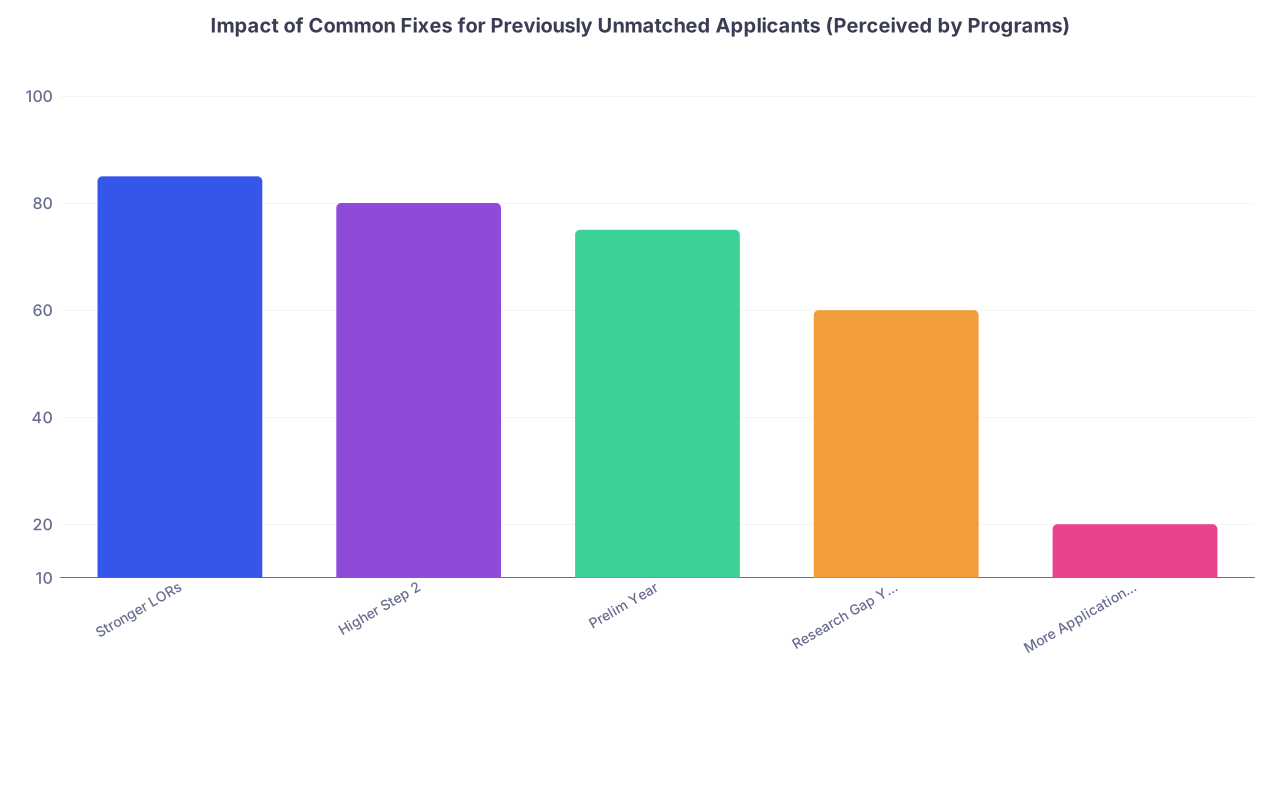
| Category | Value |
|---|---|
| Stronger LORs | 85 |
| Higher Step 2 | 80 |
| Prelim Year | 75 |
| Research Gap Year | 60 |
| More Applications Only | 20 |
If you want being unmatched to become a footnote instead of a defining trait, you need something to point to that says: “I am not the same applicant you saw last time.”
Stuff that actually moves the needle:
A solid prelim year with good evals
Medicine, surgery, transitional year – doesn’t matter as much as:- You show up
- You’re reliable
- Your evals are positive
- You have at least one attending who will go to bat for you strongly
New, strong specialty letters
Especially if last time you had:- Generic letters
- Non-specialty letters only
- Faculty who barely knew you
You want letters that literally say: “I strongly recommend [Name] for categorical [specialty] training. I’d be thrilled to have them in our program.”
Improved exam performance
If low scores were part of the issue and you:- Took Step 2/Level 2 and did significantly better
- Or passed a retake cleanly with no drama
That gives them proof you can handle their exams and boards.
Clear, consistent commitment to the specialty
This is especially true for competitive fields (derm, ortho, ENT, etc.).
More:- Rotations
- Research
- Case reports
- Involvement with the department
makes you look more serious and less like someone who just “applied and hoped.”
Things that don’t magically fix it alone:
- “I just applied to more programs this time.”
- “I rewrote my personal statement but changed nothing else.”
- “I just waited a year because I was burned out.”
You can’t change the fact that you were unmatched. You can change the story from “unmatched and stuck” to “unmatched, regrouped, and came back stronger.”
Will PDs Secretly Judge You In Training If You Matched After Being Unmatched?

This is another nasty thought that sneaks in:
“Even if I eventually match, will my PD and attendings always see me as the person who failed once?”
No. They don’t have mental capacity for that. Once you’re in the program, the main questions become:
- Are you safe?
- Are you reliable?
- Do you take feedback?
- Do you show up on time and carry your weight?
I’ve seen interns who:
- Matched their top choice first try and then crashed and burned because they were unprofessional or burned out.
- Were unmatched once, SOAPed into a prelim, then got a categorical spot and became absolute rockstar residents.
After the first few weeks, your identity stops being “that person who didn’t match” and becomes:
- “The one who’s great with patients”
- “The one who picks up extra shifts”
- “The one who always knows the literature”
- Or, unfortunately, “the one who’s always late”
Your reputation in residency is built on performance, not your Match history. PDs care way more about what you’re doing now than what NRMP email you got 18 months ago.
Most of your coresidents won’t even know you were unmatched unless you tell them. Everyone’s too busy drowning in notes and consults.
Worst-Case Scenario Brain: “What If Being Unmatched Once Ruins Every Future Application Forever?”
Let’s indulge the absolute worst-case spiral, because I know your brain is going there anyway.
Fear 1: “I’ll never match anywhere because of this.”
This is not reality. Harder? Yes. Impossible? No.
You increase your chances by:
- Being brutally honest about why you didn’t match
- Actively fixing the problem (not just passively waiting)
- Getting real feedback from someone high-yield (PD, APD, strong mentor), not just peers
Fear 2: “If I match, fellowships will see I was unmatched once and silently downgrade me.”
Fellowships look at:
- How you did in residency
- Letters from your residency PD and faculty
- Your research / niche / fit
They are not combing your NRMP history from med school. Many fellowship PDs have no clue who did or didn’t match the first time. They care if your residency PD says: “This is a top 10% resident. Take them.”
Fear 3: “Future jobs will see I was unmatched once and think I’m incompetent.”
Jobs look at:
- Board certification
- Your residency training
- References
- Your reputation from residency and fellowship
Most hiring committees don’t even have access to your ancient Match history. They see where you trained, not how many tries it took to get there.
Is your path now less linear than your classmates who matched first try? Yeah. Is it ruined? No.
How To Use This Year So Programs Don’t Freeze You Out

| Step | Description |
|---|---|
| Step 1 | Unmatched |
| Step 2 | Accept and focus on strong evals |
| Step 3 | Consider research or non-match clinical job |
| Step 4 | Get strong letters |
| Step 5 | Increase specialty exposure and output |
| Step 6 | Revise application with mentor input |
| Step 7 | Reapply strategically |
| Step 8 | Have offer for prelim or TY? |
You probably want to know what to do so this “unmatched” thing becomes a bump, not a crater.
Here’s what I’d prioritize:
Get a real read from someone who’s brutally honest.
Not your friend, not your class group chat.
A PD, APD, or faculty who:- Interviews residents
- Has seen hundreds of applications
Ask: “If you saw my file without knowing me, why wouldn’t you interview me?”
Pick one primary lane for the year:
- Prelim/TY → excel clinically, get letters
- Research year → heavy in your chosen specialty with visible output and mentorship
- Non-match clinical job → if possible, something with real patient care and physician supervision (more common in some countries/systems)
Document growth.
Keep track of:- New procedures, experiences, patient cases
- Projects you start or join
- Feedback that shows progress
Fix whatever was glaringly weak.
Low Step 2? Take and do better.
Weak specialty exposure? Add rotations, especially at places you’re applying to.
Generic letters? Cultivate real mentors and ask for strong letters based on recent work.
Your goal: when a PD compares last year’s you and this year’s you, they should clearly see forward motion.
How Long Does the “Unmatched Once” Shadow Actually Last?
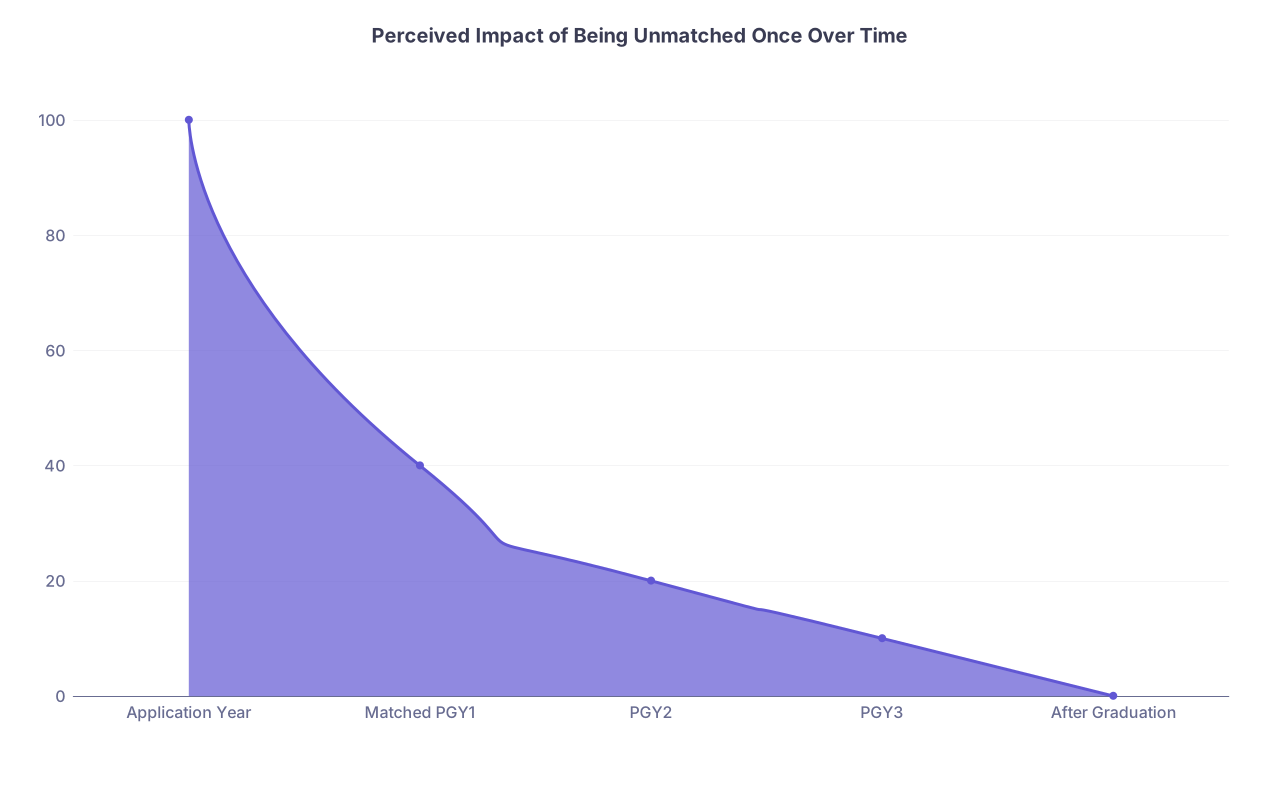
| Category | Value |
|---|---|
| Application Year | 100 |
| Matched PGY1 | 40 |
| PGY2 | 20 |
| PGY3 | 10 |
| After Graduation | 0 |
On the day you get your “unmatched” email, it feels like a 100/10 problem.
In the reapplication cycle, it’s still a big thing. Programs will ask. You’ll feel it.
But once you:
- Match somewhere
- Show up
- Do your job
The weight fades fast. For you and everyone else.
By PGY2, what stands out more is:
- Who’s always on time
- Who knows their stuff
- Who patients like
- Who’s toxic or kind
By the time you’re applying for fellowship or jobs, the “I was unmatched once” fact is either:
- Not really relevant
- Or something you mention as: “I hit a bump, figured it out, and now here’s who I am.”
That doesn’t feel true right now, I know. But I’ve watched it happen over and over.

FAQ – Exactly What Your Brain Is Panicking About
1. Are programs secretly keeping a list of “people who failed once” that follows me my whole career?
No. They barely have time to finish their own work, let alone maintain a blacklist. Programs see your prior Match status when you reapply, they evaluate it in that context, then life moves on. Once you’re in residency, day-to-day performance completely outruns your old Match story.
2. Is being unmatched once worse than a low Step score?
Different kind of issue. A low Step is a permanent number. Being unmatched is a past outcome that can be explained and reframed if you show growth. Many PDs would rather take someone who struggled once but then improved and crushed a prelim year than someone who barely passed Step and stayed flat.
3. Do I have to bring up being unmatched in my personal statement?
You don’t have to write a confession essay, but pretending it never happened can feel weird if there’s a big gap year or an obvious prelim. A concise, honest sentence or short paragraph is enough: “Last cycle, I did not match. Since then, I have…” and then focus on what you’ve done. Don’t let the whole statement orbit around your pain.
4. Will programs think I’m unstable or risky because I went unmatched?
They’ll think you’re risky if your profile hasn’t changed or if you can’t explain what happened. If you show:
- Coherent analysis of what went wrong
- Concrete steps you took to address those issues
- Strong new letters or performance
you actually look more resilient than someone who never faced a setback.
5. If I SOAPed into a prelim I don’t love, will that hurt me when I reapply to my preferred specialty?
It depends entirely on how you perform there. If you do well, get strong letters, and show professionalism, that prelim year can help your reapplication a lot. Programs care more that you handled clinical work well than that your prelim wasn’t in your dream field. A weak or problematic prelim year, though, will hurt more than the fact that you SOAPed in.
6. Is there ever a point where I should stop reapplying and change paths completely?
Yes. Being unmatched once is not that point. Being unmatched multiple times with minimal improvement, or applying unrealistically (e.g., super competitive specialty with no upgrades) might be. The line isn’t fixed; you need honest input from a PD/mentor who can tell you, “You have a realistic chance with X changes,” versus, “You probably need to pivot to a less competitive specialty or a different role.” Pivoting isn’t failure; staying stuck in a doomed loop is.
Key points, so your brain has something concrete to hold on to:
- Being unmatched once is a red flag only if you don’t learn from it or change anything.
- Programs judge what you did after being unmatched more than the fact that it happened.
- Once you’re in residency and doing your job, your Match history fades; your current performance is what defines you.


