

The fear that a gap year will ruin your residency chances is massively overblown.
Let me say that again, because I know your brain is already spiraling: a gap year can hurt you if you handle it badly, but the mere existence of a gap doesn’t automatically tank your application. Programs care way more about what you did and how you explain it than the fact that there’s a blank space between dates.
You’re probably here because you’re thinking something like:
- “I didn’t match. Do I now look radioactive with a gap year coming?”
- “I needed time off for mental health… are they going to see me as unstable?”
- “My scores aren’t great, plus I have this gap. Is it over?”
- “What if they assume the absolute worst about that year I wasn’t in training?”
Let’s walk straight into the worst-case scenarios and pick them apart.
The Ugly Truth: When a Gap Year Does Look Bad
I’m not going to sugarcoat it: there are ways a gap year can hurt you.
Here’s when programs start raising eyebrows:
The gap is completely unexplained or vaguely explained
“Personal reasons.” “Took some time off.” “Exploring options.”
That sounds like: fired, failed, unprofessional, or barely holding it together. If they have to guess, they’ll guess badly.There’s no documented activity
Twelve months with basically nothing: no work, no research, no volunteering, no courses, no explanation. On paper, that looks like you checked out of medicine. Program directors hate uncertainty more than they hate low scores.The gap follows performance issues and you still don’t address it
Failed Step, withdrawn from clerkship, professionalism concern… then a gap… and then you give a 2-sentence answer in your personal statement. That’s when they start thinking: “We’re inheriting someone else’s problem.”You sound defensive or evasive when asked about it
If during interviews you get tight, vague, or irritated: red flag. They’re not just evaluating your history; they’re evaluating how you handle uncomfortable reality.
That’s the nightmare version. That’s the “gap year looks bad” scenario everyone scares you with. But it’s not inevitable. At all.
Let’s put some structure around what programs actually see.
| Gap Scenario | Initial Reaction |
|---|---|
| Documented research year | Neutral to positive |
| Family / health issue, well-framed | Neutral if explained |
| Unmatched then structured gap year | Depends on productivity |
| Unexplained idle year | Clearly negative |
| Multiple unstructured gaps | Strongly negative |
The Part No One Tells You: Programs Expect Gaps More Than You Think
Residency application files are not full of perfectly linear, flawless lives. That’s the fantasy you have in your head when you compare yourself to imaginary applicants with 270s and six first-author papers.
Real files? They have:
- People who took a year because a parent had cancer.
- People who didn’t match and then did a research fellowship.
- People who got burned out, took time off, came back stronger.
- People who had babies, got divorced, moved countries.
And programs know this.
Here’s the mindset they actually use when looking at a gap:
- Is there a clear, believable reason?
- Did this person use the time productively, given the circumstances?
- Are they stable now and able to handle residency?
- Do they own their story without blaming or minimizing?
If you can help them answer yes to those four things, your gap becomes something they can live with. Sometimes even respect.
“I Didn’t Match. Now I Automatically Look Worse Next Year, Right?”
This is the one that really eats at people.
You’re thinking:
“I have ‘did not match’ branded on my forehead. Now I’ll have another year + that label. Why would any PD pick me over a fresh M4 with no baggage?”
Here’s the deal: being unmatched is not an automatic rejection stamp in future cycles. I’ve seen plenty of people match on a second or even third try. The pattern that kills people is:
- Didn’t match.
- Spent the year drifting or doing totally unrelated stuff.
- Reapplied with basically the same application, plus one vague paragraph.
That applicant looks stuck.
The one who gets taken seriously does something very different. Their year looks like:
- Research (ideally related to their chosen field, but even general clinical or outcomes work helps).
- Or a non-ACGME clinical role (prelim year, research fellow with clinical duties, hospitalist assistant, etc.).
- Or serious exam remediation and improvement (big Step 2 bump + clear explanation).
- Or consistent, documented clinical contact: observerships, preceptorships, regular shadowing.
And then in their personal statement and interviews, they say something like:
- “I didn’t match last cycle, and it forced me to really examine my weaknesses and priorities. Over the past year, I’ve done X, Y, Z to address those, and I’m a stronger applicant and a more realistic future resident because of it.”
Programs don’t hate that story. They see growth. Maturity. Self-awareness. That’s actually more impressive than the “everything was perfect and then I matched first try” trajectory sometimes.
Are you competing with fourth years? Yes. But you’re not dead in the water. You’re in a different category: the comeback story. That’s workable if you actually give them a comeback arc.
What You Did During the Gap Matters More Than the Gap Itself
This is the part you can control, which of course makes your anxious brain go, “Great, now if I screw this up, it’s my fault.”
But it’s also your best leverage.
Here’s what tends to reassure programs:
Research positions – Even if it’s unpaid. Especially if it’s in their specialty. Poster presentations, abstracts, helping with data, chart review. They like seeing your name on something and your feet still in the hospital.
Clinical roles – Scribe, sub-intern, non-ACGME fellow, clinical observer, assistant physician roles in some states, telemedicine support. Anything that says: I still wake up and work in patient care.
Extra degrees or coursework – MPH, MS, or even certificate programs can help if they’re connected to your story: quality improvement, public health, global health, medical education.
Clear personal or family responsibility – Caring for a sick parent. Managing your own serious illness. These don’t “add strength” in the traditional way, but they’re understandable human events. Programs don’t expect you to be publishing papers from the ICU bedside of your dying father. They do expect honesty and clarity.
Meaningful exam improvement – If Step 1 or Step 2 was your weak point, using a gap year to show a big score jump or passing a previously failed exam is huge. That tells them: this person can respond to setbacks.
What throws people off is they think: “If it’s not glamorous—like a prestigious research fellowship or Harvard degree—it doesn’t count.” Wrong. Consistency counts more than flash.
If you’re in the middle of your gap year now and it’s…not impressive so far, don’t waste mental energy beating yourself up. Get structured now. Even 6–9 months of well-documented, consistent effort is miles better than continuing to drift.
How You Explain the Gap is Almost More Important Than the Gap Itself
You can have a “good” gap on paper and still torpedo yourself in how you talk about it. Programs are asking themselves: Will this person fall apart when things get hard? Or own it and adjust?
Here’s the mental checklist I’d use if I were a PD listening to your explanation:
- Do you take responsibility where appropriate?
- Do you avoid oversharing drama while still being honest?
- Do you sound like you’ve processed it, instead of still actively drowning in it?
- Do you tie the experience to future behavior as a resident?
Some examples:
Bad:
“I had a really hard time with my school and there was a lot of unfairness, and that’s why I needed a break. The administration was very unsupportive.”
Sounds like: you’re still angry, you blame others, and you might bring drama with you.
Better:
“During M3, I struggled significantly with burnout and personal stressors. I made the decision with my dean to step away for a year to address my mental health and stabilize my situation. I used that time to do outpatient clinical work and therapy, and I’ve developed systems to maintain my mental health while meeting demanding schedules. Coming back, I completed my rotations with strong evaluations and feel ready for residency.”
That answer says: I broke, I fixed it, I learned from it, and I can function now.
Different Gaps, Different Risk Levels
Not all gaps are created equal. Your anxiety probably lumps them all into “catastrophic,” but that’s not how PDs think.
| Gap Type | Risk Level (If Well-Explained) |
|---|---|
| Planned research year | Low |
| Unmatched then structured research/clinical year | Low to moderate |
| Visa / immigration delay gap | Low to moderate |
| Family illness / caregiver role | Moderate |
| Personal health / mental health leave | Moderate to high (depends how explained) |
| Unexplained “time off” with little activity | High |
None of these are automatic fatal injuries to your app. Even the “high risk” ones are salvageable with:
- Concrete timeline
- Clear reason
- Specific actions taken
- Evidence that things are stable now
If you’re dealing with mental health stuff specifically, your fear is probably: “If I say anything, they’ll label me unsafe or fragile.” That’s the voice in your head. Not necessarily the program’s.
The trick is not to give every gritty detail. You don’t need diagnoses. You need:
- Acknowledgement that there was a problem
- Clear statement that it’s being actively managed
- Evidence that you’ve functioned well since then (clerkships, jobs, research)
International Grads & Gap Years: Is It Worse?
If you’re an IMG or FMG, yeah, gaps are looked at more critically. Especially long ones, or ones far removed from graduation where you’ve had little to no clinical contact.
Programs worry about “clinical atrophy.” Basically: are your skills rusty?
But even here, it’s not hopeless. For IMGs, the important pieces:
- Recent clinical experience in any setting (home country or US).
- Continual engagement with medicine: observerships, tele-clinics, research tied to patient care.
- Strong Step 2/Step 3 performance to compensate for time out of school.
The worst-case IMG file is:
Grad 7+ years ago, no clinical engagement in last 3–4 years, multiple gaps, weak scores, no explanation. That’s hard to rescue.
But 2–3 years with research, some observerships, steps completed, coherent narrative? That’s not automatically out. Competitive? Maybe not. Possible? Yes.
How to Stop the Spiral and Make a Plan
Your brain is probably doing the classic thing: jumping from “I have a gap year” to “I’ll never match anywhere” in two seconds flat.
Pull it back. Ask three brutally practical questions:
- What is the real reason for the gap? (Not the pretty version. The actual one.)
- What story can I ethically tell that’s honest but professional?
- What can I do from today forward to make this year look structured and intentional?
Then build your plan around:
- One main anchor (research position, job, fellowship, clinical work)
- One or two supporting things (volunteering, courses, exam studying, quality improvement project)
Don’t overcomplicate it. You don’t need to cure cancer in 12 months. You just need to prove you’re not drifting.
Here’s a simple example of turning a “bad-looking gap” into a survivable one:
You: Didn’t match in IM. Gap year started with 3 months of panic and depression, doing basically nothing but doom-scrolling Reddit.
From now:
- Month 4–12: research assistant in a hospitalist group, working on readmission projects.
- Regular shadowing on inpatient teams and letter from a hospitalist.
- Finish Step 3 with a decent score.
- Volunteer one evening a week at a free clinic.
On ERAS, that year becomes:
- Research assistant – Internal Medicine, Hospital X
- Volunteer physician assistant (or similar role permitted) – Free Clinic Y
- Step 3 completed, [score]
Does it erase the fact you didn’t match? No. Does it turn you into an obviously unmatchable disaster? Also no.
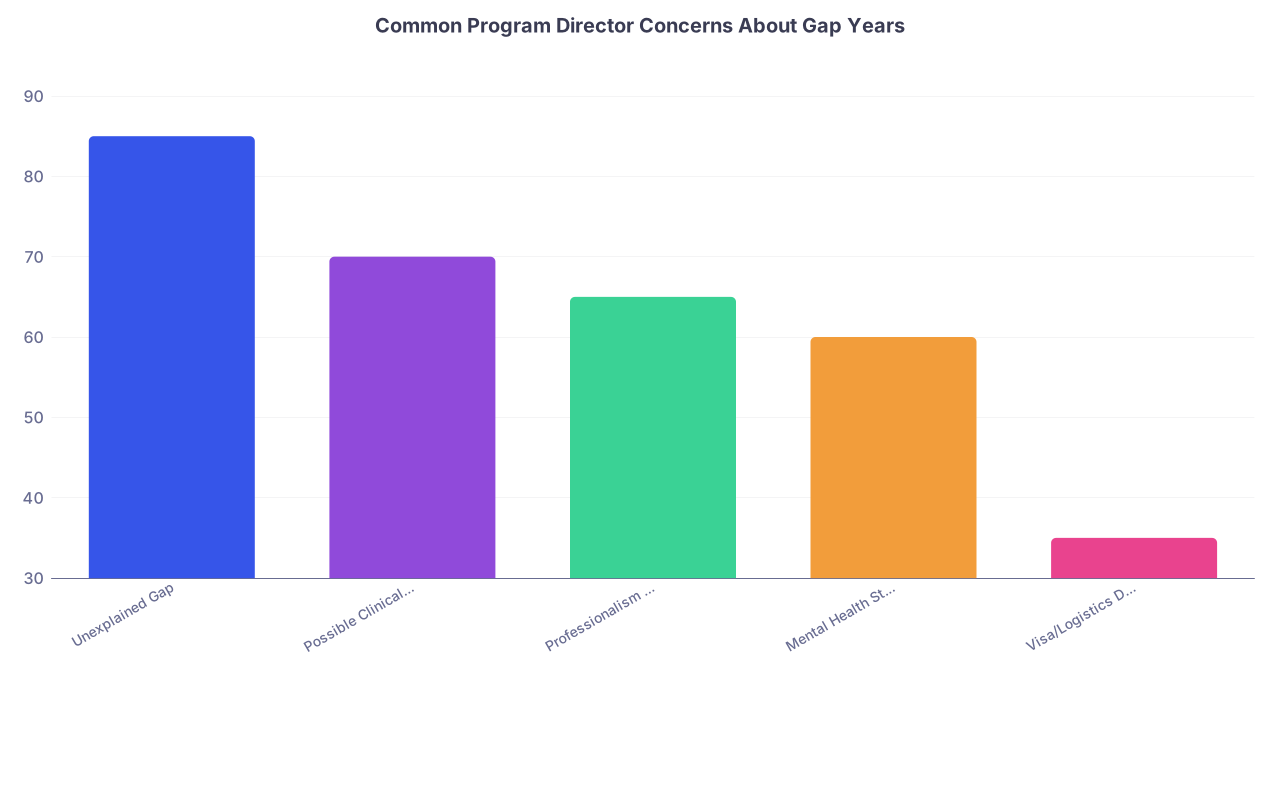
| Category | Value |
|---|---|
| Unexplained Gap | 85 |
| Possible Clinical Skill Loss | 70 |
| Professionalism Concerns | 65 |
| Mental Health Stability | 60 |
| Visa/Logistics Delays | 35 |

| Step | Description |
|---|---|
| Step 1 | See Gap on CV |
| Step 2 | Red flag - lower interest |
| Step 3 | Concern about motivation |
| Step 4 | Risky - maybe interview, maybe not |
| Step 5 | Acceptable - evaluate full app |
| Step 6 | Is it explained? |
| Step 7 | Any productivity? |
| Step 8 | Is issue resolved or stable? |
So… How Bad Does a Gap Year Really Look?
Here’s the honest, non-sugarcoated answer you probably need to hear:
A gap year doesn’t magically destroy your residency chances. What destroys them is an unstructured, unexplained, or badly framed gap.
Programs are less scared of a messy past than they are of an unpredictable future. If you can show stability, growth, and sustained engagement with medicine, they can live with the fact that your path wasn’t perfect.
Your anxiety is amplifying the risk way beyond what most PDs are actually thinking. They’re not whispering, “Gap year? Next.” They’re asking, “Does this make sense, and can this person function here?”
If you remember nothing else:
- The existence of a gap isn’t the problem. The silence around it is.
- Structured, documented activity during that time is your best defense.
- A clear, calm, honest narrative can turn a “red flag” into a “human, but stable” story—and that’s good enough to match.


