
It’s Wednesday afternoon of Match Week. You just got your SOAP offer list. None of them are in your preferred specialty. Your phone is buzzing, your dean is emailing, and you’ve got minutes—not months—to make a decision that could shape your entire career.
Here’s the blunt question you’re really asking:
Should you accept a SOAP offer outside your preferred specialty, or walk away and try again next year?
Let’s walk through this like a rational adult, not a panicked applicant.
Step 1: Get Clear on Your Realistic Options
Before you can decide anything, you need to know what you’re actually choosing between.
In most cases, your decision is not:
“Take this SOAP offer vs. magically match into my dream specialty later.”
It’s usually:
“Take this SOAP offer vs. graduate with no residency vs. try to reapply next year with a gap on my CV.”
That’s a very different calculation.
Typical realistic options for someone unmatched in their preferred specialty:
Accept a SOAP offer in:
- A different specialty
- A transitional year (TY)
- A preliminary year (prelim medicine or surgery)
Decline all SOAP offers and:
- Graduate without a PGY‑1 spot
- Do research, a master’s, observerships, or some other gap‑year plan
- Reapply next cycle
Rare but real:
- Postpone graduation (if your school allows it) and build up your application while still a student
You are choosing a path, not a one‑year experiment. Even a “temporary” prelim year has long‑term consequences. I’ve seen people rescue a tough start and build great careers. I’ve also seen people sink themselves with overly optimistic assumptions.
Step 2: Ask the Right Core Question
Here’s the core decision test I use with students:
“Would I be okay—truly okay—if this SOAP specialty ends up being my permanent specialty?”
Because that’s exactly what happens for a lot of people.
If your honest answer is “Absolutely not, I’d be miserable,” then taking that SOAP spot is dangerous.
If your answer is “I could see myself being fine or even happy in this specialty,” then a SOAP offer can be a very smart move.
You’re not deciding what sounds glamorous on paper. You’re deciding:
- Can I tolerate the day‑to‑day work of this field?
- Could I respect myself in this role?
- Do I like the patient population and lifestyle enough to live with it long‑term?
If you can’t say yes to those at least provisionally, that’s a red flag.
Step 3: Understand the Three Big Paths Through SOAP
Not all SOAP offers are equal. The right answer depends heavily on what’s on the table.
| Path Type | Typical Goal | Realistic Risk Level |
|---|---|---|
| Categorical other specialty | Make peace with new field or later switch | Moderate–High |
| Transitional Year | Strengthen app, reapply broadly | Moderate |
| Prelim (IM/Surg) | Try to jump into advanced spot | High |
1. Categorical Spot in a Different Specialty
Example: You wanted Derm, got a categorical IM offer through SOAP.
This is the biggest commitment. You are joining that specialty with the expectation of finishing it.
When this makes sense:
- You can genuinely see yourself doing that specialty forever.
- You care more about being a physician and practicing medicine than about any one specific niche.
- You’re okay with closing the door—practically, if not theoretically—on your original dream.
When this is risky:
- You’re “taking anything” out of panic.
- You actively dislike the day‑to‑day work of that field.
- You’re telling yourself, “I’ll just switch later.” (Transfers are possible but not reliable. They are the exception, not the plan.)
My stance:
If you can see yourself staying in that specialty and being reasonably content, a SOAP categorical spot is usually worth taking. Doing some residency and becoming board‑eligible is miles better than drifting unmatched for years.
But if the field truly doesn’t fit you, don’t lock yourself into a career you’ll resent.
2. Transitional Year (TY)
TY spots are the least understood and most romanticized.
What a TY actually is:
- One year of broad clinical training
- Often easier lifestyle than prelim surgery, sometimes similar to prelim medicine
- After the year, you must have an advanced spot to continue (radiology, anesthesia, etc.) or you’re done unless you find another entry point
People imagine:
“I’ll crush my TY year, network, and slide into my dream field.”
Reality:
Sometimes. But not often. TY doesn’t magically erase board scores, red flags, or competitive specialty barriers.
TY makes sense when:
- You originally applied to an advanced specialty (rads, gas, PM&R, neuro) and just need a PGY‑1.
- You’re okay with IM, FM, or another field as your eventual backup if your dream specialty never happens.
- You have a realistic plan for what you’ll do after the TY if you don’t land your dream spot.
TY is risky when:
- You’re using it as a fantasy bridge to ultra‑competitive fields (Derm, Ortho, Plastics) without fixing your underlying application issues.
3. Preliminary Medicine or Surgery
Prelim medicine/surgery can be a brutal treadmill if you treat it like a vague holding pattern.
They make sense when:
- You applied to an advanced specialty that accepts prelim years as PGY‑1 (rads, gas, ophtho, etc.).
- You have specific programs or mentors telling you, “Do this prelim here, and we’ll strongly consider you for a categorical spot.”
They’re risky when:
- You’re unmatched without a clear path to an advanced spot.
- You think “any residency is better than none” without realizing you might end up PGY‑1 forever with no PGY‑2 seat.
My honest view:
Prelim years can be great if tightly linked to a concrete plan. As a generic “I’ll figure it out later” move? High risk of burnout and dead‑end.
Step 4: Use a Simple 5‑Question Framework
You do not have time in SOAP to write a thesis. You need a quick but intelligent filter.
Sit down, no phone, and answer these 5 questions in writing:
- If this SOAP specialty became my permanent specialty, could I live with that?
- Does taking this offer keep more doors open for me than it closes?
- What is my best realistic alternative if I say no this week?
- Are my unmatched reasons fixable in 1 year? (Scores are not. Letters, research, strategy often are.)
- Which risk scares me more:
- Being in the wrong specialty, or
- Having no residency and possibly never practicing?
If your honest answers point in one direction, follow that. Don’t overcomplicate it.
Step 5: Be Brutally Honest About Why You Didn’t Match
This is the part a lot of people skip. Then they repeat the same mistake next year.
Typical patterns I see:
You applied to a hyper‑competitive field (Derm, Ortho, Plastics, ENT, IR) with:
- Average scores
- Minimal research
- Limited away rotations
- Unimpressive letters
→ Reapplying with the same credentials is self‑sabotage.
You applied too narrowly:
- 20–40 programs in IM/EM without regional ties, no backup specialty
→ Reapplication with corrected strategy may work.
- 20–40 programs in IM/EM without regional ties, no backup specialty
You have a major red flag:
- Step failure, professionalism issue, leave of absence, large gap
→ These need addressing with a serious plan, not magical thinking.
- Step failure, professionalism issue, leave of absence, large gap
If the barrier is structural (scores for ultra‑competitive fields), another year probably will not change the math. In that scenario, a SOAP categorical in a solid core specialty (IM, FM, Peds, Psych) is often the smartest path.
If the barrier is strategy, timing, or incomplete application, a well‑planned reapplication year can make sense.
Step 6: Consider Long‑Term Outcomes, Not Just Next July
You’re under enormous pressure to “not be the one who didn’t match.” Schools, families, classmates—they all push you toward any available spot.
Step back. Ask yourself:
Five years from now, which regret will hurt more?
- “I took a spot I hated out of panic.”
- “I took one extra year to reapply and ended up in a better‑fit field.”
What specialty traits matter most to me:
- Lifestyle?
- Procedures vs. cognitive?
- Inpatient vs. outpatient?
- Patient population?
- Earning potential?
Now look at your SOAP offers. Do any of them check enough of those boxes that you’d be okay building a life there?
If yes, don’t romanticize “trying again” just because it feels emotionally satisfying. Training, attending salary, and long‑term stability are not trivial.
If no, do not let fear alone push you into a multi‑decade mistake.
Step 7: How I’d Think About Common Scenarios
Let me be concrete. Here’s how I’d advise in a few very common situations.
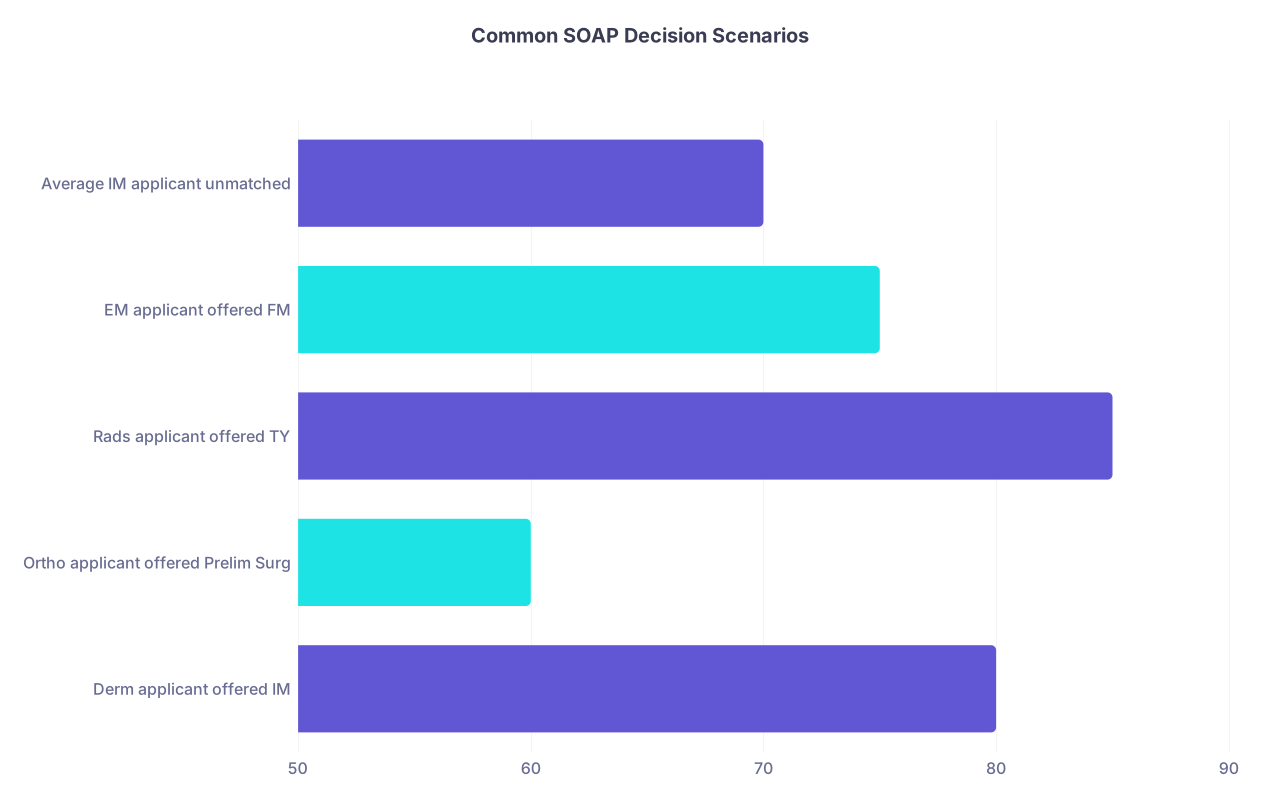
| Category | Value |
|---|---|
| Derm applicant offered IM | 80 |
| Ortho applicant offered Prelim Surg | 60 |
| Rads applicant offered TY | 85 |
| EM applicant offered FM | 75 |
| Average IM applicant unmatched | 70 |
(Values here are a rough “likelihood I’d recommend accepting” out of 100, assuming average details.)
Derm applicant, decent but not stellar stats, SOAP offer: categorical IM at a decent community program
- I usually say: strongly consider accepting IM. Derm from scratch with average stats is a long shot. IM gives you a robust, employable career, subspecialties, and plenty of options.
Ortho applicant, borderline stats, SOAP offer: prelim surgery at a malignant program
- I’m cautious. If there’s no realistic internal pipeline to categorical gen surg or Ortho, I’d be wary of signing up for a miserable year with no guaranteed path.
Rads applicant, solid stats, SOAP offer: TY at a good hospital
- Often recommend taking it, especially if there are PDs indicating they’d consider them for Rads next cycle or there’s a strong imaging culture there.
EM applicant, okay stats, SOAP offer: categorical FM in a location they can live with
- FM is extremely versatile: urgent care, ED‑adjacent work, lifestyle control. I generally lean toward accepting if they can see themselves in outpatient and acute care mix.
Average IM applicant who applied too few programs, SOAP has only prelim IM at weak programs
- I’d deeply question a prelim with no clear PGY‑2 pathway. A focused re‑application with more programs and better advising may be safer.
Step 8: If You Decline SOAP, Have a Real Plan (Not Just Hope)
If you say no to SOAP, you must treat the next 12–18 months like a second full‑time job.
Minimum viable plan:
- Get a committed faculty mentor in your specialty of choice.
- Secure a structured role:
- Research fellow
- Chief research year
- Public health / MPH with research
- Dedicated clinical research coordinator role in your specialty
- Fix what hurt you:
- Better letters from named people
- More programs next time (often 60–100+, depending on field)
- Clear, honest explanation of the unmatched year
And understand:
The longer you’re out of clinical training, the harder it gets. A one‑year gap is manageable. A two‑ or three‑year drift? Very tough.
Visual: Your Decision Flow in SOAP

| Step | Description |
|---|---|
| Step 1 | Unmatched in Preferred Specialty |
| Step 2 | Plan Reapply Year |
| Step 3 | Accept if Program Reasonable |
| Step 4 | Accept and Execute Plan |
| Step 5 | SOAP Offer Available? |
| Step 6 | Could Live With This Specialty Long Term? |
| Step 7 | Categorical vs Prelim TY? |
| Step 8 | Clear Path After Year? |
Don’t Decide Alone in a Vacuum
Last thing. In SOAP, your brain is not your friend. You’re exhausted, embarrassed, and time‑pressured.
Talk to:
- Your dean or student affairs office
- A trusted attending in your preferred specialty
- Someone actually practicing in the SOAP specialty you’re considering
Ask them the hard version:
“If I were your kid, what would you tell me to do?”
That question tends to strip away the polite, vague advice and get you the truth.

FAQs
1. Is it better to SOAP into any specialty than go unmatched?
Not always. It’s better to SOAP into a specialty you can genuinely live with than to go unmatched. But taking a categorical spot in a field you actively hate just to avoid a gap can trap you in a miserable career. The key question: would you be okay if this becomes permanent? If the answer is absolutely not, strongly reconsider.
2. Can I easily switch specialties after taking a SOAP spot?
“Easily” is the wrong word. Switching is possible but unpredictable. It depends on open positions, timing, visas, your performance, and how much your current PD supports you. Planning to switch as your primary strategy is weak. Assume that any SOAP specialty you accept might be the one you stay in.
3. Does doing a prelim or transitional year improve my chances next cycle?
Sometimes. It shows you can function in residency and gives you new letters and contacts. But it does not erase low scores or fix a fundamentally non‑competitive application to ultra‑competitive specialties. It helps most when:
- Your main issue was lack of clinical letters or experience
- You’re targeting advanced specialties that value that PGY‑1
4. What if I’m an international medical graduate (IMG)? Should I be more likely to accept?
For IMGs, the bar to re‑enter the Match after going unmatched is higher. Visa issues, perceived distance from training, and competition all work against you. That means declining SOAP is generally riskier. If you get a decent categorical spot in IM, FM, Peds, or Psych and can see yourself in that field, I usually advise IMGs to accept.
5. How much does program reputation matter for a SOAP offer outside my specialty?
It matters, but less than you think. Being in a specialty that fits you at a mid‑tier or small community program usually beats being in the wrong specialty at a “big‑name” place. Reputation matters more if you’re hoping to pivot later or do a competitive fellowship, but the base question is still: can I be okay in this field at this location for 3+ years?
Key takeaways:
- Don’t accept a SOAP offer in a field you’d truly hate, assuming you’ll just “switch later.” That’s how people get stuck.
- If you can see yourself reasonably content in the SOAP specialty, a solid categorical spot is usually better than rolling the dice unmatched.
- If you turn down SOAP, have a concrete, disciplined reapplication plan—not just vague hope that “next year will be different.”