
The most dangerous moment after you unmatch isn’t Match Day. It’s the week you start “fixing” everything.
The Trap Of Overcorrecting After An Unmatch
You’re vulnerable right now. Hurt, embarrassed, maybe angry. Perfect conditions to make reckless decisions that feel proactive but quietly wreck your next cycle.
I’ve watched strong applicants turn one unfortunate unmatch into a multi‑year disaster. Not because they were “unmatchable.” Because they panicked and overcorrected.
They:
- Switched specialties impulsively.
- Exploded their application list from 60 to 250 programs with no strategy.
- Scrapped good personal statements and letters for worse ones.
- Took random research or prelim spots that didn’t actually help their goals.
You’re not going to make those mistakes if I can help it.
Let’s go through the most common overcorrections that do more harm than good—and what to do instead.
1. The Nuclear Option: Abruptly Changing Specialties
This is the big one. The “I didn’t match in ortho so I’m just going to do FM now” move.
Sometimes, changing specialties is smart. Often, it’s not. The mistake is doing it:
- In the first 72 hours after Match results
- Without sober analysis of your actual competitiveness
- Without talking to faculty who will be honest, not just sympathetic
Here’s what I’ve seen go wrong:
Red Flag: Switching To A “Backup” You Don’t Understand
People think: “I’ll just go into Internal Medicine this year and then switch later.” That fantasy is everywhere. Program directors know it. They can smell it.
So you end up:
- Applying to a new specialty with shallow, obviously last‑minute interest
- Zero meaningful experiences in that field
- A personal statement that screams “I just need a spot”
You haven’t fixed the problem. You’ve just created a new story: “Unmatched in their first choice and now weakly pivoting into something else.”
| Scenario | Risk Level | Comment |
|---|---|---|
| EM to IM with no IM rotations or letters | Very High | Looks like desperation, not genuine interest |
| Ortho to Gen Surg with strong surgery evaluations | Moderate | Defensible if narrative is clear |
| Derm to FM with solid FM sub‑I and letter | Moderate | Can work if framed carefully |
| Psych to Psych (reapply with improved app) | Lower | Same field, easier narrative |
Red Flag: “Anything That Matches” Mentality
“I’ll apply to IM, FM, Psych, Neuro, Path—whatever sticks.”
No. That’s how you end up with 4 mediocre applications instead of 1 strong, coherent one. Programs see through shotgun, unfocused applications.
The more specialties you add, the more:
- Your letters look generic
- Your personal statements contradict each other
- Your ERAS story becomes muddy and unfocused
When A Specialty Change Makes Sense
It can be reasonable if:
- Your board scores and academic record are objectively non‑competitive for your original specialty (e.g., Step 1 failed + Step 2 low for Derm/Ortho/ENT).
- Multiple honest advisors in that specialty tell you your chances are extremely low even with improvements.
- You can realistically build 6–12 months of real, specialty‑relevant work (rotations, research, letters) before the next cycle.
But you still need a focused, deliberate shift—not a last‑minute flail.
Mistake to avoid: Changing specialties quickly to escape discomfort, rather than deliberately based on evidence and honest feedback.
2. The Application Explosion: “I’ll Just Apply Everywhere”
One of the quickest, laziest overcorrections: “I applied to 70 programs and got 2 interviews. Next year I’ll apply to 220. That’ll fix it.”
No, it probably won’t.
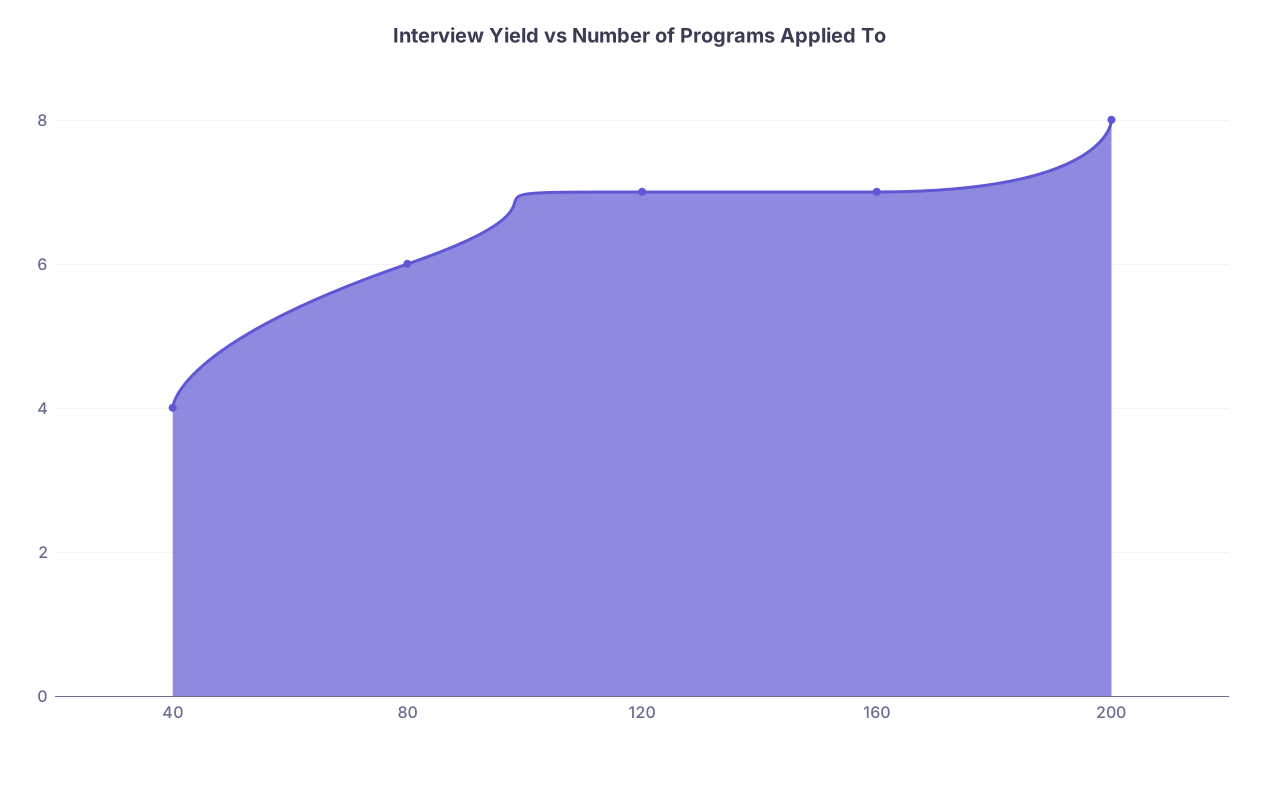
| Category | Value |
|---|---|
| 40 | 4 |
| 80 | 6 |
| 120 | 7 |
| 160 | 7 |
| 200 | 8 |
More applications past a certain point give you diminishing returns. If your underlying weaknesses are:
- Weak letters
- Poor Step 2 score
- Bad personal statement
- Red flags (failures, professionalism concerns)
- Late application submission
Then multiplying the number of programs just mass‑produces a flawed product.
The Real Cost Of Over‑Applying
Do not ignore what over‑applying does:
- Financial drain: Thousands of dollars you might actually need for living, exam fees, or focused away rotations.
- Time drain: You’ll drown in generic, low‑quality supplementary essays and emails.
- Emotional drain: Dozens of auto‑rejections hurt way more than targeted, strategic application outcomes.
I’ve watched people stay up until 2 a.m. writing garbage answers for 30 different supplemental questions that no one will remember. That’s not strategy. That’s panic.
When More Applications Are Justified
Expanding your list can make sense if:
- You were clearly under‑applying (e.g., applied to 15 programs in a competitive specialty).
- You were geographically too narrow without a strong reason (only 1 state when you had no constraints).
- You had a decent interview yield per application but just came up short in the match.
But the right move is smart expansion, not blind scaling:
- Add more lower‑tier and community programs that fit your profile.
- Target programs with historical acceptance of IMGs or lower Step scores if that applies to you.
- Reach out early and build relationships instead of just tossing another ERAS into the void.
Mistake to avoid: Doubling or tripling applications as a substitute for actually fixing the reasons you went unmatched.
3. Burning Down Your Personal Statement And Letters
Here’s a quiet disaster: people assume everything on their app was terrible because they didn’t match.
They:
- Throw out solid letters from respected faculty
- Rewrite their personal statement into a trauma dump or sales pitch
- Remove experiences that were actually strong just because “they didn’t work”
That’s not analysis. That’s emotional editing.
Personal Statement Overcorrections
Two big screw‑ups happen here.
Making it more dramatic.
They add more sob stories, more “this is my dream, I’ll never give up,” more adjectives. It reads like a reality show monologue, not a professional narrative.Being weirdly defensive.
Over‑explaining every minor issue. Turning one failed test into a three‑paragraph confession. Or using half the statement to explain why they went unmatched.
Programs want to know:
- Who you are clinically and professionally
- Why this specialty and why you fit it
- How you’ve grown from challenges, briefly and maturely
They don’t want a therapy session transcript.
Letter Of Recommendation Overcorrections
People sometimes:
- Drop strong, detailed letters from last year because they “feel old,” replacing them with rushed, generic ones from a gap‑year job.
- Ask for new letters from people who barely know them, just to have “fresh” dates.
If you had:
- Two or three glowing, specific letters from your target specialty
- From people with recognizable names or clear seniority
- Describing your clinical performance with strong detail
You don’t discard those lightly. You supplement them if needed, but you don’t burn them down.
Mistake to avoid: Assuming “unmatched = every component of my application was trash” and rebuilding from zero instead of carefully identifying what actually needs revision.
4. Grabbing The Wrong “Gap Year” Opportunity
The year after an unmatch can either save your trajectory or quietly sink you further.
What sinks you? Overcorrecting into whatever opportunity appears first, without thinking about strategic value.
Common bad moves:
- Taking totally unrelated research just because it’s at a big‑name institution (e.g., Derm research when you’re reapplying to IM, with no clinical work or patient contact).
- Accepting a random non‑clinical job that doesn’t maintain your clinical skills or show ongoing engagement with medicine.
- Jumping into a prelim year that doesn’t support your long‑term specialty goals and gives no pathway or advocacy.

The Fake Security Of “Any Prelim Spot”
Don’t assume any prelim year is better than none.
Risks with random prelim choices:
- Little to no mentorship for your target specialty
- No protected time or support for interviews next cycle
- Getting buried in service work with no chance to shine or be known
- Ending up with weak, rushed letters that say “shows up and works hard” and nothing else
A prelim year can be extremely helpful if:
- It’s in the same or adjacent specialty you want
- There’s an explicit understanding you’ll be reapplying and they’re supportive
- You’ll work closely with attendings who can write strong new letters
- There’s at least some track record of people successfully matching from that role
If not? Don’t jump just because the word “PGY‑1” looks comforting.
Research Year Overcorrections
One more trap: believing that “research year” automatically repairs a competitive specialty application.
It doesn’t.
Research helps most when:
- It’s in the same specialty you’re applying to
- You’re integrated into a team that knows you and can advocate for you
- You can realistically get at least abstracts/posters, ideally publications, within a year
- You’re also getting clinical exposure or at least strong mentoring, not just pipetting in a basement
Random, disconnected research with no specialty link is not the magic key people think it is.
Mistake to avoid: Accepting the first gap‑year job or prelim spot out of fear, instead of asking: “Will this clearly strengthen my application for the exact specialty I’m targeting?”
5. Over‑Explaining The Unmatch (And Making It Bigger Than It Is)
Another way people hurt themselves: they obsess over explaining why they unmatched.
They write emails to programs:
- Three paragraphs long
- Reliving their unmatch in detail
- Over‑apologizing for things no one asked about
Or they use large chunks of their personal statement to dissect The Unmatch Event.
Here’s the part nobody says out loud: most programs don’t have time to autopsy your entire previous cycle. They scan:
- Scores
- Red flags (fails, leaves, professionalism issues)
- Letters
- Experience and fit
Unless there’s something glaring, they don’t need a multi‑page narrative about last year.
When You Do Need To Explain
You should address it briefly if:
- You had a clear, major red flag (Step failure, withdrawal from a program, extended LOA).
- You’re entering a different specialty and need to clarify the pivot.
- Your experiences during the gap year significantly change your story.
But “briefly” means:
- One short paragraph in your personal statement, focused on growth and insight
- Or a concise note in ERAS experiences, not pages of justification
Mistake to avoid: Centering your entire narrative around the unmatch, instead of around who you are now and what you bring to a program.
6. Ignoring Real Feedback And Listening Only To Panic Voices
Another overcorrection pattern: you gather feedback, then ignore it because it’s uncomfortable.
I’ve watched people do this:
- 2 program directors tell them: “Your biggest issue is weak clinical letters.”
- 1 trusted mentor says: “You must apply to a totally different specialty or you’ll never match.”
Guess whose advice they follow? The dramatic one. The one that matches their fear.
Or they:
- Blame all outcomes on “bias against IMGs” or “Step 1 pass/fail ruined everything”
- Refuse to accept that their interview skills, professionalism, or essays were weak
So instead of fixing the fixable problems, they rebuild their entire life around a narrative that may be only partially true.
How To Handle Feedback Without Overreacting
You need:
- At least 2–3 independent opinions (PDs, faculty, dean’s office, not just friends)
- To look for patterns—what do multiple people say?
- To separate “hard constraints” (scores, failures, visa issues) from “improvable factors” (letters, interviewing, narrative, timing)
Then design your next steps around the improvable pieces, not around the story that hurts your ego the least or scares you the most.
Mistake to avoid: Making huge structural changes (specialty, country, career) based on emotional reactions or one extreme opinion, instead of a pattern of grounded feedback.
7. A Better Framework: Correcting Without Overcorrecting
Let me simplify what you actually need to do.
Before you change anything major, walk through this sequence:

| Step | Description |
|---|---|
| Step 1 | Unmatched |
| Step 2 | Get Score and App Review |
| Step 3 | Plan to Address Directly |
| Step 4 | Identify Weakest Areas |
| Step 5 | Choose Gap Plan Focused on Red Flags |
| Step 6 | Reapply Strategically Same Field |
| Step 7 | Deliberate Specialty Change |
| Step 8 | Targeted Improvements and Smart Apply |
| Step 9 | Any Hard Red Flags? |
| Step 10 | Same Specialty Still Realistic? |
Ask yourself, brutally:
- What were my numbers relative to the specialty norms?
- How many interviews did I get vs how many applications?
- Did I have obvious concerns in my letters or MSPE?
- Did I actually interview well, or am I just assuming I did?
Then, and only then, decide if you need:
- Incremental adjustments (better PS, targeted letters, expanded but sane program list), or
- Structural changes (different specialty, extra year with meaningful work)
Most people need serious refinement. Not a full demolition.
FAQ (Exactly 4 Questions)
1. I unmatched once. Does that permanently damage my chances?
Not permanently, but it does change the bar. Programs will want to see clear evidence of growth and improvement—stronger letters, additional clinical work, or a better‑aligned specialty choice. I’ve seen many applicants match after one unmatch when they avoided dramatic overcorrections and instead made focused, data‑driven changes. Multiple unmatched cycles, especially with the same weak points, are much harder to recover from.
2. Should I mention in my personal statement that I went unmatched?
Briefly, if it’s necessary to explain your timeline or gap year. One short, mature paragraph is plenty: acknowledge it, state what you learned, and show what’s different now. Do not turn it into the emotional centerpiece of your statement. Your future plans, clinical strengths, and fit for the specialty should dominate the narrative—not your past disappointment.
3. Is it better to do a prelim year or a research year after unmatching?
Neither is automatically better. A prelim year helps if it’s in or adjacent to your target specialty, with mentors who will actively support your reapplication and give you strong letters. A research year helps if it’s clearly within your specialty, gives you real output (posters, papers), and connects you with advocates. The mistake is grabbing a random prelim or random research job just to fill the gap, with no strategic benefit to your application.
4. How many programs should I apply to after an unmatch?
“More” isn’t the answer by itself. You likely need to increase your number compared with your previous cycle—especially if you under‑applied—but within reason. Use specialty‑specific data and honest advising to set a range. For many core specialties, that might mean 60–120 targeted programs rather than 25 or 250. The key is to fix underlying weaknesses first, then expand strategically—not to blindly triple your list and hope volume hides the problems.
Keep three things straight: Don’t torch your whole application out of shame. Don’t swap specialties or grab positions just to feel less scared. And don’t confuse doing “more” with doing better. Your next match cycle should be precise, not panicked.