
The cruel truth: most of the money people spend right after they do not match is thrown straight into a shredder.
Not “invested.” Not “strategic.” Torched.
Let me walk you through the biggest financial traps I see every March and April. Because the emotional pain of not matching is bad enough. You do not need a five‑figure mistake piled on top.
The Emotional Setup: Why You Are Vulnerable To Bad Spending
You are not thinking clearly the week after you do not match. Nobody is.
You are exhausted, ashamed, and terrified. You are watching your classmates post “Matched!” photos while you are Googling “what to do if you don’t match residency” at 2 a.m.
That is exactly when:
- “Advisors” appear out of nowhere, selling $2,000 “match rescue” packages.
- Programs blast out expensive prelim and reapplicant advice sessions.
- Older residents tell you, “Just apply to more programs next year, that is what I did,” as if your loan balance is not already radioactive.
You are primed to equate “spending more” with “trying harder.” That is how people burn $10,000–$25,000 in one post‑match year and walk right back into the next cycle with the same application problems.
Here is what to skip, what to question, and what actually might be worth paying for.
Money Pit #1: Spraying Applications At Everything That Moves
The most common and most expensive mistake: “I did not match, so I will just apply to more programs next year.”
Blind volume is the lazy solution. And it is usually wrong.
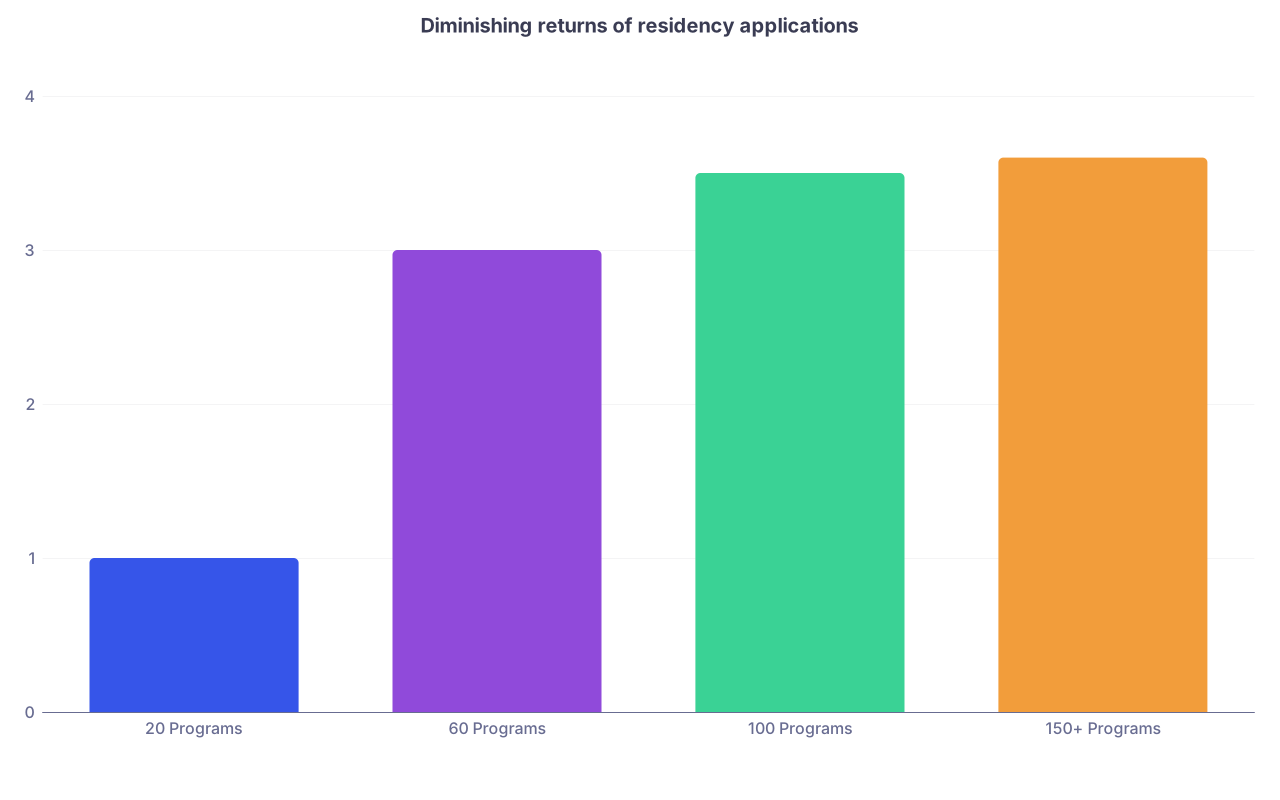
There is a predictable curve to how many applications help you and when they become pure waste.
| Category | Value |
|---|---|
| 20 Programs | 1 |
| 60 Programs | 3 |
| 100 Programs | 3.5 |
| 150+ Programs | 3.6 |
That “3.5” and “3.6” might as well be flat. Past a certain point, extra applications buy you nothing but anxiety and credit card debt.
The expensive version of this mistake
Here is what I actually see:
- IMG / DO, low Step 1 performance, applied to 120 programs, 2 interviews, no match.
- Post‑match plan: “Next year I will apply to 250 programs, all prelims and IM/FM everywhere.”
ERAS + NRMP fees at that volume easily cross $4,000–$6,000. Then add travel (if we are not in a fully virtual year), lost income because you are locked into interview days, and sometimes an “interview travel card” at 24% APR.
What changes outcome next cycle is not +80 applications. It is fixing one of:
- Step 2 or OET/English scores
- Clinical gap / no recent US clinical experience
- Terrible letters (or no US letters)
- Red flags not addressed (failures, professionalism reports, big gaps)
If none of that changes, your “250 applications” plan is just paying a larger toll to lose again.
When more applications are not a waste
There are scenarios where increasing applications is rational:
- You are close to competitive: Step scores and grades okay, a bit under‑applied in your specialty (e.g., you applied to 20 EM programs last cycle, got 6 interviews, SOAPed unmatched). Bumping to 60 with better targeting can help.
- You severely under‑applied geographically (only coasts, ignored Midwest / South). Spreading out with intention helps.
But that is not “spray and pray.” That is surgical.
What to skip
- Applying to every program that exists in your specialty just because you are scared.
- Applying to specialties you have zero experience in and no letters for (“I will just add Path, Psych, PM&R, Radiology, EM, and Anesthesia, why not”).
- Applying to obviously out‑of‑reach programs for your profile (top 10 university hospital IM with 260+ average Step 2 when you have 215 and no research).
If you cannot articulate why a specific program might realistically rank you, you probably should not be paying them.
Money Pit #2: Overpriced “Match Guarantee” Coaches And Consulting Packages
There is a cottage industry that feeds on unmatched grads. It spikes every March.
The worst offenders are the ones who use phrases like:
- “We guarantee an interview or your money back.”
- “We almost always get our clients matched.”
- “Insider connections with program directors.”
No, they do not.
The truth: some professional help can be valuable.
The scam: paying $3,000–$8,000 for info you could have gotten from your own dean’s office or a decent mentor for free.
| Offer Type | Typical Cost | Often Worth It? |
|---|---|---|
| 60–90 min strategy call | $200–$400 | Sometimes |
| Full application review | $500–$1,200 | Sometimes |
| Multi-month “match” pkg | $2,000–$8,000 | Usually no |
| “Guaranteed” services | $3,000+ | Avoid |
Red flags I want you to run from
- No transparent bios or credentials (who is advising you? What is their background?).
- Hard sell: “Prices go up in 48 hours,” “Limited seats,” “Decide now or miss your chance.”
- Vague success numbers: “We have a 95% match rate” without disclosing how many clients, what specialties, what profiles.
- “We know what program directors really want” with no actual program leadership experience.
I have seen students pay $5,000+ for:
- Rewritten personal statement that reads like generic brochure copy.
- Another rewiring of the same CV.
- “Interview coaching” that is just reading canned questions from a PDF.
Zero work on the real problem: failed Step exam, no US letters, professionalism concerns, weak clinical performance.
What can be worth paying for
You are not forbidden from spending money. You just need to spend it like an adult, not like a panicked intern with a new line of credit.
Reasonable spends:
- One or two targeted strategy sessions with someone who has actually sat on residency selection committees (your own school’s advising office often has this for free).
- A thorough application review if English is not your first language and your writing is clearly hurting you.
- Focused interview practice if you are getting invites but not converting to ranks.
If you cannot see a direct line from the consulting service to a specific, measurable fix in your application, keep your wallet closed.
Money Pit #3: Unnecessary Extra Degrees And Certificates
This one hurts more long‑term than any ERAS fee.
You do not match and someone suggests:
- “Maybe get an MPH to strengthen your application.”
- “An MBA will make you stand out.”
- “Do a 1‑year research master’s; programs love that.”
Sometimes those paths make sense. Often they are just very expensive procrastination.
Tuition for a single year graduate degree can be:
- $25,000–$60,000 (and that is before living costs).
- Often unsubsidized loans at ugly interest rates.
And many programs will quietly admit: another degree does not fix a weak Step score or a terrible clinical reputation.
When an extra degree is mostly a waste
I get suspicious in scenarios like these:
- You failed Step 1 and Step 2, have no recent clinical experience, and somehow the plan is “MPH at a random online school” with no concrete change in your clinical profile.
- You are planning to apply to a specialty that cares little about an extra degree (e.g., community FM, IM, Psych) and have no idea how you would link that degree to your future goals.
- You are doing the degree at a place with no real research infrastructure, no strong mentor, and no track record of their grads matching into your target specialty.
I have met applicants who did two costly master’s programs trying to “fix” their profile and still did not match because they never addressed why program directors passed the first time.
When it might make sense
I will not pretend all degrees are useless. There are narrow circumstances where a targeted degree or research year is strategic:
- You are aiming for a research‑heavy specialty (Derm, Rad Onc, academic IM) and you lock in with a serious mentor, real projects, and publications.
- You genuinely want that degree for your future career (health policy, admin, global health) and you would pursue it even if you matched tomorrow.
- You already have passing scores and strong clinical feedback, but lack research or academic output and want to strengthen that area specifically.
Even then, treat it as an investment decision. Ask: “If I never match after this, would this degree still be worth the debt and the time?”
If the answer is no, do not use it as a Band‑Aid for the pain of not matching.
Money Pit #4: Unstructured, Unpaid “Research Years” With No Output
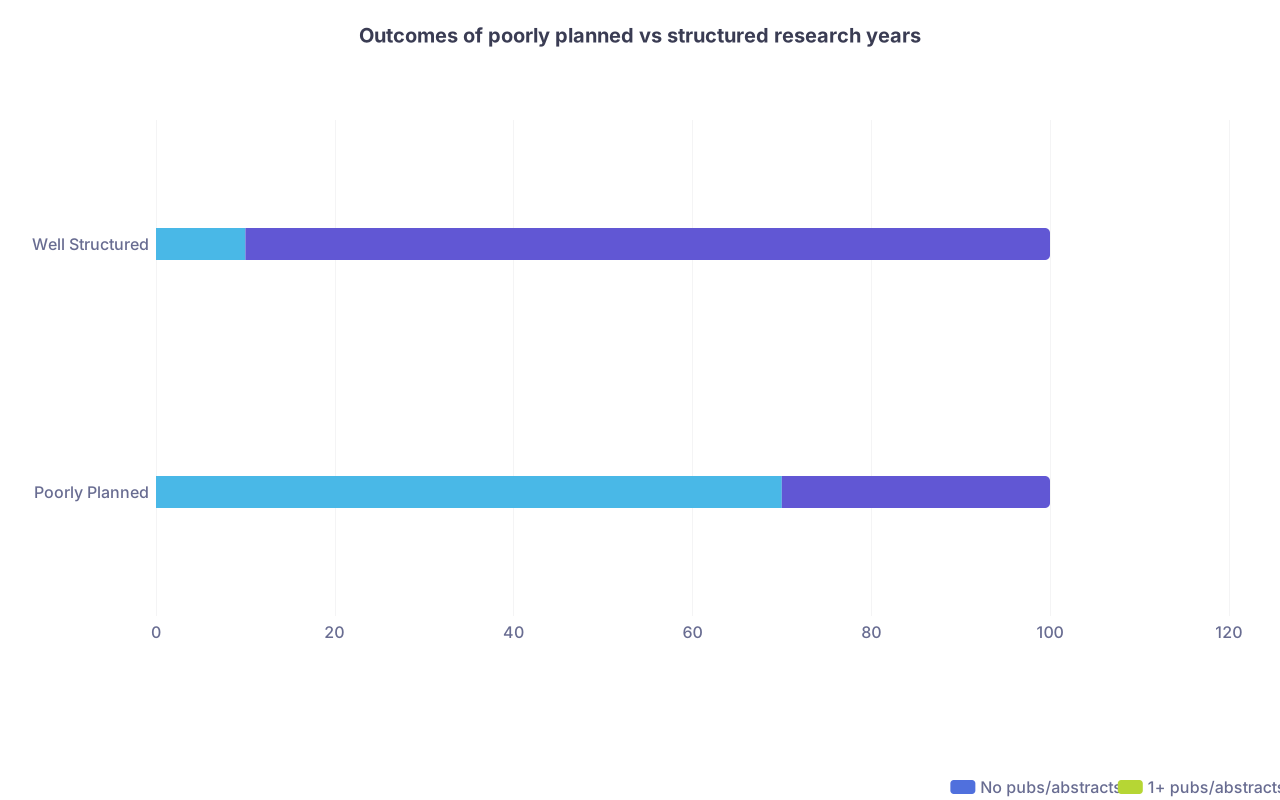
There is a romantic idea of a “research year” saving your application. Reality: an unfocused, unpaid research year can turn into 12 months of menial data entry, no publications, and you poorer but not stronger.
| Category | No pubs/abstracts | 1+ pubs/abstracts |
|---|---|---|
| Poorly Planned | 70 | 30 |
| Well Structured | 10 | 90 |
Numbers approximate, but the pattern is real.
The common bad version
What I see constantly:
- Student emails 20 labs / departments: “I am looking for research opportunities.”
- One PI answers: “Sure, come help with data.”
- No formal title. No defined project ownership. No timeline for abstracts or manuscripts.
- One year later: “I updated a database for a year but the paper is not out yet and my name might be somewhere in the middle.”
That experience adds maybe one unimpressive line to the CV and burns a year of earning potential. You cannot pay rent with “maybe co‑author.”
When a research year is worth it
A research year is only worth unpaid or low pay if you have:
- A defined role in one or more specific projects from the start.
- A PI or mentor who has a track record of publishing and of placing mentees into residency.
- Clear expectations: abstracts submitted at month 6–8, manuscripts by month 10–12.
- A backup plan if the lab implodes (and they do).
If you do not see a realistic path to at least 1–2 tangible outputs by the end of the year, you are donating free labor to someone else’s h‑index.
You are allowed to say no.
Money Pit #5: Endless Observerships And Unpaid “USCE”
Another trap: paying for observerships left and right, thinking each new hospital name magically boosts your odds.
Typical pattern:
- You did one 4‑week observership. No letters, minimal interaction.
- Someone tells you “programs want recent USCE, do as many as possible.”
- You buy three more observerships from “placement agencies” at $1,500–$3,000 each.
- Housing, flights, visa fees pile on.
Tally: you spend $8,000+ to collect a few badge photos and maybe one lukewarm letter from an attending who barely remembers you.
The problem with most paid observerships
They are often:
- Crowded: multiple observers per attending; no one really gets to stand out.
- Passive: you cannot write notes, you cannot enter orders, you are not truly part of the team.
- Transactional: the attending knows you paid a third‑party, and they treat you accordingly.
Program directors can smell the difference between real hands‑on sub‑internship‑style work and “fly‑in observer for 4 weeks.”
What is worth paying for (and what is not)
Look for experiences where you:
- Are integrated: allowed to present patients, attend educational conferences, and interact regularly with faculty.
- Can realistically earn a detailed, strong letter (not “they were present and punctual”).
- Have some continuity (2–3 months in one place is far better than six scattered 2‑week stints).
Usually worth skipping:
- Agencies that promise “guaranteed USCE” with unclear sites and no named preceptors.
- Very short observerships (1–2 weeks) that are essentially paid shadowing.
- Repeating the same weak observership setup multiple times.
If the program or site cannot tell you exactly who will be supervising you and what your role will be, do not send them money.
Money Pit #6: Lifestyle Inflation In A Gap Year
The quiet money leak: you decide to “take a year” to reapply and accidentally build a lifestyle that assumes a resident salary you do not have.
I get it. You want to feel normal. You work a non‑clinical job, you are finally earning, and the urge to self‑medicate with spending is strong.
Common traps:
- Signing a fancy lease “because I am basically a doctor anyway.”
- Financing a new car because “I will be a PGY‑1 soon.”
- Taking multiple expensive trips to “reward myself after this hard year.”
Then match day comes again. Or it does not. And your monthly burn rate is incompatible with any flexibility—another degree, a low‑paid research year, moving for a position.
You have locked yourself into financial handcuffs before you have the job to support them.
What to skip or minimize
- Long multi‑year leases when you know you may have to move for residency or a different opportunity.
- Luxury car loans. If your car payments are competing with ERAS fees, you picked the wrong car.
- Recurring subscription creep: gym, streaming, “premium” services that you barely notice until your card declines for an exam fee.
Your gap year should create options, not trap you. The more your monthly expenses balloon, the fewer doors you can afford to walk through.
Money Pit #7: Re‑Taking Exams Without A Plan
Another reflex move: “I did not match, so I need to retake Step 2 / OET / language exams / another board.”
Sometimes that is correct. Often it is a knee‑jerk reaction.
Exams are not just the fee. They are UWorld subscriptions, question banks, dedicated time off work, and opportunity cost.
When re‑taking is mostly a waste
- You already have a solid passing score relative to your target specialty and programs (for many IM/FM programs, a 225–235 Step 2 is not your limiting factor).
- Your bigger problems are zero US letters, unexplained professionalism issues, or weak interviews.
- You “just want a higher score” with no realistic path to a major jump.
Raising Step 2 from 228 to 235 will not rescue an application with no recent clinical experience.
When it might be necessary
- You barely passed, have clear evidence you under‑prepared, and can commit to a completely different, disciplined study approach.
- Some programs in your target specialty explicitly filter out applicants below a certain score and you are just under that line.
- You have a fail on record and your performance since then has not demonstrated a clear upward trajectory.
Even then, ask yourself if you have the time, resources, and discipline to produce a significant change, not a cosmetic one.
What You Should Actually Spend Money On
To be clear: you are not required to sit on your hands and spend nothing. The trick is to fund what changes your trajectory, not what simply soothes your anxiety.
Worthy categories:
- A small number of targeted application fees to programs where you can plausibly fit (with improved letters, experience, or exam performance).
- One or two specific, well‑structured clinical experiences where you can earn strong letters.
- Short, focused professional help: CV/personal statement cleanup, strategy discussion with someone experienced, not bloated packages.
- Basic living stability: a sane housing situation, food, mental health support.
And in parallel, if you are working a non‑clinical job, use that to attack interest on your loans. That alone can save you more over ten years than any short‑term “boost” you buy for your application.
Final Warnings: Three Rules To Keep You Out Of Trouble
Let me end bluntly.
Do not equate spending with effort.
Programs do not care how much you paid to “fix” your application. They care what you actually changed.Never commit thousands of dollars while you still feel panicked, ashamed, or rushed.
Sleep on it. Talk to someone who does not profit from your fear: a former attending, your dean’s office, a trusted resident.If you cannot clearly explain how a cost will fix a specific weakness in your application, do not pay it.
“It might help” is how you drift into $20,000 of “maybe.”
You already did something incredibly hard by getting to this point. Do not let one bad match cycle turn into five bad financial years because you tried to buy your way out of a problem that required strategy, not a bigger credit limit.