The most dangerous part of the Match isn’t Match Week. It’s the month after—when smart people make panicked decisions that quietly wreck next year’s chances.
If you just didn’t match, you’re vulnerable. Tired. Embarrassed. Pressured by family, classmates, and your own expectations. That’s the exact headspace where bad “post‑Match strategy” is born.
Let me walk you through the biggest post‑Match panic moves that come back to bite applicants a year later—and what to do instead.
1. Scrambling Into the Wrong Program Just to “Have Something”
This is the classic career‑long regret move.
You don’t match into your target (say, categorical IM) but you get a late SOAP or off‑cycle offer for something that doesn’t fit your record or your goals—prelim surgery when you hate the OR, a weak transitional year with zero teaching, a malignant community program everyone whispers about.
You tell yourself, “I can always reapply next year from inside.” That’s the lie.
Here’s what actually goes wrong:
You end up with:
- No time to study for Step 3
- Weak letters from overworked attendings who barely know you
- Rotations that don’t match the specialty you truly want
You’re exhausted, not “sturdier”
Your application narrative gets muddy: “So you started surgery, but now you want psych… again?”
“You left that program… why?”
Programs aren’t stupid. They can smell a panic accept.
A bad PGY‑1 year in the wrong specialty can hurt you more than a deliberate, well‑planned bridge year tailored to your actual target.
Better move: Pause. Ask three questions before accepting anything:
- Does this position materially improve my application for the specialty I want?
- Can I realistically get strong letters and relevant experience here?
- Does this program have a track record of residents successfully switching or reapplying?
If you can’t get clear yeses, think hard before saying yes.
2. Vanishing for a Year and “Just Working” Non‑Clinically

Another common move: “I’ll take a non‑clinical job, clear my head, make money, and reapply next year.”
On paper that sounds reasonable. In residency applicant reality, it’s risky.
Here’s why this often backfires:
- Programs hate clinical rust. A one‑year gap with zero patient contact looks like skill atrophy.
- Your letters get stale. LORs older than 12–18 months carry less weight, especially in fast‑moving specialties.
- You lose narrative coherence.
“So you finished med school, then did… pharma/data analytics/scribing for a year with no structured educational component?”
Do not confuse “employment” with “strategic reapplication planning.”
A year at a random non‑clinical job often signals to programs:
- Lack of commitment
- Poor mentorship
- No clear remediation of the weaknesses that caused the no‑match
If you must work non‑clinically (immigration, finances, family reasons), you cannot let it be your only lane.
You need at least one of these running in parallel:
- Structured research with clear deliverables (posters, papers, abstracts)
- Regular clinical involvement (per diem clinic work under supervision, observerships, volunteering with clinical exposure)
- Formal remediation (extra coursework, MPH or other relevant degree with academic products, not just “I got more debt”)
You want your ERAS to scream: “I stayed in the arena,” not “I disappeared into a cubicle.”
3. Reapplying With the Same Application (Plus One New Sentence)
This might be the single most common self‑sabotage move: treating a reapplication as a formality instead of a rebuild.
You’d be stunned how many reapplicants submit ERAS 2.0 that looks like a “Find & Replace” version of last year’s.
Same personal statement. Same generic “I love patient care” content. Same vague descriptions. No new letters. No substantial new experiences. Maybe a single new line: “Over the past year, I have strengthened my skills…”
Programs notice. Quickly.
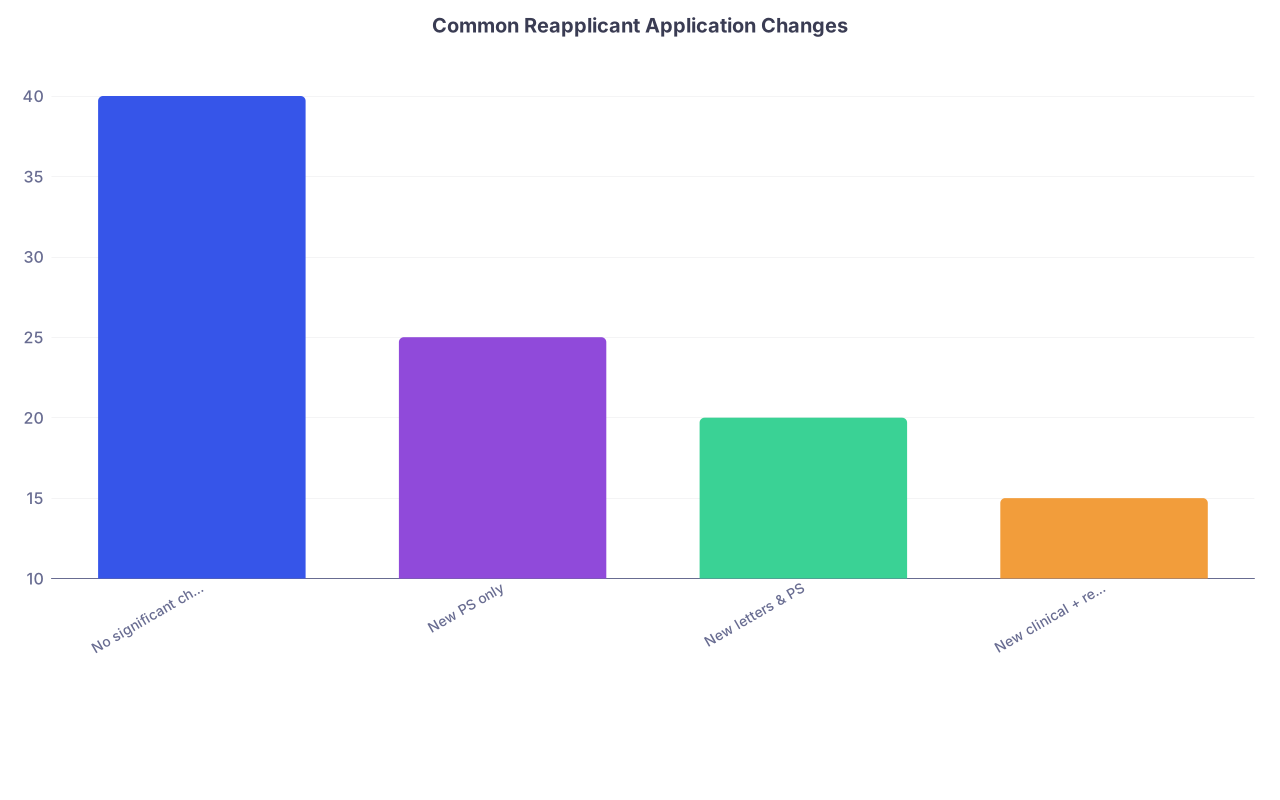
| Category | Value |
|---|---|
| No significant changes | 40 |
| New PS only | 25 |
| New letters & PS | 20 |
| New clinical + research | 15 |
If your application didn’t match the first time, a 5–10% cosmetic adjustment will not magically change outcomes.
You need to be brutally honest:
- Did you address your Step/COMLEX scores in a clear, concise way?
- Did you get new letters from the last 12 months—ideally US clinical, ideally in the specialty?
- Did you add any concrete wins? (Poster. Abstract. Quality improvement. Volunteer project with measurable impact.)
Programs are not looking for perfection. They’re looking for evidence of growth and insight. A near‑identical reapplication basically tells them, “I didn’t learn anything from last year.”
Don’t make that mistake.
4. Blindly Changing Specialties Without Strategy
| Original Target | New Target | Risk Level |
|---|---|---|
| Derm | FM | Medium |
| Ortho | IM | Medium |
| Gen Surg | Anesthesia | Medium |
| IM | Derm | High |
| Psych | Radiology | High |
There’s smart pivoting. Then there’s flailing.
Smart: After failing to match into a hyper‑competitive field with marginal scores and limited research, you pivot to a specialty that actually aligns with your record and your strengths, and then spend a year building a credible story for that specialty.
Flailing: “I didn’t match into ortho, I’ll just apply psych and FM next year and see what sticks.”
Here’s what makes specialty‑hopping so dangerous:
- You dilute your story. “I love continuity of care and long term relationships… but last year I love the OR… and the year before I loved dermatologic surgery…”
- You confuse letter writers. They don’t know what to emphasize or where to angle their praise.
- You come across as desperate rather than directed.
If you’re considering a specialty switch, you must avoid these traps:
- Switching to something just because “it’s less competitive” without actually knowing the day‑to‑day work
- Applying to 3–4 very different specialties at once
- Not doing any specialty‑specific rotations or experiences in the new field
- Using an obviously repurposed original personal statement
Better: choose a new specialty deliberately and then rebuild around it:
- At least one focused rotation or observership in the new field
- At least one specialty‑specific letter from that year
- A personal statement that doesn’t look like a cut‑paste job with “orthopedic surgery” replaced with “internal medicine”
If you cannot articulate a believable “why this specialty, why now” that doesn’t sound like “because I failed the last one,” you’re not ready to pivot.
5. Ignoring Your Exam Record and Hoping Programs Won’t Care
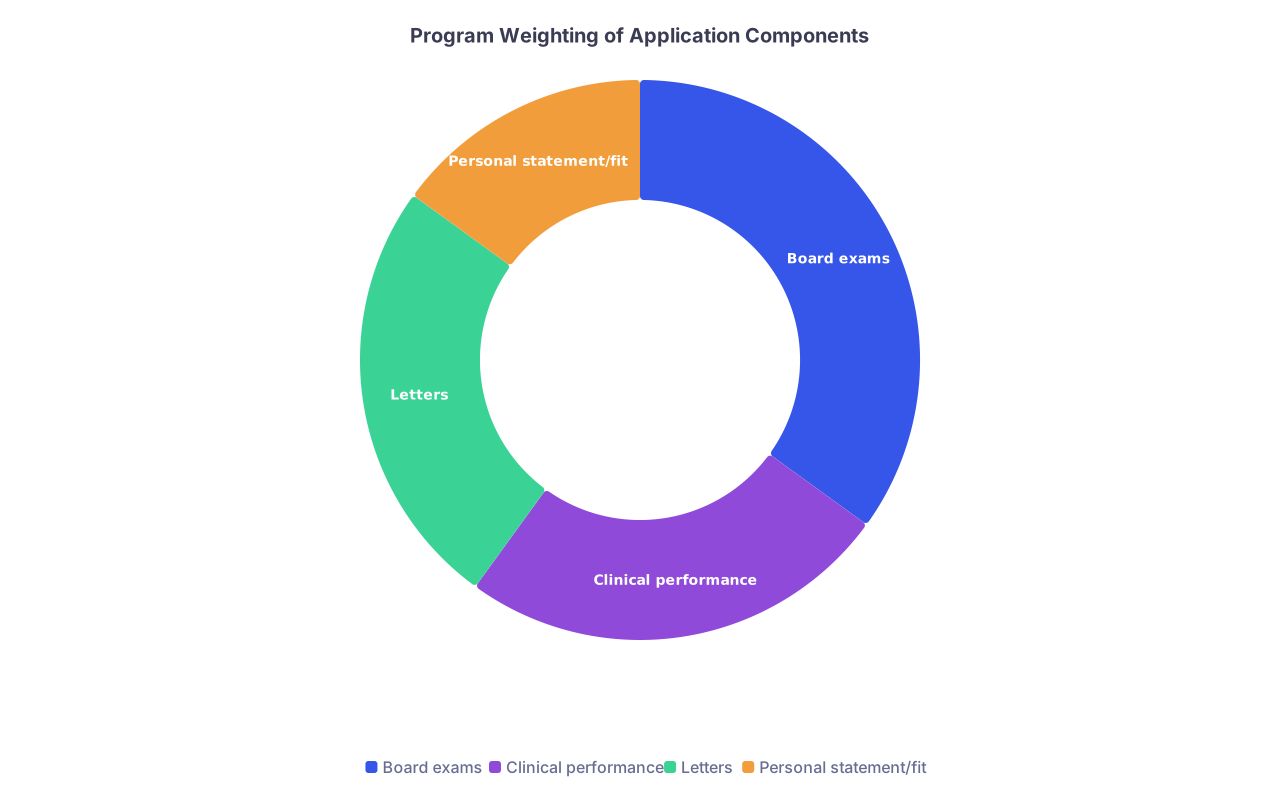
| Category | Value |
|---|---|
| Board exams | 35 |
| Clinical performance | 25 |
| Letters | 25 |
| Personal statement/fit | 15 |
Step/COMLEX problems don’t disappear because you didn’t match. They become the core question programs have about you.
Yet a lot of reapplicants do this:
- Never mention a failure or low score anywhere
- Don’t take Step 3 when it could actually help
- Avoid any academic environment where they might have to be tested again
- Assume “more time passed” equals “programs will care less”
That’s magical thinking.
If you had:
- A failed Step/COMLEX
- Borderline scores in a competitive specialty
- Multiple exam attempts
You cannot just apply again and cross your fingers.
What you can do instead:
- Consult with an experienced advisor (not just a friend) on whether Step 3 would help you or just add risk
- If appropriate, take Step 3 after real preparation and aim for a solid pass to show upward trend
- Use an MSPE or dean’s letter addendum or targeted PS sentence to directly (but briefly) acknowledge what changed: new study strategies, more time, proof of recent success
Programs don’t need a sob story. They need evidence that the problem they’re afraid of (you failing in their program) has been addressed.
Do not hide from this. Address it like an adult.
6. Staying in a Toxic “Advice Echo Chamber”

Post‑Match, group chats and forums become dangerous places.
You’ll see:
- “My cousin got in with lower scores than you, you’re fine, just apply to more places.”
- “XYZ Caribbean grad matched by applying to 300 programs in one specialty and 200 in another. Do that.”
- “Nobody reads personal statements, don’t waste time.”
- “My advisor said don’t mention the failure at all. Just ignore it.”
The problem: bad advice in medicine is confident and contagious.
Common echo‑chamber mistakes:
- Massive “shotgun” applications with no targeting—burning money and burning bridges
- Blind faith that volume can compensate for structural weaknesses (it rarely does)
- Dismissing the value of mentorship, structured research, or doing any uncomfortable self‑evaluation
If every voice you’re listening to is a fellow unmatched applicant or an anonymous internet handle, you’re at risk.
You need:
- At least one advisor who actually sits on or closely works with a residency selection committee
- Feedback from someone in your target specialty who’s willing to be blunt
- A reality check on competitiveness—both yours and the specialty’s
Don’t crowdsource your career strategy to panicked peers.
7. Misusing a Research Year as a “Holding Pattern”
Research years can be helpful. They can also be a giant waste of time if treated like a gap year with a nice title.
The mistakes I see:
- Picking any research position that offers a badge, regardless of mentor quality or project viability
- Doing low‑yield, slow‑moving projects with no realistic chance of publication or even a poster in 12 months
- Not aligning research with either:
- Your target specialty
- Your narrative (e.g., health disparities, QI, education)
You don’t need 10 publications in a year. You do need evidence of productivity.
You want things like:
- A submitted abstract for a national or regional meeting
- A poster presentation you can list
- Being able to say: “I handled data collection/analysis, weekly meetings with PI, and we’re submitting this to X journal.”
Without that, a research year reads like: “They hid for a year with no clinical work and nothing concrete to show for it.”
If you take a research position:
- Clarify expectations with your PI on what 12 months should realistically produce
- Make sure they know you’re reapplying and are willing to write a detailed letter
- Keep at least a small amount of clinical shadowing or involvement if possible
This isn’t sabbatical. It’s strategic rehabilitation.
8. Underestimating How Early You Need to Start Fixing Things
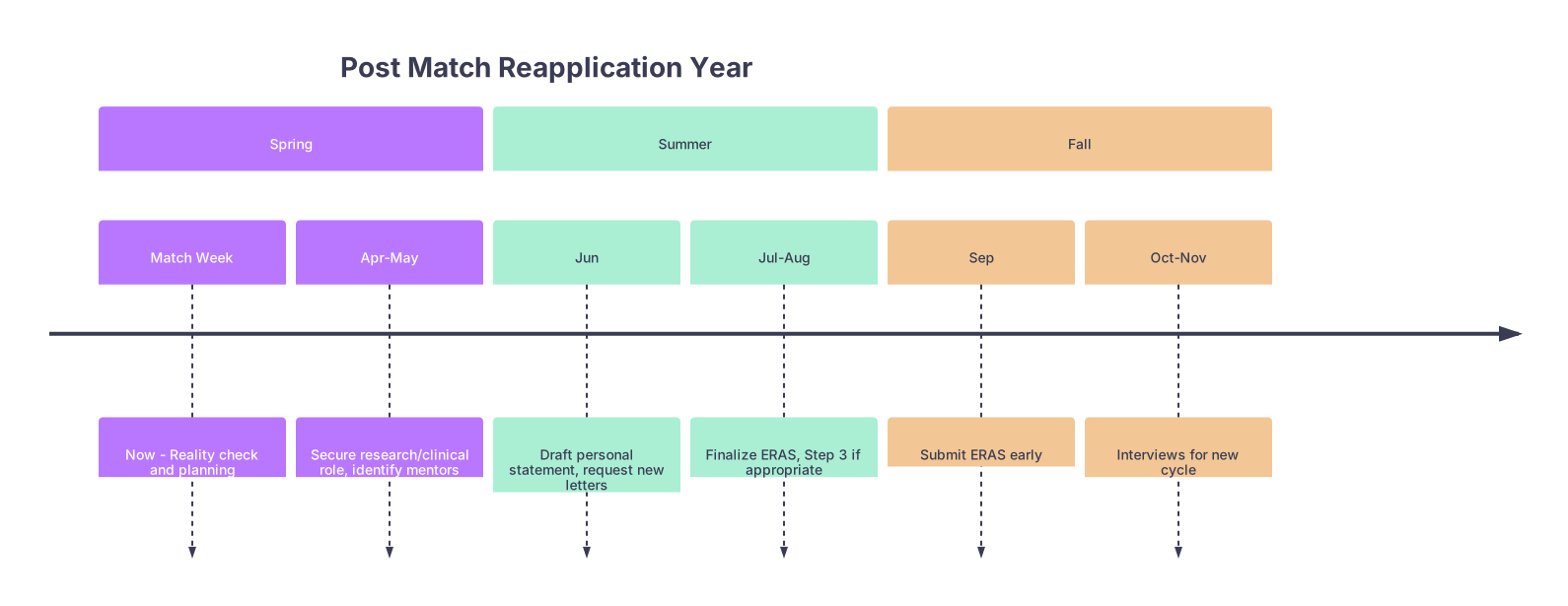
| Period | Event |
|---|---|
| Spring - Match Week | Now - Reality check and planning |
| Spring - Apr-May | Secure research/clinical role, identify mentors |
| Summer - Jun | Draft personal statement, request new letters |
| Summer - Jul-Aug | Finalize ERAS, Step 3 if appropriate |
| Fall - Sep | Submit ERAS early |
| Fall - Oct-Nov | Interviews for new cycle |
The other quiet sabotage move: waiting until late summer to “start working on reapplying.”
By the time ERAS opens, your application’s content should already exist. Post‑Match to June is not vacation; it’s rehab.
Mistakes here:
- Spending months “just processing” and doing nothing concrete
- Assuming you can backfill letters and meaningful new experiences in a few weeks
- Believing that writing a new personal statement in August equals a “stronger” application, even if nothing else has changed
Better use of time:
March–April (immediately post‑Match):
- Honest debrief of what went wrong:
- Scores?
- Letters?
- Specialty choice?
- Timing?
- Red flags?
- Decision: reapply same specialty vs pivot vs wait more than one cycle
- Identify and lock down:
- Research/gap year job
- Observerships or clinical roles
- Faculty willing to mentor and write letters
May–July:
- Actively build content that can be written about and documented:
- Clinic involvement, concrete responsibilities
- Defined projects you can finish before September
- Draft all written materials early and revise with feedback
If you wait until late summer to face the reality of your file, you’ve already lost ground.
9. Hiding Red Flags Instead of Managing Them
Some of you have real red flags:
- Failed rotation
- Unprofessionalism note
- Leave of absence
- Remediation term
- Program dismissal from a prelim year
Programs find this stuff. The MSPE, transcripts, and backchannel conversations are not your friends if you try to bury the past.
Panic move: “If I don’t mention it, maybe they won’t notice.”
What actually happens:
- They notice
- They assume the worst
- You lose control of the story
Controlled move:
- Brief, factual acknowledgment (in PS, supplemental ES, or during interviews)
- No dramatics, no defensiveness, no blaming
- Clear evidence that:
- It was time‑limited
- You did something about it
- It’s not a pattern
For example: “During my third year, I failed my initial internal medicine clerkship due to poor time management and exam performance. I remediated the rotation successfully, implemented structured study schedules, and subsequently honored two later clerkships.”
Programs don’t expect perfection. They expect accountability. Don’t run from your file; own it.
10. Letting Shame Drive the Entire Year

Here’s the quietest but most destructive pattern: you let the shame of not matching shape every decision you make.
So you:
- Avoid reaching out to faculty because you’re embarrassed
- Don’t ask for feedback from PDs because you fear what they’ll say
- Hide your situation from classmates, so you lose support
- Downplay your goals and start saying, “I’ll just take whatever I can get”
Shame makes people small. Residency applications reward people who can advocate for themselves.
The harsh truth: a lot of PDs actually respect unmatched applicants who come back with a clear plan, observable growth, and obvious resilience. They do not respect applicants who slink through the process doing the bare minimum and hoping nobody looks too closely.
You’re not the first unmatched applicant they’ve seen. You won’t be the last. Don’t turn this year into a private, silent collapse.
Get help early. Demand honest feedback. Treat this like rehab, not exile.
Key Protective Moves (If You Remember Nothing Else)
- Don’t accept random positions or change specialties out of panic. Ask if the move logically strengthens your story for your long‑term goal.
- Don’t disappear. Stay connected to clinical work, build new letters, and work with mentors who know how programs actually think.
- Don’t recycle your old application. Show clear, specific growth—new experiences, new outputs, and an honest but controlled narrative about what changed.
FAQ (Exactly 5 Questions)
1. Is it better to do a prelim year in any field than to have a gap year?
Not automatically. A prelim in the wrong field with poor support, no relevant letters, and constant exhaustion can damage your application more than a well‑structured “gap year” with research, clinical involvement, and strong mentorship. The question isn’t “gap vs prelim,” it’s “which option will leave me with stronger letters, clearer narrative, and better evidence of growth by next ERAS?”
2. Should I take Step 3 before reapplying if I have a low Step 1 or 2 score?
Only if you can realistically pass with a solid score on the first attempt. For many IMGs and applicants with prior failures, a clean Step 3 pass is reassuring to programs. But a Step 3 failure compounds your problems. If your test‑taking history is shaky, you need serious preparation and honest input from someone who understands your pattern before scheduling it.
3. How many programs should I apply to as a reapplicant?
“More” is not always better. A focused list of 80–120 well‑matched programs (depending on specialty and competitiveness) often beats 250+ random applications with no geographic, mission, or profile fit. Work with someone to categorize “high, medium, and low” reach programs based on your specific stats and background. Volume can’t fix fundamental mismatches.
4. Can I reapply to the same programs that rejected or didn’t interview me last year?
Yes, but only if your application is substantively stronger and better aligned. Some PDs won’t reconsider; others will if they see real change. If you have any personal connection (sub‑internship, research, faculty advocate), it’s more reasonable. Do not rely on “they’ll forget me.” Instead, aim for: “They’ll recognize that I clearly improved.”
5. Do I need a new personal statement if my story hasn’t really changed?
Yes. At minimum, it must reflect what you did during the interim and what you learned from not matching. Reusing the exact same statement signals either laziness or lack of insight. You don’t need to write a confessional essay, but you do need to show that this year shaped you and that you used it to become a stronger, more self‑aware applicant.