
The moment you decide to take a gap year after not matching, you’re not just choosing how to spend twelve months. You’re stepping into a political minefield that most advisors gloss over or flat‑out lie about.
Let me tell you what actually happens behind closed doors when your ERAS comes back across a program director’s screen with that one phrase they all notice: “Reapplicant. Took a year off after not matching.”
How Program Directors Really View a Gap Year
PDs won’t say this on webinars, but I’ve heard versions of it in ranking meetings over and over:
“Why didn’t they scramble into something?” “Did they actually fix the reason they didn’t match?” “Did they disappear for a year?”
Your gap year isn’t neutral. It’s a data point. And it’s political.
There are three broad ways PDs mentally file an unmatched applicant who took time off:
The “Salvaged Candidate” – took a research/clinical fellowship, heavy letters from known faculty, clear narrative of growth. These people absolutely do match again, often into reasonable programs.
The “Drifter” – vague “clinical experience” or online courses, no new US-based supervisors, no clear upgrade in letters, scores, or skills. These files get skimmed and dropped.
The “Toxic Mystery” – unexplained year, odd gaps, or whispers from faculty about professionalism issues. These are usually dead on arrival unless the specialty is truly desperate.
Everyone thinks they’ll be category #1. Most end up in #2 without realizing it.
The politics is this: PDs are risk managers. A gap year after not matching screams “risk” unless you aggressively build a counter‑narrative.
And that counter‑narrative has to be legible to faculty in 30–60 seconds of scanning your ERAS.
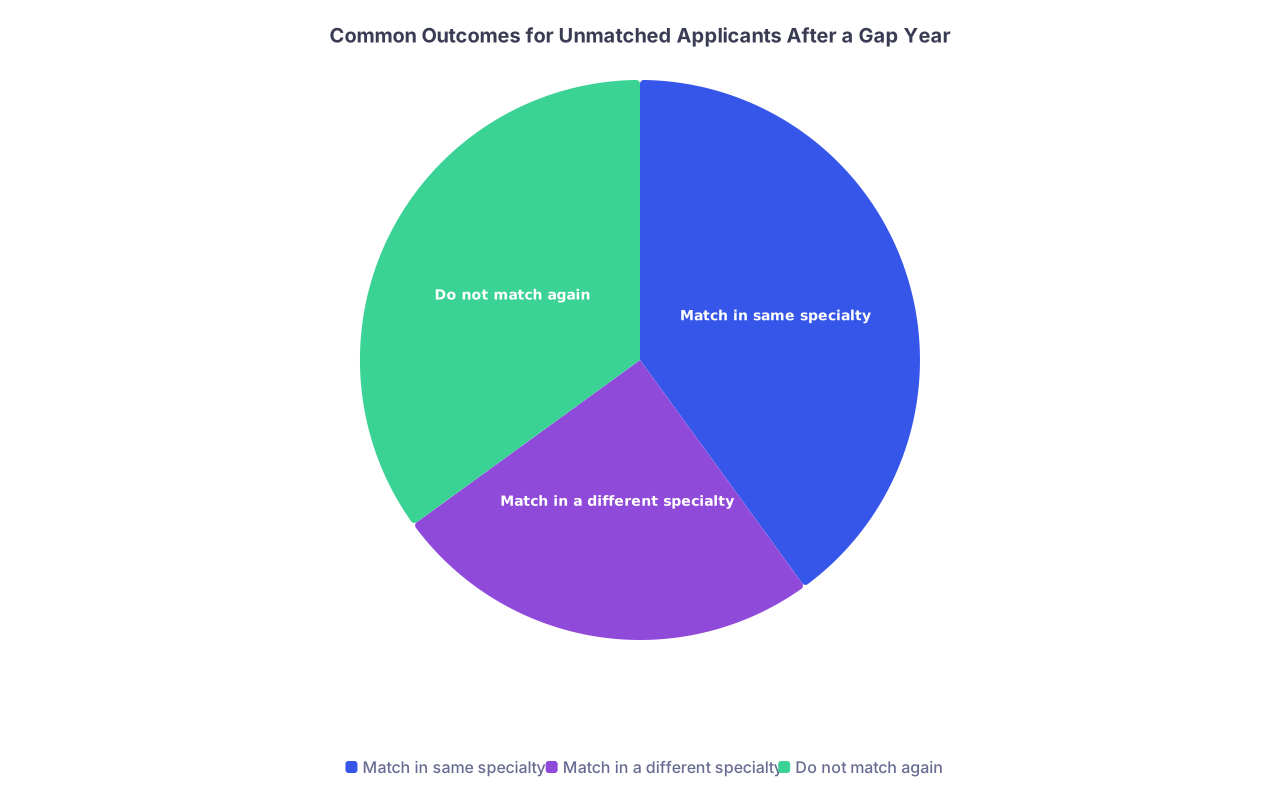
| Category | Value |
|---|---|
| Match in same specialty | 40 |
| Match in a different specialty | 25 |
| Do not match again | 35 |
Are those exact numbers universal? No. But the distribution is real in spirit: a significant chunk never make it back. The politics of how you use that year is often the deciding factor.
The Immediate Post‑Match Reality: What They Say vs What They Do
In the days right after Match week, there’s a predictable script.
Student affairs will tell you: “You have strong qualities; with a good plan, you’ll be competitive next cycle.”
Meanwhile, the same dean is emailing PDs:
“We have three unmatched students we’re trying to help. Any chance you might consider one for a prelim or research position?”
I’ve sat in those conversations. There are priorities, and not all of them are about you:
- The school wants to protect its match statistics.
- Departments want to help “their” favorites first.
- Faculty will go to bat for people who made their lives easier, not necessarily for the highest Step score.
So when you’re thinking “gap year,” understand: the first 2–3 weeks after Match are when the political chessboard is set. If you vanish emotionally, go silent, or act ashamed and disengaged, you lose leverage.
This is when PDs and chairs quietly decide:
“Is this someone we invest in for a research spot or prelim slot?” “Or do we let them drift and see if they figure it out on their own?”
If you’re going to take a gap year, you want it to be a structured year, ideally anchored to a department or PI who has a stake in your success.
If you wait six months to “figure it out,” you’re already politically behind.
The Three Dominant Narratives of a Gap Year
Let me break down how your gap year reads to decision‑makers, because the story in your head is almost never the story read in the committee room.
1. The Redemption Arc
This is the political gold standard. It looks like:
- You immediately attach yourself to a department in the specialty you’re reapplying to (or a realistic backup).
- You become indispensable: research coordinator, dedicated research fellow, full‑time sub‑I‑level worker in clinics, teaching, QI projects, call coverage in some form.
- You get new, strong letters from names PDs actually recognize.
The narrative PDs see:
“They took a hit, but they didn’t disappear. They embedded themselves in the system, proved they can function like a resident, produced something tangible, and multiple people I know are vouching for them.”
I’ve literally heard: “They basically did an unofficial PGY‑0 in our department. I’m comfortable ranking them mid‑list.”
That’s the politics working in your favor.
2. The “Life Happens” Story
You’ll see applicants try to spin this: family problems, finances, health, needing to “step back and reassess.”
PDs don’t lack empathy. But they’re juggling 800 files. So the internal monologue sounds more like:
“Okay, life happened. Did they still move the ball forward? Or did they just pause?”
If the answer is “they paused,” your story gets filed under “still a risk.” Because residency is precisely when life doesn’t stop. Ill parents. New babies. Spouses moving. They’re asking: “Will this happen again under my watch?”
If you truly had a major life event, you need:
- At least some clinical or academic continuity.
- A clear, concise, non‑dramatic way to frame it.
- Evidence you’re fully back in the game now.
Otherwise, the politics will shift against you, even if people are sympathetic on a human level.
3. The Invisible Year
This is the worst one. You did “stuff” but nothing politically legible:
- Random urgent care shifts with no academic letters.
- Shadowing that doesn’t turn into real advocacy.
- A couple of online courses and some self‑study.
When your ERAS reads like that, the committee questions are brutal:
“What did they actually do?” “Why should we believe this year changed anything?” “Did they just hope the match algorithm got nicer?”
The harsh truth: an invisible year is sometimes worse than going straight into a less‑competitive specialty immediately.
Research Year vs Prelim Year vs “Anything I Can Get”
This is where applicants get played by the system without seeing it.
You’ll hear three main recommendations:
- “Do a research year in your specialty.”
- “Grab any prelim spot you can.”
- “Consider another specialty that’s ‘easier’ to match into.”
Behind each option is a politics of who benefits and how.
| Option | Political Upside | Major Risk |
|---|---|---|
| Research Year | Strong letters, visibility in specialty | No guarantee of spot |
| Prelim Year | Shows you can function as intern | Can trap you if no PGY-2 |
| New Specialty | Higher match odds in some fields | Forever closing old door |
The Research Year
This is the classic advice. Sometimes great, sometimes a trap.
Well‑structured research year:
- Fully funded or at least clearly defined.
- Direct supervision by faculty who regularly place residents.
- Integrated into the department, not off in some lab they never visit.
I watched several unmatched psych applicants embed with a big‑name program as research fellows. They were on service, at journal club, presenting posters with attendings whose surnames carried weight. Most of them matched — sometimes at that home institution, sometimes somewhere that recognized the faculty names.
But I also watched a would‑be surgeon disappear into a basic science lab with a PI who hadn’t placed a resident in years. One lukewarm letter, a couple of middle-author abstracts, no new clinical contact. They re‑applied and got the same outcome: radio silence.
The unspoken politics: departments love cheap, smart labor for research. Not all of them feel obligated to convert that into a residency position. If you don’t clarify expectations early — “Is there historically a pathway from this role to a categorical spot?” — you may just be filling their CV, not yours.
The Prelim Year
This one is heavily political and often misrepresented.
Faculty will say: “Do a prelim year, show you can function, then you’ll be competitive.”
Sometimes true. Especially internal medicine prelims for people shooting for neuro, anesthesia, rad onc, etc. I’ve seen prelim‑IM interns impress so much their PD calls other PDs: “Take this one. They’re excellent.”
But here’s the part people gloss over:
- Prelim years can eat you alive. You’re now working 60–80 hours, trying to polish your ERAS at 2 a.m. after cross‑covering a dozen patients.
- PDs in your prelim program may or may not feel invested in solving your long‑term problem. Their priority is staffing their own service.
And the quiet calculation other programs make:
“Why didn’t their prelim program keep them?” “If they were that good, wouldn’t they have snagged a categorical conversion?”
So if you do a prelim:
- You need explicit mentorship and advocacy lined up before you sign that contract.
- You must perform at a level that makes attendings willing to pick up the phone for you.
- You still need a plan for new letters, research or projects if your field expects them.
Otherwise, you’ve just traded a weak application plus free time for a weak application plus exhaustion.
“Switch to an Easier Specialty”
This advice is often more about institutional convenience than your best interests.
Unmatched derm? “Maybe do family.” Unmatched ortho? “You’d be a great internist.” Unmatched EM? “Psych is less competitive this year.”
Sometimes it’s correct advice. There are people who are a much better fit, skills‑wise, for IM, psych, FM, peds than for hyper‑competitive surgical fields. And they end up happier.
But the politics you don’t see:
- Departments with unfilled spots (or chronically short-staffed residency programs) like “converts.” They see a motivated, desperate worker they can plug in.
- Your home institution wants unmatched numbers solved, period. Getting you into some residency helps their stats.
Once you make that jump and spend a year or two in FM or IM, going back to ortho or derm is effectively over. Not because it’s theoretically impossible. Because politically, PDs will view you as having “settled,” and the training track divergence is too big.
If you’re going to pivot specialties, do it with open eyes. It’s not just a tactical move for next year. It’s usually a one‑way door.
Who Actually Gets Back In After a Gap Year?
There’s a pattern. You see it when you sit through enough rank meetings.
The reapplicants who climb out of the unmatched hole usually have three things in common:
A clear, believable “why” for the initial failure
Low Step 2? Late specialty decision? Insufficient home support? Fine. PDs can accept a mistake once. What they hate is a mystery. You need a clean, non‑defensive explanation.Concrete, visible work during the gap year tied to their specialty
Not vague “I did research.” Think: “Two posters at [recognized conference], one manuscript submitted, weekly work in Dr. X’s clinic, strong letter from Dr. Y who trained with Z program.”A strong third‑party advocate in the specialty
This is where the politics is absolutely naked. A PD will skim you. But if they get an email from a name they respect saying, “I’d take this person in my own program if I had a spot,” you jump categories. You move from “unmatched risk” to “known quantity vouchsafed by someone in the club.”
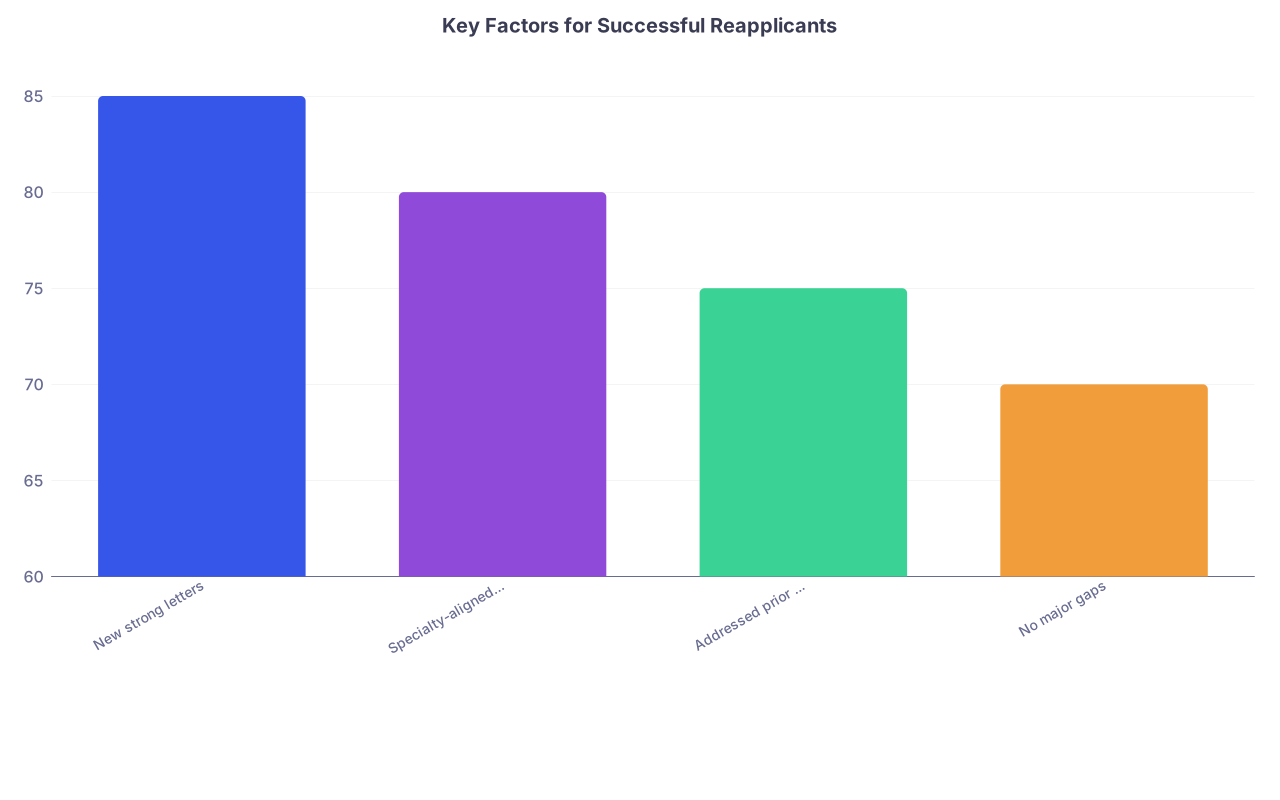
| Category | Value |
|---|---|
| New strong letters | 85 |
| Specialty-aligned work | 80 |
| Addressed prior weaknesses | 75 |
| No major gaps | 70 |
The numbers here are illustrative, but the hierarchy is accurate. Letters and visible, specialty‑linked work are the currency. Vague “growth” is cheap.
The Quiet Biases You’re Up Against
Here’s what almost no one tells you, because it’s politically unpleasant.
There are built‑in biases against unmatched reapplicants, and you cannot wish them away:
- Perception of damaged goods: Some PDs will say this bluntly in committee. “If nobody took them last year, why should we?”
- Fear of professionalism issues: A not‑match makes people wonder. Attendance? Teamwork? Sub‑I feedback that never made it into writing? You have to overwhelm this doubt with glowing letters.
- Worry about resilience: PDs need someone who won’t collapse mid‑intern year. If you present as bitter, scattered, or unable to explain your year calmly, they’ll back away.
That’s why the way you talk about the gap year matters almost as much as what you actually did.
You want to project:
- Ownership: “I misjudged X / was late with Y / underestimated Z.”
- Specific repair: “Since then, I’ve done A, B, C to address those gaps.”
- Stability: “I’m ready now, and here’s the concrete evidence.”
Not:
- Victimhood: “The match is unfair; my school didn’t help me.”
- Vagueness: “I took time to reflect and grow.”
- Overshare: 10‑minute emotional monologue about how hard the year was.
PDs can respect suffering. They just don’t want it to feel like a preview of drama on their wards.
Building a Politically Smart Gap Year Plan
A gap year that works isn’t about being busy. It’s about being visible and sponsored.
Here’s the behind‑the‑scenes playbook that the successful ones tend to follow.
1. Lock yourself to a department, not a random job
You want your name coming up in that department’s hallway conversations.
That means:
- Being physically present at conferences, grand rounds, clinics.
- Attending resident didactics when allowed.
- Taking on the projects the department actually cares about — often unglamorous QI and data cleanup.
You’re aiming for this kind of phrase in a letter: “We’ve essentially treated them like a junior resident this year.”
2. Secure at least one heavy‑hitting letter early
Do not wait until December.
By late summer/fall, you want:
- One letter from a recognized faculty member in your desired specialty.
- Ideally someone who interacts with PDs or sits on selection committees.
You may have to be explicit: “If by the end of the summer I’ve met your expectations, would you be comfortable writing a strong letter on my behalf?”
It’s awkward. But this is politics. Clarity beats passivity.
3. Produce something you can point to
Abstracts. Posters. A small first‑author paper if you can get it. A substantive QI project.
Not because publications magically make you match. Because they signal:
- You showed up consistently enough to finish work.
- Faculty trusted you with responsibility.
- You understand how academic medicine functions.
And in a committee room, it gives someone something positive to say besides “Well, they seem nice.”
4. Fix the concrete weaknesses
If you failed Step 2, you pass it with a comfortable margin.
If your MSPE hints at professionalism issues, you create a year of spotless behavior with supervisors willing to say: “I would never have guessed they struggled before. They were exemplary for us.”
If your biggest issue was poor interview presence, you don’t wait until November to practice. You start role‑playing with people who will actually be blunt.
This is where a lot of people delude themselves. “I’ll just get more research and it’ll all be fine.” No. PDs will ask: “Did they actually fix the primary problem?”
How to Talk About the Gap Year Without Shooting Yourself in the Foot
This will matter on ERAS, in personal statements, and in interviews.
You need a tight, politically savvy script. Something like:
“I applied last cycle and did not match. Looking back, my application had two major weaknesses: I decided on [specialty] late and had limited home‑institution exposure, and my Step 2 score was released after many programs had already screened. Over the past year, I’ve worked full‑time in the [X] department as a research and clinical fellow. I’ve had the opportunity to function at an intern‑equivalent level in clinic, contribute to three projects (including [brief example]), and work closely with residents and attendings here. This year has confirmed my commitment to [specialty] and given me skills and perspective I did not have when I first applied.”
Short. Direct. Owning the problem and showing specific repair.
What you do not do:
- Blame the match, the school, or “the system.”
- Drown them in your emotional processing.
- Turn it into a generic “personal growth” story without concrete outcomes.
In PD heads, the real translation they’re seeking is: “Are you now a safer bet than you were before?”
Psychological Warfare: The Part No One Prepares You For
There’s one more political thread: your own mind.
A gap year after not matching is a test of identity. You go from being “future doctor” to “technically not in training” overnight. Friends post white coat photos and intern war stories while you’re in a basement clinic or data‑entry hell.
The insecurity leaks. Into how you email. How you interview. How you walk into a room.
The candidates who come out ahead are the ones who manage to shift mindset:
From: “I’m behind, I’m a failure, I’m begging to be let in.”
To: “I’m already functioning at a resident level here, I’ve proven I can contribute, and I’m looking for a program where I can plug in and keep doing that.”
That subtle internal shift is political, because PDs can smell desperation. They prefer hungry over hopeless.
Years from now, you probably won’t remember the exact wording of the emails you sent begging for a research spot, or the sick feeling of watching another Match Day from the outside. What you will remember is whether, when the system quietly signaled you were expendable, you accepted that role — or methodically, politically, rebuilt yourself into someone they couldn’t easily ignore.