
Last March, I watched an unmatched applicant sit in a quiet conference room, clutching the same personal statement he’d used three times. He kept saying, “But everyone told me it was good.” I’d seen the notes from program directors who read it. “Generic. Defensive tone. No insight into why he keeps failing.” That’s the part nobody had told him.
Let me walk you through what really happens when a PD opens a rewritten personal statement from someone who went unmatched. What they’re actually looking for. And what gets you quietly filtered into the “no chance” pile before you even hit the interview list.
How PDs Really Read a “Reapplicant” Personal Statement
There’s a shift the second we see your history.
If your ERAS shows SOAP, prelim-only, research year, or “independent applicant,” the lens changes. We’re not reading your statement to see if you’re interesting. We’re reading it to answer one hard question:
“Does this explain why they failed last time and convince me it will not happen again here?”
That’s it.
We are not impressed by elaborate origin stories the second time around. We are hunting for:
- Evidence you understand what went wrong
- Proof you fixed it
- A believable, specific reason you’re applying here and now
And under all of that: tone. Are you self-aware and mature, or are you blaming “the system,” “COVID years,” “geography,” “visa issues,” or “luck”?
Most reapplicants blow it in the first two paragraphs.
They rewrite the same pre-med essay about the patient with heart failure, swap a few adjectives, and think “updated” means “changed a few words.” PDs notice. We read hundreds in a season. If your statement reads like it could’ve been written by any random MS4 with no scars, you’ve just told us you didn’t learn enough from not matching.
You want to know what PDs actually scan for in your rewritten statement? Keep reading.
The Non-Negotiable: Owning Why You Didn’t Match
You can’t hide it. We see your past attempts. We see SOAP. We see the gap year. We see the prelim. We see the NRMP code history.
If your personal statement pretends last cycle didn’t happen, here’s how that lands in the PD room:
“Lack of insight. No reflection. Pass.”
The reapplicant statement must answer, without drama and without self-pity:
What happened, and what changed?
Not with sob stories. With clinical clarity.
Let me give you examples of how PDs mentally categorize your “explanation.”

| Type of Explanation | How PDs Actually Interpret It |
|---|---|
| Blames the system or luck | Poor insight, high risk, likely to blame program too |
| Vague (“It was a challenging year”) | Hiding something, no clear growth |
| Honest + specific + accountable | Mature, possibly redeemable |
| Data-driven (scores, timing, strategy) with change plan | Organized, teachable, worth a serious look |
| Emotional, narrative-heavy, no concrete fixes | Still in denial, not ready |
The mistake I see constantly: reapplicants either overshare or under-explain.
Overshare:
They narrate the entire trauma of Match Week, SOAP, crying with family, burned out, “I felt broken.” PDs are not your therapist. We’re looking for outcome and adjustment, not a memoir.
Under-explain:
They say nothing. Or one cryptic sentence: “Unfortunately, I did not match last cycle, but I used that as an opportunity for growth.” Growth in what? Doing what? With what outcome?
The sweet spot sounds like this:
- One to two sentences acknowledging not matching
- One to three sentences naming concrete contributing factors
- The rest of the paragraph and beyond focused on what you actually did about it
For example (and you should adapt the structure, not the wording):
“Last cycle, I applied broadly but submitted my ERAS at the deadline, with only one away rotation and a Step 2 score that came in late in the season. I received a limited number of interviews and ultimately did not match. Over the past year, I have focused on improving my clinical readiness and application strength through… [specific actions].”
That tone—calm, factual, non-defensive—is exactly what PDs want to see.
The Checklist in Every PD’s Head: Did You Actually Change, Or Just Reapply?
When a PD, APD, or faculty reviewer sees a reapplicant statement, they’re silently running a checklist.
There’s no slide deck about this. It’s just how people who’ve done this long enough think.
- Did this person identify clear reasons for not matching?
- Did they have a realistic plan to address those issues?
- Did they execute that plan in a way that produced evidence, not promises?
Your rewritten statement should make answering “yes” to all three unavoidable.
That means the heart of the statement is not your “why medicine” story. It is:
“What I did in the time since I did not match, and what I learned from it.”
Here’s where most people misstep. They list activities like a CV.
“I spent the year in research, completed three manuscripts, and volunteered teaching medical students.”
Fine. But that doesn’t answer what PDs care about:
Can this person show up on July 1 and not be a problem?
So you have to translate your year into residency-relevant growth.
- If you did a research year: talk about owning projects, showing up reliably, communicating with attendings, presenting at conferences—focus on professional behavior and accountability, not just “I have three abstracts.”
- If you did a prelim or transitional year: demonstrate that the people who actually worked with you trusted you, gave you responsibility, and would hire you again.
- If you were out of training: show clinical involvement (observerships, locums in countries where you’re licensed, structured CME, skills maintenance) and maturity, not aimless drifting.
A PD will absolutely read between the lines. If your statement is heavy on “I took time to reflect, be with family, and rediscover my passion,” and light on “I showed up somewhere every day and worked,” you look like a risk.
Tone: The Quiet Deal-Breaker You Don’t Realize They’re Hearing
You can have a decent story, solid gap-year, and still get quietly written off because your tone screams: “This will be a difficult resident.”
Nobody will tell you this in feedback, but they say it in the ranking meetings.
The key tonal markers PDs look for in a reapplicant statement:
1. Blame vs. Ownership
If your underlying theme is “The system is unfair,” you lose. It might be unfair. PDs know that. But they still do not want to bring in someone who is already bitter.
Red flag phrasing I’ve seen:
- “Despite my strong application, I was unable to secure a position due to the competitive nature of the match.”
- “My visa status limited opportunities, and programs were unwilling to sponsor.”
- “The virtual interview format made it difficult for me to show my true self.”
You can reference barriers. But if the narrative centers on them, you look powerless.
Safer translation:
- “I received fewer interviews than I’d hoped. Reviewing my application with mentors, I realized I had limited home institution exposure and no away rotations, and my ERAS was submitted late. This cycle, I have… [actions].”
Short, adult, and grounded.
2. Desperation vs. Determination
We can smell desperation in a sentence.
“I am willing to work harder than anyone.”
“I just need one chance.”
“I will not let you down if you believe in me.”
Those read as red flags. The good residents aren’t the ones making promises; they’re the ones quietly showing patterns of reliability.
Determined tone instead sounds like:
“Over this year, I’ve sought out opportunities to take primary responsibility for patient care, improve my efficiency, and receive direct feedback on my clinical reasoning. As a result, my supervisors describe me as dependable, prepared, and calm under pressure.”
You’re not begging. You’re reporting.
3. Overcompensation vs. Realism
PDs hate grandiosity. They see right through it.
“I know that my unmatched status will ultimately make me a stronger, more empathetic physician than if I had matched the first time.”
No. That’s a Hallmark card, not insight.
Better:
“Not matching was painful and humiliating. It forced me to confront specific weaknesses in my application and performance. Facing those directly—seeking feedback, adjusting my communication style, and taking on more responsibility—has made me more self-aware and coachable.”
That’s the tone of someone who might actually improve when corrected.
What Absolutely Must Be Different In Your Rewritten Statement
Faculty readers remember patterns. Maybe not every line of your old statement, but the vibe, structure, and clichés stick.
If you recycle the same skeleton—same patient vignette, same “aha” moment, same exact ending paragraph about “the privilege of walking with patients in their most vulnerable moments”—many PDs will not say anything. They’ll just downgrade you mentally as someone who didn’t take this seriously enough.
You need to signal, clearly:
“This is not a lightly edited version of last year’s essay. It is a reflection of a different candidate.”
Here’s what actually needs to change.
The Focus of the Narrative
First-time applicants: “Why this specialty, why medicine, who am I?”
Reapplicants: “How I’ve grown into a residency-ready physician and why I’m a safer bet now.”
If your old statement opens with childhood, undergrad experiences, or a grandparent’s illness—throw it out. Start with where you are now.
For example:
“Over the past year working as a preliminary internal medicine resident at [Hospital], I’ve learned what it means to show up consistently for patients and colleagues in an imperfect, busy system. The experience has clarified not only my commitment to internal medicine, but also the kind of resident I want to be—and the gaps I needed to close after not matching categorical last cycle.”
PDs read that and think: “Okay. Current, grounded, not recycling pre-med tropes.”
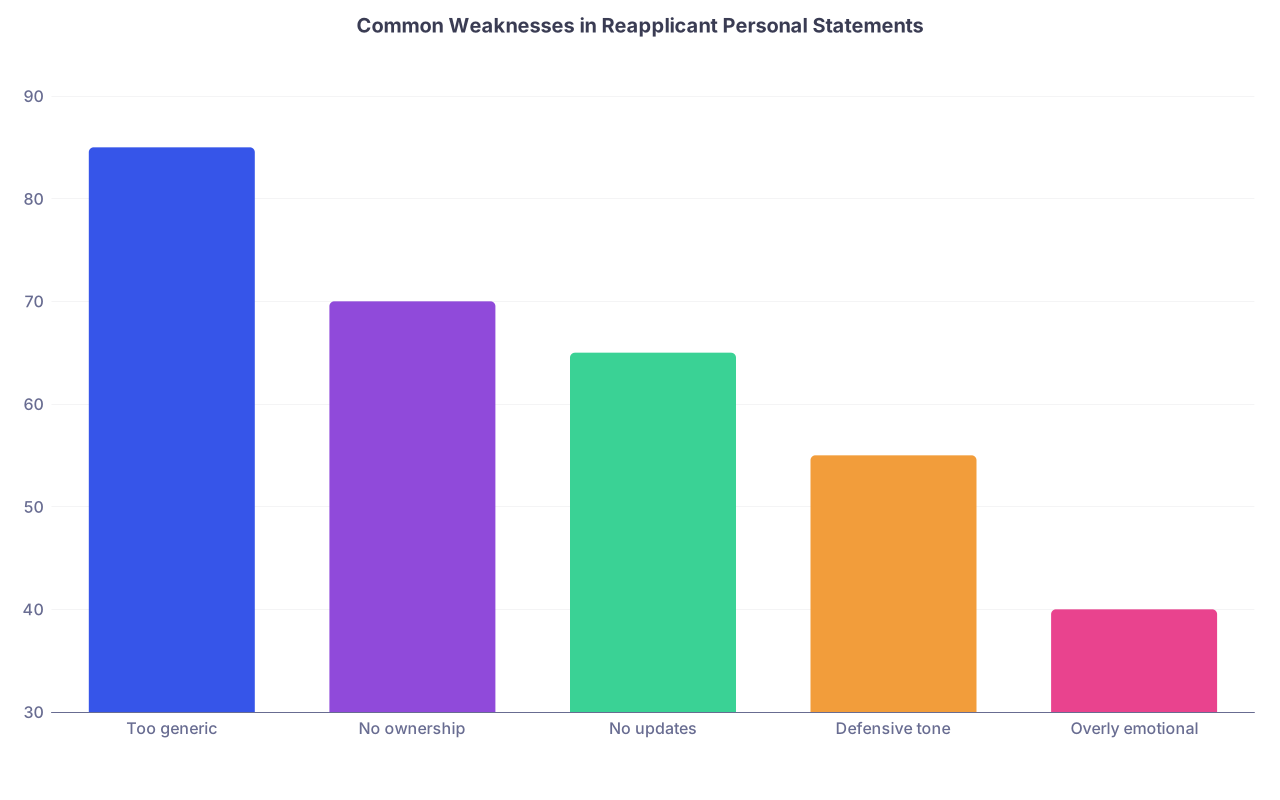
| Category | Value |
|---|---|
| Too generic | 85 |
| No ownership | 70 |
| No updates | 65 |
| Defensive tone | 55 |
| Overly emotional | 40 |
The Time Gap Section
If you had a gap or a new role, the old PS likely barely mentioned it (or it didn’t exist yet). Your new one should make that period the spine of the essay.
You don’t need to catalog every duty. But you must:
- Name the role and setting
- Describe what changed in you because of it
- Connect those changes directly to residency skills
Weak:
“I worked on several research projects and shadowed in clinic.”
Strong:
“Working as a research fellow in the cardiology department at [Institution], I initially struggled with time management and overcommitting. With my mentor’s feedback, I learned to prioritize tasks, communicate clearly when timelines were unrealistic, and follow through on data collection independently. By the end of the year, I was leading our weekly project meetings and had become the person others turned to for troubleshooting.”
PDs read that and think: “Okay, this person has been observed, corrected, and improved. That’s what we want.”
Specialty-Specific Red Flags PDs Notice in Rewritten Statements
I’ve sat in rooms where PDs in different fields read reapplicant statements out loud and dissect them. Each specialty has its own allergy triggers.
Internal Medicine / Family Med / Peds
They’re looking for humility and teachability. If your rewritten PS still centers on “being the leader of the team” rather than learning, that’s a miss.
They want evidence that you can:
- Handle a normal inpatient load
- Communicate with nursing and consultants without drama
- Show up on time and stay late when needed
So your examples should be about actual clinical work you’ve done this last year, not abstract “compassion” stories.
Surgery / Surgical Subspecialties
Reapplicant to surgery with the same old “hands-on” story? Immediate eye roll.
They’re asking, “Is this person actually gritty enough, and did they use the last year to prove it?”
So a rewritten surgical PS should show:
- Operating room exposure with specific responsibilities
- Consistency in early mornings, call, follow-up
- That someone in surgery world is willing to vouch for you now
If your gap year was pure bench research, you’d better connect that to surgical culture: responsibility, precision, being accountable to a team.
Competitive Fields (Derm, Ortho, ENT, etc.)
I’m going to be blunt. If you’re a reapplicant in these fields, PDs are reading your PS asking: “Why are they still doing this?”
If your board scores and CV are far below their typical matched cohort, a generic passion essay reads as delusion.
They’re looking for:
- Serious academic upgrades (publications, higher Step 2, strong letters)
- A realistic parallel plan (prelim medicine/surgery, IM with derm interest, etc.)
- Emotional stability—not a person whose entire identity is “I must be a dermatologist or I’ve failed as a human.”
If you’re truly staying in the same hyper-competitive field, your rewritten statement must be anchored in real accomplishments and clear-eyed about the odds, without self-pity.
Program Fit: You Cannot Afford to Sound Generic Anymore
First-time applicants get away with generic “I value teaching, diversity, and serving the underserved.” PDs sigh and move on.
Reapplicants don’t have that luxury.
By the time you’re rewriting a PS after going unmatched, you should know what kind of program might genuinely take you. Community vs academic. Underserved vs subspecialty-heavy. Heavy service vs cushy lifestyle.
Your statement should sound like it was written by someone who knows where they belong.
That does not mean dropping a program name in a generic essay. Everyone does that. It fools no one.
It means the themes of your essay align with the reality of the programs you’re targeting.
Community-heavy, service-oriented IM program PDs like seeing:
- You’re comfortable managing volume
- You actually like continuity and primary care
- You’re not using them as a stepping stone while dreaming only of fellowship prestige
Big academic places:
They want to hear about your comfort in complex systems, multidisciplinary teams, and maybe some scholarly habit—but again, from this past year, not from college.
If your rewritten statement could be sent to psychiatry, EM, and IM unchanged except for the specialty name, you’ve already lost.
The Silent Filter: Coherence With the Rest of Your Application
This is the part that feels unfair, but it’s how real PDs operate.
Your rewritten personal statement is not read in isolation. When someone is on the fence, they cross-check:
- Letters from your gap year or prelim year
- Dean’s letter or MSPE comments from med school
- Any professionalism remarks or leaves
- Your CV chronology
If you claim in the statement that your prelim PD praised your work ethic and growth, and then that PD’s letter is lukewarm or absent, we notice.
If you say you spent a year in intensive research and your CV shows one poster from a local meeting, we notice.
If you talk about fully confronting your test-taking weaknesses, and your Step 3 is still a marginal pass or failure with no retake, we notice.
The personal statement is your narrative control. It has to make the data make sense.
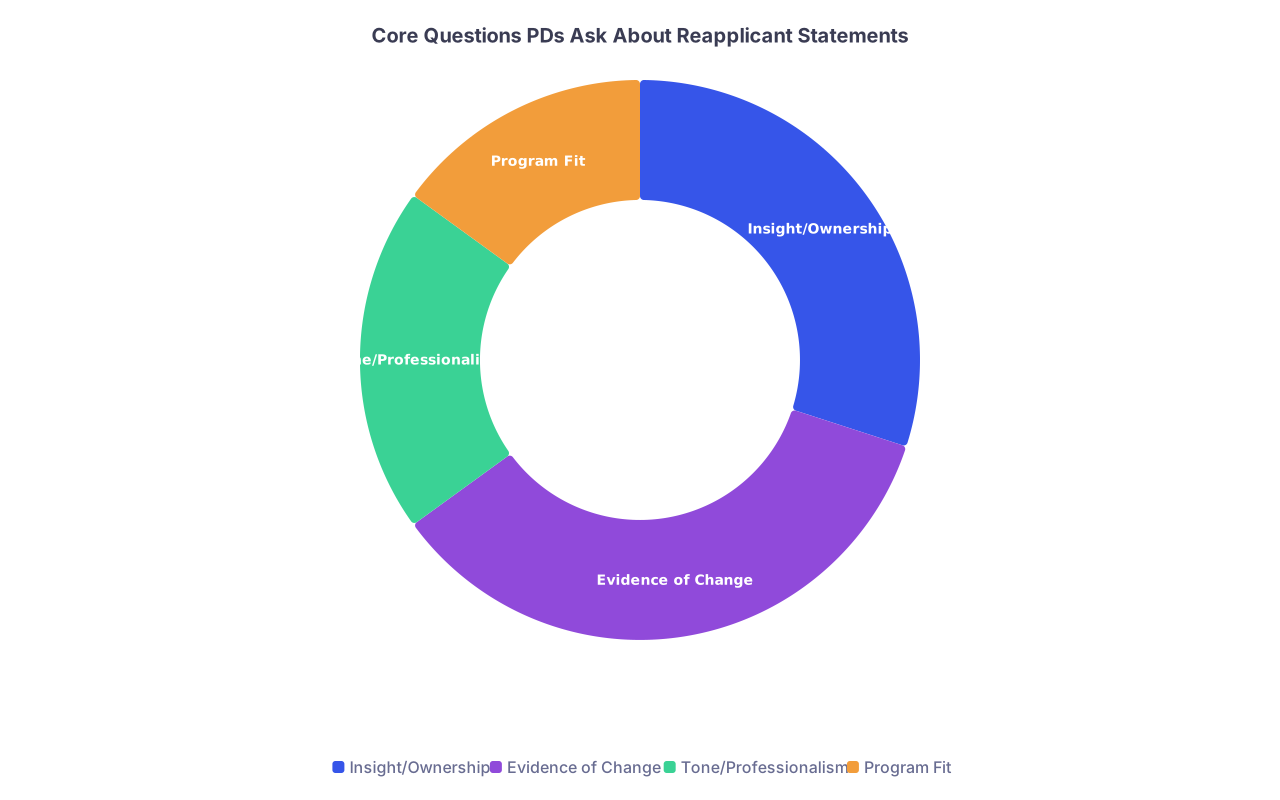
| Category | Value |
|---|---|
| Insight/Ownership | 30 |
| Evidence of Change | 35 |
| Tone/Professionalism | 20 |
| Program Fit | 15 |
One of the smartest moves you can make in this rewritten version is to preempt the obvious concern.
- Low Step 1 and 2 but decent clinicals? Talk briefly about how you addressed test-taking in your gap year and how that’s reflected in Step 3 or recent in-service scores if you have them.
- Professionalism flag in MSPE? Don’t re-litigate it, but you can mention how you learned to accept feedback or adjust communication and point to current supervisors who’d describe you differently now.
If you stay silent on the elephant in the room, PDs will fill in the gap with the worst-case interpretation.
How To Structure the Rewritten Statement So PDs Actually Finish It
You’re not trying to write literature. You’re trying to disarm suspicion.
A clean structure that works very well for reapplicants:
- Opening: Grounded in your current role, not your origin story
- Brief acknowledgment: One or two sentences on not matching / previous cycle
- What contributed: Specific, concise, accountable
- What you did about it: The bulk. Concrete actions, growth, responsibilities
- Who you are now as a residency candidate: Tie qualities to observed behavior, not adjectives
- Why this specialty still, and what kind of program you fit: Realistic and specific
- Closing: Calm, forward-looking, not begging
Skip the dramatic arc. PDs don’t need to be emotionally moved. They need to be reassured.
Final Thoughts: What PDs Want to See From You Now
You’re not the bright-eyed MS4 anymore. You’re someone who’s been punched in the face by the Match.
Program directors know that. Many of them have seen good people not match. Some were that person themselves, years back.
What they’re looking for in your rewritten personal statement is simple:
- Clear-eyed ownership of why you didn’t match, stated briefly and calmly
- Concrete, believable evidence that you used the time since then to become the kind of person they can trust at 3 a.m. on call
- A tone that says, “I’ve grown up,” not “The world owes me a spot”
If your statement does those three things—and the rest of your application isn’t catastrophic—you give yourself a real shot at someone in that PD meeting saying, “You know what? Let’s interview them. They might be worth the risk.”