
You opened your “previous application” in ERAS thinking you’d just tweak your personal statement, add a new experience or two, and be done.
Then you hit the Letters of Recommendation section.
Same old names. Same old letters. Same old “strong candidate” language that clearly was not strong enough to get you matched last cycle.
And you’re about to click “reuse” on all of them.
Do not do that blindly.
Reapplicants sabotage themselves with letters of recommendation more than they realize. Not because they have terrible letters. Because they repeat the exact same mistakes that hurt them the first time, assuming “the letters weren’t the problem.”
Sometimes they are a big part of the problem.
Let’s go through the errors I see over and over—so you do not have to repeat them.
1. Reusing All the Same Letters Without Asking the Only Question That Matters
The laziest (and most common) reapplicant move:
- Reuse 3–4 letters from last cycle
- Maybe add one new “gap year” letter
- Call it a day
That’s how people end up with the same result.
The real question you should be asking is:
“If my letters stayed exactly the same, do I honestly expect a different outcome?”
A lot of reapplicants never interrogate that.
How this mistake shows up
- Using the exact same set of letters without any changes
- Keeping a letter from an attending who barely knew you
- Reusing a letter from a weak rotation performance
- Keeping a letter from a specialty you’re no longer applying to (yes, people do this)
Programs don’t see your “previous cycle,” but they do see the quality and relevance of your current letters. If the core of your application hasn’t changed and your LORs still scream “generic, borderline, unremarkable,” you’ve done nothing to justify a different outcome.
How to avoid it
Before you reuse any letter, ask:
Did this writer:
- Supervise me directly?
- See me enough to comment on my work ethic, reliability, and growth?
- Ever say anything like “I’d be happy to write you a strong letter” (or did they sound lukewarm)?
Does the letter:
- Come from the specialty I’m applying to?
- Come from someone who actually knows me clinically?
- Still reflect my current level (e.g., not outdated by 2–3 years with no new context)?
If you can’t answer “yes” to most of that, that letter is not helping. It’s padding.
Do not keep all your letters out of convenience. Keep only the ones you’re confident are strong, specific, and relevant.
2. Clinging to “Big Names” Who Don’t Actually Know You
Classic trap: the “famous” or “big-shot” letter writer.
You think: “She’s division chief at [insert big-name program]. Her name alone will help.”
No. Her vague, boilerplate, two-paragraph letter where she can barely spell your name will actively hurt.
Red flags that your “big name” letter is weak
- The attending barely interacted with you outside a couple of conferences or a single case
- They supervised you for 1–2 days, not a full rotation
- Your only real interaction was research, and they didn’t see you clinically
- They needed you to send them your CV, personal statement, and “reminder of who you are” because they clearly didn’t remember much
Here’s what program directors actually care about:
- Specific clinical behaviors and stories
- Evidence of reliability, teachability, and consistency
- How you handle stress, feedback, and patient care
A letter that says, “I briefly worked with [Applicant] and found them professional and pleasant,” might as well say, “I do not really know this person.”
How to avoid this
If you’re a reapplicant, you especially cannot afford vanity letters.
Prefer:
- A well-known core faculty who supervised you closely over 4 weeks
instead of - A nationally known department chair who saw you twice and signed a letter written by their admin
Ask yourself:
- Who actually watched me take care of patients?
- Who pushed me, corrected me, and saw me respond?
- Who spontaneously gave me feedback like, “You’re one of the stronger students we’ve had recently”?
Those are your letter writers. Not just the ones with the fanciest titles.
3. Applying in a Different Specialty with Old, Mismatched Letters
You applied to General Surgery last cycle. You’re applying to Internal Medicine now.
And you’re planning to reuse that glowing trauma surgery letter because “it’s really strong.”
That mismatch screams indecision and lack of targeted preparation—especially for a reapplicant.
Why this is a problem
Program directors are already wondering:
- Why didn’t you match last time?
- Are you really committed to this specialty or just pivoting because it’s “easier”?
- Do people in this field know you and believe in you?
Then they see:
- 2 surgery letters
- 1 from an away rotation in Ortho
- 0 from Internal Medicine faculty
That’s the kind of pattern that gets your application quietly dropped into the “no” pile.
What to do instead
If you’re changing specialties as a reapplicant:
You need fresh, specialty-specific letters. Period.
At least 2–3 letters from attendings in the new specialty.You can maybe keep 1 older letter if:
- It is truly outstanding
- It strongly addresses work ethic, professionalism, and clinical ability
- You have already secured multiple strong, specialty-appropriate letters
Do not rely on your old specialty letters as your backbone. They’re now supporting characters, not leads.
If you are not willing to get new letters in the specialty you’re applying to, you are signaling you are not serious about that specialty. Programs notice.
4. Ignoring the Timeline and Asking for Letters Too Late (Again)
You did this last time:
- Asked for letters in late August or September
- Some attendings didn’t finish them until October
- A few never uploaded at all
- Your application was technically “in” but not really complete
So now you’re a reapplicant. You should know better. Yet many people repeat the same timing disaster.
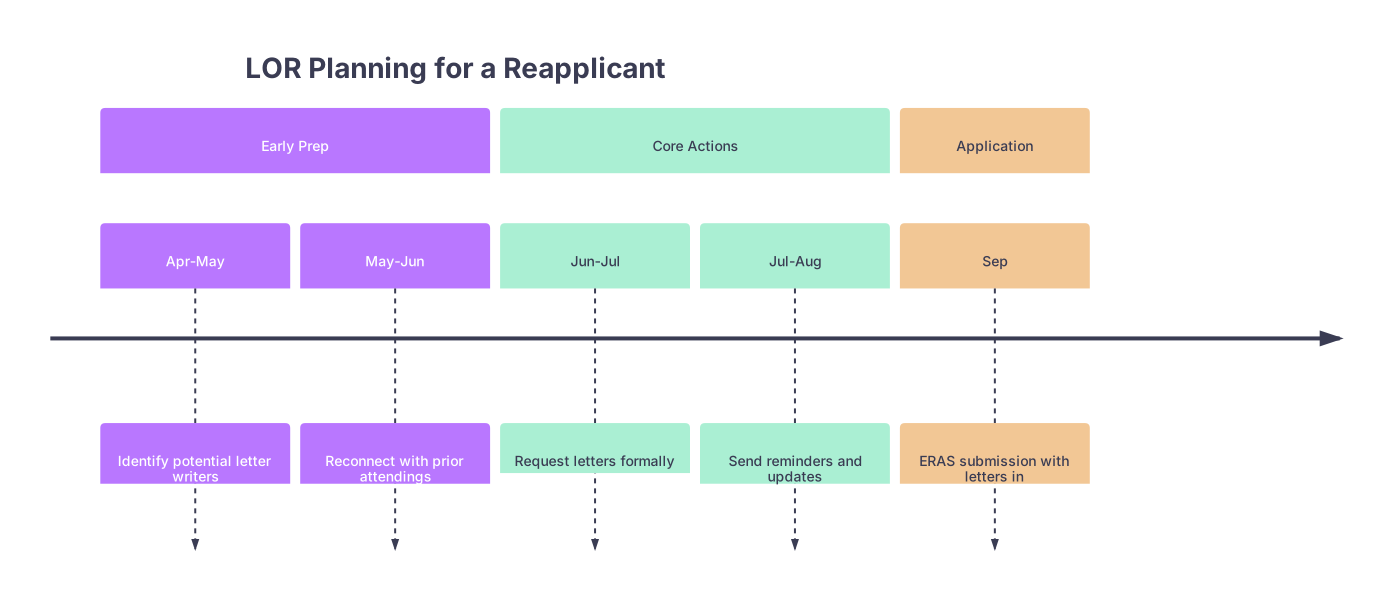
| Period | Event |
|---|---|
| Early Prep - Apr-May | Identify potential letter writers |
| Early Prep - May-Jun | Reconnect with prior attendings |
| Core Actions - Jun-Jul | Request letters formally |
| Core Actions - Jul-Aug | Send reminders and updates |
| Application - Sep | ERAS submission with letters in |
Why late letters crush reapplicants
Programs already may view reapplicants with more scrutiny. When your letters dribble in over weeks:
- Your file sits in “incomplete” limbo
- You miss early review windows
- Some programs never circle back once they’ve filled most interview slots
Reapplicants cannot afford a slow start.
How to avoid repeating the timing mistake
Back-time everything from your application opening date.
Aim for:
- Letters requested: 6–8 weeks before you plan to submit
- Letters completed: in ERAS at least 1–2 weeks before submission
You should:
- Tell letter writers your exact deadline (earlier than the real one)
- Send a brief, professional reminder 2–3 weeks before your “deadline”
- Have at least 1 backup potential writer in mind in case someone flakes
Do not wait to see if you “perform well on this next rotation” before asking. Reapplicants who do that end up bottlenecked and late. Again.
5. Getting New Letters That Say the Same Vague, Empty Nonsense
Some reapplicants do the right thing: they get new letters.
Then they repeat the same old mistake: the letters are generic to the point of being useless.
Phrases you’ll see that mean “this is a bland letter”:
- “Hardworking and diligent”
- “Pleasant to work with”
- “Will make a good resident”
- “Completed tasks assigned to them”
If your letters are basically a thesaurus of “nice, reliable, works hard,” they’re not sinking you alone, but they’re definitely not rescuing a borderline application.
Why this keeps happening
You’re asking for letters like this:
“Could you write me a letter of recommendation for residency?”
And then you attach your CV and personal statement and hope for the best.
You’re not guiding them. You’re not reminding them of specific moments. You’re not giving them anything concrete to work with. So you get a concrete-free letter.
How to avoid it
You are not “telling them what to write.” You’re giving them ammunition.
When you ask for a letter, include:
- A one-page highlight summary:
- 3–5 bullet points:
- Specific patients you helped manage
- Situations you handled well (night float, cross-cover, a difficult family)
- Any feedback they gave you during or after the rotation
- 3–5 bullet points:
- Your updated CV
- A short paragraph on:
- Which specialty you’re applying to
- Why you’re reapplying, if relevant (brief, professional, not a sob story)
- What you’re hoping they can highlight (e.g., clinical growth, reliability, ability to handle high volume, improvement since last year)
This is how you nudge them away from generic fluff and toward actual content: concrete behaviors, stories, and growth.
6. Using Letters That Quietly Signal “Red Flag” or “Damning with Faint Praise”
Most reapplicants are terrified of having a “bad letter.”
What they overlook is something more subtle and more common: the lukewarm letter.
The “damning with faint praise” letter.
Program directors are trained to read between the lines. They notice:
- What is not said
- Comparisons to peers
- The energy (or lack of it) behind the praise
Phrases that make people nervous
If you ever got feedback from a previous program director or advisor that your letters were “fine,” you need to think harder.
Things like:
- “Performed at the level expected of a graduating student”
- “Met expectations on the rotation”
- “With continued guidance, I believe they will develop into a solid resident”
These are not glowing. They’re coded language for “not impressive.”
How reapplicants get stuck with these letters
- They ask attendings who were neutral about them
- They don’t actually know what’s in their letters (because they waived their rights without thinking)
- They reuse letters from a rotation where they needed remediation or had professionalism friction
How to avoid this as a reapplicant
You do not want a letter from anyone whose honest evaluation of you would be:
- “Average”
- “Fine”
- “Met expectations”
Ask your potential writer before they commit:
“Do you feel you can write me a strong, positive letter of recommendation for [specialty]?”
Not “a letter.” Not “a supportive letter.” A strong, positive letter.
If they hesitate, waffle, or say anything like:
- “I can write a letter documenting your time here”
- “I am happy to confirm you completed the rotation”
Walk away. Politely. But walk away.
As a reapplicant, you simply cannot afford neutral letters.
7. Failing to Update Old Letter Writers on What Happened (So They Repeat the Same Framing)
Here’s a subtle but important mistake reapplicants make:
- They ask the same letter writer for an updated letter
- They do not explain what happened last cycle or what changed since
- The writer copies the previous letter with a few edits and date changes
Now you have a near-duplicate letter that doesn’t reflect your growth or how you handled not matching.
Why this matters
Program directors like to see:
- Maturity
- Insight
- Resilience
- Concrete growth after a setback
If your new letter could’ve been written before you even failed to match, you’ve lost the chance to show that you learned something.
What to do instead
When you ask an old writer for an updated letter, include:
- A short, honest update:
- “I unfortunately did not match last cycle in [specialty]. Since then, I have done X, Y, and Z to strengthen my application.”
- New experiences:
- Preliminary or transitional year
- Research
- Hospitalist or clinical job
- Additional rotations in the specialty
- What you hope they can highlight now:
- Growth over time
- Increased responsibility
- How you functioned as an intern or in a new role
Give them something new to say. Or they will just recycle the old narrative.
8. Overloading Programs With Too Many Letters—And Diluting the Good Ones
Another reapplicant overcorrection:
You think, “Maybe I just didn’t have enough letters.” So this year you go overboard.
- 5 clinical letters
- 2 research letters
- 1 from your volunteer coordinator
- 1 from a PD at your prelim year
And you try to dump all of them on every program.
Here’s what actually happens: programs skim 2–3 at most. The rest blur together. Your strongest voices get diluted by the weaker or irrelevant ones.
| Scenario | Ideal # of Letters | Core Composition |
|---|---|---|
| Same specialty, no PGY1 yet | 3–4 | 2–3 specialty attendings, 1 other |
| Same specialty, completed PGY1 | 3–4 | 1–2 specialty, 1 PD/attending, 1 IM |
| Switching specialties, new rotations | 3–4 | 2–3 new specialty, 1 prior strength |
| Research-heavy reapplicant | 3–4 | 2 clinical, 1 research max |
How to avoid it
Think like a curator, not a hoarder.
- 3–4 letters is usually enough
- Every letter should earn its spot
- Don’t send a research letter to a community program that mostly cares about clinical performance, and don’t send an unrelated volunteer letter instead of a PGY1 evaluation
Use program-specific combinations if needed:
Academic, research-heavy programs:
- 2–3 clinical specialty letters
- 1 strong research letter that speaks to work ethic and scholarly ability
Community or clinically focused programs:
- 3–4 clinical letters (specialty + PD/attending from PGY1 or significant clinical role)
More letters ≠ better. Better letters = better.
9. Not Leveraging Your Current PGY1 / Gap Year Supervisor Correctly
If you did a prelim year, TY, or worked clinically (scribe, hospitalist extender, research coordinator, etc.), and you’re reapplying without a letter from your current supervising physician or PD?
Programs will notice. And they will not assume the best.
Common mistakes here
- You “don’t want them to know” you’re reapplying
- You assume they’re too busy
- You think your med school letters are enough
- You ask a random attending you like instead of the PD or someone who has actually evaluated you formally
For a reapplicant, a recent letter that says, “I supervised [Name] in their PGY1 year and they functioned well, were reliable, and fit in with the team,” is gold.
How to avoid missing this
If you’re in any clinical role:
- Identify who has directly supervised you consistently:
- Program director
- Associate PD
- Hospitalist lead
- Clinic medical director
- Tell them early you’re reapplying:
- Professionally
- With a clear explanation of your career goals
- Without drama
You want at least one letter that answers: “What have they been like since med school? How are they functioning now?”
Programs care a lot about that for reapplicants.
10. Treating Letters as an Afterthought Instead of a Strategic Fix
Most reapplicants put their energy into:
- Rewriting their personal statement for the 9th time
- Tweaking their hobbies section
- Overthinking which programs to apply to
But they treat letters like an administrative checkbox.
That is backwards.
Where letters actually fit in your “rescue plan”
Think of your reapplication repair like this:
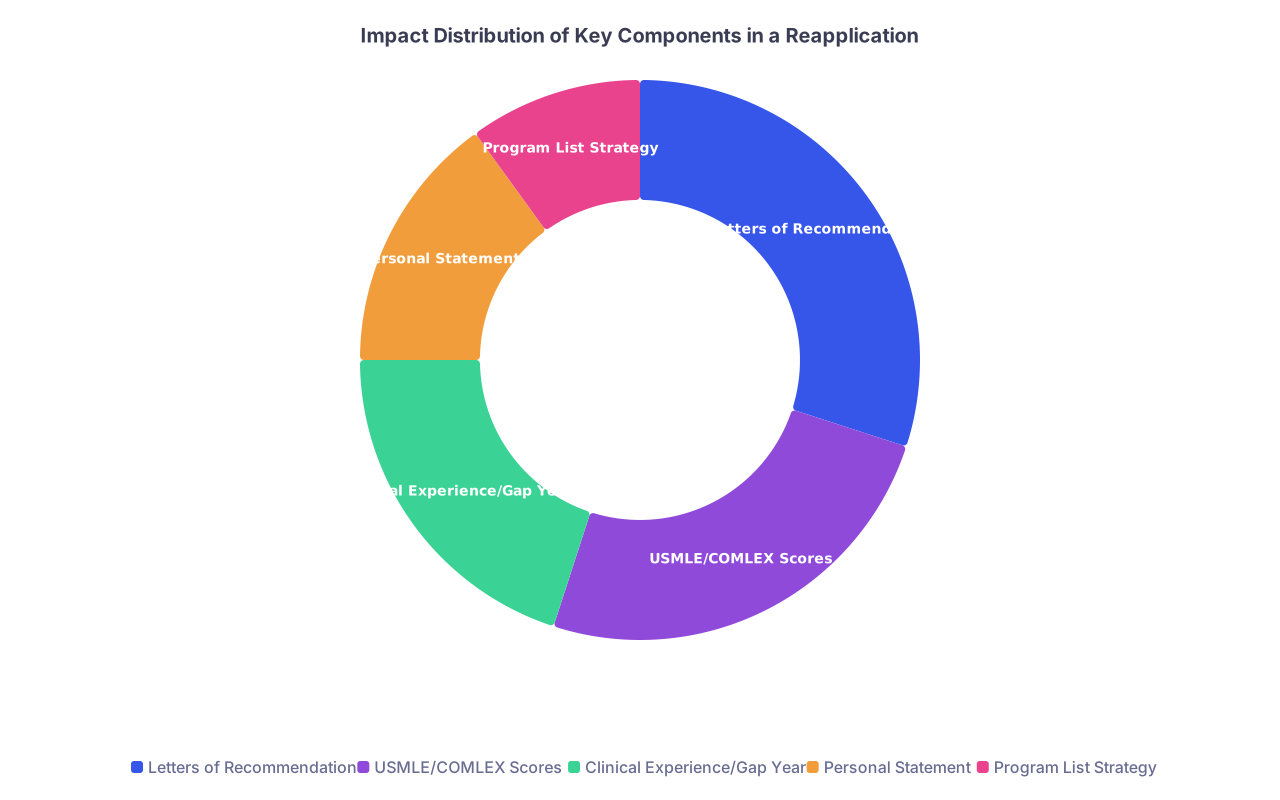
| Category | Value |
|---|---|
| Letters of Recommendation | 30 |
| USMLE/COMLEX Scores | 25 |
| Clinical Experience/Gap Year | 20 |
| Personal Statement | 15 |
| Program List Strategy | 10 |
Letters aren’t everything. But they’re the voice that explains you to a selection committee.
For a reapplicant, they can:
- Reassure programs that prior concerns are resolved
- Prove current clinical competence and maturity
- Highlight real, measurable growth
Or they can quietly repeat the story that got you screened out last time.
What a strategic LOR plan looks like
By the time ERAS opens this cycle, you should:
- Know exactly which 3–4 letters you want as your core set
- Know who can speak to:
- Your work this past year
- Your specialty commitment
- Your improvement or consistency over time
- Have already talked with each writer and clarified:
- Your specialty
- Your reapplicant status (when appropriate)
- What you’re hoping they can emphasize
Don’t wait until late summer to realize you still don’t have a single strong letter in your target specialty.

11. Copy-Pasting Last Year’s Mistakes Because You Never Got Honest Feedback
Final, brutal truth: a lot of reapplicants have no idea whether their letters were any good last time.
They:
- Waived their right to see them (which you should usually do)
- Never talked to an advisor, PD, or trusted faculty about the likely strength of their letters
- Just assumed, “My letters were fine,” because nobody told them otherwise
Then they repeat the entire LOR lineup. And get the same outcome.
How to avoid flying blind
You can’t see the letters, but you can still get clarity.
Talk to:
- A faculty advisor who knows you
- A PD or APD from your prelim year or home department
- A dean of students / dean of advising
Ask them specifically:
- “Do you think my letters last cycle were strong, or just acceptable?”
- “Would you recommend I keep any of those, or get entirely new ones?”
- “Are there any attendings you think would write a particularly strong letter for me now?”
People in those roles can often read between the lines and say, diplomatically:
- “I think some of your letters were fine, but not particularly strong. It would help to get more targeted, specialty-specific letters this time.”
Translation: replace them.
Do not guess. You already lost one cycle. This is the time to ask uncomfortable questions and get real input.

2–3 Things You Actually Need to Remember
Stop recycling weak or mismatched letters. Big names, old specialty letters, or vague “hardworking and pleasant” notes are dead weight for a reapplicant. Keep only strong, specific, relevant letters.
Get fresh, targeted letters that show who you are now. At least 2–3 from your target specialty, plus a recent supervisor (PD/attending) who can speak to your current clinical performance or growth since not matching.
Be intentional and early. Plan your LOR strategy like it matters—because this time, it really does. Ask the right people, give them the right material, and do not repeat last year’s timing or communication mistakes.