
It's late. You’re on your third night float this week. The adrenaline that got you through orientation is gone, and what’s left is…dread. You matched into this specialty, but every sign-out, every pre-round, every note just confirms it: you hate this.
Your co-intern just said, “Honestly, you should just switch. People do it all the time. Just apply to derm or anesthesia next cycle. You only live once.”
This is where people blow up their careers.
Not because switching specialties is always wrong. It isn’t. I’ve seen smart, thoughtful switches work out very well. But because doing it blindly—out of panic, impulse, or fuzzy Instagram ideas of another field—can backfire hard. Financially. Emotionally. Professionally.
Let me walk you through the landmines so you don’t become the cautionary story people whisper about during night float.
The First Big Mistake: Confusing “Bad Year” With “Wrong Specialty”
Most interns hit a wall. Around October–January, usually. Sleep debt, constant pages, getting yelled at over trivial things. Everyone around you seems more confident and less miserable. You start thinking, “This must be the wrong field.”
Sometimes it is. But often, what you’re actually experiencing is:
- Adjusting to real responsibility for the first time
- A toxic rotation or attending skewing your view
- The universal misery of being low on the totem pole
I’ve watched interns in internal medicine swear they needed to switch to radiology because they “hate rounding” and “hate social issues.” Fast forward to PGY2: fewer scut tasks, more autonomy, better teams… and suddenly they’re talking about cardiology fellowship.
They almost burned their entire career over how it felt to be the least powerful person in the room for six months.
Here’s what people get wrong:
They judge the whole specialty based on:
- One hospital
- One service (ICU, night float, or the worst floor team)
- One bad attending or senior
They compare their real intern life to a fantasy version of another specialty:
- Radiology as “sit in a dark room and chill”
- Anesthesia as “intubate and go home early”
- Derm as “clinic + nice lifestyle + easy money”
You do not see the call, the politics, the long-term grind of the specialty you’re fantasizing about. You barely see the actual real version of the one you’re in.
Before you even think of switching, you need to ask:
- Am I miserable on every rotation, or just certain ones?
- Do I hate the core work of this specialty, or do I hate being new, slow, and micromanaged?
- Have I talked to any PGY3+ or attendings who actually seem happy in this field?
If you skip that reflection and go straight to “I’m out,” that’s your first major mistake.
The Financial and Time Bomb You’re Ignoring
Let’s be brutally honest: switching specialties can be expensive, time-consuming, and in some cases, career-limiting.
| Category | Typical Consequence |
|---|---|
| Time | 1–3 extra years of training |
| Income | Delayed attending salary by 1–3 years |
| Debt | Extra interest + lost earning potential |
| Licensing/Boarding | Complex, sometimes messy credentialing |
| Reputation | Program directors may see you as a “risk” |
You’re not just “starting over.” You’re:
- Adding more years of resident/PGY pay instead of attending pay
- Delaying retirement savings, loan payoff, and family plans
- Potentially losing partial credit for years already completed
I’ve seen this play out badly:
- A surgical resident leaves after PGY2 to try for radiology, doesn’t match, and ends up scrambling into a prelim medicine year with no categorical position afterward
- A family medicine PGY1 leaves mid-year to “go for anesthesia,” doesn’t fully understand how re-applying works, and spends a year unmatched doing a random research job with no clear path back
You know what almost no one calculates?
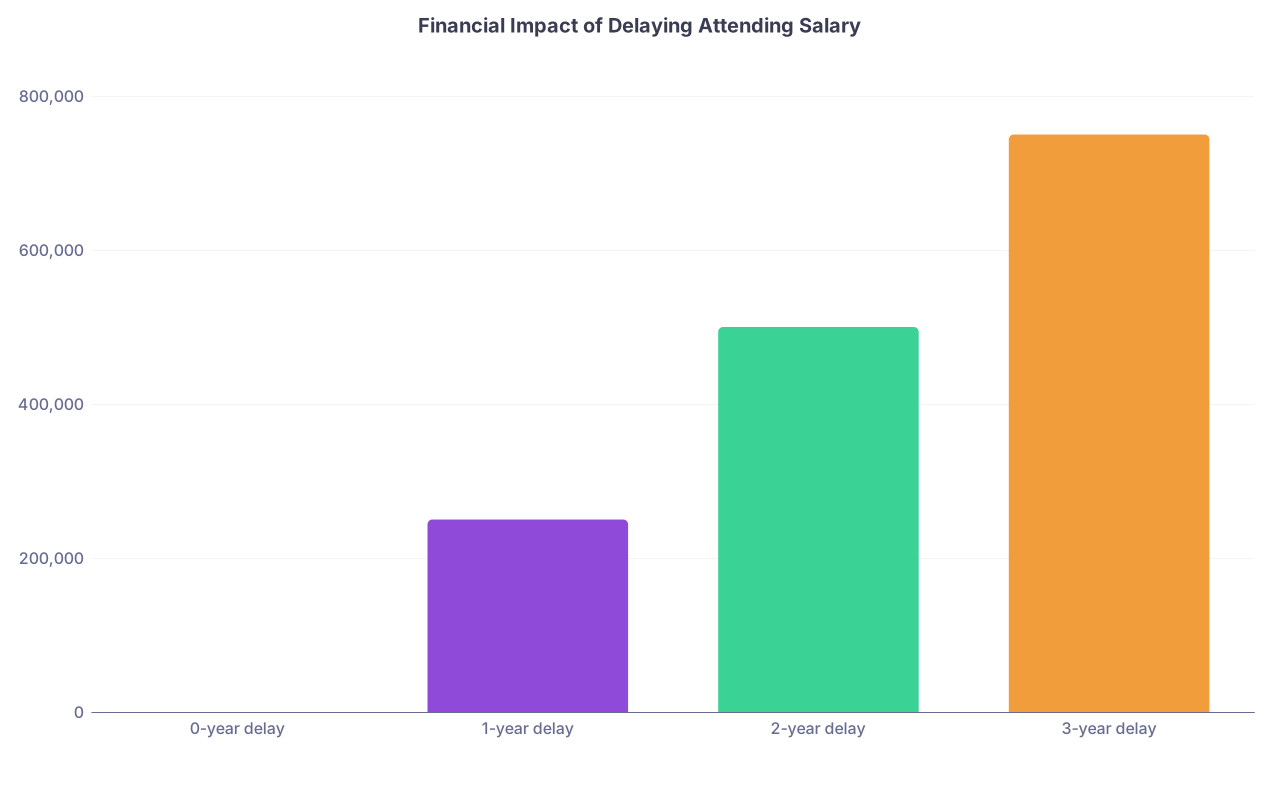
| Category | Value |
|---|---|
| 0-year delay | 0 |
| 1-year delay | 250000 |
| 2-year delay | 500000 |
| 3-year delay | 750000 |
That’s a crude estimate, but you get the point: each extra year of training is not just “another resident year.” It’s also one less year of an attending salary, savings, investments, and financial security.
If you’re going to set that on fire, do it on purpose, with a clear-eyed understanding—not because you were miserable on your first ICU month.
The Credentialing Trap: “I Thought My Years Would Transfer”
Another massive mistake: assuming your prior years of residency will “obviously count” toward the new specialty.
Sometimes they do. Sometimes they barely help.
Some specialties and boards allow partial credit for prior training (e.g., switching within internal medicine subspecialties or IM to neurology under certain circumstances). Others are rigid. You may be starting at PGY1 again even if you’ve done two full years in another field.
I’ve seen:
- A PGY3 surgery resident switch to anesthesia and only get 6 months of credit
- A psych resident switching to neurology and getting told: “Start at PGY1”
- An IM resident trying to go to radiology and basically having to start over
You need hard facts, not assumptions. Every situation is different, but these are common traps:
- Assuming “prelim surgery” automatically helps you in something like ortho or ENT later (it may not)
- Assuming “PGY2 in IM” gives you guaranteed credit in anesthesia (not necessarily)
- Assuming programs have flexibility; many are locked into ACGME and board rules
This is where talking to:
- Your current program director
- The PD of the target specialty at your institution
- Your GME office
…isn’t optional. Blow this step off and you might throw away 2–3 years of training with almost no formal credit.
Reputation Risk: How Programs Really View Switchers
Nobody likes hearing this, but let’s be real: some program directors are cautious about residents who want to switch specialties. Not all, but enough that you should take it seriously.
They’re asking themselves:
- Are you genuinely misaligned with your current specialty, or are you just running from hardship?
- Will you quit their program when something gets tough?
- Are you going to be a headache for the next 3–5 years?
When someone blindly jumps each time things feel bad, that pattern gets noticed. I’ve sat in rooms where PDs literally say, “This applicant left surgery after 6 months, now they want cards, next year it’ll be something else.”
You don’t want that narrative.
On the flip side, I’ve seen switchers get strong support when:
- They were honest but professional with their current program
- They were performing well clinically
- They framed the switch as moving toward a better fit, not just away from misery
- They did the unglamorous work of lining up rotations, letters, and realistic applications
So if your plan is:
“I’ll just bail, tell everyone I hate this field, and find something better.”
You’re playing this exactly wrong.
The Emotional Whiplash: Trading One Misery for Another
Let’s say you do it. You get a new spot. Fresh start. New email, new badge, new white coat. For a few months, you feel amazing.
Then you hit:
- Call in the new specialty
- The steep learning curve again (yes, again)
- Another toxic senior or attending
- The reality that no specialty is a lifestyle fantasy every day
I watched a colleague move from IM to radiology for “better lifestyle.” Within 6 months, they were complaining about:
- Constant pressure to be fast and accurate
- Isolation in reading rooms
- Overnight call with high-stakes reads and limited support
Different problems. Not zero problems.
If your core issue is:
- Burnout
- Poor boundaries
- Perfectionism
- Depression/anxiety
- Feeling like an imposter in any environment
Then a new specialty won’t magically fix that. You’ll carry the same brain into the next field.
Here’s the dangerous loop:
- Specialty A feels awful
- You assume the specialty is the whole problem
- You switch without fixing anything internal
- Specialty B feels awful for slightly different reasons
- Now you’re stuck, older, more indebted, and more disillusioned
You’re allowed to want a better fit. But if you don’t do the “why am I miserable?” work, you’re just spinning the roulette wheel with your whole career.
The Process Is Much Harder Than People Admit
There’s a fantasy version of switching:
“Email a few programs, explain you want to change, pick between all your new offers.”
Reality is uglier.

| Step | Description |
|---|---|
| Step 1 | Realize Mismatch |
| Step 2 | Self Assessment |
| Step 3 | Talk to Current PD |
| Step 4 | Explore Target Specialty |
| Step 5 | Arrange Rotations |
| Step 6 | Secure New Letters |
| Step 7 | Apply Through ERAS or Direct |
| Step 8 | Interview |
| Step 9 | Negotiate Start Level |
| Step 10 | Plan B - Stay or Reapply |
| Step 11 | Receive Offer? |
Places people screw this up:
- Hiding their intentions from their current PD until the last minute
- Not leaving enough time to do audition rotations in the new specialty
- Applying half-heartedly to a hyper-competitive field without the credentials
- Not having a backup if they don’t match/switch successfully
The most painful stories I’ve seen are from people who:
- Quit their current residency before having a solid alternative
- Assumed “I’m already a resident, someone will take me”
- Aimed for ultra-competitive fields (derm, plastics, rad onc) without realistic support
And then didn’t match. Now they’re:
- Out of training altogether
- With gaps in their CV
- Trying to re-enter a system that does not like unexplained gaps
Do not do this to yourself.
How to Tell If You Actually Should Switch (Without Being Reckless)
Let me be clear: sometimes switching is exactly the right move. You just need to handle it like a surgeon handles a scalpel, not like a toddler handles scissors.
Here’s what responsible switching looks like:
You’ve done deep, uncomfortable reflection.
Not one bad call night. Actual pattern recognition over months and different rotations.You dislike the core work of your specialty:
- As an IM resident, you hate longitudinal care, complex medical management, and chronic disease.
- As a surgery resident, you’re indifferent in the OR, dislike procedural work, and live for clinic instead.
That’s a mismatch, not just fatigue.
You’ve seen enough of the target specialty to know what you’re getting into:
- Shadowing
- Electives
- Honest conversations with attendings and senior residents
You’ve talked—early—with:
- Your current PD (yes, this is scary; do it thoughtfully)
- Target specialty faculty/PDs
- GME office about logistics and credit
You’ve built a real plan:
- Timeline
- ERAS or direct application strategy
- Backup if it doesn’t work out
- Financial impact estimate
If you can’t check most of these boxes, you’re not ready to switch. You’re just ready to think about switching.
The Quiet Alternative: Adjust First, Jump Later (If Needed)
The thing almost nobody tells you: you are allowed to wait.
You’re allowed to:
- Finish PGY1 and see how PGY2 feels
- Try different tracks or niches within your specialty
- Switch institutions within the same field before switching fields entirely
Some people find a better fit by:
- Moving from malignant academic IM to a more supportive community program
- Switching from general surgery to a less brutal surgical subspecialty or integrated fellowship path
- Finding a niche (palliative, addiction med, hospitalist, outpatient-heavy practice) within IM or FM
If you still hate it after:
- A change in environment,
- Some actual competence and confidence under your belt,
- And honest self-work around burnout, mental health, and expectations—
Then yes, switching may be right.
But you’ll be making that decision with your eyes open, not out of intern-year panic at 3 a.m. on a bad call night.
FAQ – Exactly 3 Questions
1. Is it ever smart to switch specialties right after PGY1?
Yes—but only when the mismatch is clear and consistent. If you’ve rotated broadly, dislike the core work of your current field, have explored the target specialty directly, and have actual mentors in both fields supporting your decision, switching after PGY1 can be reasonable. The mistake is doing it because you’re tired, demoralized, or burnt out without confirming that the specialty itself is the issue.
2. Should I tell my program director I’m thinking about switching, or will they sabotage me?
Most PDs would rather you be honest early than blindside them by abruptly leaving. The good ones will help you think it through and may even support your application to another specialty. Could there be petty or punitive PDs? Yes. But playing secret games usually backfires harder—on references, on logistics, and on your reputation. Approach them respectfully, with a thoughtful plan, not a vague “I hate it here.”
3. What if I already know I picked the wrong specialty—is it better to quit now than waste years?
Quitting immediately without a plan is usually worse than “wasting” a year. You need to stabilize your situation first: secure mentorship, understand your options, clarify what credit (if any) will transfer, and build a realistic application for the new field. Sometimes the smartest move is to complete the year (or even the program), then pivot with a clean story and solid references—rather than detonating your current position in a panic.
Key points, no fluff:
- Do not confuse a brutal intern year or bad program culture with choosing the wrong specialty.
- Switching blindly can cost you years, money, reputation, and still not fix the real problem.
- If you’re going to switch, do it deliberately: deep reflection, honest mentorship, formal planning—not because you had one terrible month and an attending made you cry.