
What do program directors say about you when your new application hits their screen: “Wow, they really grew,” or “Same file, different year”?
If it’s the second one, you’re in trouble.
This is the core reapplicant mistake: looking functionally identical to last cycle. Same scores, same story, same weak spots. Just with a new date stamped on top.
Let me walk you through the most common errors I see reapplicants make that practically guarantee they get the same result. And how to stop doing that.
Error #1: Treating “Reapply” As “Resend the Same Thing”
The worst reapplicant strategy is also the most common: change nothing meaningful and hope “better luck this time.”
Programs are not forgetting you that fast. Many databases flag reapplicants automatically. If they open your file and see a cloned version of last year’s ERAS, they assume one thing:
No growth.
What “looks the same” to programs
You look unchanged when:
- Same personal statement theme and structure
- Same letters of recommendation
- Same CV experiences with no new bullets or expanded roles
- Same red flags with zero explanation or remediation
- Same geographic pattern, same program list, same sloppy application timing
That doesn’t say “persistence.” It says “stagnation.”
I’ve heard PDs literally say:
“Reapplicant. I checked last year’s file. Basically the same. Pass.”
You must give them a reason to read you differently this time.
Fix it
If you can overlay last year’s application and this year’s and 70%+ of the content is identical, you haven’t re-applied. You’ve resent.
You need at least 3–4 clearly improved, clearly new elements:
- New or stronger Step 2 score (or OET/English metrics for IMGs)
- Substantive new clinical experience (not just shadowing)
- New, tailored personal statement that reflects the gap year
- At least one new letter from recent work or rotations
- Documented remediation of previous issues ( professionalism, fail, gap )
If you can’t name your improvements out loud in 15 seconds, a PD won’t see them either.
Error #2: Reusing the Same Personal Statement With a Few Cosmetic Edits
This one is deadly.
You change one paragraph, add a line about “perseverance,” maybe tweak the conclusion. But the core story? Same.
PDs and faculty remember patterns and phrases more than you think. If they vaguely recall your essay from last year and it reads the same, your reapplication narrative collapses.
Worse: if your previous personal statement was a problem (vague, cliché, overly dramatic, or tone-deaf), you’ve just repeated the problem.
Red flags in reapplicant personal statements
Watch for these “I didn’t really change anything” moves:
- Copy-pasting your old essay and adding a new paragraph about “resilience”
- Mentioning the match failure only in one vague sentence, buried near the end
- Blaming “the competitive environment” instead of owning your weaknesses
- Not explaining clearly what you did in the gap year
- Still writing like a fourth-year student when you’re now a graduate
If your PS doesn’t answer the unspoken PD question—“What did you do with your year off?”—you’ve failed the reapplicant test.
Fix it
You need a new personal statement, not a patched one. It should do three things:
- Reaffirm your commitment to the specialty, with more maturity and specificity
- Show what you learned from not matching without self-pity or spin
- Demonstrate concrete actions you took to become a stronger candidate
Something like:
- “After not matching, I began a full-time research position in heart failure at X, where I co-authored a manuscript and presented at Y.”
- “Working as a preliminary intern in community internal medicine, I took primary responsibility for cross-coverage and night admissions, which sharpened my clinical judgment and time management.”
Own what happened. Show what you did. Show who you are now, not who you were.
Error #3: Keeping the Same Letters of Recommendation
Reusing all the same letters is a huge mistake.
Here’s how it lands with a program director:
- “So, no one new in the last year is willing to vouch for you?”
- “No recent clinical supervisors?”
- “Still relying on that letter from 3rd year med school?”
Even if your old letters were good, using the exact same set screams: nothing has changed.
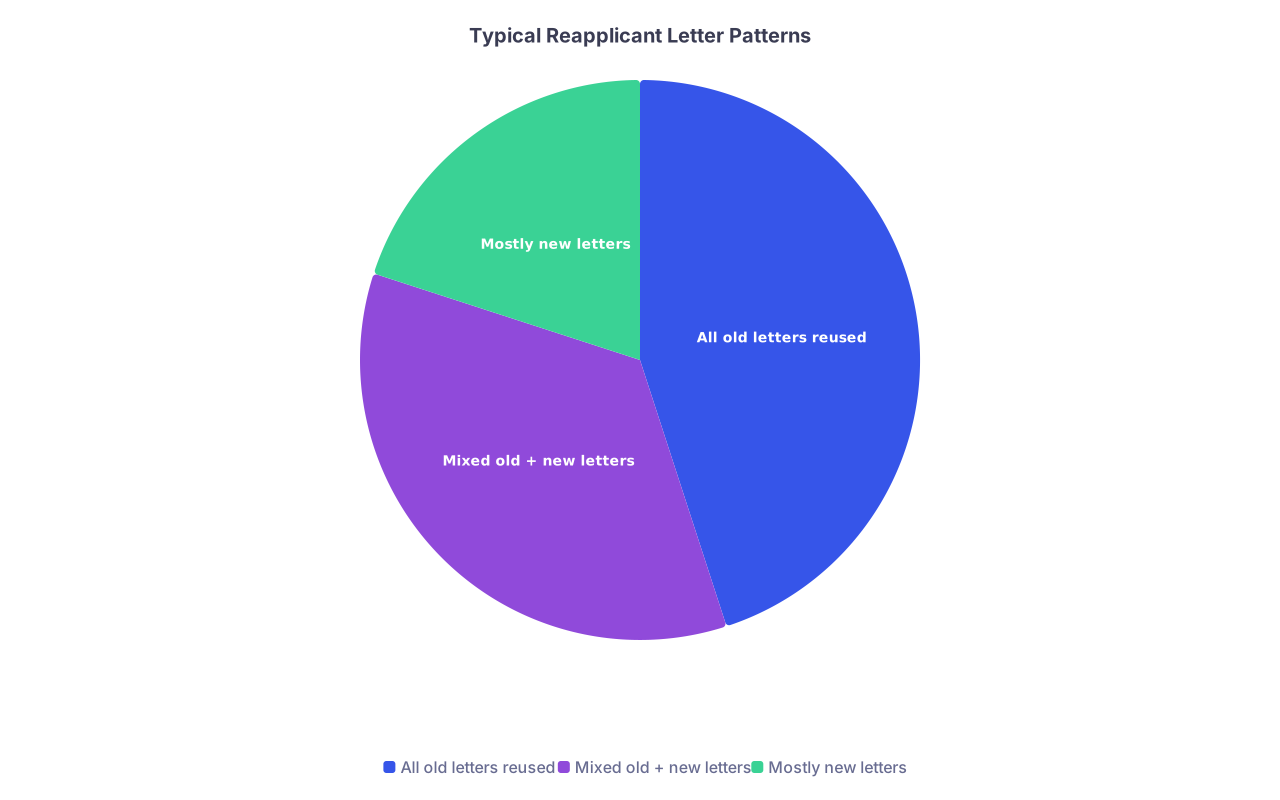
| Category | Value |
|---|---|
| All old letters reused | 45 |
| Mixed old + new letters | 35 |
| Mostly new letters | 20 |
Almost half of reapplicants I see try to reuse the entire previous letter set.
When keeping a letter is fine
- A strong chair letter that is required for your specialty
- An outstanding letter from a key away rotation that still reflects who you are
- A niche letter (e.g., from a famous researcher) that adds unique weight
But even then, you should add at least one or two new letters that:
- Are from the most recent clinical experience you’ve had
- Comment specifically on how you’ve grown and matured
- Demonstrate reliability, professionalism, and team function
Fix it
At minimum:
- Replace at least 50% of your letters with new ones
- Ensure at least one new letter is from the last 6–12 months of clinical work
- Brief your letter writers honestly: tell them you’re a reapplicant, what you’ve worked on, and what growth they might highlight
Do not be the person using a 4-year-old clerkship letter as your “primary” clinical evidence.
Error #4: Doing a Gap Year That Doesn’t Actually Fix Anything
This is painful, because it feels like work. You’re busy. You’re exhausted. You’re doing things. But they don’t move the needle.
Misaligned gap-year moves:
- Generic volunteer work unrelated to your specialty or medicine at all
- Non-clinical jobs with zero patient contact, no explanation given
- Random research in a field you’re not even applying to
- Long “US clinical experience” that is mostly observership with no real responsibility
- Or worst: no structured activity at all, just “independent study” and vague plans
From the program’s perspective: you had one year to get stronger, and you spent it sidestepping your weaknesses.
Ask yourself the harsh question
What were your actual weaknesses?
- Weak Step scores?
- Thin or non-US clinical experience?
- Poor interview skills?
- Red flags (failures, professionalism concerns, gaps)?
- Poor specialty fit or unclear commitment?
Then look at your gap year. Did you directly attack those weaknesses?
If you had low Step/COMLEX and did not improve testing metrics (Step 2, OET, another exam) or show academic remediation, that’s a big miss.
If you lacked US LORs and you didn’t secure strong supervised US rotations, same issue.
Fix it
Your gap year should be deliberate remediation, not random activity.
Stronger moves:
- Research in your chosen specialty with tangible output (abstracts, posters, co-authorships)
- Full-time clinical job (prelim year, non-categorical spot, hospitalist scribe with direct MD supervision, clinical research coordinator with patient contact)
- High-quality US rotations with real responsibility and direct evaluation
- Structured work with clear outcomes (quality improvement projects, curriculum dev, etc.)
And then—crucial—you must explain how this year changed you in your application, PS, and interviews.
Error #5: Applying to the Same Program List with the Same Strategy
You’d be shocked how many reapplicants send essentially the same ERAS list, with the same overreach, same lack of geographic targeting, same neglect of community programs or less competitive regions.
Nothing signals “I didn’t analyze why I failed” like an identical program strategy.
Common repeat-program-list mistakes
- Only targeting big-name academic centers when you’re not competitive there
- Ignoring community or university-affiliated community programs
- Refusing to widen geography (only coasts, only big cities, only one state)
- Applying too narrowly (e.g., 40 IM programs with poor stats)
- Or the opposite: spray-and-pray 200 apps with no prioritization
| Approach | Programs Applied | Interview Invites | Outcome |
|---|---|---|---|
| Same as last year | 60 | 1–2 | Usually unmatched |
| Slightly broader | 80 | 3–5 | Mixed |
| Truly rethought | 100–120 | 6–10+ | Frequently match |
Fix it
This time, you must be brutally realistic:
- Look at your score, YOG, clinical experience, visa needs (if IMG), and red flags
- Talk to advisors who will not sugarcoat your standing
- Build tiers:
- Safe-ish programs where you’re solidly within or above their typical stats
- Middle programs that are realistic stretches
- A small number of true reaches
Then:
- Include more community-based and hybrid programs
- Expand geography unless you have truly immovable constraints
- Cut programs that clearly filtered you last year unless something major changed (score increase, new LORs from their institution, etc.)
If your program list doesn’t look substantially different, don’t be surprised when the results don’t either.
Error #6: Ignoring Your Red Flags and Hoping They’ll Be Overlooked
Reapplicants almost always have some element that made things harder the first time:
- Step failure or very low scores
- Extended time to graduation
- Gaps in training
- Probation, professionalism issues
- Switching specialties late
- Being far out from YOG
The worst move? Pretending these don’t exist.
Silence doesn’t make a red flag disappear. It just leaves PDs free to write their own, usually harsher, story.
How programs read silence
Helpful translation:
- You don’t mention your Step 1 fail: “They haven’t processed this or learned from it.”
- You don’t explain a 1–2 year gap: “Were they dismissed? Visa issues? Unable to secure work?”
- You don’t address professionalism history: “Risky hire.”
Silence is almost always interpreted against you.
Fix it
You need controlled transparency:
- Brief, direct description of the issue
- Clear, specific steps you took to correct it
- Evidence of success since (scores, evaluations, supervisors’ comments)
For example:
“I failed Step 1 on my first attempt due to poor study structure and underestimating the exam. I completed a formal remediation program with my school, adopted a question-based approach, and passed on my second attempt. I applied those changes again to Step 2, on which I scored X.”
Do not wallow, but do not hide. Programs respect honest growth more than attempted invisibility.
Error #7: Not Fixing Your Interview Problem (Or Pretending You Don’t Have One)
If you had interviews last cycle and still did not match, your issue may not be your paper application.
I’ve seen this a lot: decent stats, decent experiences, plenty of interviews—then no match. And the applicant spends their entire reapplicant year obsessed with adding more research instead of fixing their actual weak point: how they come across in person (or on Zoom).
Common interview problems:
- Robotic, memorized answers
- Overly humble or underselling yourself to the point of invisibility
- Defensive or evasive when red flags are discussed
- Poor insight into your own weaknesses or growth
- Unclear commitment to the specialty or program type
- Social awkwardness or inability to connect with residents/faculty

| Step | Description |
|---|---|
| Step 1 | Previous Cycle |
| Step 2 | Primary issue is paper app |
| Step 3 | Ranking strategy issue |
| Step 4 | Interview performance issue |
| Step 5 | Need targeted mock interviews |
| Step 6 | Got interviews? |
| Step 7 | Ranked appropriately? |
Fix it
Do serious interview work:
- Multiple mock interviews with people who will not just say, “You did great”
- Record yourself and watch—yes, it’s painful, do it anyway
- Practice especially:
- “Tell me about yourself”
- “Why this specialty?”
- “Tell me about a weakness/failure.”
- Explaining reapplicant status calmly and constructively
Your story as a reapplicant must feel confident, not apologetic.
Error #8: Presenting Yourself as “Desperate” Instead of “Determined”
There’s a line. Reapplicants cross it all the time.
You do need to be proactive. You do not need to act like a spam bot.
Desperate behaviors that hurt you:
- Mass-emailing every PD and coordinator with generic messages
- Repeatedly contacting programs that clearly said they don’t accept updates
- Over-sharing your emotional distress in communications
- Saying things like “I’ll take any spot anywhere in any specialty” to a specialty-specific program
- Overly aggressive social media DMs to faculty or PDs
Programs want motivated residents, not unstable ones.
Fix it
Be professional and targeted:
- Email programs strategically where you have:
- Geographic ties
- Institutional connections
- Alumni or faculty who can advocate for you
- Keep messages short, specific, and respectful
- Use updates to share real progress (new score, new publication, new rotation)
- Let your persistence show in your actions, not your panic
You’re a reapplicant, not a beggar. Act like a colleague who has continued to grow and is now ready to contribute.
Error #9: Not Owning the “Reapplicant” Identity in Your Narrative
Some people try to hide the fact they’re reapplying. They avoid talking about it in the PS, dodge it in interviews, and hope it doesn’t come up.
It always comes up.
If you look anxious and cagey when asked, “What did you do this past year?” or “What changed since last cycle?” you sink your own credibility.
Fix it
You need a clean, confident reapplicant narrative:
- I didn’t match.
- I took responsibility and analyzed why.
- I identified specific areas to improve.
- I spent the year doing exactly that.
- Here’s what changed and how that makes me better for you now.
That story can be powerful—if you own it.
Error #10: Assuming Time Alone Will Fix It
This is the quiet mistake.
You think, “I’ll just try again; lots of people match on the second go.” True. But not because they simply waited. They improved.
Every year you’re further from graduation without significant, recent clinical experience, you become harder to match. Time, by itself, is not neutral. It works against you.
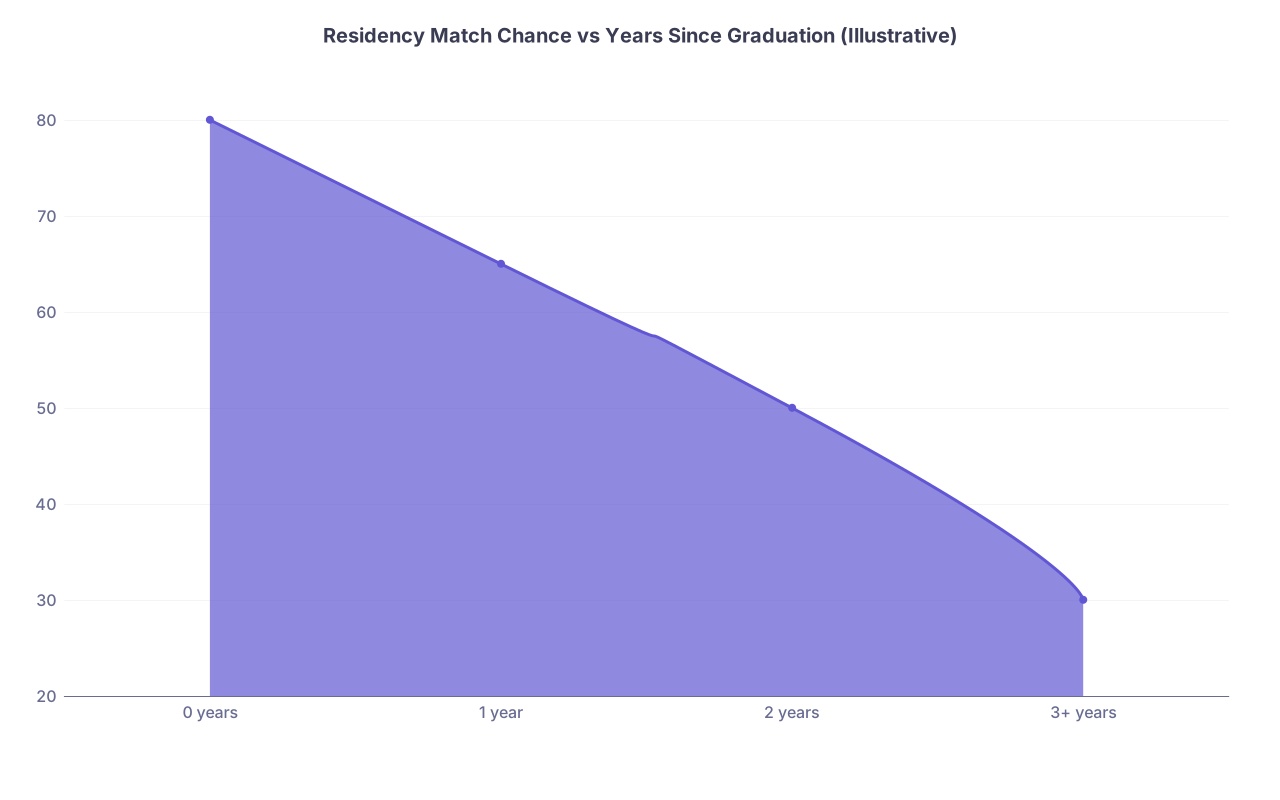
| Category | Value |
|---|---|
| 0 years | 80 |
| 1 year | 65 |
| 2 years | 50 |
| 3+ years | 30 |
If your plan for this cycle is just “apply again and hope,” you’re already repeating your main mistake.
FAQ (Exactly 4 Questions)
1. Should I mention that I didn’t match in my personal statement?
Yes. Briefly and strategically. You don’t need a long confession, but you do need to acknowledge the reality, show insight into why it happened, and emphasize what you did to become stronger. One focused paragraph is usually enough.
2. Is it okay to reuse one or two strong letters from last year?
Yes, but not the entire set. Reusing a standout chair letter or a unique away-rotation letter is fine, especially if it’s still representative. But you must add recent letters from your current work or rotations so programs see who you are now, not just who you were as a student.
3. How many programs should a reapplicant apply to?
There’s no magic number, but most serious reapplicants in competitive or moderate specialties should be in the ~80–120 range, if that list is well-targeted. Too few and you undershoot your odds; too many with no strategy becomes expensive noise. Focus on realistic fits, community and hybrid programs, and geographic breadth.
4. What’s the single biggest sign my reapplication looks “the same” as last year?
If you can describe your changes in one sentence like, “I edited my personal statement and applied to more programs,” you’re in danger. A truly different application has clear, concrete upgrades: new exam performance, new clinical work, new letters, and a different, more honest narrative. If you don’t see those, neither will they.
Key points to remember:
- If your new application looks like last year’s with a different date, expect the same result.
- Reapplying isn’t about waiting; it’s about visibly fixing specific weaknesses with targeted action.
- Own your reapplicant status, show growth, and stop pretending time alone will save you.