

The most dangerous mistake after a prelim-only match is drifting for a year without a ruthless plan.
You matched a prelim. You did not match an advanced spot. Now you’re staring at the calendar and realizing your “training gap” could quietly swallow your momentum, your letters, and your confidence. I’ve watched that happen. It’s avoidable—if you act like this is a second application season that starts now, not next September.
This is not a generic “keep your chin up” pep talk. This is: here’s what you do this week, this month, this year, so that 12–18 months from now you are not explaining an awkward, half-empty CV and stale letters.
Step 1: Get Crystal Clear on Your Timeline and Risks
First thing: you need a timeline, not vibes.
There are three separate clocks running on you right now:
- The advanced residency application calendar (ERAS/NRMP).
- Your prelim year schedule and obligations.
- The “recency” clock for letters, clinical currency, and exams.
If you do not see them all on paper, you’ll overestimate how much time you have.
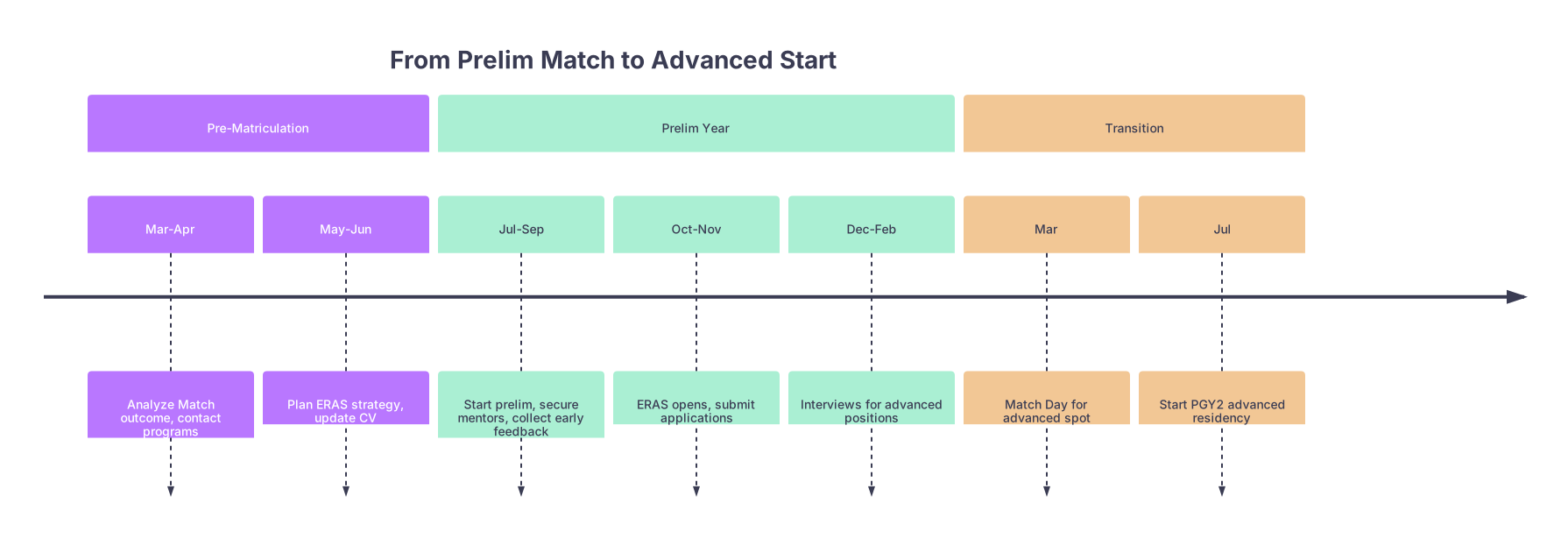
| Period | Event |
|---|---|
| Pre-Matriculation - Mar-Apr | Analyze Match outcome, contact programs |
| Pre-Matriculation - May-Jun | Plan ERAS strategy, update CV |
| Prelim Year - Jul-Sep | Start prelim, secure mentors, collect early feedback |
| Prelim Year - Oct-Nov | ERAS opens, submit applications |
| Prelim Year - Dec-Feb | Interviews for advanced positions |
| Transition - Mar | Match Day for advanced spot |
| Transition - Jul | Start PGY2 advanced residency |
A typical path if you matched prelim but not advanced:
- July: Start prelim year (PGY1).
- September: ERAS opens for applications to advanced positions starting the next July (PGY2).
- March: Match results for those PGY2 advanced slots.
- July (following year): Start advanced PGY2 if matched.
That’s the clean version. The “training gap” problem shows up when:
- You don’t match an advanced spot again.
- Or your advanced match is delayed (e.g., to the following year).
- Or you pivot specialties and need another PGY1 or supplemental training.
Know this up front:
- Gaps longer than 1 year with no clinical activity are toxic.
- Gaps filled with unstructured “research” with no output look bad.
- Gaps that are clearly purposeful, documented, and supervised can be explained.
Your job now is to make sure any gap looks like the third category.
Step 2: Decide Your Strategy – Same Specialty, Different Specialty, or Rebuild
Do not skip this decision. Everything else flows from it.
Option A: Stay in the same specialty (e.g., prelim medicine → categorical/advanced IM, neuro, anesthesia, rads, derm, etc.)
This is the most straightforward path. You’ll:
- Use your prelim year to prove you can function as an intern.
- Get strong letters from faculty in or adjacent to your target specialty.
- Apply to advanced spots in the same field during your prelim.
Good when:
- Your Step scores and CV are roughly in range.
- Your main problem was timing, application strategy, or weak letters.
- You already have some connection to the specialty (electives, research).
Option B: Pivot specialties (e.g., prelim surgery → switch to IM; prelim medicine → switch to psych, FM, etc.)
This can actually close your training gap nicely, if you plan:
- Your prelim year can often count as PGY1 for multiple fields.
- You may be able to slide into a PGY2 in a less competitive specialty.
- Or you may re-apply for categorical PGY1 in a new field.
Good when:
- Your stats are far below typical for your initial specialty.
- You realized you hate the original field (seen it often).
- You sense programs are just not biting despite a solid application.
Option C: Rebuild from the ground up
This is the hardest pill. But sometimes right.
You choose this when:
- You failed Step/COMLEX attempts.
- You had professionalism flags, leave of absence, or failed rotations.
- Your application had serious structural weaknesses (no US clinical, big red flags).
Rebuild here means: you may need a research year, extra clinical observerships, maybe an MPH or other structured degree while you fix the underlying problems.
If you’re not sure which bucket you’re in: schedule a 30–45 minute brutally honest conversation with:
- A PD or APD in your prelim program.
- A trusted faculty in your target specialty.
- Someone who has sat in rank meetings, not just “a nice attending.”
Tell them: “I matched a prelim only, I want to understand whether I can realistically stay in [specialty X] or should pivot.” If they hesitate, that’s your signal.
Step 3: Use Your Prelim Year as a 12-Month Audition
Your prelim year is not just a job. It’s your re-application engine.
Here’s how to build it properly.
1. Line up mentors by October
By the end of October you should have:
- One core faculty sponsor in your prelim department.
- One faculty member in or close to your target specialty.
- One senior resident or chief who knows your day-to-day work.
Tell them directly: “I matched prelim only, I’m reapplying to [specialty], I’d like your help positioning myself.” People respond better when they know the stakes.
2. Build a letter strategy
Your advanced application typically needs 3–4 letters. Aim for:
- 1–2 from your prelim program (PD or APD + a strong teaching attending).
- 1–2 from your target specialty (local elective, away rotation, or research mentor).
Time it:
- Identify letter writers by November.
- Ask for letters before the ERAS deadline (often late summer) – but you can have them written after you’ve worked together a couple of months.
- Remind them with a short, specific email: updated CV + bullet points of things you’ve done.
3. Be intentional with your rotations
Do not passively accept whatever schedule lands in your inbox.
Ask your chief or scheduler:
- “Can I get rotations that help with [specialty]?”
- For anesthesia: ICU, medicine wards, ED.
- For radiology: ICU, ED, medicine wards, maybe a radiology elective if allowed.
- For neurology: stroke unit, ICU, medicine, ED.
- “Can I get an elective or two in [target specialty] during the second half of the year?”
Your goal: by ERAS season, you want at least one rotation where someone in your target specialty can write, “This intern functions at or above the level of our categorical interns.”
Step 4: Attack the Advanced Application Like a Second Chance, Not a Recycle
Reapplicants make one specific dumb move: they submit the same application with minor edits. Program directors notice.
Fix your numbers if you can
If you failed or barely passed Step/COMLEX:
- Strongly consider a retake (where allowed) before ERAS opens.
- Schedule it early in prelim year if vac days and schedule allow.
- Use free question blocks between shifts ruthlessly. No heroics; just consistent practice.
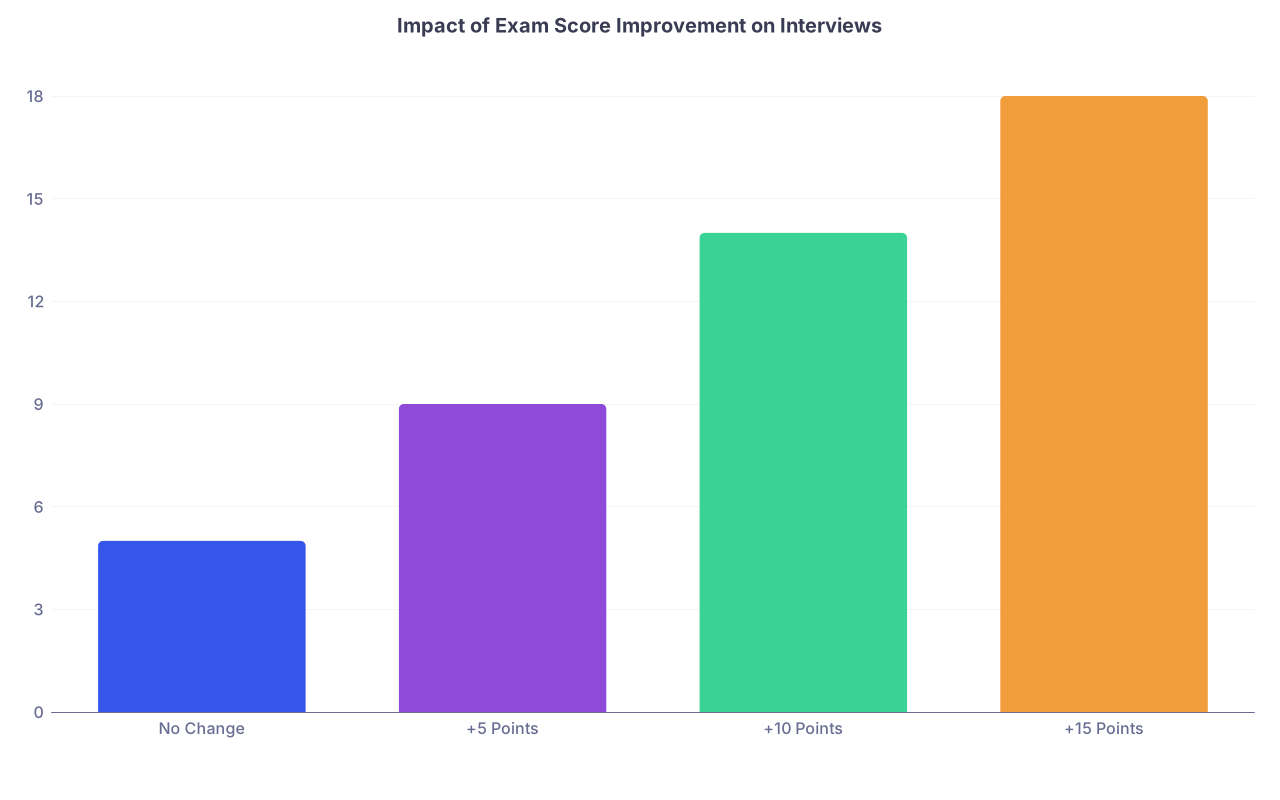
| Category | Value |
|---|---|
| No Change | 5 |
| +5 Points | 9 |
| +10 Points | 14 |
| +15 Points | 18 |
Even a 5–10 point bump can change how your file is screened at some programs.
Rewrite your personal statement like you’ve grown up
You now have:
- Real inpatient experience.
- Real nights, codes, family meetings.
- Real evidence you can carry a pager and not fall apart.
Your new statement should not read like a fourth-year med student fantasy. It should sound like someone who’s been in the trenches and still wants this specialty for specific, grounded reasons.
Expand and de-risk your school list
For advanced applications, you need to think like this:
- Mix of academic, community, and hybrid programs.
- Programs that historically accept prelim grads.
- Regions where your school or prelim program has connections.
Make a spreadsheet. Not in your head. Track:
- Program name.
- Type (academic/community).
- Whether they have current or past prelim-to-advanced transitions.
- Whether they accept applications outside the main NRMP cycle (some do).
Step 5: If You Still End Up With a Training Gap – Fill It Correctly
Let’s say the worst happens: you finish your prelim year and still don’t have an advanced spot starting that July.
Now the “training gap” is real. You have to plug it fast with something that counts as legitimate, supervised activity.
Here’s what actually helps:
| Option Type | Strong or Weak | Key Features |
|---|---|---|
| ACGME-approved fellowship (e.g., research fellow) | Strong | Structured, supervised, in your specialty |
| Non-ACGME clinical fellowship or hospitalist scholar year | Strong | Direct patient care, letters, salary |
| Full-time research with clear output and mentor | Moderate-Strong | Publishes, abstracts, strong letter |
| Random observerships & shadowing only | Weak | No responsibility, no strong letters |
| Unrelated job (tech, business, etc.) | Weak | Hard to justify clinically |
Strong options to close a training gap
Non-ACGME clinical fellow or “hospitalist” year
- Some departments hire “clinical fellows” or junior hospitalists.
- You’re supervised, write notes, manage patients.
- Shows continuity and growth since your prelim.
Research position within your target department
- Ideal if it’s 60–80% research, 20–40% clinical, but even pure research can work if:
- You’re embedded in the department.
- You get involved in teaching, conferences.
- You get strong letters and ideally an abstract/paper.
- Ideal if it’s 60–80% research, 20–40% clinical, but even pure research can work if:
Chief resident / transition roles if offered
- Occasionally, a prelim who performed well is offered a chief or similar role in a medicine department.
- This can massively boost your leadership and letter quality.
Moderate options (needs careful framing)
- Pure research in a related but not identical department.
- Teaching roles (OSCE examiner, simulation, preclinical teaching).
These can work if you:
- Keep doing some clinical work (moonlighting, per-diem under supervision where allowed).
- Are crystal clear in your application how these experiences made you a better resident candidate, not just “kept you busy.”
Weak options
I’ve seen people:
- Move home and “study” for a year.
- Do unrelated industry work with zero clinical involvement.
- Stack remote observerships without responsibility.
Those are salvageable only if you then re-enter clinical activity strongly, and you’ll be answering “What happened here?” for years.
If you’re forced into a weaker option for personal reasons (visa, family, health), your job is documentation and narrative:
- You did X for Y reason.
- You maintained Z level of clinical engagement (CME, courses, part-time clinical).
- You’re now beyond that phase and back in structured training.
Step 6: Communicate the Story So PDs Don’t Fill in the Blanks
Program directors hate guessing. They’ll assume the worst if your path looks random.
You need a coherent story that hits three points:
- Why you did a prelim-only year (and/or why you didn’t have an advanced).
- What you did during any gap to grow clinically and professionally.
- Why you are now a safer, better bet than the first time you applied.
Concrete example:
“I initially matched to a preliminary internal medicine year while reapplying to diagnostic radiology. During my prelim year at [Hospital], I managed a high-acuity inpatient census, took overnight call, and received strong evaluations for clinical reasoning and teamwork. Despite broad applications, I did not secure an advanced position in that cycle. Rather than step away from patient care, I accepted a clinical research fellowship in radiology at [Institution], where I work closely with the chest imaging service, continue participating in multidisciplinary rounds, and have co-authored two abstracts accepted at [Society] meetings. This path has confirmed my commitment to radiology and strengthened the clinical foundation I will bring as a PGY2.”
That sounds intentional. Not like failure.
Places to bake the story in
- Personal statement (but don’t turn it into a pity memoir).
- Experiences section of ERAS (gap-filling roles clearly labeled).
- Brief explanation box if there was a formal gap (some applications have this).
- Your interview answers: practiced, concise, not defensive.
Step 7: Avoid the Three Classic Traps
I’ve watched prelim-only grads fall into the same holes:
Emotional paralysis
- They are embarrassed. They avoid mentors. They “kind of” apply.
- One cycle later: same result, worse story.
Application autopilot
- Same list, same statement, no new letters.
- Programs remember. Or at least their filters do.
Unstructured “research year”
- No clear mentor.
- No concrete project.
- No output by the time ERAS comes around.
Do this instead:
- Within 2 weeks of Match: meet with at least 2 faculty advisors.
- By the start of your prelim year: have a plan for letters + at least one project or role that strengthens your next application.
- Set a quarterly checkpoint for yourself: What has changed in my application since last year? If the answer is “almost nothing,” adjust.
Step 8: If You’re Considering Switching Specialties, Do It Deliberately
Switching can actually solve your training gap if you do it right.
How to switch without blowing up your record
Talk to your prelim PD first
- Be honest, not dramatic.
- “I’ve realized [new specialty] is a better fit; I want to explore options while still being a strong intern for this program.”
- You need their support and a non-hostile letter.
Get exposure to the new specialty early
- Electives.
- Shadowing while you’re on lighter rotations.
- Attend their morning report or conferences.
Confirm transferability of your PGY1
- Some specialties accept a completed prelim year as their PGY1.
- Others require categorical from the start.
- Ask specific programs or check their websites; do not assume.
Apply with a clean story
- Not “I couldn’t get derm so now I want FM.”
- It’s: “Prelim year showed me I’m happiest in [X] kind of patient care and team structure, which aligns more closely with [new specialty].”
Done right, a switch can make your “gap” irrelevant because you’re on a coherent new path with fresh letters and real clinical experience.
Quick Reality Check: What Programs Actually Care About
Strip away the noise. When PDs look at a prelim-only path, they’re asking:
- Did this person show up, work hard, and function as a safe intern?
- Did they use the gap/prelim to grow, or did they spin their wheels?
- Are their letters recent and specific?
- Is their story coherent, or will they be a problem child who bails mid-program?
Everything I’ve given you is aimed at making those answers:
- Yes.
- Grow.
- Yes.
- Coherent and low-risk.
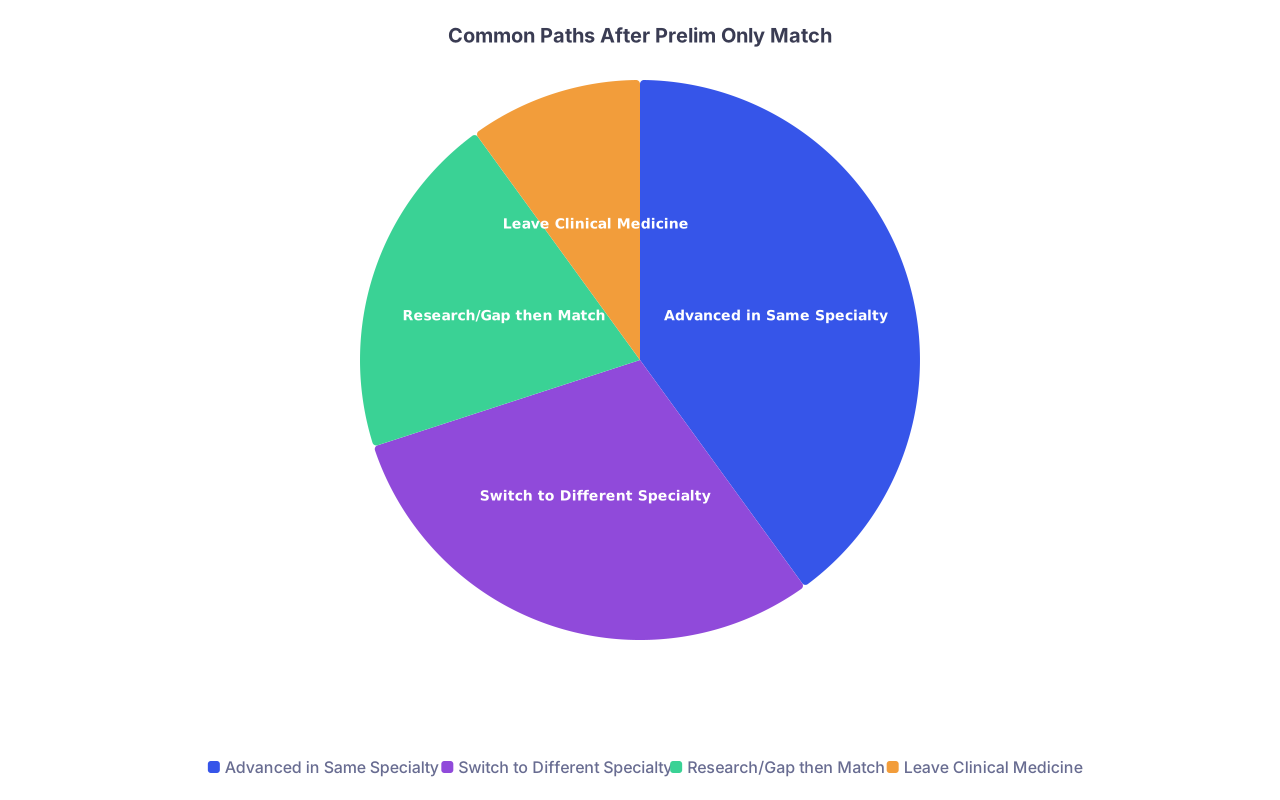
| Category | Value |
|---|---|
| Advanced in Same Specialty | 40 |
| Switch to Different Specialty | 30 |
| Research/Gap then Match | 20 |
| Leave Clinical Medicine | 10 |

FAQs
1. Can my prelim year count as PGY1 for a different specialty?
Sometimes yes, sometimes no. Internal medicine prelim years often count toward neurology, radiation oncology, and some other advanced fields. They usually do not count if you’re switching into something like categorical internal medicine at a new program or a field that requires specific PGY1 experiences (like surgery-to-IM can be variable). You need to check with the specific specialty and specific programs: email the coordinator or review their stated requirements. Do not assume “a PGY1 is a PGY1.”
2. Should I do another prelim year if I still don’t match advanced?
A second prelim year is usually a bad idea unless it’s explicitly tied to a likely advanced spot (for example, a program strongly implying they’ll move you into a categorical position if you perform well). Most PDs would rather see you move into a structured fellowship, research role, or alternate specialty path instead of repeating the same year. If someone suggests a second prelim, ask directly: “What is the realistic pathway from this to a categorical role here?”
3. How big of a problem is a 1–2 year training gap really?
A 3–6 month gap with a clear reason (visa delay, family emergency, short research stint) is usually minor if explained. A 1–2 year gap with no structured, supervised clinical or research activity is a major red flag. Programs worry you’re de-skilled, unmotivated, or hiding something. If you already have such a gap, your best move is to get into a legitimate clinical or research role ASAP and then apply only after you’ve re-established a track record and can supply strong, recent letters.
4. Who should I prioritize for letters as a prelim reapplicant?
If you’re staying in the same specialty, your top priorities: your prelim program director or APD, plus at least one strong letter from a faculty in your target specialty (even better if they’re at a different institution). If you’re switching specialties, prioritize letters from the new field, even if they’re based on a shorter rotation, as long as they’re specific and strongly positive, and back them up with a prelim PD letter that describes your reliability and performance. Stale med school letters are almost always weaker than a fresh intern-year letter from someone who has seen you carry a pager.
Open your calendar right now and block 60 minutes this week for one thing: email your prelim PD and one potential mentor to set up meetings about your advanced application or next steps. That single step moves you from drifting to driving your way out of the training gap.


