
Last March, I watched a program director scroll through a spreadsheet of unmatched applicants from the previous year. He paused at one name, sighed, and said, “This kid actually did what we told him to do. Bring him back. Let’s talk to him again.” Two lines down, another familiar name: “Nope. Same story, no growth. Hard pass.”
You think it’s about a sob story or a better personal statement. It is not. PDs have a very specific mental checklist for who gets a second look and who’s permanently written off, whether they say it out loud or not.
Let me walk you through what really happens when PDs decide who actually deserves a second chance next cycle.
The First Hard Truth: PDs Don’t Start Neutral
When you reapply, PDs do not see you as a blank slate. They remember you, or at least your type.
In their heads, you sit in one of three buckets:
- The “honest miss” – decent applicant, a few gaps, applied too top-heavy, bad luck, or poor strategy.
- The “problem file” – professionalism flags, toxic LOR, weird interview vibe, chronic story.
- The “ghost” – so average and generic they literally do not remember you.
Here’s the painful part: only bucket #1 reliably gets true “second chance” consideration. Bucket #2 almost never does. Bucket #3 can, but only if you hit them with such a clear, structured improvement they’re forced to re-evaluate.
PDs don’t say this on Zoom panels, but behind closed doors it sounds like this:
- “Did he fix it or just reapply?”
- “She still doesn’t get what went wrong.”
- “If I fight for this applicant and they flame out, I look stupid.”
You’re not just fighting for a spot. You’re fighting for someone’s political capital. That’s the lens.
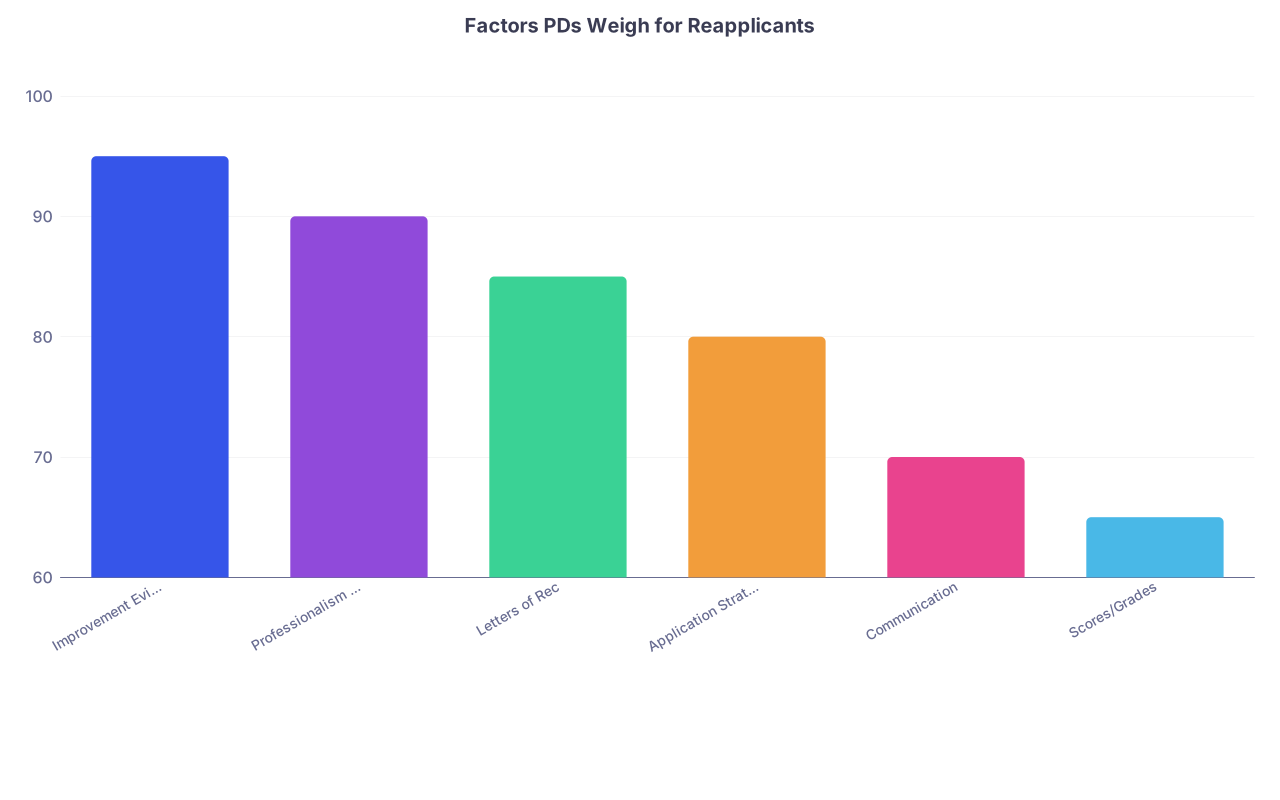
What PDs Actually Look for in a “Second Chance” Candidate
| Category | Value |
|---|---|
| Improvement Evidence | 95 |
| Professionalism Record | 90 |
| Letters of Rec | 85 |
| Application Strategy | 80 |
| Communication | 70 |
| Scores/Grades | 65 |
Let me strip away the fluff. PDs care about six main things when deciding if you deserve another shot.
1. Clear, Objective Improvement (Not Just “More Time Passed”)
If your new ERAS is basically last year’s with a different personal statement, PDs notice in 10 seconds. They’re looking for delta. Movement. Change.
The minimum kinds of improvement that make them pause:
- A new Step 3 pass (for prelims, IMGs, or those in limbo)
- Substantial recent clinical experience with strong, specific letters
- A structured research output if you’re in a competitive field
- Documented professional rehabilitation if there was any red flag
They ask themselves: “If I put this person in front of my residents and attendings now, what’s tangibly different from last year?”
If you cannot answer that in one sentence, they will answer it for you. With “nothing.”
2. Pattern of Reliability Since the Last Cycle
You’d be shocked how much weight PDs put on what you did with your “bad year.”
Did you:
- Disappear and do part-time scribe work with no meaningful supervision or letters?
- Drift through observerships with no one willing to stake their name on you?
- Or did you intentionally build a coherent year that looks like preparation, not purgatory?
Behind the scenes, PD talk sounds like:
- “He used that year to work on our service and nobody complained.”
- “She did a research year with X, and X only writes for people he’d hire.”
- “He just spun wheels. Same candidate plus 12 months.”
They’re not just judging the gap. They’re judging how you handle failure.
3. Letters That Explicitly Address “Readiness This Time”
Second-chance candidates live or die by letters. But not generic “great team player” letters. PDs are looking for wording that tells them: this person is ready now, not “maybe someday.”
Golden phrases PDs love to see in reapplicants’ letters:
- “I am aware the applicant was unsuccessful in matching previously. In the past year, I’ve seen them grow into someone I would not hesitate to have as my resident.”
- “Compared to when I first worked with them, their clinical reasoning and independence have markedly progressed.”
- “I would rank this applicant in the top X% of students I’ve worked with and would be comfortable supervising them as a first-year resident.”
Red-flag letters for reapplicants are the ones that avoid specifics, avoid comparison, and sound like a lukewarm character reference instead of a clinical endorsement.
PDs read subtext. “Pleasant, hard-working, and well-liked by peers” without “I would gladly work with them as a resident” might as well say: “Fine person, not my problem.”
How PDs Actually Review Reapplicants Behind the Scenes

| Step | Description |
|---|---|
| Step 1 | Recognize Name or Flag as Reapplicant |
| Step 2 | Scan for Objective Changes |
| Step 3 | Reject Unless Major Overhaul |
| Step 4 | Reject |
| Step 5 | Read New Letters |
| Step 6 | Discuss at Committee |
| Step 7 | Offer Interview |
| Step 8 | Previous Impression |
| Step 9 | Meaningful Improvement? |
| Step 10 | Strong Endorsements? |
| Step 11 | Any Champion? |
This is the internal algorithm, even if no one writes it on a whiteboard.
- Someone recognizes your name or sees “Reapplicant” in the notes.
- They recall the previous vibe: neutral, mildly positive, or problem.
- They scan for clear upgrades – scores, letters, roles, research, new degrees, Step 3, etc.
- If nothing obvious jumps out, you are silently dropped.
- If there’s something real, your file gets a longer look and maybe a hallway conversation:
- “Hey, you remember this guy from last year? Look what he did this year.”
- You still need one thing: a champion.
No champion = no second chance. Period.
A champion is that attending, APD, or PD who says: “I’ll put my name on this one.” They’re not doing that unless your growth is obvious and defensible.
Who Actually Gets That Second Chance vs Who Doesn’t
Let’s talk patterns. I’ve watched this play out years in a row.
The Reapplicants PDs Are Willing to Save
These are the ones PDs talk about as “worth another look”:
- The solid but unlucky: mid-range scores, some regional ties, decent letters, applied too aspirational. Next year they come back with Step 3, a meaningful home or affiliated rotation, and two new letters that say, “ready now.”
- The late bloomer: rough early med school, then clear upward trend, but not enough time to show it before first application. Spends the interim year on a busy service where attendings see real growth, then reapplies with strong clinical letters pointing to that trajectory.
- The previous near-miss: someone they interviewed and liked but didn’t rank high enough, or got squeezed out by numbers. PDs remember these people. A concise email saying, “This is what I’ve accomplished since we last spoke” can absolutely reopen the door.
The Ones PDs Quietly Blacklist
There’s another group that, frankly, PDs will not touch no matter how many cycles go by, unless there is overwhelming rehabilitation.
Patterns that land you there:
- Professionalism issues that involved dishonesty, boundary violations, or significant patient-safety problems
- Toxic comments from prior attendings that spread informally through the network (“I’d never hire this person”)
- Interview behavior that screamed poor judgment: badmouthing programs, arrogant, defensive, or clearly not insight-oriented
- Chronic instability — multiple unexplained leaves, dropped rotations, vague “personal issues” with no consistent references
You will never see “blacklisted” written down. But I’ve been in the room where someone said, “He’s reapplying again?” followed by eye rolls. You do not want to be that name.
What a “Convincing” Second-Chance Application Year Really Looks Like

The applicants who get respect as reapplicants don’t accidentally stumble into a better year. They design one.
For PDs, the most convincing pattern usually looks like this:
- You secure a structured clinical role: research fellow with patient contact, prelim/transitional year, hospitalist extender, or well-run externship with real supervision.
- You deliberately work with people who are known in the field or at least known locally, and you tell them, explicitly, that you are reapplying and need honest, strong letters.
- You fix whatever hurt you last time: late Step 2 score, weak sub-I, no recent US clinical experience, disorganized application list.
- You stay plugged in: grand rounds, journal clubs, M&M conferences, local projects; not just clocking in and out.
Most PDs respect this: “They got knocked down, put themselves in a harder environment, did the work, and now there’s proof.”
What they don’t respect: random shadowing, two-page CV updates of fluff, and “gap year” personal statements about “resilience” with no real-world performance behind it.
How Your Communication Shapes PDs’ Willingness to Forgive
This part almost no one teaches you.
The way you frame your previous failure and your current application in emails, personal statements, and interviews can instantly move you toward “mature and insight-oriented” or “still doesn’t get it.”
Three patterns PDs see over and over:
The Victim Narrative
- Everything is external: “the match is broken,” “US IMGs are discriminated against,” “my school did not support me,” “it was all timing.”
- PD takeaway: They’ll blame others when they struggle here, too. Pass.
The Self-Flagellation Spiral
- Overconfession, oversharing, long paragraphs of “I failed, I’m ashamed, I let everyone down.”
- PD takeaway: Emotionally unstable, may not handle residency stress well.
The Balanced Ownership (the one that works)
- Brief acknowledgment: “I did not match last cycle.”
- Clear ownership: “My application was weaker in X, Y, and I applied too broadly/narrowly in Z.”
- Focused growth: “This past year, I addressed those gaps by…” followed by concrete evidence, not emotional fluff.
In interviews, the best reapplicants answer “So what happened last year?” in about 60–90 seconds. Clear, factual, and then pivot to what’s different now.
The worst ones give a 7-minute monologue that has the PD staring at the clock.
The Silent Currency: Backchannel Calls and Off-the-Record Comments

You need to understand how much of your fate as a second-chance applicant is decided off paper.
When a PD is even partially interested in giving you another chance, they often do one or more of the following:
- Email or call someone at your med school or current institution: “What’s the real story with this person?”
- Ask a colleague at another program who might know you: “You guys interviewed him — how was he?”
- Check with prior letter writers indirectly: “You wrote for her last year. How did she handle not matching?”
If those backchannel conversations return with:
- “Honestly, they took it hard but bounced back and have been solid.”
- “He’s been incredibly reliable for us this year.”
- “She’s exactly the kind of person who learns from setbacks.”
You’ve just multiplied your odds.
If instead it’s:
- “They went pretty quiet after the match.”
- “Still some maturity concerns.”
- “I’d be cautious.”
You’re dead in the water, even if your ERAS looks slightly better.
That’s why I push unmatched applicants to stay visibly professional and consistent all year. People are watching even when you think they aren’t.
Red Flags PDs Will Not Overlook a Second Time
Some of you are hoping the system will “forget” what happened. It usually doesn’t.
Things that almost automatically kill your second chance unless dramatically addressed:
- Unexplained failures (course, rotation, Step, remediation) with no clear story of what changed
- Repeated exam attempts with minimal improvement – PDs read flat score curves as “this is their ceiling”
- Prior unprofessional behavior with no concrete steps to repair trust (formal coaching, remediation, documented improvement)
- Applying to the exact same unrealistic cluster of programs again – PDs see this as a judgment problem, not just bad luck
The worst-case scenario is when your file looks different only in volume, not in quality. More observerships, more “experiences,” more vague volunteering. Same weaknesses. PDs are not fooled.
How to Make a PD Think: “They Actually Earned Another Shot”
Let me give you a composite picture of an applicant PDs were willing to re-evaluate.
- First cycle: mid-range US MD student, okay scores, no red flags, applied super top-heavy to a competitive specialty, 7 interviews, no match.
- Gap year:
- Took a funded research position in that same specialty at a mid-tier academic center.
- Worked closely with one or two well-known faculty who saw them in clinic as well as research.
- Presented at a national meeting, co-authored a paper, and took a lead role on a QI project.
- Sat for and passed Step 3 during the year (if already graduated).
- Stayed in touch with prior interview programs via brief, non-desperate updates.
Second application:
- Personal statement: 1 short paragraph on not matching, 2 strong paragraphs on what they did about it, 1 on why they still want this field and what they bring now.
- Letters: 2 from the new institution, both explicitly addressing growth and readiness. 1 from an old mentor reaffirming support.
- Application strategy: a more balanced list, including mid-tier academic and solid community programs, realistic geography.
How PDs reacted:
- “They got real experience this year.”
- “Their letters actually say something.”
- “They fixed their strategy.”
Result: A few of the same programs re-interviewed, plus several new ones. And a match.
That’s what “deserving a second chance” looks like from our side of the desk.
Quick Comparison: What PDs See Side-by-Side
| Aspect | Weak Reapplicant | Strong Reapplicant |
|---|---|---|
| Gap Year Activity | Shadowing, casual work, vague observerships | Structured clinical/research role with supervision |
| Letters | Reused or generic | New, specific, address growth and readiness |
| Exams | No change or more failures | Passed Step 3 or clear improvement |
| Narrative | Blames system or over-apologizes | Owns gaps, focuses on concrete changes |
| Application Strategy | Same list, unrealistic | Adjusted, balanced, clearly more mature |
PDs may only spend 3 minutes on your file. But these differences jump out fast.
When It’s Time to Pivot Instead of Reapply Again
One more uncomfortable truth: sometimes the bravest move is not another application cycle. It’s a pivot.
PDs quietly talk about “chronic reapplicants” with 3, 4, 5 cycles. At some point, your persistence stops looking admirable and starts looking like denial.
Signals that another reapplication in the same specialty is unlikely to pay off:
- No meaningful new letters after a full year of trying
- Multiple attempts with no significant change in interview numbers
- Repeated feedback (direct or indirect) that your profile isn’t competitive for that field
- You’re stacking exam failures or marginal passes without an obvious breakout
When PDs see your name in ERAS for the third or fourth time with minimal change, they don’t think: “Wow, determined.” They think: “Why hasn’t anyone given this person realistic advice?”
Alternative paths — different specialties, non-residency careers, or delayed clinical roles — aren’t moral failures. They’re sometimes the only rational move.
FAQs
1. Should I directly mention that I did not match last cycle in my personal statement?
Yes, briefly and cleanly. One or two sentences acknowledging you did not match, paired with specific points about what was missing then and what you did to fix it. Anything longer starts to feel like justification or emotional processing instead of professional reflection. PDs want to see insight, not a diary entry.
2. Is it worth emailing programs where I interviewed before to say I’m reapplying?
If you were not a disaster there and you’ve truly improved, yes — but keep it short. One concise email: remind them who you are, acknowledge you didn’t match, list in 3–4 bullets what’s changed (Step 3, new position, publications, letters), and express continued interest. No attachments. No begging. Just signal: “I did the work; if you’re reconsidering reapplicants, I’d like to be in that conversation.”
3. How many cycles will PDs realistically consider someone as a serious candidate?
For most specialties, once you’re past two serious attempts without major change or a formal residency (prelim, TY) in between, your stock drops sharply. By cycle three, unless you have a compelling new credential (Step 3, strong US clinical work, clear remediation of prior issues), PDs start to assume there’s a reason no one has picked you. That doesn’t mean impossible, but your odds shrink dramatically.
4. Can a single bad comment or letter permanently kill my chances?
One truly toxic, detailed negative letter can absolutely poison your file for years, especially if it’s from a well-known person. But it’s not always permanent. PDs can reconsider if they see a long, consistent track record of excellent performance with new supervisors who explicitly state that any prior concerns have been addressed and that they’d trust you as a resident. The key is that the positive data has to be so strong, and so recent, that it feels risky not to give you another shot.
Years from now, you won’t be able to recite your exact ERAS entries or how many interviews you got. What will stick is how you responded when the system said “not this time.” PDs are not just deciding if you deserve a second chance as an applicant. They’re deciding if you’re the kind of physician who can take a hard hit, learn fast, and come back better. That’s what they’re betting on. And that’s the story you need your next application year to tell.