
The fastest way to get ignored during SOAP is not your Step score. It’s your email and phone behavior. Programs notice, and they talk.
You don’t get a second chance at first contact in SOAP. They’re stressed, moving fast, and trying to fill spots. If you look disorganized, unprofessional, or annoying in that tiny window, you’re done. I’ve watched perfectly viable applicants silently crossed off because of a single tone-deaf email or a missed call with a chaotic voicemail.
Let me walk you through the mistakes that quietly kill your chances—and exactly how to avoid them.
1. Acting Like SOAP Is Casual Email, Not High-Stakes Professional Contact
SOAP is not “reach out and see what happens.” Programs are triaging hundreds of applications in hours. Your emails and phone behavior are part of your file whether you realize it or not.
The big mental mistake: treating SOAP communication like a normal job search. It isn’t.
Common errors that scream “not ready for residency”:
- Sloppy subject lines like “Hi” or “Question”
- Writing from a sketchy personal email (think: [email protected] or worse)
- Walls of text with no structure
- Overly emotional language (“I’m devastated,” “I’m begging for a chance”)
You need to behave like someone they’d trust at 3 a.m. with a crashing patient and a terrified family.
Fix this before SOAP even starts:
- Use a clean, professional email: firstname.lastname@…
- Set a serious email signature with full name, degree, AAMC ID, phone
- Decide on one subject line format and stick to it (more on that later)
- Draft templates in advance so you’re not writing in panic mode on Tuesday
If your communication looks chaotic, programs assume your work will look the same.
2. The Email Subject Line Mistakes That Get You Ignored
Programs get flooded with emails during SOAP. Many are desperate, unclear, or flat-out useless. Your subject line determines whether they even open it.
Common subject line disasters:
- Vague: “Hopeful applicant” / “My interest” / “Question about your program”
- Overdramatic: “Please consider me, I’m very passionate”
- Demanding: “Urgent request regarding my application”
- All caps: “VERY INTERESTED IN YOUR PROGRAM”
- No identifiers: They have no idea who you are, what specialty, what context.
Here’s the harsh truth: if they can’t quickly connect your email to an ERAS application, many won’t bother opening it.
Use a clear structure like:
SOAP Applicant – [Specialty] – [Your Full Name, AAMC #]
For example:SOAP Applicant – Internal Medicine – Jane Doe, AAMC 12345678
That tells them, in two seconds, who you are and why you’re in their inbox. Do not get cute or creative here. Clarity beats clever every time.
3. Writing Overlong, Emotional, or Generic SOAP Emails
The worst SOAP emails I see hit all three: long, emotional, and so generic they could’ve been sent to every program in the country.
Programs hate this. They can smell copy-paste “Dear Program Director” spam instantly.
Red-flag patterns:
- Two-page essays retelling your entire life story
- Explaining why you didn’t match in painful detail
- Apology tours: “I know my scores are low, but…” repeated three times
- Generic “I am deeply interested in your excellent program” with zero specifics
- No reference to their program at all—just “your program”
During SOAP, they want concise and useful. Not catharsis.
Your email should:
- Identify you clearly
- State your link to their program or reason for interest briefly
- Highlight 1–2 concrete strengths that matter for that specialty
- Reassure them you’re ready to start July 1 and committed to that field
- End with an easy way to reach you quickly
If you cannot fit this on a single short screen of text, you’re writing too much.
Bad version (real vibe I’ve seen):
“I was heartbroken on Monday when I learned I did not match, but I have always dreamed of being a surgeon and your program is my top choice because of your commitment to excellence and community service…”
Better version:
“I’m a SOAP applicant in General Surgery (AAMC 12345678) who has applied to your program. I completed two GS sub-internships with strong evaluations and have performed over 120 OR cases as a sub-I and acting intern…”
You’re not writing a personal statement. You’re giving them a reason not to swipe past your ERAS file.
4. Blowing the Line Between “Professional Interest” and “Desperation”
Programs are allergic to desperation. They understand you’re in SOAP. They know you want a spot. What they don’t want is an applicant who appears unstable, needy, or boundary-blind.
Things that feel like “showing how much you care” but actually turn them off:
- “Your program is my top choice” emailed to 12 different places (yes, people forward screenshots)
- Repeated emails when they don’t respond
- Mentioning how your family is pressuring you or how devastated you are
- Talking about how you’ll take “any spot, anywhere” – that sounds unfocused and risky
- Name-dropping: “Dr. X said you should take a look at me” when Dr. X barely knows them
Your tone should be calm, respectful, and competent. Not frantic.
You can express genuine interest like this:
“I would be honored to train at [Program Name] and would gladly commit to your program if offered a position through SOAP.”
That’s clear, professional, and doesn’t sound unhinged.
5. The Follow-Up Mistake: Becoming a SOAP Stalker
This one is brutal. Somebody tells a program coordinator, “That applicant emailed three times in 24 hours,” and your name starts circulating with an eye-roll attached.
Over-contacting is a fast way to get quietly blacklisted.
Watch out for:
- Emailing before SOAP windows open or before you’re actually allowed to contact
- Sending a “just checking in” email a few hours after your first one
- Calling the program office “to see if you received my email”
- Trying multiple numbers in the hospital directory when no one picks up
- Contacting residents on social media to push your application
Anything that makes you look unable to respect process, timing, or boundaries is dangerous in SOAP.
Reasonable follow-up rhythm:
- One initial email during the appropriate SOAP window
- At most one follow-up after 24–48 hours, if the program is still unfilled and you truly have a strong, specific reason to reach out
If they don’t respond after that? Take the hint and move on. Pestering doesn’t convert into offers; it converts into, “Absolutely not.”
6. Catastrophic Phone Mistakes: Missing, Ignoring, or Mishandling Calls
During SOAP, your phone is not a phone. It’s life support. Treat it that way. Programs move fast—if you don’t answer, they may not call back.
Here’s how people accidentally sabotage themselves:
- Using a voicemail greeting that’s a joke, a song, or dead silence
- No voicemail set up at all
- Voicemail box full
- Unknown numbers screened or sent to voicemail automatically
- Not answering calls during SOAP blocks because they “didn’t recognize the number”
- Loud background noise when they pick up (bar, driving with windows down, TV blaring)
I’ve seen a PD literally say, “We tried, they didn’t pick up, moving on.” That’s it. No drama. Just gone.
Before SOAP week starts:
- Record a short, professional voicemail:
“Hello, you’ve reached [Full Name]. I’m unable to answer right now. Please leave your name, number, and a brief message and I’ll return your call as soon as possible. Thank you.” - Make sure your voicemail box is EMPTY and functioning
- Disable spam filters/“silence unknown callers” on your cell
- Keep your phone charged, on loud, and with you at all times during SOAP windows
And when you answer?
- Quiet background if humanly possible
- Clear greeting: “Hello, this is [Full Name] speaking.”
- Don’t say “Who’s this?” to an unknown number. Ever.
You want them thinking, “This sounds like someone I’d trust on night float,” not “This person can’t handle a basic phone call.”
7. Sounding Unprepared or Disorganized on the Phone
Programs expect you to be a little rattled. They do not expect you to be incoherent, clueless, or clearly unfamiliar with their program.
Common live-call mistakes:
- Fumbling to remember which specialty you applied for with them
- Saying “Uh…which program is this again?”
- Admitting you’re in the bathroom, half asleep, or driving and distracted
- Having to dig around for basic information (“Wait, what’s my AAMC ID…”)
- Rambling, oversharing, or talking in circles when asked direct questions
You don’t need a full script, but you do need a mental framework. Programs are trying to gauge: Is this someone I can trust? Are they serious about this specialty? Are they at least minimally prepared?
Have this by your phone:
- A one-page “cheat sheet” with:
- Your AAMC ID
- Your ERAS ID
- Top 5 programs you applied to in each specialty and 1–2 facts about each
- 2–3 key talking points about your strengths in that specialty
- A very brief “elevator pitch” introduction ready:
“I’m [Name], a graduate of [School], applying in [Specialty]. I’ve done [X] sub-I’s in [field], with strong evaluations in [Y and Z]. I’m especially interested in [short interest that matches their program type].”
If you answer the phone sounding like you’ve just been woken up from a coma, that’s what they’ll remember.
8. Time Zone and Availability Screwups
Yes, people still blow this. And it’s preventable.
Mistakes that make you look unreliable:
- Telling a program “Any time works” and then not picking up
- Confusing time zones for scheduled calls or virtual interviews
- Trying to reschedule last minute for a clearly avoidable reason
- Having overlapping interviews because you didn’t track times properly
SOAP is chaotic for programs. If you add chaos, they will cut you out of the pile if they have any other options.
Do this instead:
- Convert every time they give you into your time zone immediately and write it down
- Use a single calendar (Google, Outlook, doesn’t matter) and put SOAP times in big, obvious blocks
- Unless there’s a genuine emergency, don’t ask to reschedule
- During SOAP windows, assume you’re on call. For real. You’re on the “SOAP pager.”
9. Unprofessional Tone: Too Casual, Too Familiar, or Too Cold
Tone is where many otherwise strong applicants trip. They swing too far one way:
- Too casual: “Hey Dr. Smith! Just checking in :)”
- Too familiar: Using first names, making jokes, referencing personal details from their bio
- Too stiff/robotic: Sounds like ChatGPT wrote it. Completely generic. No actual connection.
You’re aiming for: professional, respectful, concise, and human.
Common tone mistakes:
- Overusing exclamation points
- Using text-speak or abbreviations
- Overpraising the program in a way that sounds fake (“Your world-renowned, exceptional, prestigious program…”)
- Sounding entitled: “Given my qualifications, I believe I would be an excellent addition…”
Better approach:
- One courteous greeting: “Dear Dr. [Last Name] and Selection Committee,” or “Dear Program Director,” if you truly don’t know their name
- Neutral, clear language
- A single, specific compliment or connection point: “I was particularly drawn to your strong community focus and the continuity clinic structure described on your website.”
If your email reads like either a fan letter or a legal memo, you’re off.
10. Inconsistent Information Between Email, ERAS, and Phone
Nothing unnerves programs faster than inconsistency. It raises questions about honesty, reliability, or both.
Watch out for:
- Saying in email you’re “fully committed to Internal Medicine” while your ERAS SOAP list is 80% another specialty
- Claiming a geographic tie you can’t actually back up if they ask
- Giving different stories about why you didn’t match
- Telling Program A they’re your top choice… then accidentally forwarding that same line to Program B
You will get caught. People talk. Coordinators compare notes, especially in smaller specialties and regions.
If you’re switching specialties in SOAP, own it clearly and consistently:
- One simple, non-dramatic explanation
- Show that you’ve done the homework for this new field (rotation, letters, some experience)
- No emotional rebranding of your entire history overnight
Alignment matters: ERAS, phone conversations, and emails should tell the same story.
11. Ignoring the Coordinator: The Hidden Gatekeeper
Huge mistake: treating the program coordinator like a scheduler instead of what they actually are—the gatekeeper.
The coordinator often:
- Screens the initial contact
- Flags applicants as “professional” or “not worth the headache”
- Tells the PD who was polite, responsive, and organized
Ways people accidentally irritate coordinators:
- Demanding updates: “Have you reviewed my application yet?”
- Sending multiple emails in a row when there’s no response
- Messy formatting, missing identifiers, or unclear questions
- Being short or dismissive on the phone because “they’re not the PD”
You’re not just auditioning for the program. You’re auditioning for the people who make the program run.
Treat every interaction—email or phone—with the coordinator as if the PD is BCC’d. Because sometimes, they are.
12. Not Preparing a Clean, Reusable Email Template (and Then Rushing)
The chaos mistake: trying to write every SOAP email from scratch while you’re emotionally fried. That’s when typos, wrong program names, and embarrassingly generic content creep in.
I’ve seen:
“Dear [Program Name], I am writing to express my strong interest in [Other Program Name].”
Instant delete.
You need:
- One base template that has:
- Your intro
- One short paragraph about your training and strengths
- One line you’ll customize about their program
- Your clear contact information
Then, for each program, you change:
- Program name
- One specific sentence about why you’re interested in them (location, structure, population, etc.)
And you proofread. Every. Single. Time.
If you’re copy-pasting between emails, double-check:
- Program name
- Specialty
- Any specific details (do they actually have that track you mentioned?)
Sloppy templates are how strong candidates get tossed for looking careless.
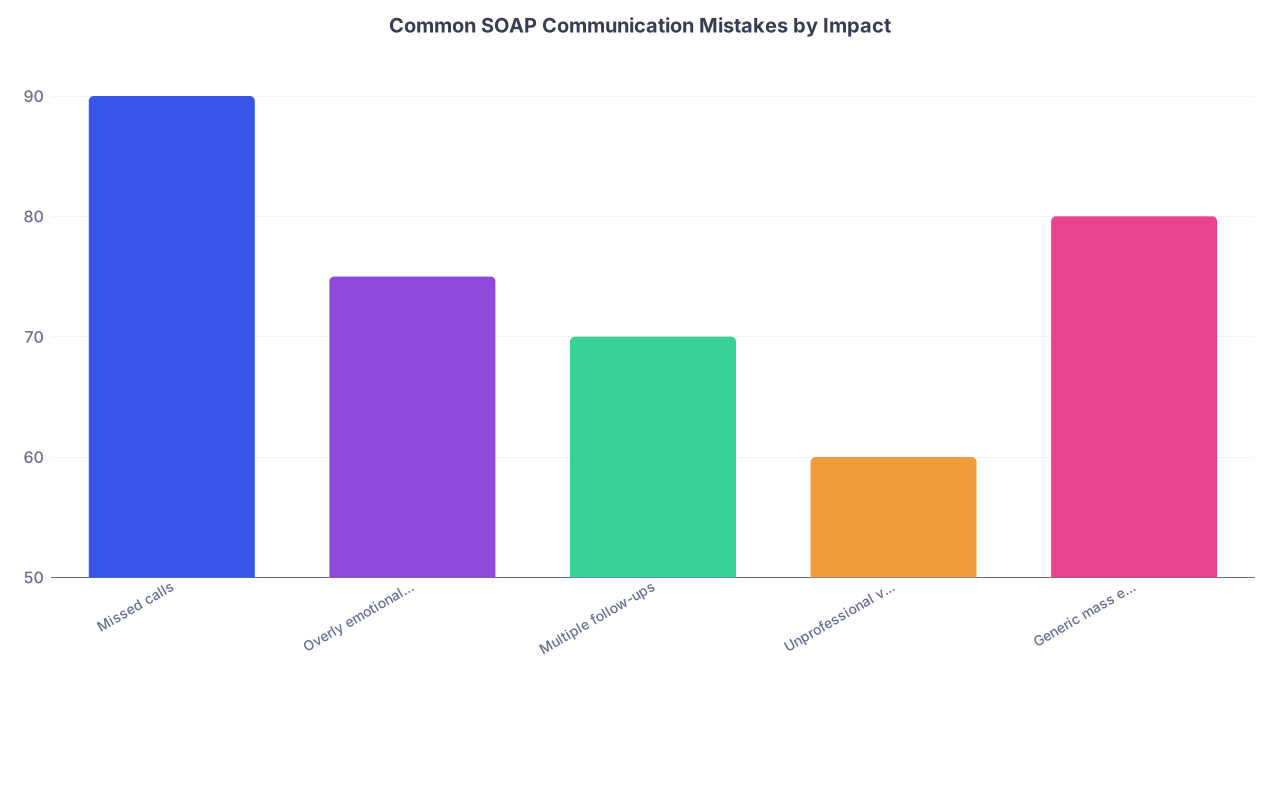
| Category | Value |
|---|---|
| Missed calls | 90 |
| Overly emotional emails | 75 |
| Multiple follow-ups | 70 |
| Unprofessional voicemail | 60 |
| Generic mass emails | 80 |

| Step | Description |
|---|---|
| Step 1 | Before SOAP |
| Step 2 | Professional email set |
| Step 3 | Voicemail updated |
| Step 4 | Templates drafted |
| Step 5 | Phone always on |
| Step 6 | Send concise, tailored reply |
| Step 7 | Answer professionally |
| Step 8 | Limited follow up |
| Step 9 | Contact from program |

| Area | Must-Haves During SOAP |
|---|---|
| Clear subject, concise body, identifiers | |
| Phone | Professional greeting, voicemail, charged and on |
| Tone | Respectful, calm, specific |
| Follow-up | Limited, spaced, non-demanding |
| Consistency | Same story across ERAS, email, phone |
FAQ (Exactly 5 Questions)
1. Should I email programs before SOAP officially starts to “get on their radar”?
No. That’s a classic mistake. Before SOAP windows open, many programs will not and should not engage with applicants. You risk looking like you don’t understand the rules or boundaries. Wait until the appropriate communication windows and follow NRMP guidance.
2. Is it okay to say a program is my “top choice” during SOAP?
Only if you mean it and are prepared to back it up. That phrase has been abused into near-meaninglessness. Use it sparingly and never send the same “top choice” line to multiple programs. If it hits the wrong inbox, it will hurt you.
3. How long should my SOAP interest email be?
Aim for 2–3 short paragraphs. If someone has to scroll more than once on a standard laptop screen, it’s probably too long. You’re not redoing your personal statement—you’re giving them enough signal to decide whether to click your ERAS file.
4. What if I miss a call from a program during SOAP?
Call back immediately. Leave a concise, professional voicemail if they don’t answer: your name, that you’re a SOAP applicant, your callback number, and that you’re available for a return call anytime. Then send a brief, very professional email to the coordinator or generic program email if you have it, acknowledging the missed call and your availability.
5. Can I text a program coordinator or PD if they call from a cell number?
Do not assume texting is appropriate unless they explicitly invite it. Even then, keep it minimal and very professional. Default to email and phone calls for anything substantive. A stray casual text can easily come across as too informal or boundary-blind in this context.
Key things to remember: Your SOAP emails and phone behavior are part of your application, not separate from it. Don’t look desperate, disorganized, or pushy. Answer your phone like a professional, keep your messages short and specific, and respect boundaries and timing. That alone will put you ahead of a depressing number of applicants.