
You’re a few months from “graduation invitation” emails going out. Your CV is open on one screen, NRMP Charting Outcomes on the other. Your Step scores and application list don't look great for your specialty. And the thought has hit you:
“Would it be smarter to delay graduation so I’m still a student if I don’t match?”
Let me be direct: delaying graduation can be smart in very narrow situations, but it’s one of the most misunderstood and misused “strategies” around the Match. A lot of people hurt themselves trying to game this.
Here’s how to think about it like an adult, not a panicked MS4.
The Core Question: What Problem Are You Actually Solving?
Delaying graduation can only help you with exactly three problems:
You need more time to:
- Patch big application holes (no home letter, weak clinical performance, no backup specialty).
- Take/retake Step 2/COMLEX 2 to show improvement.
- Do targeted aways or sub-Is in a different specialty.
You need to keep “student” status:
- To access student loans/financial aid.
- To use your med school’s malpractice coverage for extra electives or research.
- To qualify for certain Match pathways or programs that require “recent graduate” status.
You want to avoid having a “gap year as an unmatched graduate” on paper:
- Because some PDs are suspicious of grads who weren’t in training or a structured role.
- Because once you graduate, your school has less formal obligation to support you.
Everything else—like “NRMP will treat me differently” or “I’ll be less likely to SOAP if I’m a student”—is mostly noise or flat-out wrong.
When Delaying Graduation Actually Makes Sense
There are a few scenarios where I’ve seen delaying graduation be genuinely smart.
1. You Realize Way Too Late You Chose an Overreach Specialty
Example:
You’re applying ortho/derm/neurosurgery with:
- Step 2 in the low 220s (allopathic) or COMLEX on the lower side for that specialty.
- Minimal home support.
- No real backup applications submitted.
If it’s still before rank list certification or even before applications go out and you’re already thinking “I probably won’t match,” you have a decision:
- Graduate, go all-in, likely go unmatched, then scramble for a plan next year as a graduate.
- Or intentionally delay graduation, spend an extra year:
- Doing aways and building a real application in a more realistic specialty.
- Strengthening your academic and clinical narrative.
- Applying next cycle as a stronger first-time student applicant.
Delaying makes sense if:
- You’re willing to pivot specialties.
- Your school actually supports a fifth year and can structure it (sub-Is, research blocks, etc.).
- You can reasonably improve your competitiveness in that time.
If you’re just delaying a year to apply again with the same weak application? That’s pointless.
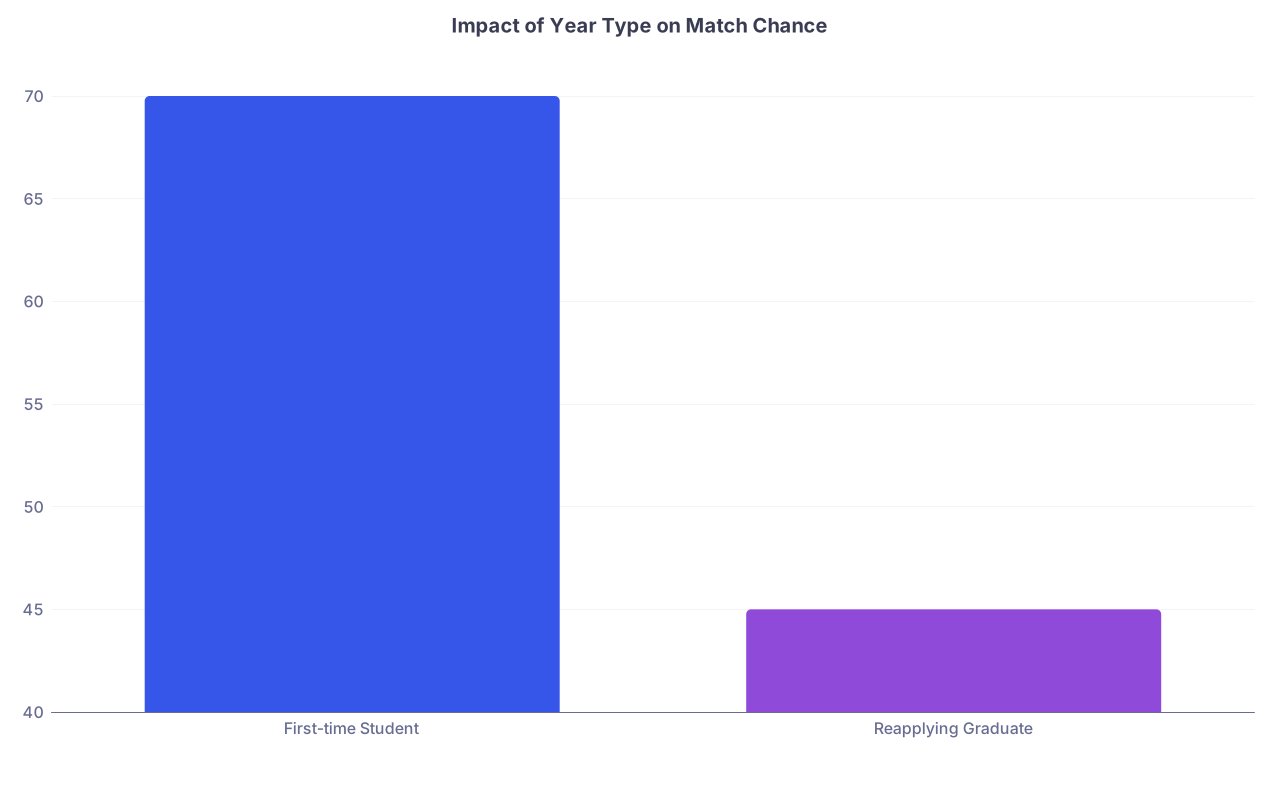
| Category | Value |
|---|---|
| First-time Student | 70 |
| Reapplying Graduate | 45 |
(Those numbers aren’t exact for your case, but the pattern is real: a weaker first attempt as a student beats a second attempt as a drifting graduate in many fields.)
2. You Need a Structured Year to Fix Real, Documented Problems
This is more common than people admit.
Situations like:
- Marginal clinical evaluations or professionalism concerns.
- A string of passes/borderline rotations with no strong letters.
- Step 1 pass, Step 2 barely passing, serious concern about performance.
Delaying graduation can be smart if it lets you:
- Repeat or extend key clerkships with close mentoring.
- Do sub-Is in your target specialty or your backup that can generate strong fresh letters.
- Have your Dean’s letter / MSPE updated later with improved performance.
This only helps if:
- Your school will rewrite or meaningfully supplement your MSPE.
- You actually plan to work and improve, not just exist for 12 months.
If your school says, “We don’t change the MSPE in any meaningful way,” then the impact of delaying drops sharply.
3. You’re Switching Specialties, Not Just “Delaying the Inevitable”
If you’re pivoting from something competitive to something more aligned but still selective (e.g., from plastics to ENT, or from derm to radiology), staying a student during the transition can help.
Why?
You can do:
- Targeted sub-Is in the new field.
- Research with recognized faculty in that specialty.
- Networking that isn’t awkward (“I’m an MS4 exploring X” sounds better than “I’m an unmatched graduate asking for help”).
Programs:
- Generally prefer “current students” over “unmatched grads” unless there’s a compelling story.
- Like to see your narrative evolve before you graduate, not after.
If your only plan is “I’ll stay a student, not change much, and hope for a miracle in the same specialty”? That’s magical thinking.

When Delaying Graduation Is Usually a Bad Idea
Let’s be blunt. A lot of people consider delaying for bad reasons.
1. You’re Just Afraid of Failing
“I’ll delay a year and then for sure I’ll match.”
No. Not unless something major changes.
If:
- You don’t have a concrete plan (new Step score, significant letters, true pivot).
- You’re mostly motivated by anxiety and avoidance.
Then you’re just buying an expensive, stressful extra year of being in limbo.
2. Your School Can’t Offer a Solid Fifth-Year Structure
Red flags:
- They say, “We’ve never done that before.”
- There’s no formal curriculum for extended students.
- They won’t guarantee:
- Enough sub-I/elective spots.
- Malpractice coverage for outside rotations.
- Ongoing career advising.
If you’re going to “delay” but just do random research and one extra elective while paying full tuition? Not smart.
3. Your Specialty Won’t Care Much That You Were Still a Student
In some primary care fields (FM, IM, peds), what matters more is:
- Recent clinical activity.
- Solid letters.
- Evidence of reliability.
You can get that as a graduate too:
- Chief year.
- Preliminary spot.
- Research position with clinical responsibilities.
- Locum/teaching roles in certain systems.
If your field doesn’t strongly value “we like students more than grads,” staying in school is less critical than actually building experience.
Key Practical Questions to Ask Before You Delay
Sit down with a trusted advisor or your Dean and go through these. If they can’t answer concretely, that’s your signal.
| Topic | Key Question |
|---|---|
| Curriculum | What will my actual schedule look like? |
| MSPE | Will my MSPE be updated with new strengths? |
| Financial | What tuition and fees will I owe? |
| Match Support | Will I still get full Dean/advising help? |
| Rotations | Can I get guaranteed sub-Is in my target field? |
And then the personal side:
- Am I actually going to work hard this extra year, or am I stalling?
- Do I have the money and emotional bandwidth for one more year?
- Is there a more direct route (e.g., prelim year, research fellowship, SOAP) that makes more sense?
How Delaying Interacts with the Match and SOAP
Let me clear up a few common misconceptions.
Does delaying graduation make SOAP easier?
Not really.
SOAP eligibility cares about:
- Your graduation date.
- Whether you’re eligible for the Match and for residency training by July 1.
Being a current student vs a fresh graduate doesn’t magically change your SOAP pool. Programs might have preferences, but NRMP doesn’t give you a special lane because you’re still technically MS4.
Does delaying make you look better to PDs than being an unmatched grad?
Sometimes, yes.
Programs often feel more comfortable with:
- “Student who took an extra year for X specific, structured reason.” vs.
- “Graduate who went unmatched and spent a year drifting or doing an unstructured job.”
But that only works if:
- Your reason is clearly explained in your application and MSPE.
- The extra year actually produced something: scores, letters, publications, sustained clinical performance.
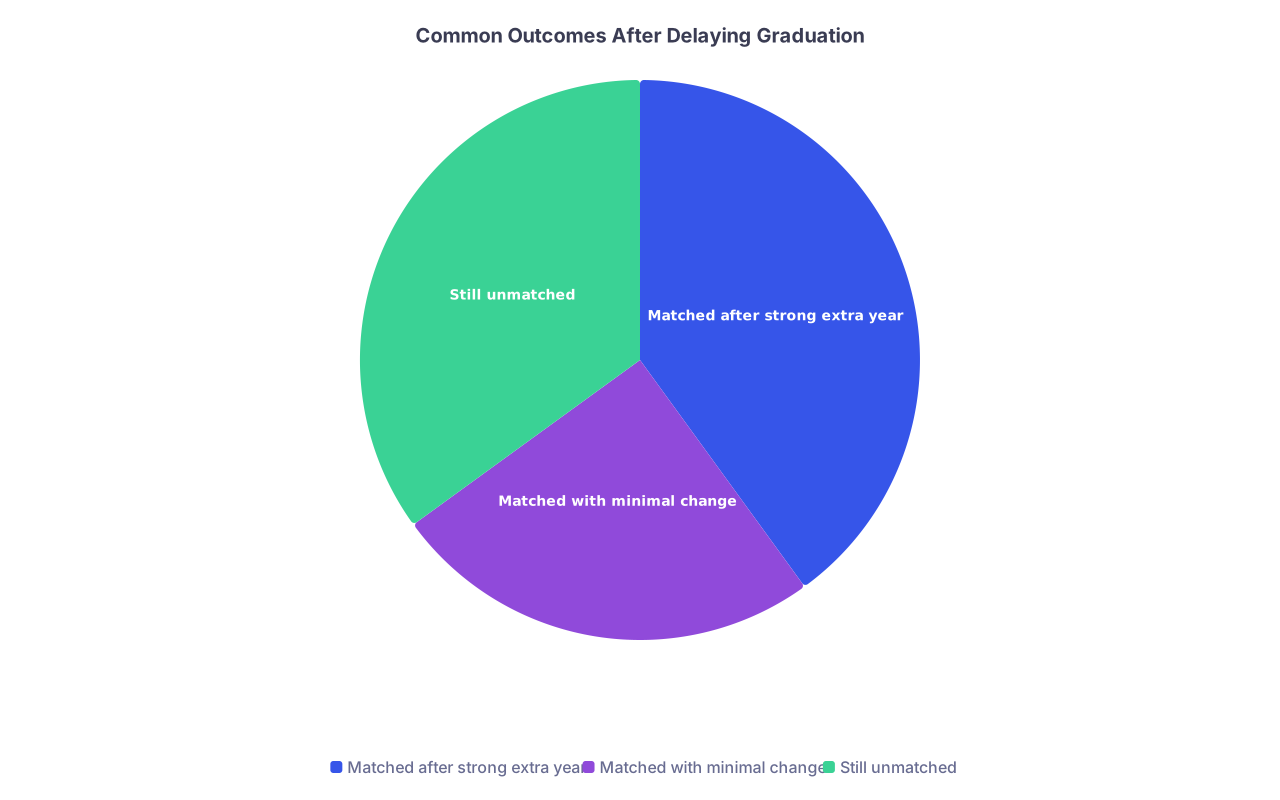
| Category | Value |
|---|---|
| Matched after strong extra year | 40 |
| Matched with minimal change | 25 |
| Still unmatched | 35 |
Again, the theme: strategy matters more than the extra calendar year.
Alternative Moves That Can Be Smarter Than Delaying
Before you commit to another year of tuition, look at these.
1. Commit To a Real Backup Specialty This Cycle
Many unmatched students never really used a backup. They “sort of” applied, but:
- No real tailored personal statement.
- No targeted letters in that specialty.
- Very few programs.
If you’re early enough in the season:
- You might be better served by:
- Aggressively applying to a realistic backup now.
- Rewriting your personal statement.
- Requesting at least one strong letter in that specialty.
Sometimes the best move isn’t to delay. It’s to stop pretending the reach specialty is still alive this cycle.
2. Use SOAP + Immediate Post-Match Planning
If it’s already late in the cycle:
- You might roll the dice this year, fully commit to SOAP if needed, then:
Post-match (if you don’t land something):
- Secure:
- A research fellowship in your target or backup specialty.
- A prelim/TY year if available.
- A structured role with direct patient care under supervision.
Then apply next cycle as:
- A graduate with current clinical/research credentials and clear growth.
Often, that’s more efficient than paying for another year of “student” status where you’re basically doing the same thing.

| Step | Description |
|---|---|
| Step 1 | Expect not to match |
| Step 2 | Add realistic backup specialty |
| Step 3 | Commit to SOAP plan |
| Step 4 | Revise PS and letters |
| Step 5 | Apply broadly this cycle |
| Step 6 | If unmatched pursue SOAP |
| Step 7 | Start residency |
| Step 8 | Plan structured gap year |
| Step 9 | Research, prelim, or extra clinical role |
| Step 10 | Reapply next cycle |
| Step 11 | Still time this cycle? |
| Step 12 | SOAP outcome |
How to Decide: A Simple Framework
Use this as a decision filter. If you can’t answer “yes” to at least most of these, delaying is likely a bad move.
Can I clearly state:
- Why I’m delaying?
- What will be different in my application next time?
Do I have:
- Specific rotations, projects, or exams scheduled during the extra year?
- Faculty on board who will supervise and advocate for me?
Did my Dean or experienced advisor say:
- “Yes, in your situation, delaying is actually reasonable”
and not just “We can support you if you really want to…”
- “Yes, in your situation, delaying is actually reasonable”
Is there no better alternative:
- SOAP + structured gap year.
- Applying in a backup specialty now.
- Taking a prelim year and reapplying from that position.
If you’re just hoping that time itself will fix your file, that’s magical thinking, not strategy.

Financial and Emotional Realities (People Gloss Over This)
Delaying graduation is not just about strategy; it’s about your life.
Questions you should actually answer:
Tuition and fees:
Are you paying full freight for a fifth year? Half? Per-credit? That number matters.Loans:
Will this push your loan burden into absurd territory? How does it change your repayment start date?Mental health:
Another year of “I’m not really done, I’m not really a doctor yet” weighs heavily. Some students handle it; others do not.Personal obligations:
Partner, kids, visa issues, location constraints—these can make delaying graduation a luxury you do not have.
Sometimes the emotionally and financially sane choice is:
- Graduate.
- Take a structured position.
- Reapply with a clear story.
Even if a theoretical “fifth year” might look nicer on paper.

FAQ: Delaying Graduation If You Expect Not to Match
1. Does delaying graduation increase my chances of matching next year automatically?
No. The year itself does nothing. Your chances improve only if you use that time to:
- Fix weak exam scores.
- Get strong, new letters.
- Add real clinical or research experience. If your application looks almost identical next year, most PDs will treat you exactly the same.
2. Is it better to be a fifth-year student or an unmatched graduate when reapplying?
It depends. Being a fifth-year student can be better if:
- Your school gives you structured rotations and active support.
- Your MSPE is updated with new strengths.
- You actually improve your CV.
Being a graduate can be just as good—or better—if you secure a strong prelim year, research spot, or clinical role with solid mentorship and letters.
3. Can delaying graduation help me avoid SOAP and just try again next year?
You can intentionally skip ranking or SOAP and plan to reapply, but:
- You’re wasting a shot this cycle.
- You’re paying for extra time as a student when you might instead be building experience as a prelim or research fellow.
I rarely recommend skipping SOAP if you’re already this far.
4. Will programs see my delayed graduation as a red flag?
They’ll see it as a question that needs a coherent answer.
If your explanation is:
“I extended to complete additional sub-internships in internal medicine and conduct a research year after realizing cardiology-focused IM was a better fit than neurosurgery,”
that’s fine.
If your story is:
“I just…stayed another year,”
that’s weaker.
5. What if my school discourages delaying graduation?
Then take that seriously. Schools that rarely approve fifth years often:
- Lack good infrastructure for it.
- Will not rewrite MSPEs.
- Can’t guarantee useful rotations.
You may be better off graduating and securing a structured role instead of forcing a reluctant institution to keep you on.
6. If I expect not to match, what should I do this week—not next year?
This week:
- Meet with your Dean or residency advisor and ask bluntly about your odds.
- If you still have time, identify and apply to a realistic backup specialty with a specific plan for letters and a tailored personal statement.
- If it’s late in the cycle, build a SOAP strategy now: what fields you’d accept, how broad you’ll go, who will help you.
Only after that conversation should you even bring up “Should I consider delaying graduation?”
Today’s actionable step:
Open a blank document and write a one-paragraph answer to this question:
“If I delayed graduation one year, what exactly would be different in my application and why would that make a program say yes next time?”
If you can’t write a clear, concrete paragraph, you’re not ready to delay. You’re just tempted to stall.