

What actually happens if you go unmatched not just once, but multiple times… and you start to wonder if you’ll never match at all?
Because that’s the real fear, right? Not just “I didn’t match this year,” but “What if this is it? What if I wasted med school, all that debt, all those nights on call as a student… for nothing?”
Let’s walk straight into that fear instead of dancing around it.
First: The Nightmare Scenario You’re Imagining
You probably know the stats people throw around:
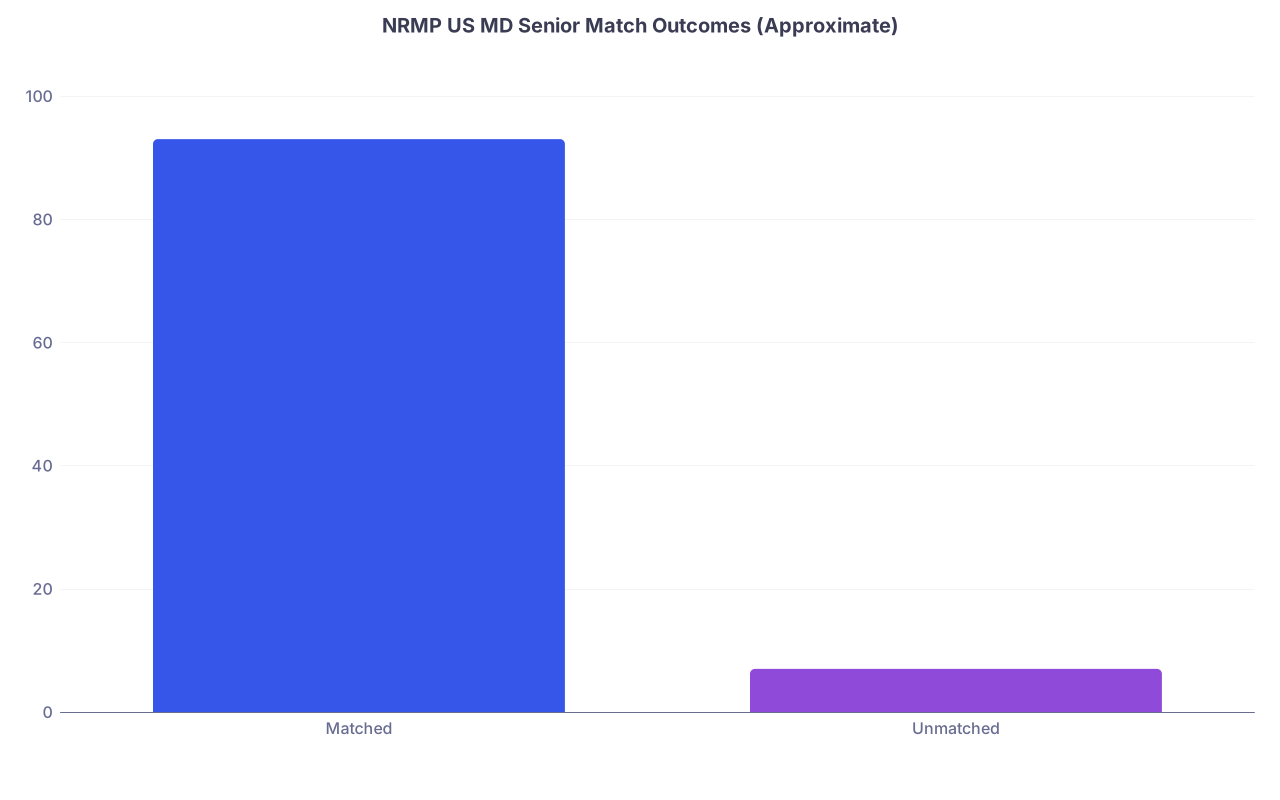
| Category | Value |
|---|---|
| Matched | 93 |
| Unmatched | 7 |
Everyone likes to say “most people match,” which is technically true and completely unhelpful when you are sitting there thinking, “Okay, but what if I’m in the 7%… again… and again?”
The nightmare version in your head usually looks like this:
- You don’t match.
- You try SOAP and still don’t get a spot.
- You apply again next year, still unmatched.
- Your attempts pile up, your CV gets “stale,” people stop answering emails.
- You hit the “too many years since graduation” wall.
- Doors quietly close and nobody tells you exactly when it happened.
And then what? You work some random non-clinical job with an MD/DO next to your name that you can’t really use. You avoid old classmates. You quietly rewrite your whole identity.
You’re not crazy for thinking this through. I’ve seen versions of this happen. Not the Hollywood disaster movie version, but the slow, confusing, “what now?” version.
The good news: “never match” is possible but way less common than your brain is telling you at 2 a.m.
The bad news: if you do nothing strategic and just “try again next year” on repeat, yeah, you can drift into that zone.
So let’s be brutally honest about what actually happens and what your realistic outcomes are.
Year 0: The First Time You Go Unmatched
You open your email on Match Day (or earlier for pre-match systems). No position. Your name isn’t on the list. Your heart drops into your stomach.
Here’s reality: the first time you go unmatched, your career is absolutely not over. It feels like it is. It isn’t.
There are a few immediate tracks you can land on:

| Step | Description |
|---|---|
| Step 1 | Unmatched |
| Step 2 | SOAP or scramble |
| Step 3 | Take gap year and reapply |
| Step 4 | Consider different specialties |
| Step 5 | Consider alternate careers |
Most people:
- Try SOAP (or the equivalent)
- Reassess their specialty choice
- Plan 1–2 “bridge” years (research, prelim year, teaching, etc.)
- Reapply with a stronger application
If you’re a US grad within 1–3 years of graduation, especially in a core specialty (IM, FM, peds, psych, etc.), your chances of eventually matching with a decent salvage plan are still pretty solid.
The key is this: your first unmatched year is a fork in the road, not a dead end. What you do in the 12 months after that is what really decides your trajectory.
When “Never Matching” Starts To Become More Likely
“Never” usually doesn’t happen in one big moment. It happens through a combination of these:
- Repeated attempts without meaningful changes (same specialty, same programs, same personal statement, same weak letters)
- No fresh clinical experience for several years
- Step/COMLEX failures without a clear redemption story
- Being 5+ years out from graduation with nothing strongly clinical to show for it
- Very limited geographic flexibility
- High-competition specialty fixation (e.g., derm, ortho, plastics) with no backup you’ll truly follow through on
If you want a rough idea of risk zones, think something like this:
| Years Since Graduation | Risk Level If No New Clinical Work |
|---|---|
| 0–2 years | Low |
| 3–4 years | Moderate |
| 5–7 years | High |
| 8+ years | Very High |
This table isn’t official. It’s just what you start to see informally:
- Under 2 years: People expect some chaos. Research years, personal issues, second attempts. Programs are flexible.
- Around 3–4 years: Programs start asking “Why no residency yet?” and mean it.
- 5+ years: You need a really strong narrative and usually ongoing clinical work (research with patient contact, teaching, something).
- 8+ years: People do still match… but it’s rare and usually involves major sacrifices: location, specialty, salary, etc.
Realistic Outcome #1: You Match Later Than You Wanted
This is actually the most common “scary” outcome.
You don’t match the first time. Maybe not the second. You take a research year. You do a prelim year. You switch specialties. You swallow your pride.
Then one day you’re the PGY‑1 who started two or three years behind your classmates.
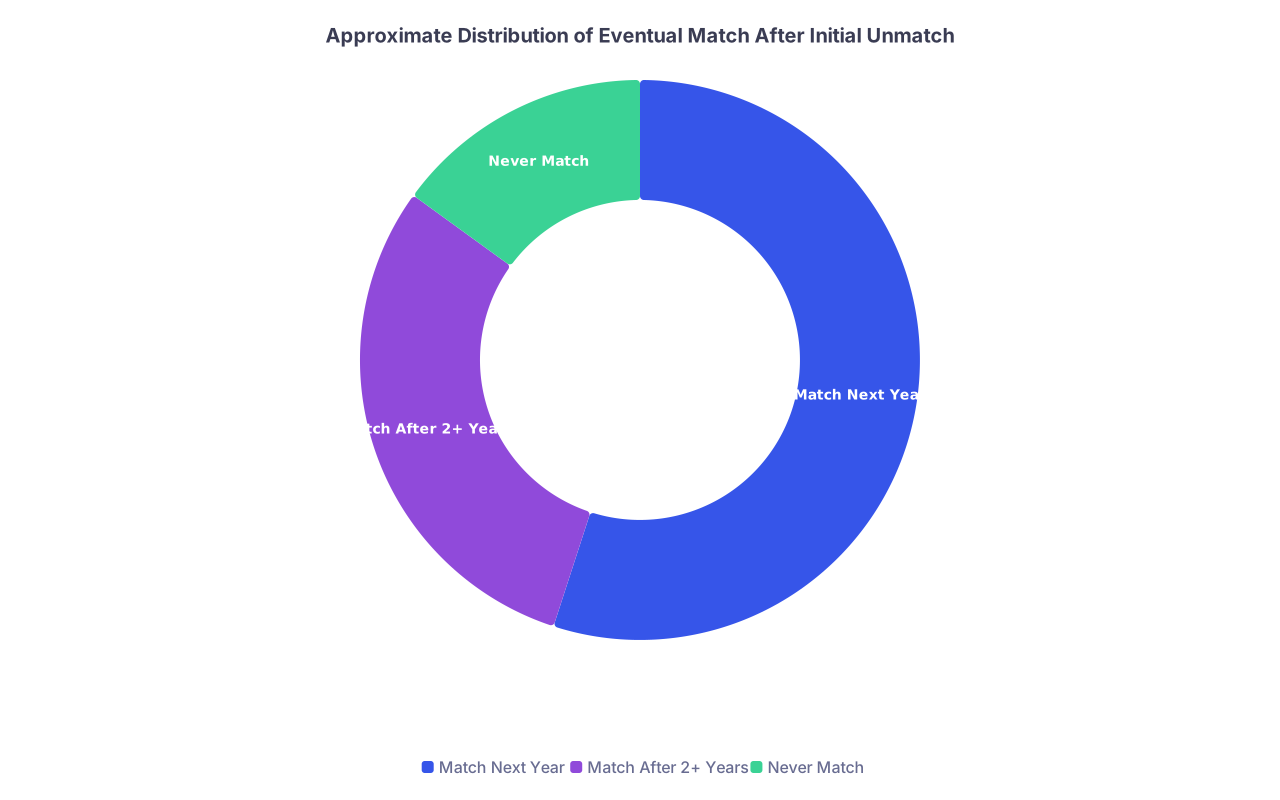
| Category | Value |
|---|---|
| Match Next Year | 55 |
| Match After 2+ Years | 30 |
| Never Match | 15 |
Again, these aren’t official exact numbers, but this is roughly the vibe from what I’ve seen:
- A big chunk match the following year after strategic changes.
- A decent group match after multiple cycles + bridge experiences.
- A minority really do never match.
What this looks like in real life:
- The IMG who went unmatched in internal medicine twice, did two research years, picked up some observerships, rewrote the personal statement with a clear arc, and finally matched into a small community IM program in the Midwest.
- The US MD who struck out in EM, took a year as an ED scribe director + research, then swallowed the ego and applied broadly to FM and matched at a solid unopposed program.
- The DO who failed Step 1 once, passed on second attempt, went unmatched in ortho twice, then pivoted to PM&R and matched after a transitional year.
You don’t see these stories blasted on social media. People don’t brag about “I matched on my third try.” But it happens a lot more than people admit.
Realistic Outcome #2: You Pivot Specialties (Sometimes Hard)
This one hurts the ego the most: actually letting go of a dream specialty and moving into something else.
You probably already know which specialties are brutal:
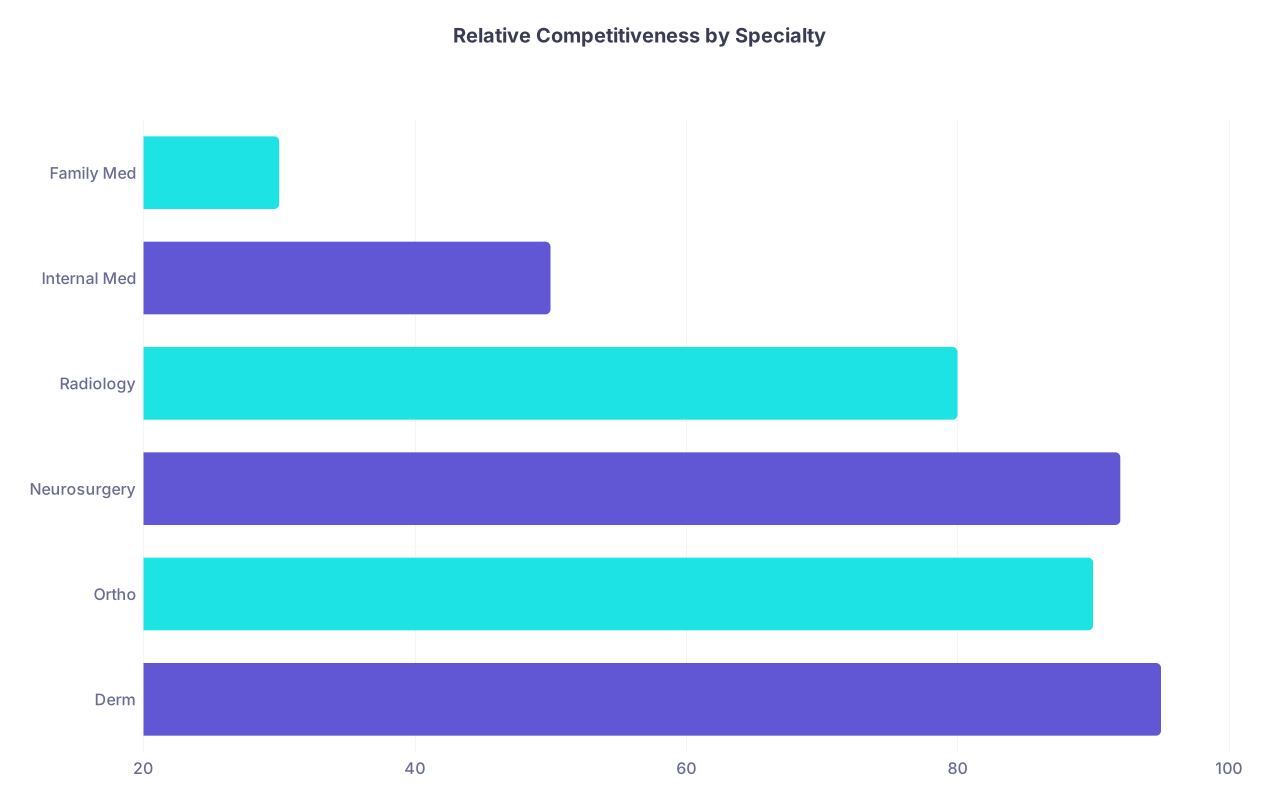
| Category | Value |
|---|---|
| Derm | 95 |
| Ortho | 90 |
| Neurosurgery | 92 |
| Radiology | 80 |
| Internal Med | 50 |
| Family Med | 30 |
(Values here = rough competitiveness vibe, not real percentages.)
If you’ve gone unmatched pursuing something like derm, ortho, neurosurg, plastics, ENT, etc., and your application has real red flags (failed exams, poor class rank, minimal research, late interest), hanging on for 3–4 more years “just trying again” can drag you straight toward the never‑match cliff.
The people who salvage their careers:
- Take a brutally honest look at their competitiveness.
- Talk to PDs who will actually tell them the truth, not just pat their head.
- Switch to a field that fits their stats and gives them a realistic shot.
Do you want derm more than you want any residency? Really? Or do you want to be a physician first, then see what kind of career you can build inside that?
If your honest answer is “I just want to be a practicing doctor,” then pivoting is not a failure. It’s survival.
Realistic Outcome #3: You Stop Chasing Residency And Build Another Career
Here’s the one nobody wants to say out loud but it’s absolutely real: some people never match. At some point, they stop applying.
That doesn’t automatically mean they “wasted” their degree, but it does mean they have to rewrite the story they thought their life would follow.
I’ve seen:
- A US MD who never matched after 4 cycles go into medical writing and then pharma. Six years later they were making more than their classmates and working remote.
- An IMG who got stuck 8+ years out of graduation, became a clinical research coordinator, then a site director, then moved into CRO work.
- A DO who didn’t match, then did utilization management for an insurance company and later became a medical director.
Is this everyone’s dream? No. Does it feel like a consolation prize at first? Absolutely. But is it viable and sometimes even turns out okay? Yes.
If “never match” happens, it usually looks like this:
- 2–4 failed cycles of trying (sometimes more).
- No new meaningful clinical or academic activity.
- Graduation date creeping further into the past.
- Quietly realizing your odds are dropping and your mental health is tanking.
- Making a conscious choice to stop, rather than waiting until you’re completely burned out.
That conscious choice part matters. It gives you back some control.
How To Tell If You’re Drifting Toward “Never Match” Territory
Ask yourself some very uncomfortable questions. Write the answers down. No sugarcoating.
- How many cycles have I applied seriously? (Not half-hearted attempts.)
- Has my application significantly changed since the first time?
- Do I have clear feedback from PDs or advisors who actually know what they’re talking about?
- Am I widening my specialty and geographic options, or clinging to the same narrow set?
- Is there a point (years from now) where I personally would choose to stop trying?
If the honest answers are:
- “Multiple cycles, with basically the same application”
- “No real new clinical or research experience”
- “Still no interviews, or always the same one or two places”
…then yeah, the probability of never matching starts creeping up.
This isn’t to scare you. It’s to stop you from sleepwalking into a situation where five years vanish and you’re still saying, “Maybe next year will be different” with no plan.
Concrete Moves To Pull Yourself Away From “Never”
There’s a difference between anxious spinning and strategic action. Here’s the kind of stuff that actually changes your trajectory:
- A research year with a known, well-connected PI in your target or adjacent specialty, with real output (posters, abstracts, manuscripts).
- A prelim or transitional year with strong evaluations and letters you actually ask for early and proactively.
- Redoing Step 2/Level 2 (if possible) or crushing any remaining exams to show upward trend.
- Rewriting your entire personal statement and experiences to show a coherent story, not “I like helping people and I love the specialty.” Everyone writes that.
- Asking PDs straight-up: “If you were me, what would I need on my CV in 1 year for you to realistically consider me?” and then actually doing those things.
And the big one: being willing to rank and apply to places you used to say you’d “never” go. Because “never that location” is a luxury mindset if you’re also terrified of never matching at all.
Your Worst Fear, Plainly Stated
Here’s the raw version of what you’re scared of:
“I will try for years. I will keep hoping. My life will be on pause. I’ll watch everyone around me move on. And one day, I’ll have to admit it didn’t happen, and I’ll feel like I ruined my one shot.”
That’s the monster under the bed.
The truth is messier:
- Some people do match late and end up fine.
- Some pivot to different specialties and end up surprisingly happy.
- Some never match and eventually find other careers and identities that are… okay. Sometimes more than okay.
None of those paths erase the pain or the grief or that punched‑in‑the‑stomach feeling of going unmatched. That’s real and it sucks.
But this idea that your life is either “match on time into dream specialty” or “total failure forever” is just wrong. That’s your anxiety talking, not reality.
What You Can Control Right Now
You can’t control the algorithm. You can’t control how many positions get offered or which PDs actually read your file.
You can control whether you’re:
- Getting real feedback or hiding from it.
- Making strategic changes or repeating the same cycle.
- Expanding options or clinging to a fantasy version of how this “should” have gone.
- Setting a personal stopping point—or letting this drag on until everything feels numb.
You don’t need to decide your whole life tonight. But you can pick one concrete thing to do that pulls you even 1% away from the “never match” edge and toward an actual plan.
FAQ (Exactly 4 Questions)
1. Is it true that if I don’t match within a few years of graduation, I basically have no chance?
Not “no chance,” but your odds do get worse the further you are from graduation without ongoing clinical work. Programs worry about knowledge decay, readiness, and why nobody has picked you up yet. If you’re 5+ years out with no residency and no strong clinical or academic role, it’s tough. Not impossible, but tough enough that you should be very intentional about whether you keep trying and how.
2. Should I apply again next year even if I don’t change much in my application?
Honestly? That’s usually a waste of time and money. If your last application got you zero or almost zero interviews, something substantial has to change: specialty choice, exam scores, research/clinical experience, letters, or breadth of programs. Just resubmitting the same story and praying is exactly how people wander toward the “never match” outcome.
3. Is switching to a less competitive specialty basically giving up?
No. It’s giving up an image you had of yourself, which hurts, but it’s not giving up on being a physician. A lot of people discover that what they actually cared about—patient population, procedures vs. clinic, lifestyle—can be found in multiple fields. Clinging to derm or ortho or neurosurg at all costs while your chances crater isn’t brave; it’s self-sabotage.
4. If I eventually decide to stop chasing residency, how do I even tell people?
You tell them the truth in one or two clean sentences, and you practice it until it doesn’t choke you: “I pursued residency for several years, but it didn’t work out the way I hoped. I’ve since moved into [medical writing/pharma/research/whatever], and that’s my focus now.” Some people won’t get it. That’s fine. The real work is making peace with it yourself, and that takes time—but it starts with owning the decision instead of treating it like a shameful secret.
Open a blank document right now and write two lists: “If I match later than planned, I can accept…” and “If I never match, I’d eventually pivot to…”. Get those worst-case scenarios out of your head and onto paper, where you can actually start making a plan instead of just spiraling.


