

You’re sitting on your couch with your phone face‑down because you can’t look at it anymore. Emails have stopped coming. Match is over. Or maybe you pulled your application this year because Step scores, life stuff, burnout, whatever. Either way, you’re looking at your MD or DO diploma thinking: “If I don’t start residency now, did I just light this entire degree on fire?”
That’s the fear, right? Not just “I didn’t match” or “I’m delaying a year.” It’s: Did I waste the last decade of my life and six figures of debt if I don’t go straight into PGY‑1 like everyone else?
Let me say this directly: No, your medical degree is not “wasted” if you don’t start residency right away. But I also won’t sugarcoat it—there are real consequences, and some paths get harder the longer you wait. Both things can be true.
What Programs Really Think About “Gaps” After Graduation
You’re probably replaying that phrase in your head: “time since graduation.” You’ve seen it on program websites. You’ve heard rumors—“no one takes grads more than 3 years out.” It sounds like a death sentence.
Here’s what’s actually going on.
Programs don’t care about “gaps” because of some moral failing. They care because they’re terrified you’ll be rusty, unsafe, or checked out. They want to know:
- Did you keep one foot in medicine?
- Can you explain what you were doing?
- Does your story make sense or look like chaos?
There is a rough reality to “years since graduation” though, and it varies:
| Specialty Type | Common Comfort Range | Gets Hard After |
|---|---|---|
| Primary Care (FM, IM) | 0–5 years | 5+ years |
| Pediatrics, Psych | 0–5 years | 5+ years |
| Surgical specialties | 0–3 years | 3+ years |
| Competitive specialties | 0–2 years | 2+ years |
Are there exceptions? Yes. I’ve seen a 7‑years-out FMG finally match Family Medicine after doing research and hospitalist assistant work. I’ve seen a guy who left after not matching surgery, did 2 years of solid research, then matched gen surg.
But here’s the ugly truth people whisper in the back of the library: the longer you’re out with no clinical or academic connection, the more you will have to fight for your application to be taken seriously.
Still not wasted. Just more uphill.
So if you’re thinking, “If I don’t match or start this July, I’m done,” that’s simply not accurate. But “I can vanish for 3 years and then easily stroll into Derm”? Also no.
What Actually Makes a Degree Feel “Wasted”
It’s not “not starting residency right away” that does it.
What makes people feel like their degree is wasted is a mix of three things:
Total disconnection from medicine
I’m talking about the people who, after not matching or delaying, go, “Screw it,” and vanish. No clinical work. No research. No teaching. No CME. Nothing. Just DoorDash and existential dread.
A year of recovery? Fine. A year of complete disappearance with no plan? That’s the part that hurts when you try to come back.Shame paralysis
You avoid old classmates. You don’t email attendings. You don’t ask for help because you feel embarrassed. You pretend you’re “figuring things out” while mostly doom‑scrolling.
That’s not a character flaw; that’s what chronic shame does. But programs can’t support a story you never write.Random, disconnected choices
You stack on 3 different non‑clinical jobs, none of them related to health or education, and then ask a PD to believe you’ve always been passionate about Internal Medicine. It’s not impossible to explain, but it’s harder.
Here’s the flip side: I’ve seen people delay residency or reapply later and end up stronger applicants because their “off year” or “off years” were actually coherent:
- Research fellow in a department they later matched into
- Longitudinal clinical job (scribe, clinical instructor, hospitalist extender in some countries)
- Global health or public health work with actual structure and letters
- MPH, MBA, MEd with projects tied to actual patient care or systems
Your degree gets “wasted” when you stop giving it any context, not when you stop residency on July 1st.
Concrete Things You Can Do If You’re Not Starting Residency Right Away
Let’s say: You didn’t match. Or withdrew. Or you’re an IMG still waiting on Step scores or visas. And your brain is screaming: “Fix it. Fix everything. Now.”
Slow down. You don’t have to fix your entire career this week. But you do need to be intentional in the next 6–12 months.
Here’s the stuff that actually helps, not the vague “network and keep your options open” fluff.
1. Anchor yourself to a department or institution
Programs like seeing that someone else in medicine took a chance on you and trusted you.
That might look like:
- A research position in the department you want (even unpaid at first, but try to convert that fast)
- A clinical instructor/observer role (if you’re an IMG or in a system where this exists)
- A formal non‑ACGME job: research fellow, junior clinical fellow, hospitalist assistant, whatever acronym your country uses
If you can get your name and face regularly in front of attendings, you can get:
- Recent letters
- A PD or chair who can say, “I see this person weekly. They’re good. They’re safe.”
That matters a lot more than whether you started residency exactly 2 months after graduation.
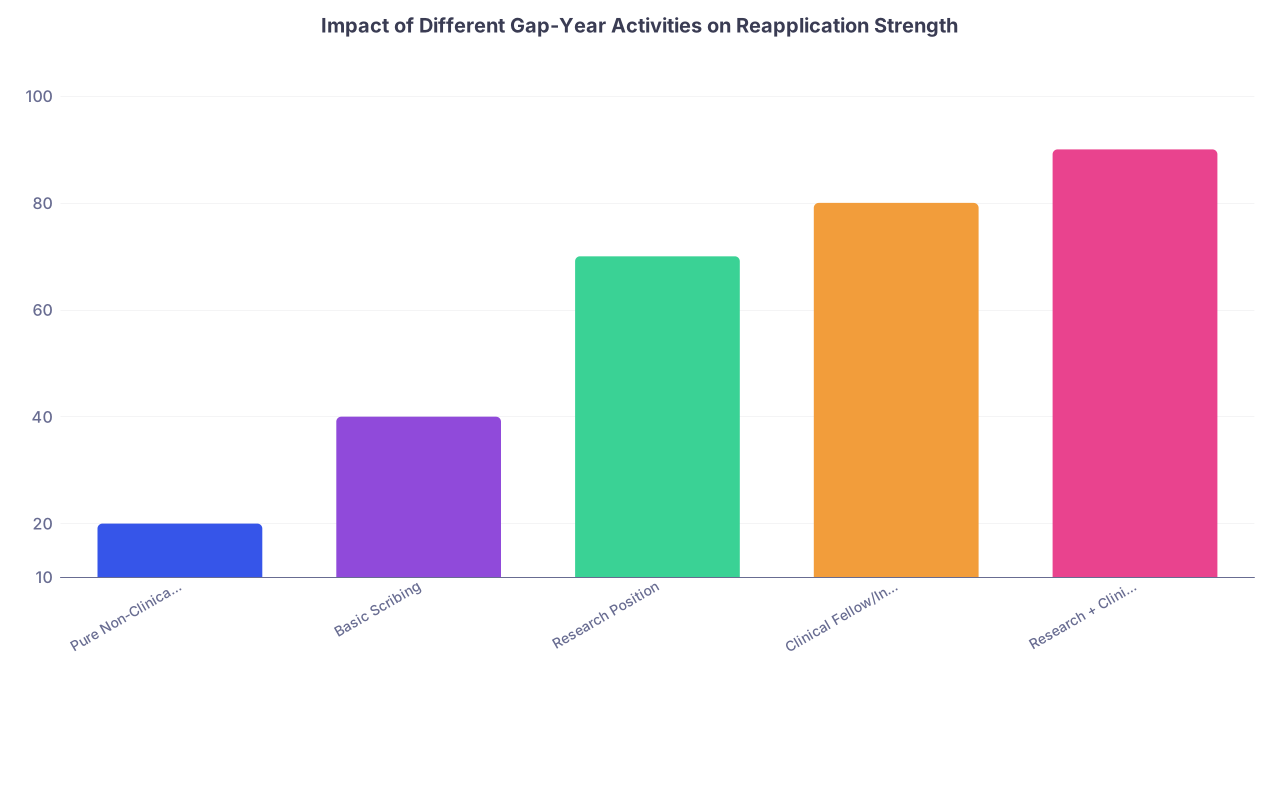
| Category | Value |
|---|---|
| Pure Non-Clinical Job | 20 |
| Basic Scribing | 40 |
| Research Position | 70 |
| Clinical Fellow/Instructor | 80 |
| Research + Clinical Mix | 90 |
(Think of those numbers as rough “helpfulness” scores, not actual stats.)
2. Stay clinically and academically “alive”
Priority: Do not look frozen in time on paper.
You want things like:
- Recent clinical exposure: observerships, part‑time clinical roles (where allowed), shadowing with documentation that it happened
- CME: online modules, in‑person courses, certificate programs in your interest area
- Academic output: a poster, a case report, a quality improvement project, something that produces a bullet point on your CV with dates in the last 12–18 months
Is it annoying and sometimes unpaid or low paid? Yeah. But when a PD opens your file and sees activities up to “2025–2026” instead of “last updated 2022,” it instantly lowers their anxiety about you being rusty.
3. Get brutally honest about specialty choice
This is where the “wasted” fear gets loud.
You might be clinging to a hyper‑competitive specialty because you feel like settling for anything else proves you weren’t “good enough.” I’ve seen people stay stuck in a 4‑year limbo chasing Derm, Ortho, or Plastics with mediocre scores and no research, instead of transitioning to something they’d actually be excellent at.
You will not get a badge for suffering in limbo the longest.
If your stats, trends, or application history clearly say, “This specialty is a brick wall for you,” forcing your degree through that one door is how you make it feel wasted.
Sometimes the smart move is:
- Pivoting to a less competitive but still satisfying specialty
- Looking at prelim/transitional years as a foot in the door
- Considering community programs more than big branded names
Your MD/DO/MBBS is not married to one specialty. You’re allowed to change strategy without it being a failure of the entire degree.
4. Stabilize your life enough that you don’t crater mid‑year
Nobody talks about this, but it’s huge.
If your gap year(s) are financially and emotionally catastrophic, it gets harder to show up as a functioning human on interview day. You need some baseline:
- A predictable income (even if it’s not glamorous)
- A place to live that isn’t on the verge of collapse every month
- At least some mental health support, especially if you’re dealing with shame, depression, or anxiety
No PD is going to say, “Oh, your CV was perfect except for the year you took care of your dying parent and worked at Starbucks to stay afloat, so we rejected you.” Life happens. You just have to be able to say, “Here’s what happened, here’s what I learned, and here’s how I stayed connected to medicine as much as I reasonably could.”

“What If I Never Do Residency?” – The Nuclear Fear
Let’s walk straight into the worst‑case scenario your brain keeps replaying:
“What if I never match? What if I never start residency? Was all of this pointless?”
Here’s where people either lie to you or talk around the truth. I’ll just say it:
If your dream was direct patient care as an attending and that never happens, that’s a loss. A real one. You’re allowed to grieve that.
But “never do residency” =/= “degree is trash, forever useless.”
People with medical degrees who don’t complete residency end up in all kinds of roles:
- Clinical research coordination and leadership
- Pharma and biotech (medical affairs, clinical trials, safety)
- Public health, policy, health systems design
- Consulting (yes, the cliché, but it exists for a reason)
- Medical education, MCAT/USMLE prep, curriculum design
- Health tech, startups, product design for medical tools
Are these paths always easy to break into? No. Some are saturated. Some require networking you don’t feel like doing. Some pay less at first than you imagined as an attending.
But I’ve seen people who never did residency become:
- Senior clinical scientists in pharma making more than many attendings
- Directors of medical education content
- Successful founders of health‑adjacent companies
If you zoom out 15 years, the question becomes less “Did I ever do an ACGME residency?” and more “Do I have a career that feels meaningful and uses what I know?”
The degree gives you credibility, pattern recognition, and a language very few people have. Not doing residency may close some doors, but it does not erase that.
| Path | Uses Clinical Knowledge? | Common Entry Point |
|---|---|---|
| Pharma/biotech | Yes | Clinical research roles |
| Public health | Yes | MPH, fellowships |
| Consulting | Indirectly | Analyst/associate |
| Ed/USMLE/MCAT | Yes | Tutoring/content dev |
| Health tech | Yes | Product/clinical lead |
How to Explain a Delayed Start or Gap Without Sounding Like a Disaster
At some point, you’re going to have to put this into words. In an ERAS PS. In an interview. In a “tell me about yourself.”
The nightmare script in your head probably sounds like:
“I failed, then I panicked, then I worked random jobs, then I got depressed, then I tried to fix it, but I’m not sure if I deserve to be here.”
That’s not what you’re going to say.
You’re going to aim for something like this structure:
Brief, clear reason
“I did not match in 2025 and used the following year to strengthen my application and support myself.”What you did (specific, recent, purposeful)
“I worked as a research fellow in the cardiology department at X Hospital, where I coordinated two clinical trials and co‑authored a manuscript. I also remained clinically engaged through X observership.”What you learned/why you’re better now
“This period forced me to be very deliberate about my choice of Internal Medicine and gave me more experience with longitudinal patient care, which reinforced that this is the right path for me.”Tie directly into why you’re ready now
“Because of that, I feel more prepared and more committed entering residency this cycle than I would have fresh out of graduation.”
You don’t have to confess every emotional spiral. You’re not lying by being concise. You’re framing the narrative like an adult who went through something hard and didn’t disappear.
Your Timeline Is Off. That Doesn’t Mean You’re Done.
Here’s a mental reframe that might keep you from losing your mind:
You’re not “behind.” You’re “off the template.”
The template is:
Med school → Match → Residency → Fellowship → Job. All neatly on rails. No interruptions. No mess.
Real life looks more like:

| Step | Description |
|---|---|
| Step 1 | Graduate Med School |
| Step 2 | Start Residency |
| Step 3 | Research or Work Year |
| Step 4 | Alternative Career Paths |
| Step 5 | Fellowship or Practice |
| Step 6 | Career Evolves and Changes |
| Step 7 | Match? |
| Step 8 | Reapply? |
There are people in your hospital right now who:
- Didn’t match first try
- Switched specialties after PGY‑1
- Took years out for family, visas, illness, or burnout
- Did residency in another country before starting over
None of them walk around with a flashing sign over their head saying “OFF-TEMPLATE.” They’re just physicians.
You’re in that messy middle part where nothing is guaranteed and your brain only plays catastrophic scenarios. But that doesn’t mean the end is catastrophic. It just means you’re still in the middle.

FAQ (Exactly 5 Questions)
1. If I take a year off before residency, will programs automatically reject me?
No. A single “gap year” is common and often expected now, especially if you use it for research, extra clinical experience, or personal reasons like family or health. Programs care more about what you did in that year and whether you can explain it clearly than the simple fact that there’s a gap.
2. How many years after graduation is “too many” to match?
There’s no universal cutoff, but once you’re past 3–5 years from graduation without significant clinical/academic activity, many programs become hesitant. That said, people have matched even 7–10 years out by staying very engaged in research or clinical roles and targeting programs that are open to older graduates. It gets harder, not impossible.
3. Does working a non‑medical job during my gap ruin my chances?
No. But if it’s only non‑medical work and nothing on your CV connects you to medicine for several years, it raises questions. If you need that job to survive (totally valid), try to layer in something medical: part‑time research, observerships, CME, volunteering. Survival first, then add medicine where you can.
4. Should I apply to a less competitive specialty just to “use” my degree?
Not automatically. But you should be honest about your competitiveness for certain specialties. If you’re repeatedly not matching into an ultra‑competitive field without significantly improving your application, it might be smarter (and kinder to yourself) to consider specialties where your chances are real. Using your degree in a field that fits you is not “settling.” Wasting five cycles on a brick wall often does feel like a waste.
5. Is my medical degree useless if I never do residency?
No. It limits some paths—attending-level clinical practice being the big one—but it still gives you a deep understanding of medicine, credibility, and skills that translate into research, pharma, public health, education, consulting, and health tech. It’s not the future you pictured, and that grief is real, but “no residency” is a pivot, not the total erasure of everything you did.
If you strip this all the way down, there are really three key points:
- Not starting residency right away doesn’t erase your degree; it just makes your next moves matter more.
- Your job is to stay connected to medicine in some coherent way and be able to tell that story without drowning in shame.
- Even if residency never happens, the years you spent becoming the person who could be a doctor are not wasted—they just may get used in a different way than you planned.


