

Last March, a classmate of mine disappeared the week of Match. No social media posts. No photos in front of the NRMP banner. When I finally saw him in the library two weeks later, he just said, “I didn’t match,” then stared at the table like he was waiting for it to swallow him whole.
If you’re here, I’m guessing some version of that’s you right now. Staring at a screen. Heart dropping at “We are sorry to inform you…” Trying not to throw up at the thought of telling your family, your classmates, your mentors. Wondering if you’ve just ruined the career you’ve spent a decade building.
Let’s walk through this. Honestly. The shame, the fear, the options, and what “moving forward” actually looks like when it feels like your life just exploded.
First: The Shame Feels Like It’ll Kill You
You open the email. You read “did not match.” Your brain basically blue screens.
There’s this instant flush of, “I’m the failure in my class. I’m the one they’ll whisper about in the hallway.” Your mind goes straight to the worst:
- Everyone else matched.
- I must be the weakest one.
- Programs must’ve looked at my app and laughed.
- I’ll never be a doctor now.
That soundtrack sound familiar?
I’m going to tell you something that won’t feel true right now, but it is: not matching is way more common and way less career-ending than your brain is telling you.
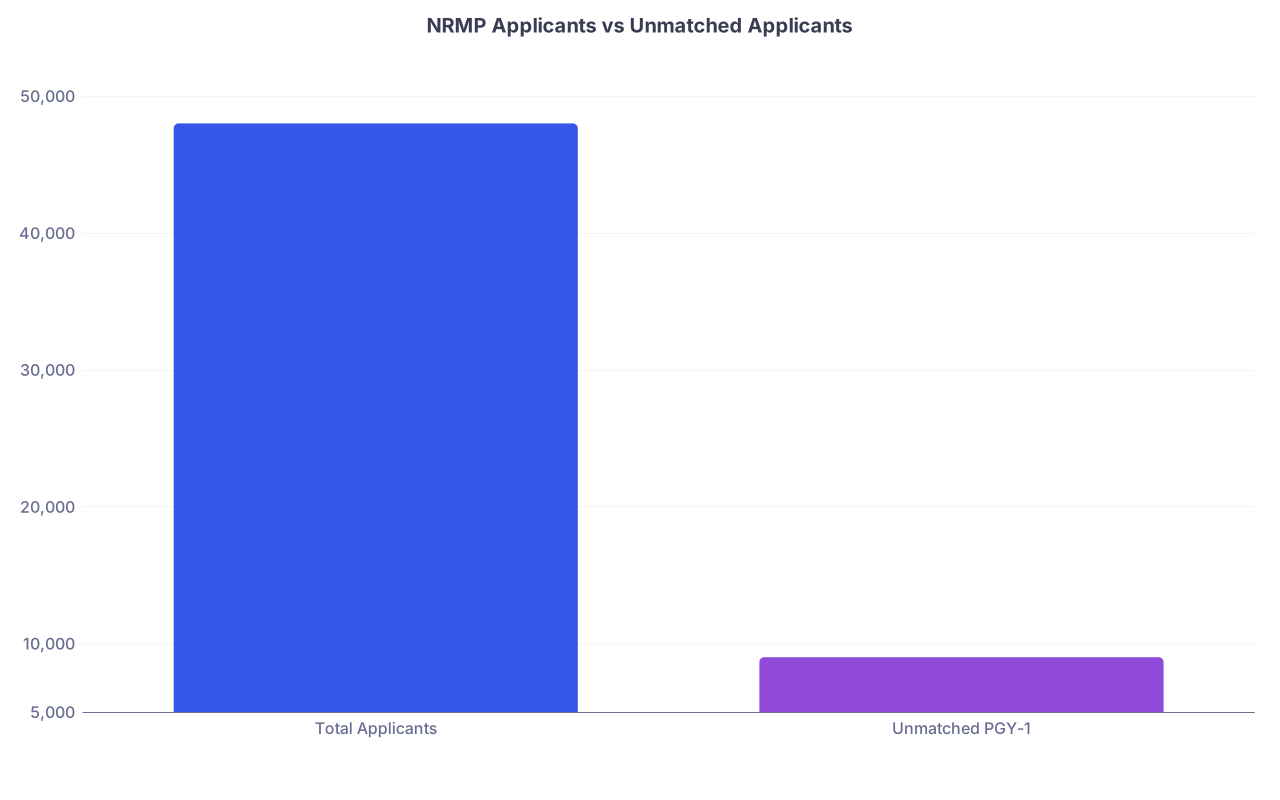
| Category | Value |
|---|---|
| Total Applicants | 48000 |
| Unmatched PGY-1 | 9000 |
Every year thousands of applicants don’t match. U.S. MDs. DOs. IMGs. High Step scores. Honors. Publications. It’s messy and numbers-driven and sometimes cruel. It’s not a tidy “good vs bad” filter, even though your shame is trying to convince you it is.
But I know that doesn’t fully help, because shame isn’t logical. It’s emotional. It’s, “How do I look my parents in the eye?” “How do I show up to class on Monday when everyone else is swapping program T‑shirt photos?”
Here’s the raw truth: the only way through that shame is to tell a few people anyway.
You won’t want to. You’ll want to hide, make excuses, mumble something about “still waiting to hear.” That instinct will make everything worse. It traps you alone with your brain, which right now is not your friend.
Tell at least:
- One trusted classmate
- One faculty mentor (ideally someone who knows your field of interest)
- Someone outside medicine who loves you (family, partner, close friend)
You don’t need a TED Talk. You can literally say:
“I didn’t match. I’m devastated and embarrassed and I don’t really know what to do yet.”
If they’re worth keeping in your life, they’ll respond with care, not judgment. And if anyone responds badly? That’s data about them, not you.
What This Actually Means for Your Career (Not the Disaster Version in Your Head)
Your brain is probably doing that all-or-nothing thing: “I didn’t match → I’ll never be a doctor → I’ve wasted my 20s → I’ll be paying off loans for a career I don’t even have.”
Let me cut through that:
Not matching this year means:
You don’t have a PGY‑1 spot starting July 1 this cycle.
That’s it. It does not mean:
“You’ll never practice medicine.”
“You’re blacklisted.”
“You’re unemployable forever.”
Here’s how I’ve seen this realistically play out with people who didn’t match the first time:
- Some reapply the next year and match into the same specialty.
- Some switch specialties and match into a different field.
- Some do prelim/transitional spots, build more experience, and then match into categorical positions later.
- A small group ultimately choose a related-but-different career (industry, MPH, consulting, teaching, etc.)—but that’s usually after multiple deliberate tries, not a single bad cycle.
Is the road harder? Yes. Is it impossible? No. Not remotely.
The trap right now is catastrophizing yourself into paralysis. “If I can’t be a dermatologist at a top‑10 program, I’m done.” That mindset kills your ability to execute the steps that actually move you forward.
You’re allowed to grieve the version of your future you were expecting. But don’t bury the whole career with it.
The Brutal Week-Of Reality: SOAP and Silence
If you’ve already gone through SOAP and still didn’t land a spot, that’s a second gut punch. Now it’s not just “I didn’t match,” it’s “I didn’t match and SOAP didn’t work either.”
That can feel like confirmation that you’re truly hopeless.
It’s not. SOAP is a fire drill with bad odds.
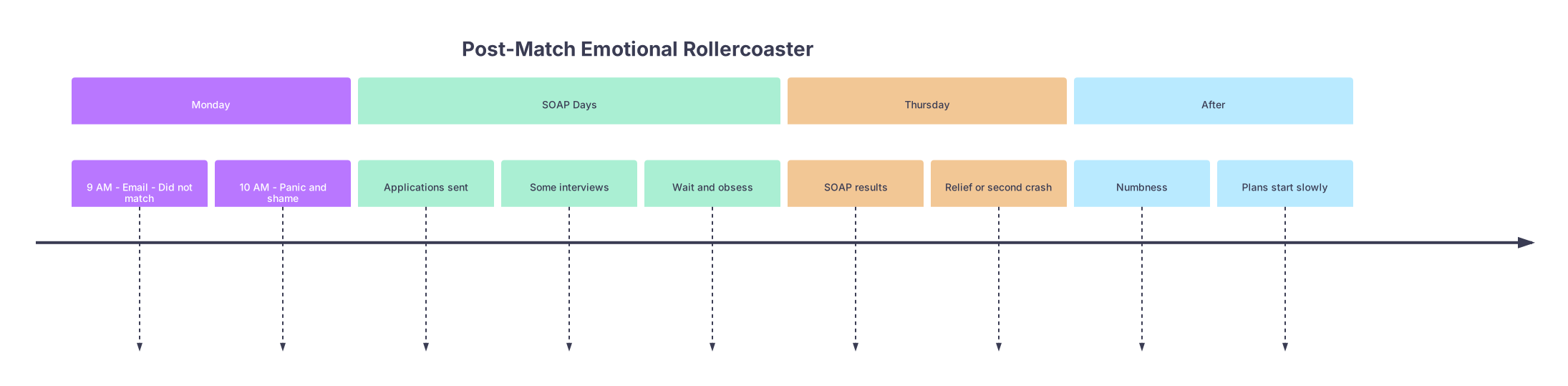
SOAP is:
- Hyper‑compressed (hours instead of months)
- Brutally numbers-driven
- Full of applicants who are basically flailing and mass‑applying to anything with a pulse
If you didn’t get anything in SOAP, it does not mean programs “secretly know” you’re unfit. It means: in a few chaotic days, with limited spots, you didn’t land one. That’s it.
After SOAP, there’s this eerie silence. Everyone else is posting “can’t wait to start PGY‑1!” photos and you’re just… sitting there. It’s very easy to think: “Well, that was my one shot.”
No. That was one chaotic week. You’re allowed to feel wrecked by it, but don’t assign it a meaning it doesn’t have.
What You Can Actually Do in the Next 2–4 Weeks
Let’s get concrete. Because spinning in anxiety without tasks makes everything worse.
1. Do a cold-eyed autopsy of your application
This part sucks. Do it anyway. Not alone.
Get at least one experienced person (advisor, PD you know, dean, faculty) to go through your whole app with you: CV, personal statement, LORs, Step scores, rank list.
You want to answer:
- Was I realistic in where I applied and ranked?
- Did I apply broadly enough?
- Are there obvious red flags? (fails, professionalism issues, huge gaps, weak letters, massive specialty switch with no story)
- Are there soft problems? (generic personal statement, weak interview skills, lukewarm LORs)
Yes, this will sting. But you can’t fix what you won’t look at.
2. Decide if you’re staying in the same specialty or seriously considering a switch
This is huge. And scary. But you can’t sit in limbo all year.
Ask yourself:
- Did I 100% only apply to ultra‑competitive programs/regions with stats that weren’t really in range?
- Do I still genuinely want this specialty enough to fight for it again?
- Are there closely related fields I’d be happy in that are less competitive?
I’ve seen:
- Anesthesia reapplicants who strengthened with research and matched the second time.
- Surgery applicants who moved to categorical IM and are now doing GI or cards and perfectly content.
- Derm applicants who shifted to IM or FM, then did outpatient procedures and cosmetics and built careers they like.
There isn’t a right answer. But you need an answer, so the next year isn’t random.
3. Map out how you’re going to spend the “gap year”
Here’s where people go wrong: they fill a year with random stuff that doesn’t clearly move the needle.
You want your year to scream: “I am committed, reliable, and stronger than last cycle.”
Depending on your situation, that can mean:
- Research year in your intended specialty
- A structured clinical job (hospitalist scribe, clinical research coordinator, etc.)
- Home or away sub‑I equivalents if your school permits it
- MPH/MBA/other degree only if it connects logically to your path, not just as a hiding place

| Option | Main Benefit |
|---|---|
| Research year | Stronger CV, new letters |
| Clinical job | Ongoing patient exposure |
| Additional rotations | Fresh clinical evaluations |
| MPH/degree | Niche focus, story depth |
| Nonclinical work | Income, time to regroup |
Whatever you choose, make sure:
- It can produce at least one new, strong letter of recommendation
- You’ll have contact with someone who is willing to go to bat for you on the phone
- You’ll have actual accomplishments to list in ERAS next year, not just “lived somewhere and thought about stuff”
How to Tell People Without Falling Apart
This part might honestly feel harder than actually remediating your app.
You don’t want the pity face. The awkward silence. The, “But you’re so smart!” comments that just make you feel worse.
Here’s a script you can steal and tweak.
For classmates:
“I didn’t match this year. It completely sucks, but I’m meeting with [advisor/PD] and planning a [research/clinical] year and I’ll reapply. I’d rather you hear it from me than through rumors.”
For family:
“I didn’t get a residency spot this cycle. It doesn’t mean I’ll never be a doctor, but it does mean my path is going to be longer and harder than we hoped. I’m devastated, and I could really use support and not pressure right now while I figure out next steps with my school.”
For mentors:
“I wanted to let you know I did not match this cycle. I’m disappointed and trying to understand where my application fell short. Would you be willing to review my materials with me and give honest feedback, and possibly help me plan a productive year so I can be a stronger applicant next cycle?”
You do not have to share every detail. You don’t have to justify yourself. You’re not on trial. You’re updating people who can help or who care about you.
The truth: after that first awkward conversation, it gets easier. The secret loses its power. And the shame softens because it’s out in the open and the world did not, in fact, end.
Dealing with the Internal Mess: Anxiety, Comparison, and the “I’m Behind” Spiral
The professional fix is only half the problem. The other half is the 3 a.m. brain sludge:
- “I’m a year behind everyone.”
- “No one’s going to respect me now.”
- “Programs will assume I’m damaged goods.”
- “What if I put myself through this again and still don’t match?”
All of that is loud. Some of it even has a grain of realism. But if you let those thoughts set the agenda, you will freeze.
You need a way to hold two truths:
- This is hard, painful, and unfair.
- It is also survivable and fixable with deliberate work.
Some practical things that actually help:
- Limit social media during the immediate post-Match glow. You don’t need to see everyone’s “Meet my co-interns!” posts while you’re raw.
- Set a tiny daily structure. One thing for your career (email, meeting, reading) and one thing for your mental health (walk, lifting, therapy, talking to a friend).
- Seriously consider therapy. Not because you’re “broken,” but because this is an identity-level shock and it will bleed into everything if you don’t process it.
And that “I’m behind” story? Yes, you’re on a nonstandard timeline now. But in five or ten years, literally no one is going to care if you started residency at 27 or 29. They’ll care if you’re competent, safe, and not miserable to work with.
How Programs Actually See Reapplicants (The Part Your Brain Is Lying About)
Your fear: “Once they see I didn’t match the first time, they’ll toss my app.”
Reality’s more complicated.
Program directors I’ve heard talk about this say some version of:
“I don’t care that they’re a reapplicant if they’ve clearly done something meaningful with the year and I can trust them to show up and do the work.”
What hurts reapplicants is not the reapplication itself. It’s:
- No meaningful new experiences
- No new letters from people who can vouch for current performance
- No clear explanation of what changed
- Applying in exactly the same unrealistic way (same super-competitive programs only, same weak materials)
What helps reapplicants:
- Strong new specialty-specific letters
- A concrete story: “I didn’t match, here’s what I learned, here’s what I did, here’s why I’m stronger now”
- Signals of humility and reliability rather than bitterness and blame
You’re building a narrative: “I got knocked down, I learned, I stood back up, and this is the doctor I’m becoming.” That story is compelling if it’s backed by actual work.
FAQ – The Things You’re Probably Too Embarrassed to Ask Out Loud
1. Does not matching mean I was never good enough for medicine?
No. It means your application this year, in this system, with these numbers and this strategy, didn’t produce a match. I’ve seen absolutely solid future physicians not match the first time because they aimed too high, applied too narrow, had bad advising, or just plain bad luck. If your fitness for medicine were truly the issue, you’d likely have been filtered out long before Match.
2. Are programs going to judge me harshly for not matching the first time?
Some will, yes. Let’s not sugarcoat it. There are programs that are risk-averse and prefer “clean” trajectories. But plenty of programs care more about who you are now than what your NRMP status was a year ago. Your job is to tailor your list to the latter group, strengthen your file, and present a mature, honest explanation rather than hiding it or sounding defensive.
3. Should I switch to an “easier” specialty just to get in somewhere?
Only if you can see yourself actually doing that specialty without hating your life. Switching purely out of panic is dangerous—you don’t want to wake up three years from now in a field you resent. That said, there’s nothing shameful about reassessing. Wanting to be a physician in a slightly different capacity (IM instead of ortho, FM instead of EM) is not a failure. It’s adaptation.
4. Is doing an MPH or MBA a good way to “cover” my unmatched year?
It can be, but it’s not magic. A degree can look like avoidance if it’s disconnected from your story and doesn’t lead to strong clinical or research experiences and letters. Programs don’t think, “Oh, they have letters after their name now, all is forgiven.” They think, “What did this person do that makes them a better resident candidate?” If the degree deepens your interests (public health, policy, admin) and you still build clinical connections, it can help. If it’s just, “I didn’t match so I hid in grad school,” it won’t.
5. What if I go all in for another year and still don’t match?
That’s the nightmare scenario you keep replaying. And yes, it’s possible. That’s why you should use this year to both strengthen your application and quietly explore parallel routes—like understanding non-residency roles in medicine, industry, research, informatics. That way, if worst‑case happens, you’re not starting from zero. But I’ve seen a lot more people match on a second try than permanently bounce out, especially if they adjust strategy and seek real feedback.
6. How do I stop feeling like I’m “the one who failed” in my class?
You probably won’t stop feeling that immediately. Identity shame isn’t a light switch. What helps: telling a few people the truth so you’re not carrying it alone, staying involved with your class where it feels tolerable (don’t isolate completely), and actively working on your plan so you’re not frozen in place. Over time, your identity shifts from “the one who failed” to “the one who took a hit and kept going.” And honestly, that’s a more useful identity in medicine than “the one for whom everything was easy.”
Here’s what I want you to walk away with:
You didn’t match. That hurts like hell, and it’s allowed to.
You’re not the only one, you’re not broken, and you’re not done.
You need a clear-eyed plan, a few honest conversations, and time—but this can be a detour, not an ending.


