

The fear of reopening ERAS after an Unmatch is not irrational. It’s brutal—and it’s common.
You’re not crazy for feeling like just logging in might rip open a wound you barely managed to bandage. I’ve watched people stare at the ERAS login page for days. Literally logged in, saw the dashboard, froze, and closed the browser.
Let’s talk about that. Not in the fake “chin up, you’ve got this!” way. In the real, “this sucks and you’re scared and here’s how to actually deal with it” way.
The Silent Horror of Opening ERAS Again
You know what nobody tells you? Reopening ERAS after an Unmatch feels more personal than the Unmatch email itself.
The email was one moment of pain. ERAS is a whole museum of your past self:
- Old personal statement you thought was “pretty good”
- Letters you begged for
- Programs that ghosted you
- Scores and red flags you’ve memorized like a prison sentence
And now you’re supposed to… go back in there and “fix it.”
Here’s what your brain is probably doing right now:
- “What if I open it and realize my application was actually terrible?”
- “What if there’s nothing to fix and I’m just not good enough?”
- “What if I pour myself into this again and Unmatch twice? Then what?”
- “What if my classmates or attendings secretly think I should just give up?”
This is why you’re stuck. You’re not just afraid of editing an application. You’re afraid of what your application says about you as a person. As a future doctor. As someone who already tried and was told “no.”
You’re not avoiding ERAS because you’re lazy. You’re avoiding ERAS because it’s now emotionally radioactive.
So step one is not “update your CV.”
Step one is: make reopening ERAS a small, controlled, non-catastrophic act. Not a referendum on your future.
How to Actually Face ERAS Again (In Tiny, Tolerable Steps)
You don’t need some inspirational speech. You need a plan that doesn’t make you want to throw up.
Here’s how I’d break it down.
Step 1: Change the Goal for Your First Login
Your first login is not:
- “Fix my application”
- “Make everything perfect”
- “Figure out why I failed”
Your first login goal is:
- “I will log in and just look for 5–10 minutes, then log out.”
No changes. No decisions. No judgment.
Literally:
- Log in.
- Click through sections.
- Note (mentally or on a scrap paper): what exists, what’s outdated, what feels wrong.
- Log out.
Done.
You are not allowed to “fix as you go” on this first pass. That’s how you’ll get overwhelmed and never reopen it again.
Step 2: Decide What You’re Actually Changing (Not Vague “Work Harder” Nonsense)
You probably feel like you have to “redo everything.” That’s panic talking.
Usually, only 2–4 things need deliberate, strategic change. Not 27.
| Area to Review | Typical Issue |
|---|---|
| Personal Statement | Generic, unfocused, weak narrative |
| Program List | Too competitive, too few safeties |
| LORs | Lukewarm, outdated, wrong specialty |
| CV / Experiences | Passive descriptions, no impact shown |
Now your job is to figure out which ones are yours.
Ask yourself honestly:
- Did I apply to a realistic range of programs? Or was I delusional / overly optimistic?
- Did anyone experienced read my personal statement? Or just peers/family?
- Were my letters actually strong? Or just “fine” and generic?
- Did I explain my gaps/overlaps/low scores? Or just hope they’d ignore them?
You don’t need to solve this alone. If you can, sit down with:
- A program director you trust
- An APD/attending in your specialty
- A dean/advisor who’s seen hundreds of apps
Tell them: “I unmatched. I need you to be very honest about what’s wrong with my ERAS.”
That conversation might sting. But it’s better than guessing.
What If the Problem Is… Me?
This is the nightmare thought, right?
“Maybe I’m just not competitive enough. Maybe there isn’t a fix.”
I’ve seen this up close. People with:
- 205–215 Step 1 back when scores still reported
- A failed Step 2 that they then passed
- A leave of absence
- Failed a clerkship they had to remediate
- Switched specialties late
- Graduated years ago and feel “expired”
And a lot of them matched on their second or third cycle. Not all. But a lot.
You’re not going to like what I say next, but it’s true:
There are only three broad categories of problems:
- Application structure (strategy, program list, timing)
- Application content (how you present yourself)
- Objective metrics / red flags (scores, gaps, professionalism issues)
Your job isn’t to spiral about “Am I doomed?” Your job is to honestly figure out which category was your biggest killer and then match the solution to that.
Here’s a harsh but useful view:
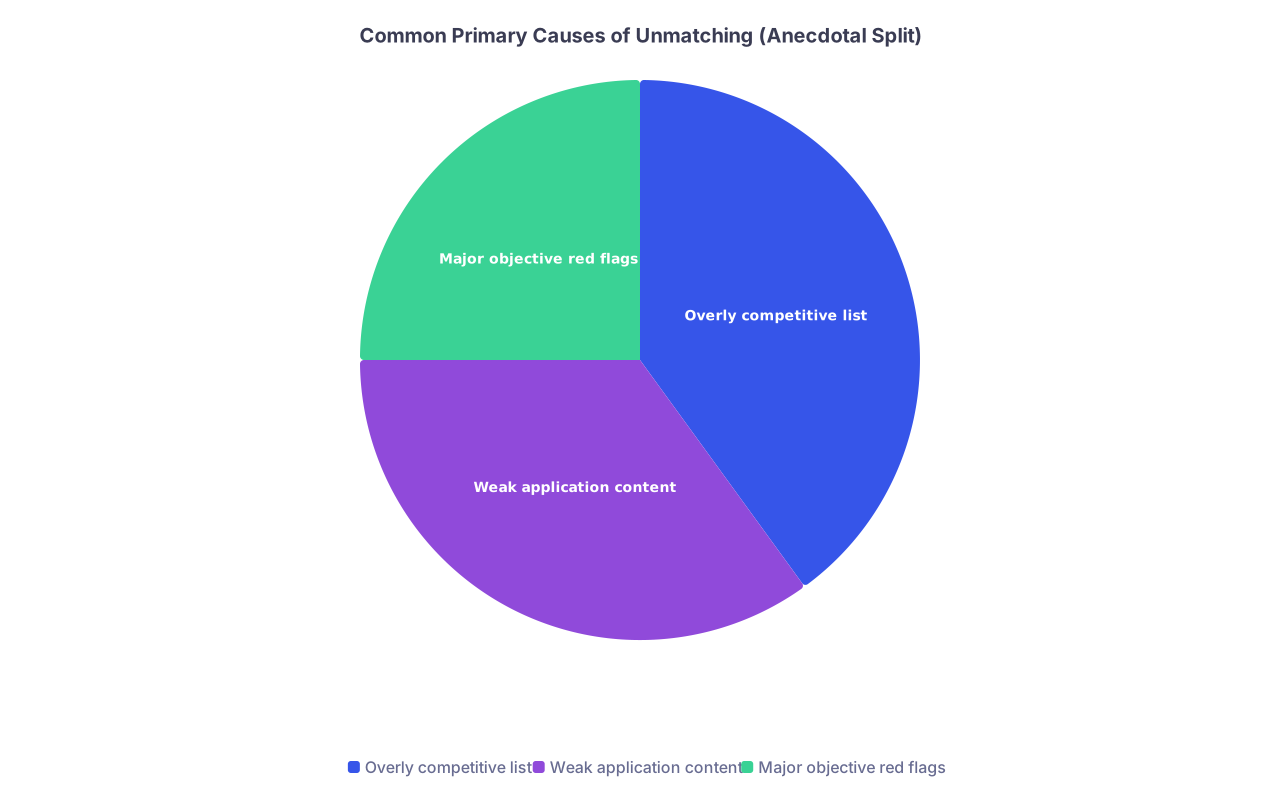
| Category | Value |
|---|---|
| Overly competitive list | 40 |
| Weak application content | 35 |
| Major objective red flags | 25 |
So no, it’s usually not “you as a human are unmatchable.” It’s often “you misjudged something important.”
That’s fixable more often than it feels.
Breaking Down the ERAS Sections Without Melting Down
Let’s go section by section like someone sitting next to you at your laptop, because otherwise this stays abstract and scary.
Personal Statement: The Self-Esteem Trap
You’re probably afraid to read what you wrote last year. You’re worried you’ll cringe.
That’s fine. Cringe is data.
Ask:
- Does this sound like it could be written by 500 other applicants?
- Do I actually say why this specialty fits me, or do I just say I “love patient care”?
- Do I show any real stories? Or just vague statements about “compassion” and “teamwork”?
If you don’t have the stomach to fully rewrite it yet, do this:
- Highlight in one color: boring, generic lines
- Highlight in another: specific, unique, personal lines
If 80% is the generic color, you already know what needs to happen.
Program List: Where A Lot of People Quietly Sabotage Themselves
Biggest pattern I’ve seen? People who:
- Apply to 20–40 places in a competitive specialty, mostly university programs, low or mid board scores… and are shocked when they don’t match.
- Barely touch community programs or lower tier academic places.
- Ignore new programs because they “don’t have a reputation yet.”
You cannot fix your stats, but you can absolutely fix your strategy.
If you’re willing to be honest, someone (PD, advisor, older resident) can tell you whether you need:
- More programs
- More community / lower tier programs
- Backup specialty
- SOAP vs no SOAP strategy if it happens again
It doesn’t feel good. But it’s better than repeating the same mistake.
When You’re Terrified of Rejection Round Two
This is the real reason you don’t want to reopen ERAS: you don’t know if you can survive another Unmatch.
You’re not just reopening a portal. You’re reopening the possibility of that morning again. The screenshot. The texts. The silence. The shame.
So your brain is trying to “protect” you by not starting at all.
Here’s the uncomfortable truth: if you want residency in the US through NRMP, ERAS is the doorway. Not touching the door doesn’t make the house disappear. It just keeps you standing outside, exhausted and cold.
What I’ve seen help people emotionally:
Naming the worst case out loud
“If I Unmatch again, I will ____.”
Maybe it’s try again, switch specialties, seek a research year, consider non-clinical. It feels less like a black hole when you actually put some words around it.Setting a time boundary
“I will give myself X cycles. After that, I reassess my life plan.”
Even saying “I’ll try one more serious time” can make this feel like a decision, not an endless torment.Separating your identity from your outcome
Yes, I know that sounds like therapy-speak. But residency programs reject applications, not human worth. I’ve seen absolute rockstar human beings get burned by a bad year, a weird dean’s letter, a terrible advisor.
A Practical “Face ERAS Again” Timeline
Let me sketch a very rough, realistic emotional + practical flow.
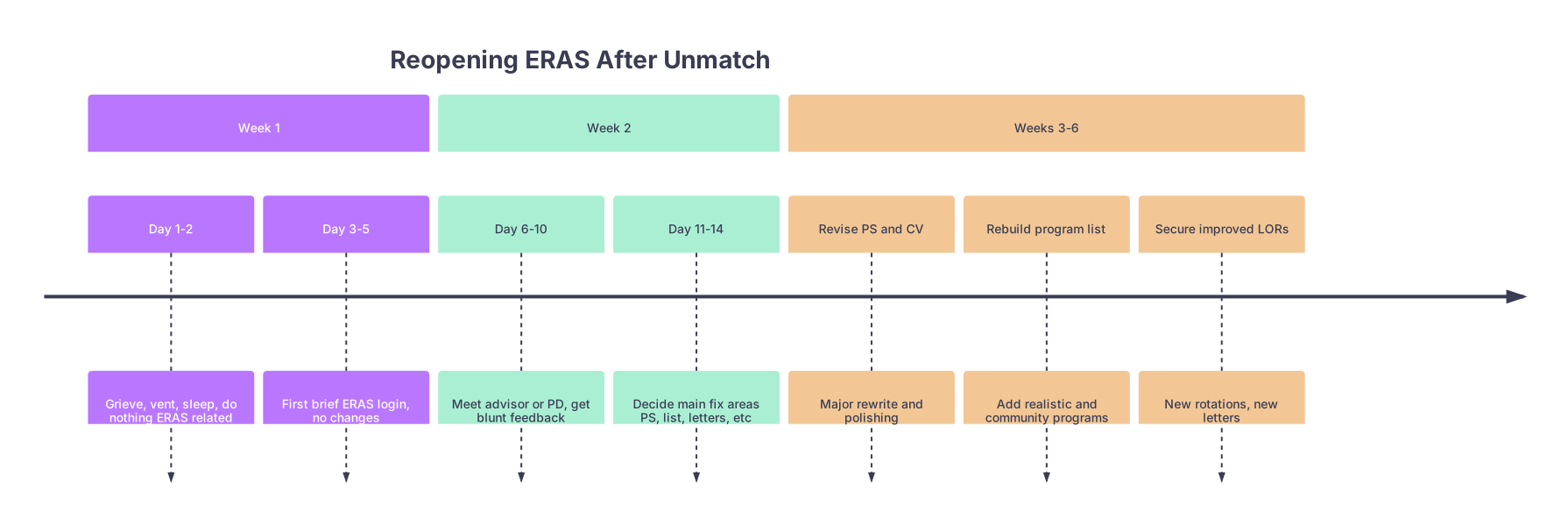
| Period | Event |
|---|---|
| Week 1 - Day 1-2 | Grieve, vent, sleep, do nothing ERAS related |
| Week 1 - Day 3-5 | First brief ERAS login, no changes |
| Week 2 - Day 6-10 | Meet advisor or PD, get blunt feedback |
| Week 2 - Day 11-14 | Decide main fix areas PS, list, letters, etc |
| Weeks 3-6 - Revise PS and CV | Major rewrite and polishing |
| Weeks 3-6 - Rebuild program list | Add realistic and community programs |
| Weeks 3-6 - Secure improved LORs | New rotations, new letters |
Is this idealized? Sure. Life is messier. You might get stuck for 2 weeks just staring at your personal statement doc. But having a rough map helps you see this as a process, not one giant impossible task.
You Don’t Have to Be “Over” the Unmatch to Start
This is something people get wrong constantly.
They think: “I’ll reopen ERAS when I’ve processed everything and feel better.”
No. That’s backwards.
You’re probably going to feel sick, ashamed, and anxious the first several times you work on your app again. Not because you’re weak—because you just went through a trauma connected to this exact portal.
You don’t wait to feel brave. You set up guardrails so you can function while still scared:
- 25-minute ERAS work blocks, max, with timers.
- One small, defined task per session: “Update work experiences,” not “Fix ERAS.”
- A person you can text, “I opened ERAS today” who will actually get how big that is.
You’re not trying to be a hero. You’re trying to be consistent.
Facing the Ugly Questions Head-On
You probably have a few dark questions circling your head. Let’s say them. Out loud. Then answer honestly.
“What if my old app was actually horrible and I was delusional?”
Then good. Seriously. Then you found the problem. A bad personal statement or weak program strategy is fixable. Someone can help you rewrite, restructure, re-aim.
The truly scary scenario would be: “Everything was perfect and I still Unmatched.” That’s almost never the full story.
“What if there’s nothing major to fix and I’m just below the bar?”
Then this becomes a strategy discussion:
- Do you add a prelim year to get US clinical experience?
- Do you do a research year with someone known in your field?
- Do you switch to a slightly less competitive specialty?
- Do you increase your program count and target a different tier?
I’ve seen people go from aiming for Derm to ultimately matching FM and ending up very, very happy. That’s allowed. Changing the dream is not failing. It’s adjusting to reality.
“What if I Unmatch again and everyone judges me?”
Some people will judge silently. Some already are. But I promise you this: people forget fast.
Your classmates move on with their own drama. Faculty see multiple cycles; you’re not the first or last person to struggle. And the people whose opinions truly matter long-term? They care more about how you respond than the fact that you fell.
Are you the person who ghosts and disappears? Or the one who gets punched in the throat by the process and still shows up, eyes swollen, trying again with a better plan?
Programs notice that.
FAQ (Exactly 4 Questions)
1. How long should I wait after Unmatching to reopen ERAS?
You don’t need to rip the bandage off on Match Day. Give yourself a few days to be a wreck. But don’t let it stretch into months of avoidance. Within 1–2 weeks, you should at least:
- Log in once
- Look around for 5–10 minutes
- Set up a meeting with an advisor or faculty member to review your app
You don’t need to fix anything in those first days. You just need to prove to your brain that ERAS isn’t a monster that will eat you when you click “login.”
2. Do I need to completely rewrite my personal statement after an Unmatch?
Not always. But if your statement was generic, cliché, or didn’t address obvious concerns (like a failed exam, a leave, or a specialty switch), you probably do need a serious overhaul. A good test: show it to a resident or attending in your specialty and ask, “Would you remember me after reading this?” If the answer is no, rewrite. Don’t just tweak adjectives. Burn it down and build something sharper and more specific.
3. Should I apply to the same programs again or completely change my list?
You don’t have to abandon every program, but you should be ruthless about your prior strategy. If you:
- Applied mostly to reach programs
- Ignored community or newer programs
- Applied to too few places
…then yes, your list needs major restructuring. You can keep a handful of prior programs, especially where you had interviews, but your new list should be: - Broader
- More realistic
- Heavier on programs that historically take applicants with your stats and background
4. What if I emotionally can’t handle another full cycle?
Then you don’t white-knuckle it alone. Options:
- Take a structured gap year: research, prelim, or non-match-dependent clinical work with mentorship
- Set a hard limit: “I’ll try one more serious cycle; if I Unmatch again, I’ll reassess larger life plans”
- Work with a therapist who understands medical training trauma (yes, that’s a thing)
You’re allowed to decide that your mental health matters more than chasing this indefinitely. But make that decision intentionally, not because you were too scared to even reopen ERAS.
Key points:
- Avoiding ERAS after an Unmatch is a trauma response, not laziness—but staying frozen will quietly kill your chances.
- Your first job isn’t to fix everything. It’s to log in, look, get honest feedback, and identify 2–4 concrete changes.
- You don’t need to be “over it” to start. You just need a plan small enough that you can follow it even while you’re still scared.


