
Most “post‑match clinical experience” advice quietly normalizes exploitation. You do not have to accept that.
Let me break this down specifically: after an unmatched or partially matched result, you are vulnerable. Programs know it. Some hospitals know it. Random “observer-ship companies” definitely know it. If you are not deliberate, you will donate free labor, carry uncredited responsibility, and walk away with almost nothing that actually moves your application.
You want three things from post‑match clinical work:
- Real, credible US clinical experience (USCE) that programs respect.
- Powerful letters and concrete evidence of growth.
- Protection from being used as cheap labor or a liability sponge.
You can get all three. But you need to understand the landscape and call out bad offers for what they are.
1. The Core Problem: You Need Them More Than They Need You
Most people in your position make the same two mistakes:
- They accept any clinical role that will take them.
- They cannot articulate why a given position helps their next application.
That is how you end up “working” in a clinic for 40 hours a week, no salary, no malpractice coverage, no EMR login, no letters, and no clear responsibility besides “helping out.”
Let me be blunt: that is exploitation with a stethoscope.
To avoid that, you have to:
- Understand the main categories of post‑match options.
- Know exactly what each one can and cannot do for your application.
- Recognize red flags that scream: “We want free labor, not a trainee.”
2. The Main Paths: What Actually Counts and What Programs Respect
| Option Type | Clinical Hands-On | Paid | EMR Access | Strong LOR Potential |
|---|---|---|---|---|
| Hospital Observership | No | No | No | Weak–Moderate |
| Private Clinic Shadowing | Minimal | Often No | Often No | Weak |
| Structured USCE Program | Limited–Moderate | Usually Yes | Sometimes | Moderate–Strong |
| Research Assistant (Clinical) | Indirect | Usually Yes | Sometimes | Strong (with right PI) |
| Non-ACGME Fellowship | Yes | Yes | Yes | Strong |
Now let’s dissect these.
2.1 Pure Observerships (Hospital-Based)
The classic: “Observer” status at a teaching hospital, usually 4–8 weeks.
You typically:
- Do not touch patients independently.
- Do not write notes or orders.
- Do not bill, prescribe, or take call.
So is it useless? No. But it is easily overvalued.
Advantages:
- Big-name institutional letter is possible if you impress.
- You see real inpatient care, morning reports, codes, family meetings.
- You learn US documentation expectations by watching.
Limitations:
- Program directors know you did not actually carry a panel.
- One observership will not compensate for multiple prior failures, low scores, or weak home performance.
- Scaling this up (3–4 observerships in a row) quickly hits diminishing returns.
When observership is worthwhile:
- You need fresh US exposure to your target specialty within 6–12 months of reapplying.
- You strategically cluster it at a place that takes IMGs or unmatched applicants.
- You have a plan to convert it into a strong letter: case presentations, QI project, attending seeing your growth.
What to demand:
- Clear schedule and defined objectives.
- A named supervising attending who is open to letter writing if you perform well.
- A real role on the team: present patients on rounds, prepare brief topic talks, attend all teaching.
If they describe your role as “just observing,” with no expectations – your ceiling is low. That might be acceptable for one short rotation, not a year of your life.
2.2 Private Clinic “Shadowing” and Unpaid Assistant Roles
This is where exploitation thrives.
Scenario I keep seeing: a solo internist or small group primary care clinic “hires” unmatched grads as “volunteers.” Duties:
- Room patients, vitals, sometimes minor procedures.
- No salary.
- No malpractice coverage.
- No guaranteed letter.
- Owner bills for your work as “incident to” or simply uses you to move faster.
From a program director’s perspective, this looks flimsy:
- Unknown clinic. No teaching structure.
- Variable supervision.
- No formal evaluation or academic oversight.
- Often vague documentation of your role.
Is there any value here? Maybe, in narrow conditions:
- You need something locally to keep you close to a target geographic region.
- The physician genuinely teaches, has academic connections, and will write a sincere, detailed letter.
- You can carve out a meaningful project: a QI audit, workflow analysis, patient education initiative.
Otherwise, a year of this is exactly what you fear: free labor with minimal career benefit.
Concrete standards you should insist on:
- Written description of your role and supervision.
- Confirmed malpractice coverage if you touch patients or perform procedures.
- Formal evaluation and a plan for a letter, contingent on performance.
- Explicit prohibition on you prescribing, signing notes, or making independent medical decisions.
The moment someone says, “You can see patients on your own; we will bill it under my name,” you are in liability territory and absolutely being exploited.
3. Structured USCE, Non-ACGME Spots, and Real Clinical Roles
Let’s talk about the options that do move the needle when chosen correctly.
3.1 Structured USCE Programs
I am not talking about random “observership agencies” that charge $3,000 for 4 weeks of standing in a hallway.
I mean:
Hospital- or system-administered visiting clinical scholar / extern programs.
Some large IM-heavy systems (e.g., community affiliates of university programs) offer paid or stipended extern-like roles.
Programs that give you:
- ID badge, EMR access in some capacity
- Defined teaching and evaluation
- On-paper role (clinical research coordinator + structured bedside exposure, for instance)
These are rare, competitive, and often not well advertised. But they exist.
Pros:
- Institutional name recognition.
- Clear academic structure.
- Letter from faculty used to writing for residency candidates.
Cons:
- Often time limited (2–3 months).
- Expensive in big cities if unpaid.
- Selection favors those who already look decent on paper.
If you are going to pay for anything, this is the only category that sometimes justifies a fee. However, you must verify:
- The fee goes to the hospital/system, not an opaque middleman.
- There is a formal evaluation mechanism.
- Past participants have matched to actual residencies you would apply to (ask for specific outcomes or alumni contacts).
3.2 Research Assistant / Clinical Research Coordinator (CRC)
This is underused, especially by unmatched US grads.
You want clinical research roles embedded in departments that run residencies:
- CRC in cardiology tied to an IM program.
- Research assistant in trauma surgery at a Level I center.
- Data analyst in an academic psych department that takes IMGs.
You will not be the one placing central lines, obviously. But you can:
- Attend conferences, M&M, journal clubs.
- Co-author posters, abstracts, maybe a paper.
- Be physically present, dependable, and visible to faculty.
Program directors look at this differently:
- Longitudinal commitment (6–12+ months) shows stability and professionalism.
- Publications and presentations signal academic maturity.
- Letters from PIs can be extremely strong when they have seen your work ethic over hundreds of hours.
Bonus: most of these roles are paid, with W2 status and institutional benefits. That alone moves it firmly out of the “exploitation” category.
Key questions before you accept:
- How often will I interface with clinical teams or residents?
- Can I attend grand rounds, didactics, or case conferences?
- Does the PI have a history of supporting trainees into residency (ask directly)?
- Will my name be on abstracts/manuscripts if I contribute meaningfully?
If everything is “maybe” and “we will see,” keep looking.
3.3 Non-ACGME Fellowships and “Gap Year” Clinical Jobs
Certain specialties and large academic centers have non-ACGME positions that are effectively junior attending / advanced resident roles without board eligibility. Examples:
- Non-ACGME hospitalist fellowships.
- Advanced cardiology imaging fellowships for IMGs.
- Research-track clinical fellowships in heme/onc, stroke, etc.
These are gold when legitimate:
- Full integration into clinical teams.
- Salary and benefits.
- Protected academic time in some cases.
- Letter from division chiefs with real weight.
The catch: many require completion of an ACGME residency in the US or at least full ECFMG certification plus strong prior training abroad. They are not first-step options for everyone.
Do they count as “US clinical experience”? Yes, very much so. For competitive specialties or those switching fields, these can be decisive.
Red flags in non-ACGME offers:
- No defined curriculum.
- “Fellow” status but doing pure service coverage with no teaching.
- Payment structure that looks like independent contractor / 1099 with no benefits, no malpractice, minimal supervision.
That starts to look and feel like a cheap staffing solution, not training.
4. Blunt Talk on Commercial Observership Companies
Someone is already WhatsApping you a flyer: “GUARANTEED USCE – 4 WEEKS – $3,500 – LOR INCLUDED.”
You know this is sketchy. Let me articulate why.
Common issues:
- Middleman companies have no academic stake in your development. They sell you a slot on a preceptor’s schedule. That is it.
- Letters from these set-ups often read formulaic and generic. Program directors recognize the language. Some literally have a “template” feel.
- Preceptors hosting >50 observers a year will not remember you well enough to write a truly individualized, vivid letter.
Are there exceptions? Yes. A small minority of for-fee programs are partnered with legitimate hospitals and maintain standards. But the baseline is low.
If you must consider one:
- Demand to know exactly which hospital or clinic.
- Ask how many residents the preceptor has in their program and how many observers rotate annually.
- Confirm whether you can present at conferences or participate in QI.
- Talk to a recent participant who successfully matched.
If all you get are polished sales answers and no specifics, walk away.
5. Exploitation: What It Looks Like, How to Say No
Here is the pattern that screams exploitation, almost every time:
- Unpaid or token-paid work (e.g., $200/month “stipend”) for 30–60 hours per week.
- Tasks that directly generate revenue or carry medical risk: independent patient visits, prescriptions, orders, procedures.
- No malpractice coverage in writing.
- No structured evaluation; letters “if time allows.”
- Pressure to sign something vague about your role and responsibilities.
I have seen grads asked to:
- Round alone in nursing homes with the physician signing later.
- Cover telemedicine “intake” calls that clearly involved triaging chest pain and stroke symptoms.
- Perform procedures (I&Ds, joint injections) unsupervised “because you are a doctor in your country.”
Let me be clear: these situations are not only exploitative. They are dangerous for you legally and ethically.
How to shut it down:
You: “Before I accept, I need a written description of my role, supervision, and coverage. Specifically: no independent billing in my name, no unsupervised prescribing, and documentation of malpractice coverage for any patient contact.”
If they balk, evade, or accuse you of not being “hungry enough,” you have your answer. They wanted risk-free labor, not a trainee.
6. Designing a Post-Match Year That Actually Works
Now, the constructive part. Suppose you have 12–18 months before the next (or second) match cycle. You need a plan that:
- Fills your CV with credible entries.
- Fixes whatever tanked your last cycle (scores, letters, gaps).
- Minimizes opportunities to be exploited.
Here is a reasonable skeleton for many applicants:
Core pillar: paid, academic-adjacent role
- Clinical research coordinator in your target specialty.
- Research assistant in a department that sponsors a residency.
- Non-ACGME fellowship if qualified.
Targeted USCE: 1–2 observerships or structured externships
- 4–8 weeks each, at places known to accept IMGs/unmatched grads into residency.
- Time these so letters arrive before ERAS submission, not after.
Concrete output:
- Aim for 1–2 posters or abstracts, ideally at national meetings.
- One quality-improvement project tied to patient care (documentation improvement, readmission reduction, etc.).
- Strengthened Step 2 CK or OET score if those were prior weaknesses.
Deliberate letter cultivation:
- From your PI/supervisor: long-term, high-detail letter.
- From at least one inpatient attending who can comment on your clinical reasoning and professionalism.
- From any program leadership you work closely with (associate PD, chief, etc.), if earned.
Stitched together, that year looks very different from “I spent 12 months volunteering at a clinic doing whatever they asked.”
7. How Program Directors Actually Read Your Post-Match Story
Program directors are not sitting there tallying up your “months of USCE” like loyalty points. They read trajectory.
They ask:
- Did this person identify their weakness and do something intelligent about it?
- Did they take on more responsibility, or just accumulate random experiences?
- Do their letters describe real growth, ownership, and professionalism?
A coherent narrative sounds like:
“I did not match last year, largely because my application showed limited US-based clinical exposure and no recent letters from US faculty. Over the past 12 months, I worked as a clinical research coordinator in the internal medicine department at X Medical Center, where I attended daily rounds on the cardiology service, co-authored two abstracts presented at ACC, and collaborated with residents on a QI project to reduce readmissions. I also completed an 8-week inpatient medicine observership at Y Hospital, where I presented patients on teaching rounds and received structured feedback.”
That is specific. That is believable. It does not sound like free-floating shadowing.
Compare that to:
“I gained further clinical experience at multiple outpatient clinics and hospitals, where I participated in patient care and improved my clinical skills.”
Program directors see that line fifty times a season and move on.
8. Practical Screening Checklist: Is This Opportunity Worth It?
Use this as a mental flowchart every time someone offers you “a chance to work in my clinic” or “an externship.”

| Step | Description |
|---|---|
| Step 1 | New Opportunity |
| Step 2 | High Priority Option |
| Step 3 | Moderate Priority |
| Step 4 | Investigate Further |
| Step 5 | Likely Exploitative |
| Step 6 | Consider with Caution |
| Step 7 | Paid or Clear Stipend? |
| Step 8 | Institutional Affiliation? |
| Step 9 | Strong Training Structure? |
| Step 10 | Recognized Preceptor? |
| Step 11 | Malpractice Coverage? |
Hard questions to answer before you commit:
- Who is my direct supervisor, and what is their title?
- What are my specific duties, hour by hour, on a typical day?
- What teaching or feedback structures are built into this role?
- How will my performance be documented?
- Under what circumstances will you write a letter, and what will you be able to comment on?
If the answers are woolly, they probably plan to plug you into a gap and leave you there.
9. Non-Clinical Add-Ons That Often Matter More Than Another Clinic
Clinical experience is not the only lever between you and a match. In fact, for some unmatched candidates, pushing non-clinical levers yields better ROI than an extra 6 months of shadowing.
High-yield non-clinical actions:
Step score repair:
- Step 2 CK improvement if Step 1 was low.
- Or shelf-like structured learning that proves you can still perform academically.
Communication polish:
- Get brutal, honest feedback on your personal statement and ERAS entries from someone who has actually sat on a selection committee.
- Practice real interviews with senior residents or attendings, not just peers.
Program list surgery:
- Many unmatched US grads are “over-aiming.” They apply to 60–70 mid- to upper-tier programs and skip the 60–80 community programs where they actually have a shot.
- An experienced advisor can often double your realistic target list.
Geographic anchoring:
- If you know you want to be in the Midwest, it is more valuable to have one meaningful role at a Midwest hospital plus clear narrative reasons to be there than scattered observerships on both coasts.
Do not hide behind endless “clinical experience” as a way to avoid fixing harder issues like poor interviewing or a toxic MSPE. Those matter more than whether you spent another 4 weeks in a private clinic.
10. Concrete Examples: What Good vs Bad Post-Match Years Look Like
To make this painfully clear, let me sketch two typical patterns I have seen.
Example A: Exploited and Stagnant
- March: Does not match. Panic.
- April–June: Pays $3,000 for a 4-week private observership in Florida. Mostly watches; gets generic letter.
- July–December: Volunteers full-time in a primary care clinic. No salary, no formal teaching. Takes vitals, room patients, occasionally translates. No malpractice coverage documented.
- January: Scrambles to ask busy physician for a letter. They write three paragraphs of generic praise.
- ERAS: Application lists “Clinical observer” and “Clinical volunteer” with vague descriptions. No research, no new scores, no leadership.
Outcome: Application looks busy but thin. Narrative screams, “I floated around, hoping proximity would turn into opportunity.”
Example B: Strategic, Non-Exploited
- March: Does not match. Cool-headed review of application with faculty advisor reveals weak USCE and no academic output.
- April: Applies deliberately to 15 research assistant/CRC roles in IM/Neuro/Psych.
- May: Hired as CRC in IM department at a medium-sized community teaching hospital with a residency program.
- June–February:
- Works 40 hours/week, paid, with EMR access and daily interaction with hospitalists.
- Attends resident noon conference and grand rounds.
- Helps design and implement a QI project on VTE prophylaxis compliance.
- Co-authors one poster for a regional meeting.
- September ERAS:
- Includes one strong letter from CRC supervisor (an attending) describing reliability, teamwork, and specific project impact.
- Includes one letter from a hospitalist who saw clinical reasoning on case discussions and presentations.
- Application narrative clearly explains the year as intentional upskilling and integration into US hospital culture.
Outcome: Same 12 months, radically more persuasive story, and not built on free labor.
11. Final Guardrails So You Do Not Get Used
Three guardrails to keep you aligned:
- If you are doing revenue-generating clinical work, you should be paid and covered.
- If you are not getting systematic teaching, feedback, or documentation, you are not in a training role.
- If your supervisor cannot write a detailed, personalized letter after 3–4 months, that time is largely wasted from a residency perspective.
You are allowed to say no. You are allowed to prioritize your own training over someone else’s staffing needs. You are allowed to walk away from a “great opportunity” that is, under the hood, just unpaid work propping up a clinic.
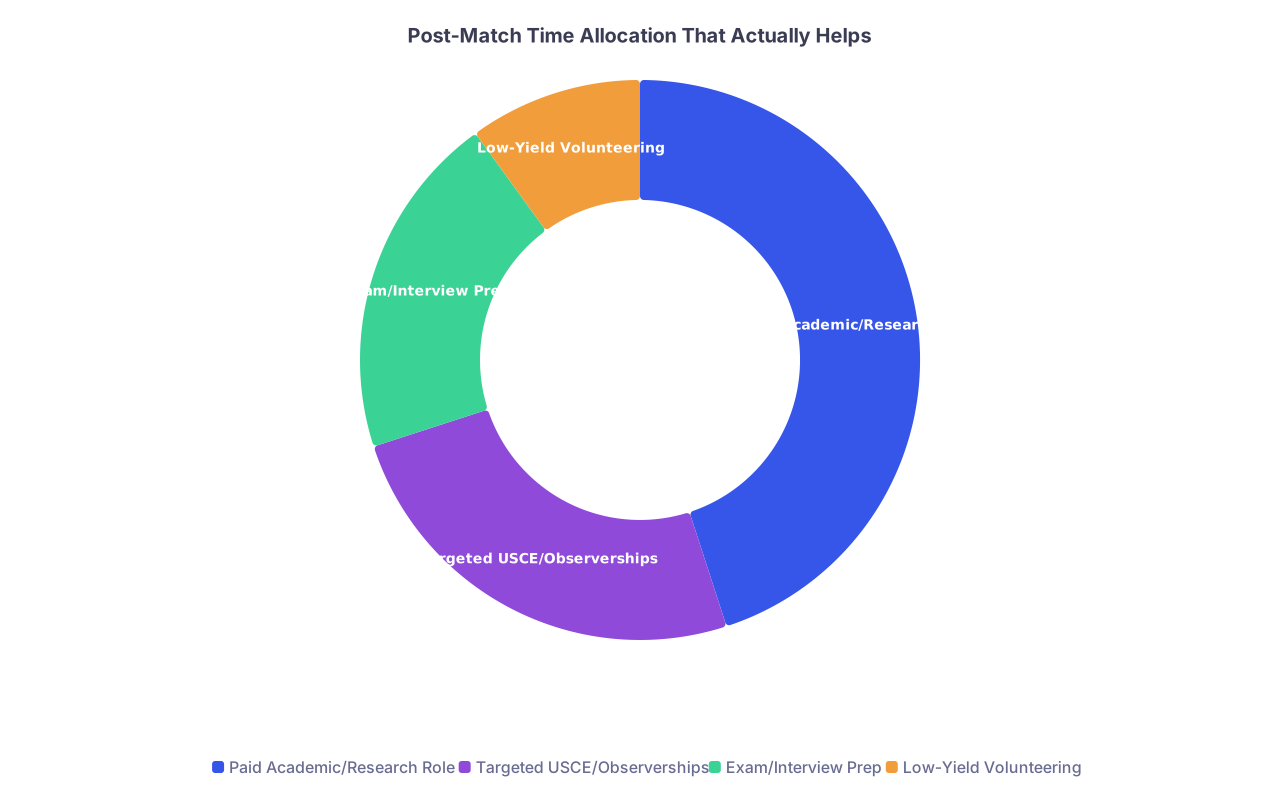
| Category | Value |
|---|---|
| Paid Academic/Research Role | 45 |
| Targeted USCE/Observerships | 25 |
| Exam/Interview Prep | 20 |
| Low-Yield Volunteering | 10 |

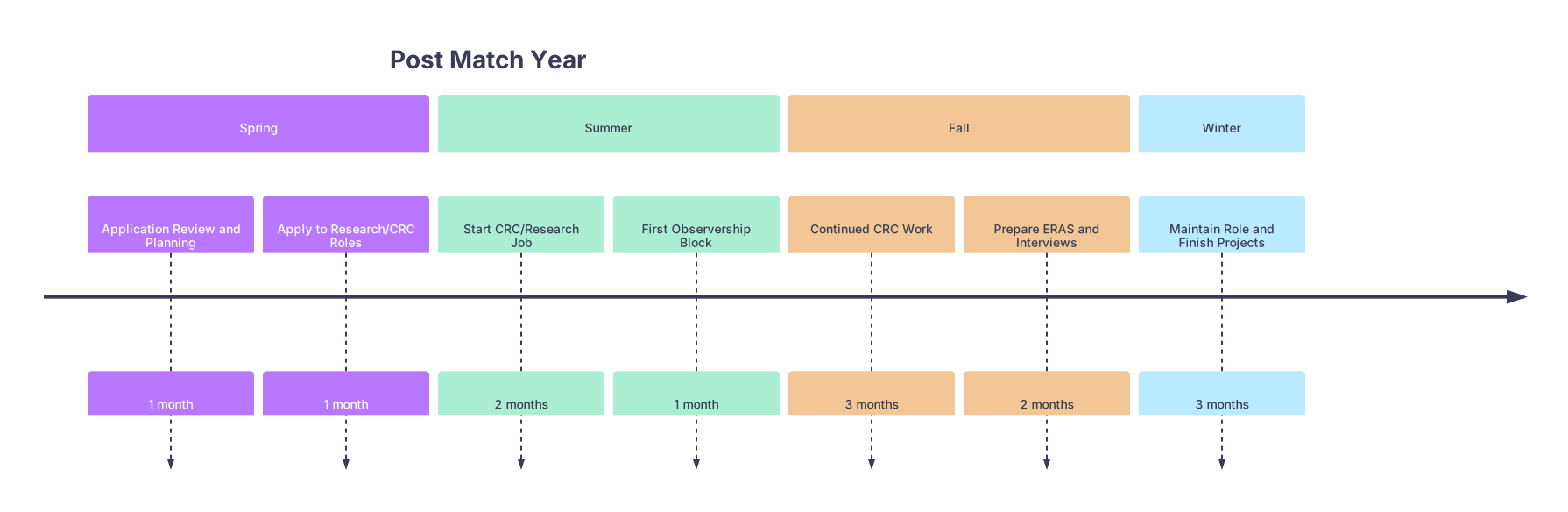
| Period | Event |
|---|---|
| Spring - Application Review and Planning | 1 month |
| Spring - Apply to Research/CRC Roles | 1 month |
| Summer - Start CRC/Research Job | 2 months |
| Summer - First Observership Block | 1 month |
| Fall - Continued CRC Work | 3 months |
| Fall - Prepare ERAS and Interviews | 2 months |
| Winter - Maintain Role and Finish Projects | 3 months |

Key takeaways:
- Not all “clinical experience” is equal; prioritize paid, structured, academically connected roles and limited, high-quality USCE over endless low-yield volunteering.
- Exploitation usually hides behind vague roles, unpaid revenue-generating work, and absent malpractice coverage—walk away when you see that pattern.
- Design your post-match year as a coherent story of growth, with strong letters, clear responsibilities, and tangible output, not just hours spent in someone else’s clinic.