
The way most applicants talk about their “non-clinical gap year” is terrible – and residency program directors can smell the insecurity a mile away.
You are not “taking time off.” You are building a story that either reassures a PD you still belong in medicine… or quietly convinces them you do not. There is no neutral here.
Let me break this down specifically: a non‑clinical job year can be an asset, but only if you frame it with surgical precision. Otherwise it gets interpreted as drift, burnout, or loss of clinical identity – especially in competitive specialties.
This is about controlling the narrative so program directors see:
- You remained clinically relevant.
- You grew in concrete, usable ways.
- You are more ready – not rustier – than last cycle.
If your year was in consulting, tech, pharma, teaching, scribing, “random” office work, or just something to pay the bills, this is for you.
How Program Directors Actually Read a Non‑Clinical Year
Stop guessing what they “might think.” Here is how this usually plays out in real programs.
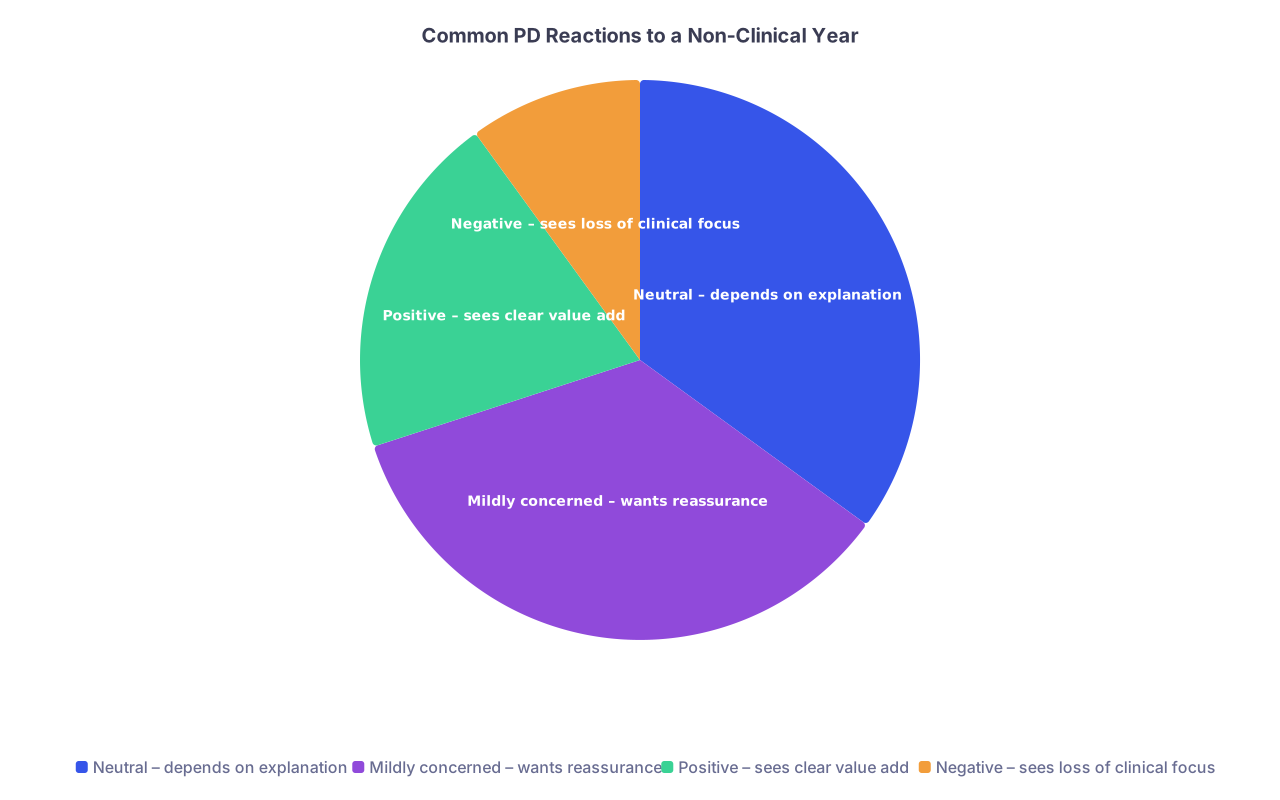
| Category | Value |
|---|---|
| Neutral – depends on explanation | 35 |
| Mildly concerned – wants reassurance | 35 |
| Positive – sees clear value add | 20 |
| Negative – sees loss of clinical focus | 10 |
Most PDs I have worked with fall into one of four camps when they see a non‑clinical year:
Curious but neutral
“Okay, they stepped out. Why? Did they grow? Are they still serious about residency?”Mildly concerned
“Are they rusty? Will they struggle on day one? Did they try to match and fail? Are we inheriting someone who is discouraged?”Genuinely impressed
“They did outcomes work at a major health system? Or led a data project in population health? This could actually help our residents.”Turned off
“They walked away from medicine into something unrelated, and their explanation is vague. Hard pass unless the rest is stellar.”
You cannot control which baseline bias a PD brings. You can absolutely control what “bucket” they put you in after reading your application and talking to you.
The default, lazy way to talk about this year? “I took time to explore other interests and work on myself.” That is death on paper. It reads as unfocused and self‑absorbed.
You need a much clearer frame.
The Three Frames That Work (And The Ones That Do Not)
Think in terms of story architecture. PDs need a clean, linear thread from M1 to your application year that makes sense without mental gymnastics.
There are only three frames that consistently work.
1. The “Applied Medical Skills in a Different Setting” Frame
This is the easiest to sell. You were outside the hospital but still using your medical brain.
Examples that fit this frame:
- Clinical research coordinator
- Medical education fellow / simulation coordinator
- Public health or QI analyst in a hospital system
- Health tech / digital health role with clinical input
- Medical writing for CME or guideline development
You present it as:
- Extension of your clinical identity
- Exposure to systems, quality, outcomes, or education
- Directly beneficial to how you will function as a resident
The message: “I never left medicine. I just changed my vantage point.”
2. The “Deliberate Skill‑Building” Frame
Here, the job is less obviously clinical (consulting, data science, teaching, startup), but you are crystal clear about what you built that is valuable in residency.
Things PDs actually value:
- Project ownership and follow‑through
- Data literacy (SQL, R, Python, advanced Excel – yes, that matters in QI)
- Communication with non‑medical stakeholders
- Leadership of small teams
- Time and task management at scale
You frame it as:
“I intentionally stepped into [X role] to develop [A, B, C specific skills]. Those skills now shape how I approach [patient care, team leadership, QI, teaching].”
The job ceases to be a detour; it becomes targeted training.
3. The “Stability and Maturity” Frame
Sometimes you worked to pay bills, support family, or stabilize your life. It may not be glamorous. But you can still frame it with dignity and clarity.
PDs respect:
- Taking responsibility for finances or family
- Outgrowing chaos and moving into structured habits
- Coming back with discipline and perspective rather than excuses
Bad frame: “I just needed a break.”
Better frame: “I took a year to address [concrete life responsibility] so that I can now commit fully to residency without divided priorities.”
You must also show you kept at least one foot in medicine (shadowing, volunteering, research, teaching).
Frames That Backfire
These are the ones that quietly kill your application:
The vague wellness sabbatical
“I needed time to reflect and prioritize my well‑being.” That sounds like someone who will burn out easily and may not handle call.The bitter anti‑medicine narrative
“I left because of how broken the system is, then decided to come back.” PDs do not want residents who start from cynicism.The “accidental” year
“I did not match, so I just found something to do.” Reads as passive and unstrategic.
If any of that sounds like you, you do not hide it. You structure it. You show reflection, change, and a concrete plan forward.
Non‑Clinical Jobs: How To Translate Them For PDs
Here is where people get lazy. “I worked in consulting” means nothing. You need to translate the job into clinical language.
| Role Type | Weak Description | Strong, Residency-Relevant Frame |
|---|---|---|
| Clinical research | Helped on studies | Managed patients through protocol steps |
| Health consulting | Did slide decks | Led QI-style analysis for health systems |
| Tech / startup | Worked at a health app | Bridge between clinicians and engineers |
| Teaching / tutoring | Taught science | Designed curricula and assessed learners |
| General office job | Admin assistant | Coordinated complex workflows and teams |
Let’s go through common categories and how to reframe them with specificity.
Clinical Research Role
Wrong: “I was a research assistant on a cardiology project.”
Better: “I served as a full‑time research coordinator in interventional cardiology, managing patient recruitment, consent, guideline‑driven follow‑up, and adverse event reporting for multi‑center trials.”
For your application:
- Personal statement or experiences: emphasize handling clinical data, interacting with patients, coordinating with attendings and nurses, learning evidence appraisal.
- Interview talking point: “I learned to see beyond single patients to patterns in outcomes and to coordinate care across multiple touchpoints.”
Key line for PDs: “I stayed bedside‑adjacent and sharpened my ability to synthesize data into decisions.”
Health Consulting / Analytics
Most applicants undersell this badly or sound like McKinsey brochures.
Wrong: “I worked in healthcare strategy consulting doing market assessments and financial modeling.”
Better: “I led analysis for hospital readmission and throughput projects, mapping patient flows and identifying system bottlenecks that directly impacted ED boarding and inpatient bed shortages.”
Translate to residency:
- Shows systems thinking: you understand throughput, capacity, and waste.
- Shows project discipline: deadlines, multi‑stakeholder communication.
- Shows QI alignment: PDs need residents who can meaningfully contribute to QI projects.
In interviews: “This work made me obsessed with why processes fail. As a resident, I want to be the person who not only notices failure points but has the skills to fix them.”
Tech / Startup Roles
If this is just “I worked for a startup,” it reads like you were bored with medicine. Fix that.
Example:
- Position: Clinical liaison at a digital health startup.
- Frame: “I translated clinician needs into product features, evaluated pilot data on patient adherence, and helped design workflows that actually fit into clinic realities.”
PD takeaway: You understand documentation pain points, EHR workflows, patient usability barriers. You are not naive about technology promises.
You can say in your PS: “Seeing how a slight change in interface could reduce clicks and errors confirmed how much design influences burnout and safety. It reinforced my desire to be back in the clinical environment, where these decisions play out in real time.”
Teaching / Tutoring / Academia
Programs love residents who teach well. But you have to be concrete.
Wrong: “I tutored MCAT/Step for a year.”
Better: “I provided structured, longitudinal tutoring in physiology and clinical reasoning to premed and medical students, designing individualized study plans and developing formative assessments that targeted their specific knowledge gaps.”
Link it to residency:
- You are comfortable explaining complex concepts.
- You know how to assess a learner quickly.
- You can contribute to morning report, intern teaching, or resident‑led didactics.
Dropping one line like “My residents had the biggest impact on me as a student; teaching during this year made me want to be that kind of resident for someone else” goes a long way.
“I Just Needed To Pay The Bills” / General Non‑Clinical Work
I have seen everything here: restaurant management, retail, call center, family business, logistics.
You do not apologize for surviving. You frame it:
- Reliability: showed up, did the work, often in high‑stress, customer‑facing roles.
- Teamwork: dealt with difficult people without imploding.
- Leadership: sometimes supervising others or running shifts.
You still must show parallel clinical engagement:
- Shadowing a few times a month.
- Weekend free clinic volunteering.
- Picking up a small research project or case report.
- Regular CME / online modules.
A PD’s mind changes from “They left medicine” to “They held their life together and still chose to come back.”
The Rust Question: Clinical Readiness After Time Away
The unspoken fear: “Will this person be dangerous on day 1?”
You have to anticipate that.
, Structured knowledge review, Explanation for gap year, USMLE/COMLEX recency](https://cdn.residencyadvisor.com/images/articles_svg/chart-what-pds-look-for-after-time-away-from-direct-clin-8291.svg "What PDs Look For After Time Away From Direct Clinical Care")
| Category | Value |
|---|---|
| Evidence of ongoing clinical exposure | 90 |
| [Fresh letters of recommendation](https://residencyadvisor.com/resources/post-match-options/letters-of-recommendation-mistakes-reapplicants-keep-repeating) | 80 |
| Structured knowledge review | 75 |
| Explanation for gap year | 70 |
| USMLE/COMLEX recency | 65 |
Program directors want to see five things:
Ongoing clinical exposure
Shadowing, free clinic, per diem scribing, telemedicine support, student‑run clinics, overseas volunteering (if legit, not “medical tourism”). List it explicitly in ERAS with dates.Fresh letters of recommendation
At least one letter dated during or after your non‑clinical year, preferably from:- A clinician you worked with clinically.
- A research or QI mentor who can speak to your current performance and professionalism.
Evidence of knowledge maintenance
You can mention:- Question banks or structured review you completed.
- CME courses.
- Attending virtual grand rounds or conferences (by name).
Do not just say “I reviewed material on my own.” Too vague. Add structure and specifics.
Clarity about timing and exams
If your Step/COMLEX exams are older, explain how you have kept current. If you took Step 3 during this year, mention that. Step 3 during a non‑clinical year is a powerful signal you are serious and capable.A realistic, humble attitude
In interviews, you say plainly: “I know I will need a brief ramp‑up for procedural and EMR muscle memory. I have a plan for that and I am comfortable asking for feedback early.”
You want the PD’s nervous system to relax: “They know they have some dust; they also walked in with Windex.”
Where To Embed This Story: ERAS, PS, LoRs, Interview
You cannot rely on a single sentence in your personal statement and hope for the best. The reframing needs to be woven across the whole application.
The Personal Statement: One Clear Arc
Your PS should not be a 1,000‑word apology for your non‑clinical year. The biggest mistake I see is applicants making the gap the main character.
Correct structure:
- Why this specialty – rooted in clinical experiences.
- Core traits and values.
- Brief, tight paragraph on your non‑clinical year and how it reinforced or sharpened those traits.
- Where you see yourself in residency and beyond.
For the non‑clinical year paragraph, aim for 5–7 surgical sentences:
- What you did (concrete role).
- 2–3 specific skills you built.
- 1–2 ways those skills map to residency.
- One line that reaffirms your commitment to patient care.
Example skeleton: “After graduation, I spent a year as [role] at [organization], where I [specific actions]. Working with [stakeholders] to [outcome] forced me to develop [skills], which I now bring back to patient care in [specialty]. This time away from the bedside clarified that I miss [specific aspects of patient care] and want to commit fully to residency training in [specialty].”
That is enough. Do not dwell.
ERAS Experiences: Translate, Do Not List
For the non‑clinical job entry:
- Use action verbs: managed, coordinated, analyzed, taught, designed, implemented.
- Include scale: “coordinated 200+ patient contacts,” “tutored 30+ students per term,” “analyzed data from 5 hospitals.”
- Add outcome: “reduced process time by 20%,” “improved student pass rate,” “informed new clinic workflow.”
Avoid corporate fluff: “leveraged synergies,” “provided thought leadership,” “drove innovation.” You are not interviewing for Bain.
Letters of Recommendation: Quietly Script the Frame
You cannot write the letter, but you can guide your letter writers by providing:
- A 1‑page summary of your work and goals.
- A short paragraph explaining how you hope they will contextualize your year.
What helps in a letter:
- “Despite working outside a traditional clinical role, [Name] has maintained a clear commitment to patient care.”
- “Their work here has strengthened skills that will be directly relevant to residency, including [A, B, C].”
- “I have no concerns about their readiness to return to full‑time clinical training.”
PDs trust that more when it comes from someone who saw you this year, not just in med school.
Interview: The 30‑Second Answer You Must Nail
You will be asked some version of: “Tell me about your last year” or “What have you been doing since graduation?”
If you ramble or sound defensive, it is over.
Your answer needs three beats:
What – 1–2 sentences
“I spent the past year working as a [role] at [place], where I [core responsibilities].”So what – 3–4 sentences
“In that role, I developed [skills] and gained perspective on [systems/teams/patients]. For example, I [short concrete story].”Now what – 1–2 sentences
“This confirmed that I want to return full‑time to [specialty] and that I bring [X] and [Y] to a residency program that I did not have before.”
Say it out loud until you can deliver it cleanly, without sounding like a TED talk or a confession.
Risk Categories: How Much You Need To “Over‑Explain”
Not all non‑clinical years are equal. Some barely need explanation; others need serious reframing.
| Risk Level | Scenario Example | How Hard You Must Work To Reframe |
|---|---|---|
| Low | Clinical research, teaching in med ed | Light – just show relevance |
| Moderate | Health consulting, tech, pharma, data science | Moderate – clear links to medicine |
| High | General non-medical work, retail, business | High – emphasize stability + engagement |
| Very High | Multiple years away, no clinical exposure | Very high – may need reentry plan |
Low Risk: Clearly Medical‑Adjacent
If you were in research, med ed fellowship, hospital QI – your main job is not to screw it up:
- Do not over‑apologize.
- Do not sound like you ran away from the wards.
- Do not turn your PS into a research CV.
Just show that you:
- Stayed near patients.
- Worked with clinicians.
- Built analytic and communication skills.
Moderate Risk: Related to Health Systems But Not Bedside
Consulting, pharma, payor, health policy, EHR vendor, startup. Here, you must:
- Emphasize interaction with clinicians and patients (direct or indirect).
- Highlight systems understanding: throughput, access, safety, equity.
- Show that this expanded your motivation, did not replace it.
I have seen applicants move from health analytics to IM or EM very successfully if they lean into: “I learned where the system breaks; now I want to be one of the physicians actually caring for the people inside it.”
High / Very High Risk: Far From Medicine
If you were in finance, family business, or out of work and mostly at home, you need a two‑pronged approach:
Stability narrative
“I addressed [X] responsibilities so that my life is now stable enough for residency.”Reentry plan
Show you are already doing:- Clinical observerships.
- Question banks.
- Maybe Step 3.
- Documented CME.
And talk specifically about your first 3 months as an intern: “I plan to [shadow in June, review [specialty] guidelines, practice documentation in a mock EHR, etc.].”
PDs need to see you are not walking in blind.
Strategically Using Projects During The Year
If you are mid‑year right now, you still have time to shape the narrative with targeted add‑ons.

| Step | Description |
|---|---|
| Step 1 | Non clinical job |
| Step 2 | Add shadowing |
| Step 3 | Add shadowing and QI or research |
| Step 4 | Add shadowing, project, teaching |
| Step 5 | Get fresh clinical letter |
| Step 6 | Stronger reapplication story |
| Step 7 | Time available each week |
You can still:
Attach yourself to a small QI or research project that produces:
- A poster.
- A presentation.
- A manuscript (even in progress).
Volunteer consistently at one clinic or hospital:
- Emphasis on consistency over prestige.
- Let the attending write about your reliability and growth.
Take on teaching (for med students, undergrads, community health education).
These bolt‑ons convert “just a job” into “a strategically designed growth year.” PDs notice that architecture.
A Quick Reality Check: Specialty and Competitiveness
I will be blunt. The higher the specialty’s competitiveness and the more time away, the harder you must work to sell this.
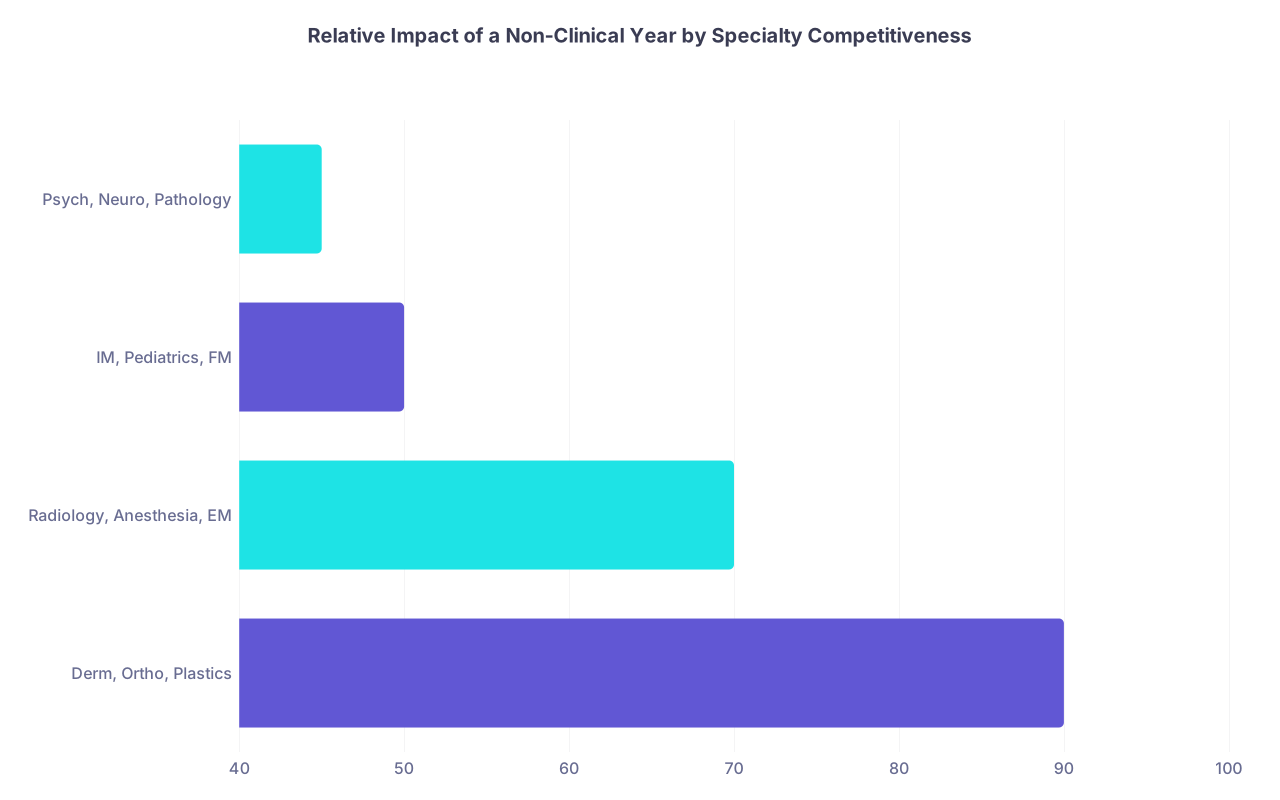
| Category | Value |
|---|---|
| Derm, Ortho, Plastics | 90 |
| Radiology, Anesthesia, EM | 70 |
| IM, Pediatrics, FM | 50 |
| Psych, Neuro, Pathology | 45 |
In hyper‑competitive fields (derm, ortho, plastics, ENT):
- A non‑clinical year must come with serious research output or extremely compelling skill gain.
- Or you pivot to a related but less competitive field where your story fits better.
In middle‑tier competitiveness (IM, EM, anesthesia, radiology):
- A well‑framed non‑clinical year is absolutely survivable.
- Strong letters, solid scores, and clear commitment matter more.
In primary care or psych:
- Personal maturity and commitment to underserved populations carry real weight.
- A year in community work, public health, education, or even stable non‑clinical employment with service side projects can actually help if you frame it well.
You need to be honest with yourself about where your profile fits and adjust your strategy accordingly.
Final Tightening Before You Hit Submit
Before you send anything, do this sanity check on your story:
Can you summarize your year in one sentence that sounds intentional, not accidental?
If someone read only your ERAS experiences, would they know:
- Why you did this job?
- What you learned?
- How it helps you as a resident?
Does your personal statement:
- Keep the non‑clinical year to a focused paragraph?
- Reaffirm your clinical identity, not your corporate one?
Do you have:
- At least one recent clinical letter?
- At least one ongoing connection to patient care?
Is your 30‑second interview answer about the year clean, confident, and honest?
If not, fix that before you worry about secondary details.
Key Takeaways
A non‑clinical job year is not automatically a red flag; it becomes one when you present it as drift, burnout, or an accident rather than deliberate growth.
Program directors want three things from your explanation: proof you stayed clinically engaged, clear skills that translate directly to residency, and a believable, confident commitment back to patient care.
You control the narrative. Translate your job into clinical language, anchor it with concrete examples, and make sure your ERAS, personal statement, letters, and interview all tell the same, coherent story of a future resident who is more prepared – not less – because of this year.