
The worst thing you can do with a gap year after not matching is “doing some research” without a strategy.
You are not collecting PubMed participation trophies. You are rebuilding your residency application signal. That requires a publication strategy, not random busywork.
Let me break this down specifically.
1. Define the Real Goal of Your Gap-Year Publication Strategy
You are not trying to become an academic celebrity in 12 months. You have three concrete goals:
- Repair or strengthen your application narrative
- Increase your perceived readiness for residency
- Move your file higher in the next screening pile
Everything else is noise.
Translate that into residency world
For program directors, your gap year research is answering questions like:
- Did this person do something focused and coherent, or just scatter-shot case reports in seven unrelated areas?
- Does this activity explain or offset their red flags (low score, late interest in the field, institutional issue, prior failure)?
- Is there evidence they can:
- Commit to a field
- Finish what they start
- Work in teams
- Handle academic writing and deadlines
Your publications are not just citations. They are signals. If your output does not change how a PD views you in a 30‑second skim of your ERAS, it is not helping.
So before you chase any project, answer:
- What is the story I want next year’s application to tell?
- How will this specific project support that story?
If you cannot answer that in one sentence, skip the project.
2. Clarify Your Specialty Situation First
Your publication strategy depends heavily on where you are aiming.

A. You are reapplying to the same specialty
Example: You applied ortho, did not match, and still want ortho.
Your research must:
- Be heavily aligned with your specialty (or at least musculoskeletal, outcomes research, sports medicine, etc. for ortho)
- Involve recognizable faculty names if possible
- Drive towards multiple outputs (abstracts + posters + at least one full paper)
You are signaling: “I am still serious about this specialty, and I spent my year going deeper.”
B. You are pivoting to a less competitive specialty
Example: You applied derm, plan to pivot to internal medicine.
Your research should:
- Be clearly relevant to the new field (IM, cards, heme/onc, etc.)
- Help explain the pivot narrative:
- Derm → IM: outcomes, chronic disease management, immunology-based projects
- Show you are not flailing, but deliberately transitioning
Programs will ask: “Why the switch?” Your research should help answer that without you opening your mouth.
C. You are applying to a research-heavy vs. community-heavy path
Research-heavy programs (university IM, radiation oncology, neuro, academic EM) look for:
- PubMed-indexed works
- Multi-author team participation
- At least some structured projects (clinical trials, registries, retrospective cohorts)
Community-heavy programs (many FM, IM, psych, transitional years) care more about:
- Productivity (finishing what you start)
- Conference presentations
- Evidence you can juggle tasks and follow deadlines
You still benefit from pubs, but the bar is lower for impact factor and first/last author vanity. Focus more on volume and completeness.
3. Choose the Right Types of Projects for a One-Year Window
You have 12 months. Often less, if your position starts late or onboarding drags. You do not have time for a 5-year prospective trial.
Pick project types with high output probability inside your timeline.
| Project Type | Time to Output | Publication Probability | Best Use Case |
|---|---|---|---|
| Case report/series | 1–3 months | High | Start-up wins |
| Retrospective chart | 6–12 months | Moderate–High | Main project |
| Systematic review | 6–12 months | Moderate | Methods cred |
| Narrative review | 3–6 months | High | Fast first pub |
| QI / education project | 6–12 months | Variable | Teaching/QI |
Case reports and small series
These are your quick wins.
Pros:
- Fast turnaround
- Good for building writing skills and getting on PubMed quickly
- Easy entry for someone with no prior research
Cons:
- Lower impact
- Transparently “filler” if that is all you have
- Not very persuasive alone for highly competitive specialties
Strategy: aim for 2–4 case reports early, then move your energy to bigger projects.
Retrospective chart reviews / database studies
This is the workhorse for a 1-year gap.
Pros:
- Feasible within a year if the dataset is accessible
- Can produce multiple outputs:
- Abstract
- Poster / platform presentation
- Full manuscript
- Stronger academic signal than just case reports
Cons:
- IRB can be slow if your institution is disorganized
- You are at the mercy of the attending/PI for final push and co-author cooperation
If you do only one “big” project in your gap year, make it a well-designed retrospective or database study that clearly relates to your target specialty.
Reviews (systematic or narrative)
Systematic reviews:
- Strong methods credibility if done properly
- Painful, tedious, and easy to derail if team is disorganized
- PRISMA, PROSPERO registration, complex screening → time sinks
Narrative reviews:
- Faster
- Often invited or based on a faculty member’s idea
- Can be rejected if not well framed or if the journal just did something similar
Use reviews as secondary projects unless you have a PI who has done many and can push it through quickly. Do not make a solo systematic review your primary plan unless someone experienced is tightly supervising.
QI and education projects
These matter more for fields that claim to value teaching and systems: IM, peds, FM, psych, EM.
Pros:
- You can often implement quickly
- Presentable at local or national conferences
- Good for interview talking points (“We reduced unnecessary labs by 20%”)
Cons:
- Publication is not guaranteed
- Many QI projects die after poster stage
If you go this route, front-load discussions about publication intent with your mentor: “I want to plan this from the start as a manuscript, not just a poster.”
4. Decide Where You Need Your Name to Show Up
Not all authorship is equal. You know this; PDs definitely do.
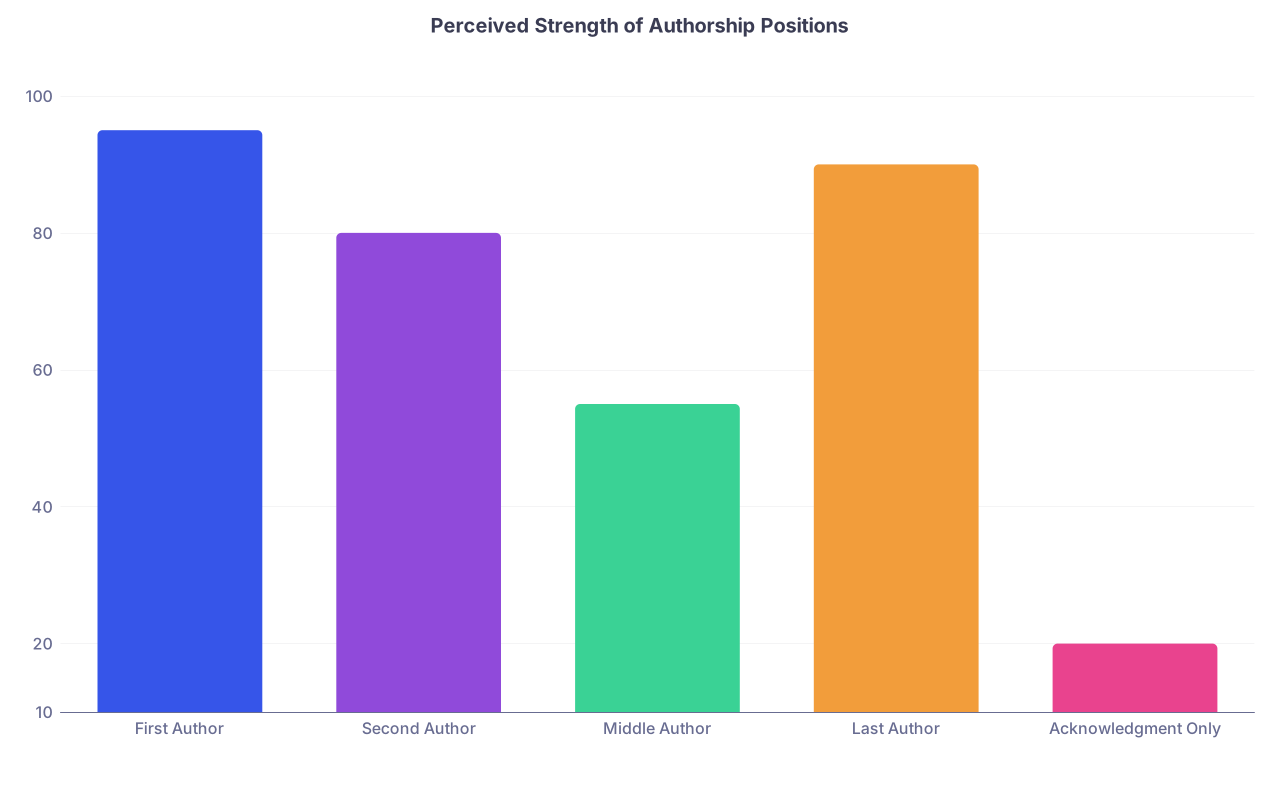
| Category | Value |
|---|---|
| First Author | 95 |
| Second Author | 80 |
| Middle Author | 55 |
| Last Author | 90 |
| Acknowledgment Only | 20 |
I am not saying middle author is worthless. I am saying you need to understand how each slot is interpreted.
- First author: You drove the bus. Data, writing, revisions. Very strong signal if aligned with your specialty.
- Second author: Still meaningful. Often indicates heavy lifting.
- Middle author on a big team: Helps count-wise, especially in competitive fields that expect many pubs (pathology, rad onc, derm, ortho research tracks).
- Last author: Usually faculty / PI. Not your role during a gap year, unless it is some unique non-medical field you brought in.
In a one-year strategy, I usually advise:
- Aim for 1–2 first-author projects you can realistically finish
- Accumulate several middle-author works by being a good collaborator
The trap: taking on 8 projects where you are “helping” but have no control over timeline. Six of them stall. You end the year with nothing you can list as submitted.
You need at least some projects where you control the calendar.
5. Month-By-Month Structure: What a Smart Year Actually Looks Like
Here is what a deliberate 12-month publication plan might resemble if you start in July after not matching. Adjust months as needed.
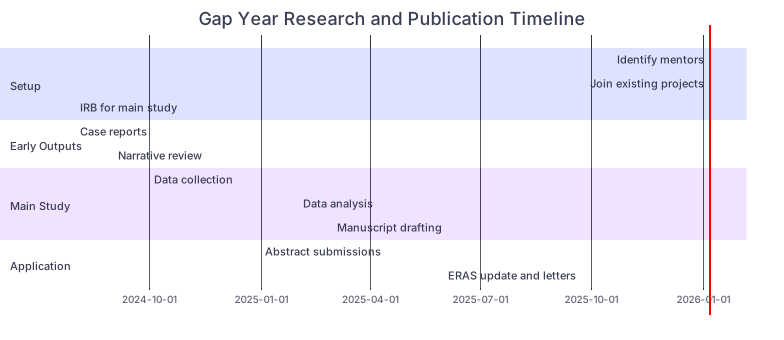
| Task | Details |
|---|---|
| Setup: Identify mentors | a1, 2024-07, 1m |
| Setup: Join existing projects | a2, after a1, 1m |
| Setup: IRB for main study | a3, 2024-08, 2m |
| Early Outputs: Case reports | b1, 2024-08, 3m |
| Early Outputs: Narrative review | b2, 2024-09, 3m |
| Main Study: Data collection | c1, 2024-10, 4m |
| Main Study: Data analysis | c2, 2025-02, 2m |
| Main Study: Manuscript drafting | c3, 2025-03, 3m |
| Application: Abstract submissions | d1, 2025-01, 3m |
| Application: ERAS update and letters | d2, 2025-06, 2m |
Let me unpack the logic.
Months 0–1: Immediate triage and positioning
Your first month should not be “I’ll read about research.” It should be:
- Identify 1–2 research-heavy mentors in your target specialty or adjacent:
- Ask directly: “I am taking a gap year after not matching. My goal is to produce publishable work before ERAS. Can I join existing projects and start one focused project under your supervision?”
- Join at least one ongoing project that is midway through:
- Data already collected
- Paper in draft
- Abstract ready for submission
This gets your name on something that might be submitted or accepted within 3–6 months.
At the same time, define your main project with that mentor. Ideally a retrospective or robust QI study with clear endpoints.
Months 1–3: Quick wins + IRB
You should be:
- Drafting one or two case reports from interesting patients
- Helping push the joined project(s) to the next concrete milestone:
- Data cleaning
- First manuscript draft
- Getting IRB submission in for your main project
You want at least one item under review and one IRB “in review” by the end of month 3.
Months 3–6: Data and mid-stage writing
This is the grind period.
- Extract data for your main project
- Continue working on mid-stage projects
- Start a narrative review or education/QI project as a controlled side bet
You should aim by month 6 to have:
- 1–2 manuscripts submitted or near-submission (case report, joined project)
- Main project: data collection well underway or done
Months 6–9: Abstracts and conference strategy
Now you start caring about where your data will be seen.
Target conferences that line up with:
- Your specialty (ACR, ACC, ATS, APA, etc.)
- The ERAS timeline (conference in late fall or winter, with abstract deadlines in spring/summer)
You want at least one national or regional abstract accepted before interview season, even if the full paper is pending. That is still a line on ERAS and a talking point.
Months 9–12: Manuscript push and ERAS integration
By this point, if you were intentional, you should be able to list:
- Submitted or accepted case reports
- At least one main paper “submitted” or “in revision”
- One or more abstracts/posters
Use late months to:
- Clean every citation and status in ERAS
- Extract your contributions into tight, concrete bullets for interviews:
- “I designed the data collection tool and ran the analysis for a retrospective cohort of 250 patients with X…”
- Secure LORs specifically mentioning your research work ethic and reliability
6. How Many Publications Actually Move the Needle?
Let me be blunt: “How many pubs do I need?” is the wrong question. But you are going to ask it anyway, so I will give you a realistic framework.
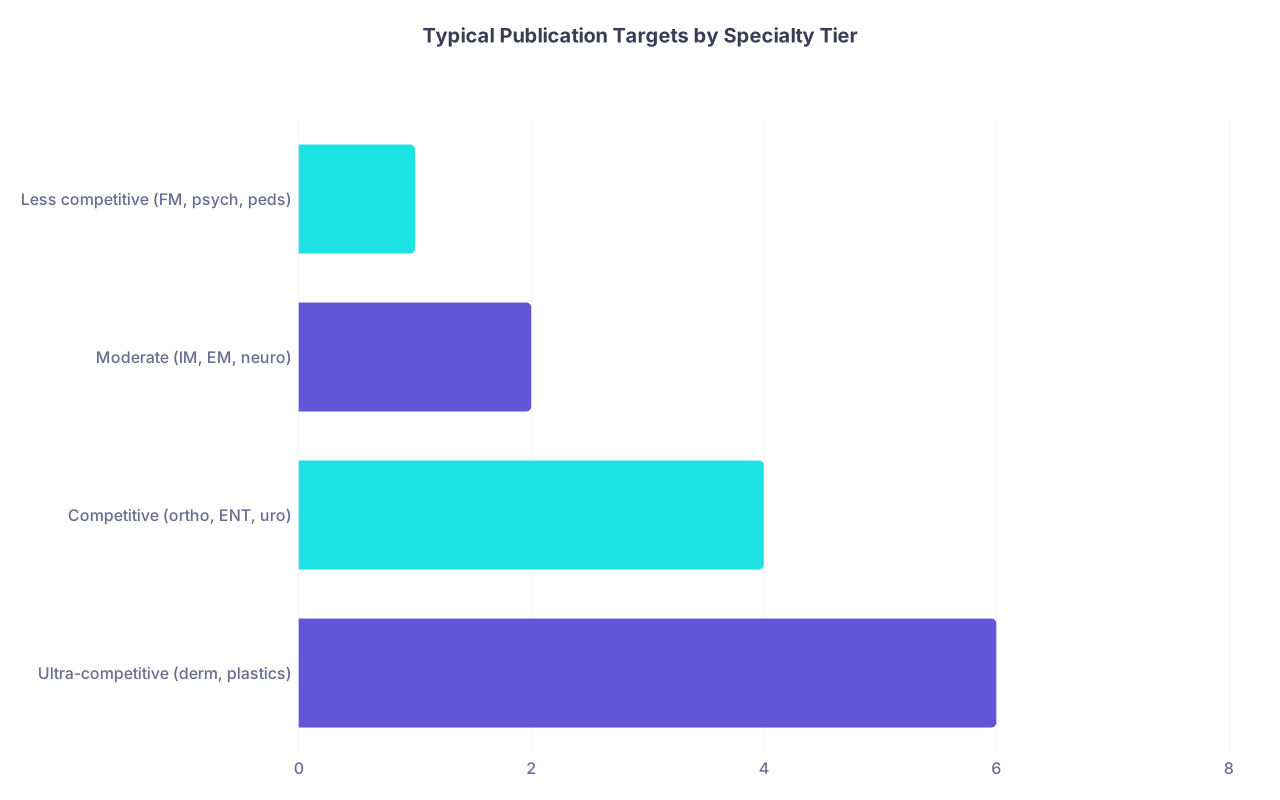
| Category | Value |
|---|---|
| Ultra-competitive (derm, plastics) | 6 |
| Competitive (ortho, ENT, uro) | 4 |
| Moderate (IM, EM, neuro) | 2 |
| Less competitive (FM, psych, peds) | 1 |
This is not a rule. It is pattern recognition from what I see on successful reapplicants:
Ultra-competitive: You are not fixing your application in one year with two case reports. People who reenter derm/plastics successfully usually have:
- Multiple first-author works
- Several middle-author projects
- Strong mentorship at a well-known institution
Competitive surgical / procedural: For ortho, ENT, urology, ophtho, a cluster of 3–6 total publications (not all first-author) with at least one solid main project can meaningfully improve your odds when paired with other improvements (Step 2, rotations, networking).
Moderate competitiveness (IM, EM, neuro, anesthesia): Moving from 0–1 pubs to 2–4 pubs, especially with clear relevance to the field, absolutely helps. Not magic. But PDs notice.
Less competitive (FM, psych, peds in many regions): Even 1–2 well executed works can differentiate you, especially if you had prior red flags and now show consistency and maturity.
What matters more than the raw count:
- Alignment with your field
- Evidence of completion (accepted or submitted, not “in progress” vaporware)
- Your described role
7. Don’t Waste Time: How to Filter Bad Projects Fast
This is where many unmatched applicants get burned: they join anything that looks like research, then discover 8 months later that the “project” was a vague idea an attending had in 2015.
Before committing, ask (out loud):
What is the study question, and what is the planned final product?
- “We want to publish in Journal X” beats “We’ll see how it goes.”
What is the timeline?
- “We aim to submit an abstract to Conference Y by March and a manuscript by July.”
Who has done this before successfully on the team?
- If nobody on the team has actually published something similar, double your skepticism.
What will my role be?
- You are not signing up to “help as needed.” That yields middle-author status on a project that might never finish.
Good answers:
“You would lead data collection and first draft. I have two residents who will help with stats and revisions. We have three similar papers in this journal.”
Bad answers:
“We’re still thinking about what exactly to study.”
“We’ll figure out authorship later.”
“There’s no rush on this.”
Your time is your currency. Treat it that way.
8. Build a Daily and Weekly Execution System
Strategy is meaningless if you drift.
You cannot binge-write 3 papers in August and call that a plan. You need a boringly consistent work pattern.

Daily blocks
You want protected, non-negotiable blocks of research time, especially if you also have a paid clinical or scribe job.
Example pattern:
1–2 hours of deep work in the morning:
- Data extraction
- Analysis
- Manuscript drafting
30–60 minutes in the evening:
- Emails to co-authors
- Reference management
- Minor formatting tasks
The actual hours do not matter. The consistency does.
Weekly structure
Every week, set hard deliverables, not vague intentions:
- “By Friday, I will:
- Extract data for 20 more patients
- Finish Methods draft for Project A
- Outline Introduction for Project B
- Email my mentor a draft figure”
Then track completion. If you keep missing your self-set goals, scale them down, but keep them explicit.
Tools that actually help
- Reference manager (Zotero, Mendeley, EndNote). Messy citations kill time.
- Shared docs (Google Docs, Overleaf) for real-time feedback.
- A simple spreadsheet or Notion board tracking:
- Project name
- PI
- Your role
- Stage (Idea, IRB, Data, Draft, Submitted, Accepted)
- Next action
- Hard deadlines
You should be able to look at one dashboard and answer:
“What are my top 3 tasks this week to move publications forward?”
9. How to Talk About Your Gap-Year Research on ERAS and in Interviews
Publications are only half the point. The other half is how you integrate them into your story.

ERAS entries: be concrete
Under experiences and publications:
- Avoid fluff like: “Assisted with research on outcomes in heart failure.”
- Instead: “Designed data collection tool and extracted data for 200-patient retrospective cohort examining 30-day readmissions in heart failure.”
For publications under review:
- List them clearly as “Submitted” with the target journal.
- Do not invent acceptances. PDs do check.
Interviews: have 2–3 go-to research stories
You need a few polished narratives, each 60–120 seconds, that show:
- Your role (not just what the group did)
- A specific challenge and how you handled it:
- Missing data
- IRB revisions
- Conflict about authorship
- A clinical or systems lesson you took from the project
For example:
“I led a retrospective review of 180 patients with septic shock to identify predictors of ICU length of stay. Midway, I realized our inclusion criteria were pulling a lot of borderline cases and diluting the signal. I proposed a stricter definition, re-ran the extraction, and worked with our biostatistician to adjust the model. The lesson for me was that sound clinical judgment upstream matters as much as fancy stats downstream.”
That is much stronger than dryly reciting: “We found X was associated with Y, p < 0.05.”
Addressing the “Why did you not match?” elephant
Your research year should be part of a mature, forward-looking answer, not an apology tour.
Something like:
“I did not match last cycle in [specialty]. My application was weaker in [specific area: timing, scores, lack of focused exposure]. I took a structured gap year where I [clinical work + research specifics] to deepen my commitment to [field] and build skills that will make me a better resident. Concretely, that meant leading a study on [topic], presenting at [conference], and working closely with [mentor] on [X].”
You are showing growth and direction, not desperation.
10. Anchor Your Strategy With the Right People
You can design the perfect plan on paper and still fail if your mentors are disinterested or disorganized.

What a good gap-year research mentor looks like
Patterns I have seen in mentors who reliably get students and reapplicants publications:
- Actively publishing in the last 2–3 years in your specialty
- Has multiple parallel projects at different stages
- Responds to emails within a reasonable time (days, not months)
- Gives you ownership of clearly defined pieces
- Knows the politics:
- Which conferences are realistic
- Which journals are a waste of time
- How to pace submissions around ERAS
If you are currently at an institution with weak research in your target field, you may need to:
- Arrange a research fellowship or non-degree position at a larger academic center
- Cold-email faculty with a structured pitch:
- Who you are
- Your gap year situation
- Your prior skills (stats, coding, languages, previous projects)
- Your time commitment
- Your clear ask: “I am seeking to join an existing project and start one main project I can complete in 12 months.”
The more concrete you are, the more likely you get a real opportunity instead of vague promises.
Key Takeaways
Treat your gap-year publication work as targeted signal repair, not random research tourism. Every project must support your specialty story and application narrative.
Prioritize a mix of quick wins (case reports, narrative reviews) and at least one serious, first-author capable project (retrospective or QI) that can generate real outputs—abstracts, posters, and a manuscript—inside 12 months.
Anchor everything around strong mentorship and disciplined execution: clear roles, written timelines, weekly deliverables, and concrete ERAS/interview narratives that turn your publications into evidence of readiness, not just lines on a CV.