
Most unmatched applicants waste their transitional year. That is the mistake you cannot afford to make.
A transitional year (TY) after unmatching can either be a holding pattern or a launchpad. The difference is never luck. It is strategy, documentation, and how ruthlessly you align your PGY‑1 with your next application.
Let me break this down specifically.
You are in a bad spot emotionally and professionally. You unmatched, maybe scrambled into a TY, maybe SOAPed into a prelim/TY you were not expecting. Everyone says, “It’ll be fine, just work hard.” That advice is incomplete and, frankly, dangerous. Working hard but invisibly is how you burn a year and reapply with the same problems.
You need to turn this year into leverage. That means:
- Targeted rotations that serve your reapplication story
- Deliberate relationships that turn into powerful letters
- Concrete “delta” between last cycle and the next (scores, skills, publications, roles)
- Documentation that proves you are different from the person who unmatched
Let us go step by step.
1. Understanding Exactly What a Transitional Year Can and Cannot Do
Transitional year is not magic. It will not automatically “fix” a weak application. It is a tool. You either use it well or it works against you.
What a TY actually gives you
- A full PGY‑1 year of ACGME-accredited training
- A chance to show you can function as a physician in the United States system
- Access to faculty, program leadership, and sometimes chairs who write letters and make calls
- Time and institutional affiliation for research, QI, teaching, and exams (Step 3)
- A buffer to clarify your specialty goals if those were previously unfocused or unrealistic
Where people get confused is thinking “any” TY is fine and “any” good performance will be rewarded. Not true. Programs re-evaluating you want to see that your PGY‑1 year directly addresses the perceived reasons you unmatched.
If you had:
- Limited clinical exposure in your target field → your TY must include heavy exposure there.
- Weak letters → you must leave TY with at least 2 outstanding, specialty-relevant letters.
- Questionable professionalism feedback or red flags → your TY evaluations must be flawless and narratively strong.
- Low Step scores or poor test performance → you should pass Step 3 on first attempt with a solid score (when possible and useful).
If you do not know why you unmatched, you are already behind.
2. First Step: Diagnose Why You Unmatched, Precisely
You cannot leverage a TY if you are guessing about the problem. Vague “maybe I applied too competitive” is not enough. You want a concrete list.
Sit down and create three columns:
- Objective metrics: Step 1/2 scores, attempts, class rank, AOA, number of programs applied, interview count.
- Subjective inputs: Prior letters quality, feedback from advisors, any professionalism issues, COMLEX-only status, visa issues.
- Application strategy: Specialty choice competitiveness vs profile, number of backup specialties, geographic limitations, late application, poor personal statement, weak MSPE.
Then, do something most people avoid: ask for blunt feedback.
- Email your school’s dean of student affairs or residency advising director. Ask for a 30‑minute brutally honest review.
- Contact one or two PDs or APDs where you interviewed, if you feel comfortable. Keep it short: “I would appreciate any candid feedback that could help me improve my application as I complete a PGY‑1 transitional year.”
You are looking for patterns. Not one-off comments.
Common underlying problems I have seen:
- Applying to derm/ortho/ENT/PR with mid 220s–230s and almost no research, then having no real backup plan.
- Mediocre or generic letters that describe the person, not the doctor.
- Interview problems: awkward, defensive answers, lack of insight, poor explanation of red flags.
- Dead-on-arrival personal statement or sloppy ERAS (gaps, typos, list of hobbies that say nothing).
- Excessive geographic restriction that eliminated half the viable programs.
Once you have a working diagnosis, you can design your TY as a corrective.
3. Choosing the Right Mindset: Transitional Year as a One-Year Fellowship in “Proving Yourself”
If you treat TY like “just get through it,” you will waste it.
Reframe the year as a one-year fellowship in:
- Professionalism under pressure
- Bread-and-butter inpatient medicine
- Specialty-directed development (for your target field)
- Building credibility with people whose emails other PDs actually open
Your attitude in the first 2–3 months will decide almost everything: the quality of your letters, who advocates for you, what chief or PD thinks when asked, “Would you rehire this resident?”
The resident who wins this game:
- Shows up early, leaves late sometimes, but more importantly looks prepared and calm
- Owns their patients (knows all their labs, plans, family concerns)
- Asks for feedback explicitly and acts on it quickly
- Never complains about scut in front of attendings or leadership
- Is transparent but mature about their unmatched situation when asked
The resident who loses:
- Hides their unmatched story, radiates shame, answers vaguely when asked
- Treats TY as “temporary,” feels too good for the work, compares constantly to categorical peers
- Waits passively for someone to “notice” how hard they are working
- Spends so much time on side research that their clinical work slips
You are now in a one-year live audition. Behave like it.
4. Structuring Your Transitional Year for Maximum Leverage
Here is where people either get surgical or sloppy.
You want your schedule and activities to map directly onto your reapplication strategy.
Step 4A: Align rotations with your target specialty
If you already know your specialty re-target (for example: shifting from derm to internal medicine, or reapplying to anesthesia), you design the year around it as much as the program allows.
Priorities:
Core inpatient rotations early
You want strong early evaluations. Medicine wards, ICU, ED are prime. PDs look at your early TY feedback when you apply in September.Specialty-aligned electives before September
If you are reapplying to anesthesia, you want at least 1 anesthesia elective before ERAS submission, ideally with someone who will write a letter by late August. Same for radiology, IM, EM, psych, etc.Critical rotations where you can shine
Places where residents run the list, teach students, and interact closely with attendings. Those settings produce stronger letters.
Example: you unmatched to IM last year. You SOAPed into a TY at a community hospital.
Your ideal PY‑1 structure (as much as scheduling allows):
- July–August: Medicine wards
- September: ICU or CCU
- October: Medicine wards again or night float
- November–December: Your target field rotations (IM subspecialty, hospitalist service)
- January–March: Mix of ED, electives, and research/QI time
- April–June: Flexible, but guard against burnout right before interviews for the next cycle
If you matched TY late and cannot dictate the first few months, talk to your chief residents and program coordinator early. Ask: “I plan to reapply to X this year. Is there any flexibility to place at least one rotation in X before September so I can obtain a letter?”
You will not always get your ideal schedule. But residents who ask early often do significantly better than those who never ask.

| Step | Description |
|---|---|
| Step 1 | Start TY July |
| Step 2 | Early core rotations |
| Step 3 | Identify target specialty mentors |
| Step 4 | Secure 2-3 strong letters |
| Step 5 | Submit ERAS early |
| Step 6 | Ongoing performance + projects |
| Step 7 | Interviews with clear story |
| Step 8 | Match with improved profile |
5. Letters of Recommendation: The Real Currency of Your TY
For reapplicants, letters carry disproportionate weight. PDs are asking, “Is this person the same risk they were last year, or has someone I trust vetted them this time?”
Your TY letters need to be:
- Specialty-appropriate (at least 2 from your target specialty, if reapplying there)
- From attendings who directly supervised you, not just “everyone likes them” hallway fans
- Specific about growth, work ethic, clinical reasoning, and reliability
How to engineer a strong TY letter
On day 1 of each potentially useful rotation:
Tell the attending something like:
“I am a transitional year resident planning to reapply to internal medicine this cycle. I unmatched last year, and this PGY‑1 is my chance to prove myself clinically. I would really value any feedback along the way, and if I earn it, I hope to ask you for a strong letter.”
You are doing three things here:
- Declaring your goal openly (people cannot help you if they do not know it).
- Inviting feedback (shows maturity, reduces surprise when you ask for a letter).
- Subtly stating you only want a letter if it can be strong (which protects you from lukewarm letters).
Mid‑rotation, ask:
“Can I get a sense of how I am doing compared to other interns at this point in the year, and what I should improve over the next two weeks?”
End of rotation:
“Would you feel comfortable writing me a strong letter for internal medicine? Specifically focusing on my clinical reasoning, reliability, and how I have grown over the rotation?”
If they hesitate or use lukewarm language, thank them and do not push. You aim for 2–3 stellar letters, not 6 average ones.
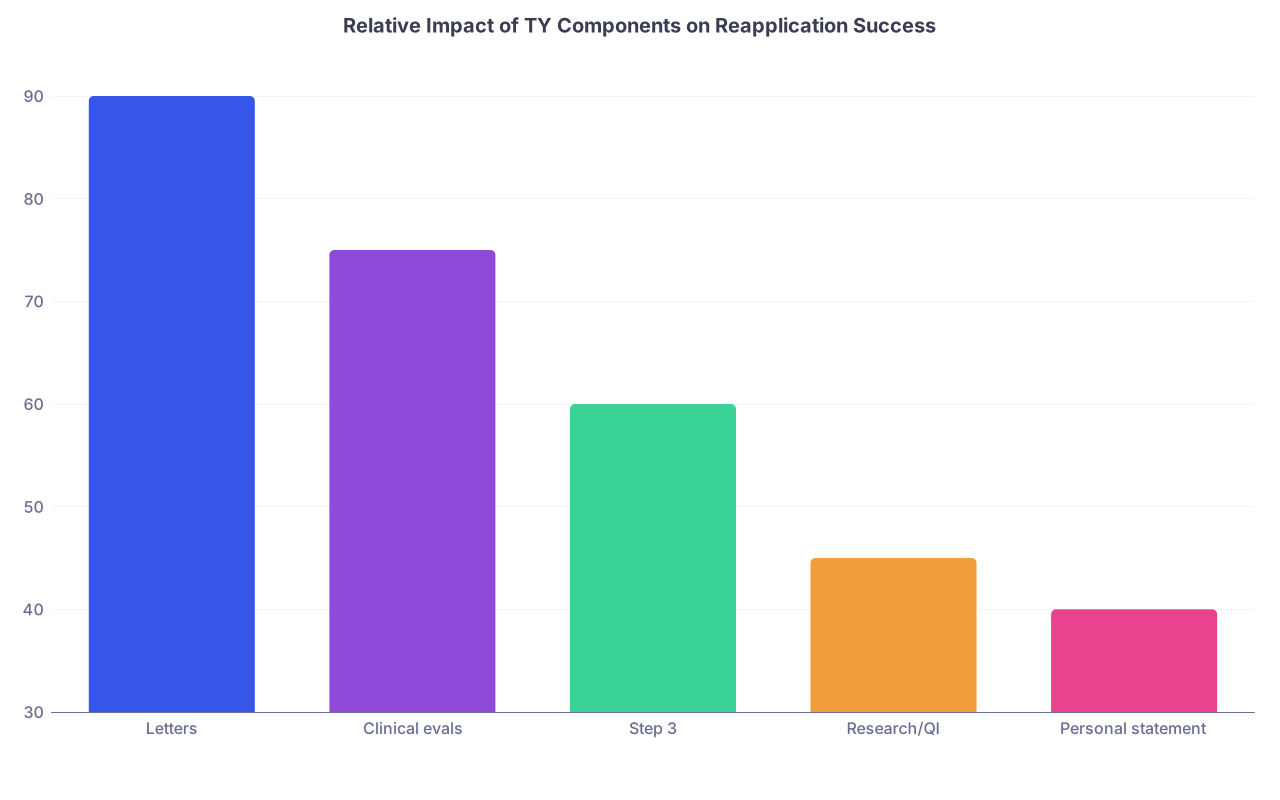
| Category | Value |
|---|---|
| Letters | 90 |
| Clinical evals | 75 |
| Step 3 | 60 |
| Research/QI | 45 |
| Personal statement | 40 |
(Scale: 0–100 relative subjective importance based on PD feedback and reapplicant outcomes.)
6. Using Step 3 and Exams Strategically
If you have passing Step 1 and 2 but no Step 3, your TY is a realistic and usually advantageous time to take it—if you can pass on the first attempt.
You do not take Step 3:
- If you are already overloaded clinically and at risk of failing.
- If your target specialty does not care much and your prior scores are excellent.
- Just to “look busy.”
You do take Step 3:
- If you had borderline Step 1/2 scores and need to demonstrate that you can pass high-stakes exams independently.
- If programs in your target specialty prefer or require it (many IM, FM, anesthesia, psych programs like seeing it for reapplicants).
- If you are an IMG whose biggest question mark is “test performance and readiness.”
Plan the timing:
- Best: during a lighter elective block or a month where you have some control over evenings.
- Worst: middle of ICU or heavy wards when you are barely sleeping.
When you pass: include it prominently in ERAS and in your update emails to programs. It is one of the few “hard data” changes you can make in 12 months.
7. Research, QI, and Extra Projects: Useful or Distraction?
This part is overdone by anxious residents and underappreciated by PDs.
You do not need a new first-author NEJM paper. You need evidence that you contribute academically or in improvement projects in a sane, sustainable way.
For highly competitive specialties (derm, ortho, ENT, PR, neurosurgery) reapplying after TY, research is more important. For mid-competitiveness specialties (IM, EM, anesthesia, peds, psych), QI and teaching often carry as much narrative weight as another small paper.
Your approach inside a busy TY:
- Identify one or two faculty with ongoing work in your target area.
- Ask to join specific, bounded projects: chart review, QI project, guideline implementation, curriculum design.
- Aim for outputs that can be completed within the year: abstract, poster, small paper, presentation at local/regional meeting.
Do not sacrifice your clinical performance for a marginal CV line. PDs will trade one excellent specialty letter for three extra posters every time.

8. Telling Your Story: How to Frame a Transitional Year After Unmatching
You will talk about your unmatched year and TY in:
- Your personal statement
- ERAS “experiences” and “education” sections
- Interviews (and occasionally in casual conversations during rotations)
The bad approach:
- Over-explaining
- Blaming the system, your school, or “bad luck”
- Sounding ashamed or evasive
The better approach has three elements:
Ownership
“I applied too narrowly and overestimated how competitive my application was for emergency medicine. I did not build enough depth in the specialty before applying, and my letters were not as strong as they needed to be.”Action and growth
“During my transitional year, I prioritized becoming a reliable, independent PGY‑1, sought high-volume internal medicine and ICU rotations, and worked closely with faculty in my chosen field to strengthen both my clinical skills and my letters.”Outcome and alignment
“This year confirmed that I want to build a career in internal medicine in an environment where I can care for complex inpatients, teach learners, and engage in QI. The feedback from my current attendings reflects the physician I am now, not just the student I was when I first applied.”
Short. Direct. No drama.
You do not need to confess your soul. Just show that you understand what changed and why you are safer to bet on now.
9. Managing the Politics and Hidden Curriculum of a TY
Some hard truths.
Transitional year residents are sometimes treated:
- Like short-timers
- Like extra staffing
- Like “not real” members of the categorical cohorts
That can make you defensive or disengaged. Both are visible and both will hurt you.
You counter this with three things.
1. Professionalism that is boringly excellent
- Charts done. Notes on time. Calls returned. Sign-out clear.
- No drama in group chats about leadership.
- If you are upset about something, you bring it to chief/residency leadership appropriately, once you have cooled down.
2. Intentional relationship building
You do not have to be everyone’s best friend. But you must be known.
Quick ways:
- Ask seniors how they like sign-out structured and then adapt.
- Offer to swap a call or cover a shift when you can, once or twice, for people who matter.
- Say out loud, “I appreciate how you explained X; I am going to use that approach,” to attendings who teach you well.
People remember basic courtesy more than another research line.
3. Clear, calm explanation of your situation
When someone asks, “So what is your plan after this year?” you need a practiced answer:
“I unmatched last cycle for internal medicine. I was competitive but not exceptional and did not apply broadly enough. This year, I am focusing on becoming a strong, dependable intern and earning solid medicine letters while I reapply.”
No apology. No pity. Just facts and direction.
| Timeframe | Top Priorities |
|---|---|
| Months 1–3 | Clinical performance, early letters, schedule |
| Months 4–6 | Step 3 (if needed), first projects, ERAS prep |
| Months 7–9 | ERAS submission, interviews, ongoing evals |
| Months 10–12 | Finish strong, update programs, plan backup |
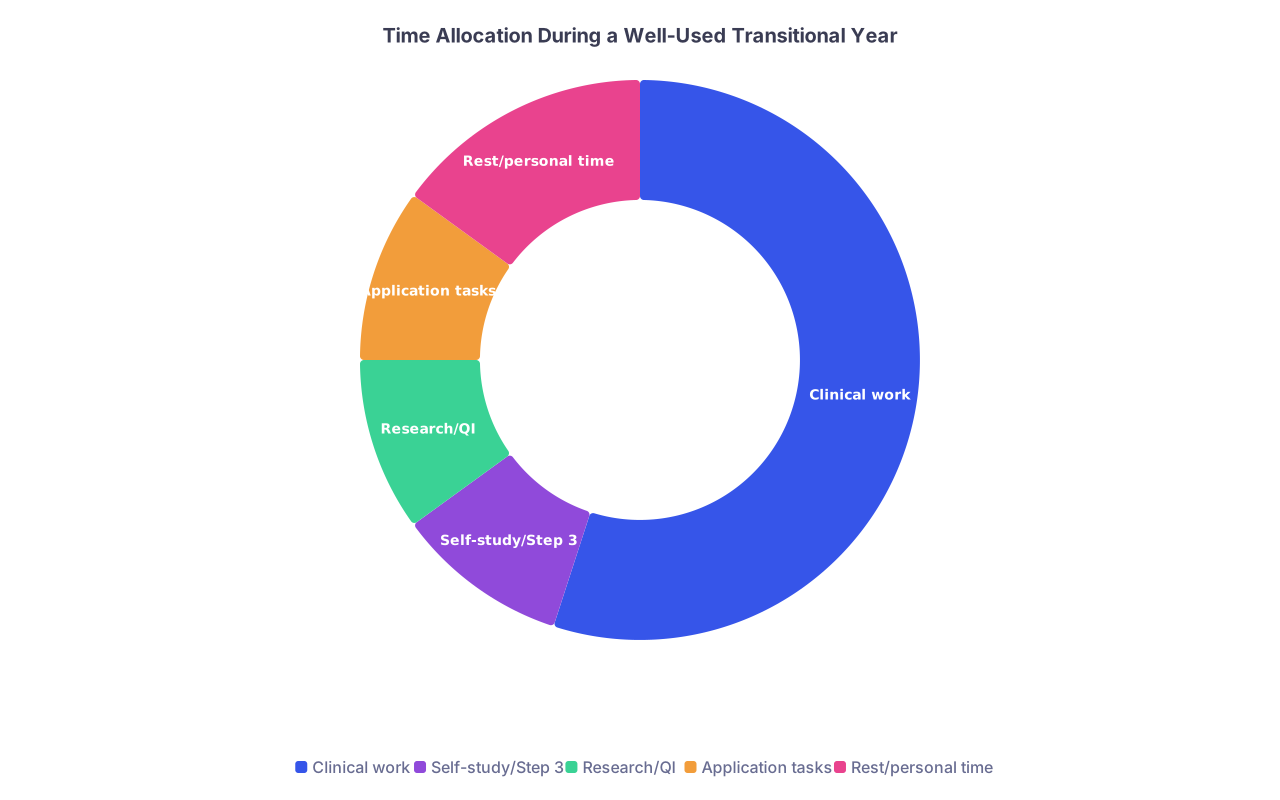
| Category | Value |
|---|---|
| Clinical work | 55 |
| Self-study/Step 3 | 10 |
| Research/QI | 10 |
| Application tasks | 10 |
| Rest/personal time | 15 |
10. Reapplying Smart: Specialty Choice, Program List, and Communication
You cannot repeat last year’s strategy and expect a different outcome.
Specialty choice
You have three broad pathways:
- Reapply to the same specialty with a much stronger application.
- Shift to a related but less competitive specialty that still fits your interests.
- Shift dramatically (for example, from surgery to psychiatry) when your experiences and performance justify it.
Be honest about competitiveness. If you were 10th–20th percentile for your dream field before, TY plus Step 3 plus better letters might push you up, but it will not turn you into a top-decile applicant for derm, ortho, or ENT. For many unmatched applicants, the real win is pivoting to a field where they can thrive, not chasing the same wall again.
Program list
Use your one-year vantage point wisely:
- Include your TY institution if they take categorical residents in your target specialty. You are already a known quantity.
- Add more community and mid-tier university programs. Overfocusing on “top names” killed many applicants the first time.
- Use NRMP data and recent match outcomes to sanity-check. If your composite metrics are below the 25th percentile of matched applicants in that specialty, widen the net.
Communication with programs
You have a transitional-year story. Use it.
- In September: send short update emails to a small, high-priority subset of programs after ERAS submission, especially where you have genuine geographic or institutional ties.
- When interviews start: be prepared to mention your TY very early—often in answer to “Tell me about yourself since graduation.”
- Late season: if you have strong new information (accepted abstract, completed Step 3, glowing mid-year evals), send a concise update to programs that have not yet rejected you.
Keep all of this brief and factual. No long emotional narratives.

11. When a TY Still Does Not Lead to a Match
Sometimes, even with good use of a TY, the match does not break your way. That is reality. Not always your fault.
If you are in that situation, your options include:
- Second PGY‑1 year in a categorical program (different specialty or same, depending on offers)
- Non-ACGME fellowships or research years leading to later entry
- Non-residency clinical roles (hospitalist extender, research physician, etc. in some systems)
- Non-clinical careers drawing on your medical training
But you do not plan for failure from day 1. You plan for success, with the awareness that you may have to pivot again.
Even in that worst-case scenario, a well-used TY gives you:
- A full year of U.S. clinical experience
- Confirmed letters and professional references
- More clarity on what you want, and where your ceiling is
That is still leverage. Less than you hoped for, but far more than if you had spent the year drifting.
FAQ (Exactly 5 Questions)
1. Should I hide the fact that I unmatched when talking to attendings during my transitional year?
No. Hiding it makes you look evasive when it inevitably comes up. A simple, direct explanation earns respect: you applied to X, did not match, took a TY to strengthen your skills and reapply. Then pivot to how you are using the year productively. What you must avoid is blaming others or sounding bitter.
2. Is a preliminary internal medicine or surgery year better than a transitional year for leverage?
It depends on your target specialty. For IM, prelim medicine often gives slightly more credibility than a pure TY, because the work mirrors categorical IM intern duties. For many other fields (radiology, anesthesia, PM&R), a TY with good medicine and ICU exposure is perfectly acceptable. The quality of your performance and letters matters more than the exact label on the year.
3. How many letters should come from my transitional year versus medical school?
Aim for at least 2 letters from your transitional or prelim year, ideally in or adjacent to your target specialty. You can keep 1 strong legacy letter from medical school if it is still relevant and specific. A common, effective mix is 2 TY letters + 1 prior specialty letter + 1 chair/department letter when required.
4. Do programs see TY residents as “failed” applicants?
Some individuals think that way; most PDs are more pragmatic. They have seen excellent physicians who took non-linear paths. What they care about is whether you learned from the unmatched year, whether your current attendings vouch for you enthusiastically, and whether your performance this year reassures them you will not struggle or quit.
5. How early should I start my next ERAS application during my transitional year?
Start drafting and organizing by late spring/early summer. By June: update your CV, list experiences, and outline your personal statement. By July: refine your statement and request specific letters with a clear deadline (mid‑August). By early September: have everything submitted. Treat ERAS like a longitudinal project, not a last-minute chore squeezed into ward weeks.
Key points, without sugarcoating:
- A transitional year only becomes leverage when you design it ruthlessly around your weaknesses and your target specialty.
- Strong TY letters, solid clinical performance, and a clear story of growth outweigh another stack of generic research lines.
- You are not just surviving PGY‑1; you are running a one-year audition. Act like someone who expects to be hired.