

The brutal truth: if you did not match and you’re on a visa or pending status, your immigration clock just started ticking louder.
Most advice you’ll find online is either too generic (“talk to a lawyer”) or completely divorced from the actual timelines IMGs and non‑citizen grads face. You do not have that luxury. You’ve got hard dates, SEVIS records, DS‑2019/DS‑160s, grace periods, and a dozen opaque USCIS rules that do not care that you almost matched Internal Medicine.
So let’s treat this like what it is: a time‑sensitive, high‑stakes logistics problem.
This is how you handle visa and status issues after not matching into residency.
Step 1: Get Clear On Your Current Status And Deadlines (Within 48–72 Hours)
Before you start “planning next year,” you need to know exactly how much legal time you have in the country (or when your consular options shift if you’re abroad).
You’re dealing with real constraints, not vibes.
At a minimum, you need:
- What status you are currently on (not what you think you’re on: what your I‑94, I‑20, DS‑2019, or visa actually says)
- When that status expires
- Whether you have a grace period and how long it is
- Whether your status is tied to an institution (university, ECFMG, employer) and what their internal deadlines are
If you’re physically in the U.S. you should:
- Pull your I‑94 online (https://i94.cbp.dhs.gov).
- Look for:
- “Admit Until Date”
- “Class of Admission” (F‑1, J‑1, H‑1B, etc.)
- Grab your latest:
- I‑20 if F‑1
- DS‑2019 if J‑1
- I‑797 approval notice if H‑1B or other work status
If you’re outside the U.S.:
- Your “status” is technically not active; the issue is whether your visa category will still be valid and realistic next cycle, and whether anything about this failed match changes that (it might, for J‑1s who had committed to a program, for example).
Do not guess. Do not rely on “my friend had 60 days.” Different categories, different rules.
To keep this straight, think in buckets.
| Status Type | Typical Situation | Key Time Pressure |
|---|---|---|
| F‑1 | Current/Recent US student | 60‑day grace after program end |
| J‑1 | Research scholar/observership | 30‑day grace after program end |
| H‑1B | Already employed (research/clinical) | Grace only after employment ends |
| B1/B2 | Visitor for interviews/observership | I‑94 end date; no real grace |
| Abroad | No US status yet | Focus on next visa route (J‑1/H‑1B) |
You should know your exact end date and grace period within 48–72 hours after Match Week. That’s your runway to work with.
Step 2: Separate Emotional Decisions From Visa Decisions
You’re probably dealing with at least three hits at once:
- You did not match.
- Your backup SOAP options fell through or were unacceptable.
- Now your ability to stay in the country (or get back in) is at risk.
If you make immigration moves from a place of pure panic, you will either:
- Overstay and create a ban problem, or
- Jump into a ridiculous unpaid “program” or “volunteer observership” that gives you no real visa benefit.
So here’s the sanity rule I tell people in this mess:
You make visa decisions on three criteria only:
- Does this keep me in status or give me a clean way back next year?
- Does this materially improve my application (USCE, scores, research, letters)?
- Does this avoid long‑term damage (unlawful presence, fraud, shady programs)?
Anything that fails 1 or 3 is off the table. Even if it hurts. Even if your cousin’s friend did it “and it was fine.”
Now we can talk concrete paths.
Step 3: If You’re On F‑1 (Or Recently Graduated In The U.S.)
This is one of the more flexible starting points, but people screw it up by waiting too long.
Typical scenarios:
- You’re an IMG who did a U.S. master’s (MPH, MS Clinical Research, etc.) on F‑1.
- You’re finishing or just finished that program while applying to residency.
- You did not match, and your I‑20 program end date is near or just passed.
Your levers are:
- Program extension
- New program (change of level)
- OPT / STEM OPT
- Change of status (CS) to something else (rarely ideal)
First: talk to your DSO immediately
Your Designated School Official (DSO) at the international office controls your SEVIS record. If that closes and you drift into “out of status,” it’s a mess.
You ask them, directly:
- “What is my SEVIS program end date?”
- “Am I eligible for OPT or STEM OPT?”
- “Can my program be extended for valid academic reasons?”
- “If I start another degree or certificate, when must I have a new I‑20 in hand to stay in status?”
Do not tell them your life story. They care about immigration rules, not the NRMP algorithm.
Common F‑1 strategies that actually work
Use OPT strategically
If you just finished a degree that qualifies for OPT and you haven’t used it:- Apply for OPT on time (you’ve got a small window after program completion).
- Target employment that helps your application: research assistant, clinical research coordinator, data analyst in a medical department.
- Make sure employment counts as “related to your field of study” and meets hours requirements.
That buys you 12 months (sometimes +24 STEM) of legal presence and CV building.
Start a new degree that isn’t garbage
Some people panic‑enroll in random “pre‑med prep” or unaccredited programs. That’s how you burn money and time.Better options:
- Biostatistics / epidemiology
- Clinical research
- Public health with real research opportunities
- A short, credible certificate connected to a major academic center
The key: does this program put you physically in a place where you can realistically secure USCE, research, or strong letters?
Do not: invent “volunteer” roles and assume they keep you in F‑1
Unpaid shadowing or observerships alone do not maintain F‑1. SEVIS cares about enrollment and academic status, not how many clinic hours you log.
Step 4: If You’re On J‑1 (Research, Observer, Or Previous Training)
J‑1 is trickier because of sponsorship rules and the infamous 2‑year home residency requirement (212(e)).
Common cases:
- You’re on a J‑1 research scholar visa through a university or hospital, using this year to strengthen your app.
- You’re on a J‑1 short‑term scholar or J‑1 trainee/observer category.
- You had a J‑1 offer for residency that didn’t materialize (program changed, you mismatched, etc.).
Here’s what you actually care about:
- End date on DS‑2019: That plus a 30‑day grace period is your real runway.
- Will your host renew? If they won’t extend the appointment, you start that 30‑day clock the day your end date hits.
- 212(e) home requirement: If it applies to you, long‑term paths to H‑1B or green card get more complicated.
Moves that keep you alive in the system
Extension with the same sponsor
Best case:- Your PI loves you.
- The department has funding.
- They extend your appointment and get you a new DS‑2019.
That buys you another 6–12 months in valid status and usually more research output.
Move to another J‑1 research role
Harder but possible:- New institution offers you a research position.
- They’re willing to sponsor J‑1 research scholar.
- You coordinate timing carefully so there’s no status gap.
This requires early, aggressive networking. You’re not sending three emails; you’re sending 50.
Do not rely on “unpaid observership” as a J‑1 basis unless the institution has a formal program
If someone in a random clinic says “we can bring you on as a J‑1 observer,” you stop and sanity‑check:- Is this through ECFMG?
- Does this hospital actually have a J‑1 category like short‑term scholar or clinical trainee?
- Are there real, official DS‑2019s involved?
If the answer is vague, it’s a red flag. If your name is going into a spreadsheet, not SEVIS, it’s not real.
Step 5: If You’re On H‑1B Or Another Work Visa
Most people in this bucket are either:
- Already in a research or clinical job on H‑1B
- Transitioning from prior training (like fellowship)
- Rarely: matched but then position fell through and now stuck
Your single biggest trigger is loss of employment.
- When your job ends, your 60‑day H‑1B grace period starts (or until I‑94 end date, whichever is shorter).
- Within that period you must:
- Get a new H‑1B sponsor and file a transfer, or
- Change status to something else (F‑1, B2—often a last‑ditch bridge), or
- Leave the U.S.
If you did not match but your H‑1B job continues? Fine. Your status is not tied to the Match. Just make sure:
- Your employer actually plans to keep you through the next cycle.
- You get clear on whether they’ll extend if your current petition is close to expiry.
If your job ends soon after an unsuccessful Match (grant ending, lab closing, they hired someone else), you cannot just “wait and reapply next year” inside the U.S. with no plan. That’s how you end up with unlawful presence and future visa denials.
Step 6: If You’re On B1/B2 (Visitor) For Interviews Or Observerships
This is the tightest rope.
B1/B2 is not designed for:
- Long‑term research roles
- Long observerships with clinical contact
- Multi‑year “let me just stay and apply again” plans
You typically have:
- An I‑94 with a specific end date (often 6 months after entry)
- No formal grace period beyond that date
- Little flexibility to “pivot” into another status inside the U.S. without raising eyebrows
If you did not match and you’re on B1/B2:
- Check I‑94 today. That date is not a suggestion.
- Decide fast:
- Do you leave before that date and plan a cleaner reentry on another visa?
- Do you file a change of status (B2 to F‑1, etc.)? This can work but is slow and sometimes risky if it looks like you had this plan all along.
- Do not overstay hoping it “won’t matter.” It will. Over 180 days of unlawful presence can trigger big reentry bars.
For many in this category, the smartest move is actually to leave on time, regroup, build your profile from your home country or a third country, and come back next year with a stronger, cleaner visa category (J‑1 research, F‑1 degree, etc.).
Step 7: Use This Year To Actually Improve Your Application (Without Breaking Status)
Immigration strategy without application strategy is pointless. You could maintain perfect status and be in the exact same weak position next Match.
You need both.
Think of the next 12–18 months as divided into four functions:
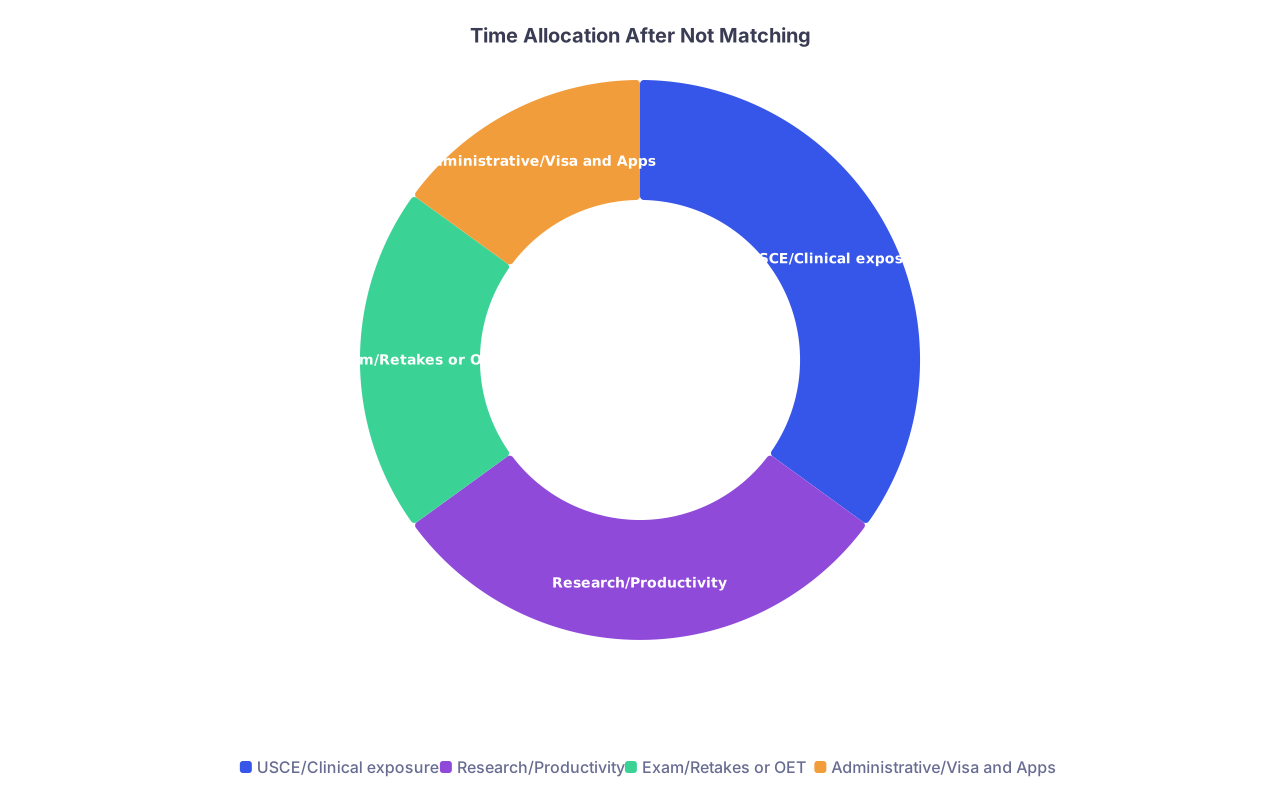
| Category | Value |
|---|---|
| USCE/Clinical exposure | 35 |
| Research/Productivity | 30 |
| Exam/Retakes or OET | 20 |
| Administrative/Visa and Apps | 15 |
High‑yield visa‑compatible moves
Depending on your status, prioritize things you can legally do:
- On F‑1 with OPT: paid research jobs, possibly some limited clinical‑adjacent roles (within legal bounds).
- On J‑1 research: heavy research productivity, networking with faculty, getting letters.
- Abroad: tele‑research, remote projects, publications, strong home‑country clinical work + letters, strategic USCE visits on the right visa.
What you should not do:
- Assume any clinical role that smells like direct patient care is automatically legal under your visa.
- Pay for shady “hands‑on USCE” programs that promise visa help but actually offer nothing immigration‑wise.
If an “observership” or “externship” claims it will “help with your visa,” ask them:
- “What visa category do you sponsor?”
- “Who is the responsible officer or DSO?”
- “Will I receive an I‑20, DS‑2019, or I‑797 from an institution?”
Vague answers = walk away.
Step 8: When And How To Involve An Immigration Attorney (Not Your WhatsApp Group)
People either:
- Never talk to a lawyer and crowdsource legal advice from Telegram groups, or
- Throw $400 at a random consult without preparing and then leave more confused.
Both are bad.
You bring in an actual immigration attorney when:
- You’re considering a change of status (B2 → F‑1, J‑1 → H‑1B, etc.)
- You’re close to/at risk of overstay or unlawful presence.
- You’re dealing with the J‑1 2‑year home requirement and waiver questions.
- You want to understand whether your long‑term residency path makes more sense on J‑1 or H‑1B.
Before that call, you prepare like it’s an OSCE:
- A one‑page summary: what status you’re on, key dates, what you want (e.g., “Stay in U.S. one more year to reapply,” or “Regroup back home and come on J‑1 later.”)
- Copies of I‑20/DS‑2019/I‑94/visa stamps.
- Rough timeline of your Match attempts, offers, and current work.
You’re not there to “tell your story.” You’re there to ask:
“Given this timeline and these documents, what are my cleanest options to stay in or re‑enter the U.S. while I improve my residency application?”
If the lawyer doesn’t understand what NRMP or ERAS is, that’s fine. You need them for status law, not for SOAP strategy.
Step 9: Map Out A Concrete 12–18 Month Plan (Not Just “Apply Again”)
A vague “I’ll try again next year” is how people end up in the same SOAP spreadsheet three years running.
You need an actual plan, with dates.
Here’s a rough structure:

| Step | Description |
|---|---|
| Step 1 | Today - Did not match |
| Step 2 | Clarify current status and end dates |
| Step 3 | Decide stay in US or leave |
| Step 4 | Secure legal status for 12-18 months |
| Step 5 | Plan home/third-country work and US trips |
| Step 6 | Set USCE and research goals |
| Step 7 | Prepare ERAS updates and personal statement |
| Step 8 | Submit stronger application next cycle |
You should literally write this out with months:
- Month 1–2: finalize visa path, secure position/program that keeps me in status.
- Month 2–10: research/USCE/exams according to what’s realistic on that visa.
- Month 5–7: reach out to letter writers with clear timelines for next ERAS.
- June–September: submit ERAS early, updated personal statement that honestly explains growth since last cycle.
- Throughout: monitor status documents and dates like they’re lab results for a septic patient.
Step 10: When Leaving The U.S. Is Actually The Smart Move
This part no one wants to hear, but I’ve seen people save their future careers by doing it.
There are situations where:
- Your status is about to expire.
- You have no real, clean option to extend or change without huge risk.
- The only way to stay would be some sketchy, exploitative arrangement.
In those cases, leaving on your terms, with a clean record, is often the best possible move.
You can still:
- Build your clinical experience at home or in another country.
- Do remote research with U.S. collaborators.
- Fly in for short, clearly defined visits: observerships, interviews, conferences—on the appropriate visa.
- Reapply with a much stronger profile and no immigration black marks.
What destroys futures is ego plus fear:
“I can’t go home, everyone knows I applied!”
“I’ll just stay a little longer, it’s just visa stuff, I’ll fix it later.”
USCIS and consulates do not care about your pride. They care about dates, categories, and truthfulness. Respect that, and you keep doors open.
A Quick Reality Check On Next Cycle
Your visa status and your competitiveness are now welded together. Programs will quietly worry about:
- “Will this person have a viable visa next July?”
- “Will we get stuck in a waiver problem?”
- “Is this candidate stable or in constant immigration chaos?”
Your job is to present, next cycle, as:
- In clean, legal status (or abroad with a clear path to J‑1/H‑1B).
- More productive (research, USCE, exams) than last year.
- Clear‑eyed about your specialty choice and program list (no more fantasy lists if you’re a marginal applicant).
If that means one more year in research on J‑1 before a serious push? Do it. If it means going home and stacking real clinical responsibility to show progression? Do it.
The bad outcome is floating in a gray area—no status stability, no real CV improvement—just “waiting for next Match.”
Final Takeaways
- Treat your visa like a patient on the floor: know the numbers, monitor the dates, and intervene early. Guessing or ignoring status is how careers die.
- Any plan that keeps you in status but does not improve your application is a stall, not a strategy. Tie your immigration moves directly to USCE, research, or exam progress.
- Leaving on time with a clean record is better than staying illegally in hope. Protect your long‑term ability to train and practice, even if it stings in the short term.


