

The worst advice you’re getting right now is “just reapply next cycle, it’ll work out.”
If you’re burned out and unsure about reapplying after not matching, you do not need more vague encouragement. You need a clear decision framework, realistic options, and permission to press pause without burning your future to the ground.
Let’s walk through what to do if you’re in exactly this spot.
Step 1: Call the Situation What It Is
You did not match. You’re exhausted. You’re questioning if you even want this anymore.
That’s not weakness. That’s data.
People around you will rush to fill the silence:
- “You’ve worked too hard to stop now.”
- “Everyone feels this way. Just push through.”
- “Take a research year and you’ll be fine.”
Sometimes they’re right. Often they’re just uncomfortable with your uncertainty.
Your first move is naming what’s actually going on:
There are at least three separate questions here:
- Am I too emotionally burned out to do another application cycle right now?
- Do I still want to be a physician at all?
- If yes, do I want to pursue the same specialty?
Most people mix those into one fuzzy panic question:
“Should I reapply?”
That’s way too blunt for what’s happening.
Right now, do not jump to “reapply or quit.” Your goal is assessment, not decision.
Step 2: Stabilize Before You Strategize
You can’t think clearly if you’re in constant fight-or-flight. And post-Match, a lot of people are.
Signs you’re in that state:
- You reread your ERAS app at 2 a.m. and spiral
- You’re doom-scrolling Reddit/SDN for “didn’t match, matched second time” threads
- Even opening an email from NRMP or ERAS makes your chest tighten
- You feel numb when people say “Doctor” around you
If that sounds familiar, your first task is not career planning. It’s stabilization.
Here’s a 1–2 week stabilization plan that I’ve seen actually work:
Set a decision moratorium.
For the next 14 days: you are not deciding whether to reapply, switch careers, or move specialties. You’re just collecting information and cooling your nervous system.Shrink the problem.
Today’s job: 2–3 things max:- Sleep 7+ hours (phone in another room)
- Move your body 20–30 minutes (walk is fine)
- One small concrete task: reply to 1 email, schedule 1 appointment, list 3 people to talk to
Tell 1–2 safe people you’re burned out.
Not the “I’m fine, just disappointed” script. The real version: “I’m honestly so drained I don’t trust myself to make big decisions right now.”
If you can, talk to a therapist (ideally someone who knows medical training culture). Burnout plus shame after not matching is gasoline on a fire. Do not fight that alone if you can avoid it.
Step 3: Separate “Don’t Want Medicine” from “Can’t Do This Right Now”
This distinction is everything.
You might be saying “I don’t know if I even want to be a doctor anymore.”
Okay. But what part of this do you hate?
I want you to write down answers to three very blunt questions:
When did I first start feeling like I didn’t want this?
- During M3 when you were on surgery and hated the culture?
- Only after interview season dried up?
- Back in preclinical when everything felt like a grind?
If loans and sunk cost disappeared overnight, would I still feel pulled to medicine at all?
Don’t overthink. First gut reaction.What parts of medicine still feel meaningful or energizing, even a little?
Examples:- Teaching junior students
- Complex diagnostic thinking
- Longitudinal patient relationships
- Procedure days vs clinic days
- Advocacy, policy, QI work
If your honest answers look like:
- “I haven’t enjoyed any part of this in years.”
- “If I could walk away debt-free tomorrow, I would.”
- “There’s nothing about clinical work that still excites me”
…then it’s not just burnout. It’s likely a values mismatch with clinical medicine as a career. That deserves real exploration, not another forced application cycle “because loans.”
If instead your answers look like:
- “I used to like patient care, but this year broke me.”
- “I still care about being a doctor, but the idea of redoing apps makes me want to vomit.”
- “I love X part of medicine; I just can’t handle more failure right now.”
…then you probably still want to be in medicine. You’re just depleted and traumatized by the process. That’s burnout + grief, not a fundamental “wrong field” problem.
Those are very different situations.
Step 4: Get Objective Data on Why You Didn’t Match
Feelings aside, you need hard feedback. Your brain will either:
- Blame everything on yourself (“I’m not good enough”), or
- Blame everything on bad luck (“the Match was brutal this year”)
Both are incomplete.
You need external assessment from people who see hundreds of applications, not just friends.
Here’s who to talk to, and in what order:
Your home program director / clerkship or sub-I director in your chosen specialty
Ask them directly:- “Given my application as it was this cycle, what do you think were the main reasons I did not match?”
- “If I reapply to this specialty, what specific, measurable changes would I need in the next 12 months to have a realistic shot?”
- “If you were me, would you reapply to this same specialty, switch specialties, or take a different route?”
Your dean’s office / career advising staff
Ask for:- A blunt read on your competitiveness (scores, grades, red flags, number of interviews)
- Historical match data for applicants like you who didn’t match the first time
At least one program director from a program that did not interview you but knows you through a rotation or mentor
Their view is often less emotionally entangled.
Then put that data in a simple, honest table:
| Factor | Was it an issue? | Can it be improved by next cycle? |
|---|---|---|
| Step scores / exams | Yes/No | Yes/No |
| Clinical grades | Yes/No | Yes/No |
| Letters of rec | Yes/No | Yes/No |
| Specialty choice | Yes/No | Yes/No |
| Interview performance | Yes/No | Yes/No |
If most of your issues are in the “cannot realistically improve” column (e.g., major professionalism red flag, chronically poor clinical performance, multiple failures), then reapplying in the same way is just self-punishment.
If you have multiple clearly fixable gaps (weak letters, late application, minimal home support, poor interview performance), there’s a path—if you have the emotional fuel to walk it.
Step 5: Understand Your Realistic Paths from Here
You’re not choosing between “reapply or give up on life.” That’s drama, not strategy.
Here are the main paths people in your situation actually take:
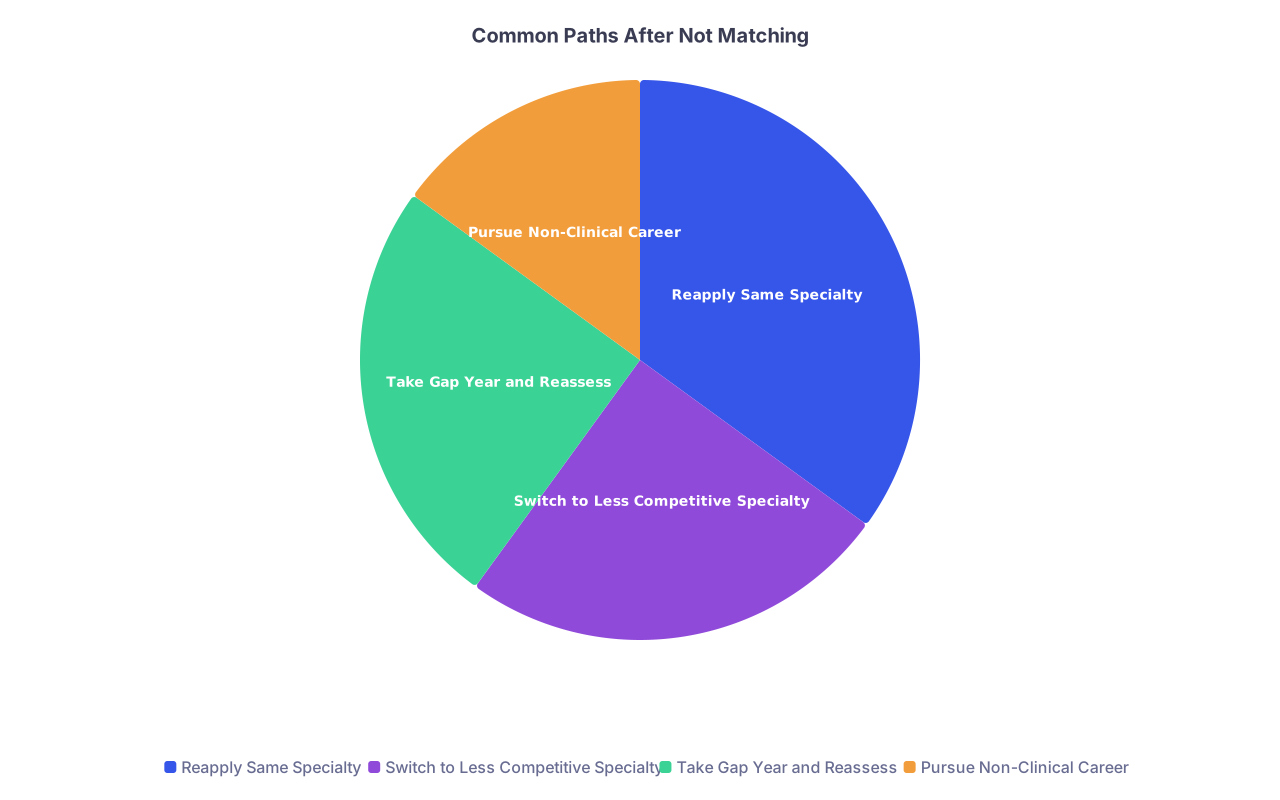
| Category | Value |
|---|---|
| Reapply Same Specialty | 35 |
| Switch to Less Competitive Specialty | 25 |
| Take Gap Year and Reassess | 25 |
| Pursue Non-Clinical Career | 15 |
Path 1: Reapply to the Same Specialty Next Cycle
Best suited for:
- People who still strongly want that specialty
- Who got some interviews but not enough
- Who have a clear plan to strengthen their app
You need honest answers to:
- Can I get substantively stronger letters? (e.g., new away rotation, research mentor, PD letter)
- Can I fix obvious application mistakes? (late apps, poor personal statement, not enough programs)
- Can I live with another possible “no” from the same field?
If the thought of doing another season of talking about this specialty makes you feel nauseated, that’s a sign. Desire matters. Program directors can smell when you’re just going through the motions.
Path 2: Switch to a Different (Usually Less Competitive) Specialty
This is the unspoken “escape hatch” many people use but feel ashamed of. Like they’re “settling.”
Let me be blunt:
Switching from, say, derm to internal medicine is not a character flaw. It’s pattern recognition.
Appropriate when:
- You wanted Specialty A but didn’t get any traction (no interviews or very few)
- Your scores / application are heavily mismatched to that specialty’s competitiveness
- You can identify at least one other specialty where:
- You could genuinely see yourself long term, and
- Your home institution/programs are more supportive
Examples:
- Unmatched ortho applicant going into PM&R or anesthesia
- Unmatched EM applicant switching to IM or FM
- Unmatched radiology applicant exploring IM, path, or prelim + later transfer routes
This path still requires work:
- New letters in the new specialty
- A believable narrative (not fake—real reasons) for why this field now fits you
- Possibly an extra year to get the right experiences
Path 3: Take a Deliberate Gap Year Focused on Recovery + Clarification
This is underused and underrated.
Sometimes the correct move is:
“I’m not making a 3–7 year commitment while I’m half-broken and resentful. I’m going to take 6–12 months to recover and then decide.”
Possible structures for a gap year:
- Research position (paid if possible), ideally connected to fields you’re considering
- Clinical job: scribe, clinical research coordinator, utilization review, telemedicine support
- Public health, policy, or quality improvement roles within a health system
Non-negotiable:
The gap year is not just about padding your CV. It’s about:
- Getting back to baseline mental health
- Testing what kind of work still feels meaningful
- Proving to yourself you can function and contribute outside of constant evaluation
This is especially important for people thinking “maybe I don’t want clinical medicine at all.”
Path 4: Start Building a Non-Clinical or Alternative Career
This isn’t failure. It’s a different route.
Some people realize, after the pressure of the Match is off:
They liked anatomy. They liked problem-solving. They never liked actual clinical care.
Alternative tracks you can realistically build from an MD/DO:
- Clinical research / pharma (medical science liaison, clinical trials management)
- Health tech / startups (product, medical content, clinical strategy)
- Public health, epidemiology, policy roles
- Medical writing, education, consulting
This doesn’t mean you must immediately cut all ties with residency. You can:
- Spend 1–2 years in a non-clinical role
- Keep an open mind about whether you want to attempt a carefully chosen residency later, or not at all
Step 6: Weigh Burnout Level Against Each Path
You can’t just pick the “best career move.” You have to pick what you can actually execute in your current state.
Here’s a simple sanity check:
| Question | If Mostly Yes → Caution Flag |
|---|---|
| Do I feel dread at the thought of interviews again? | Yes |
| Do I feel numb when imagining Match Day next year? | Yes |
| Am I already fantasizing about getting sick just to avoid the process? | Yes |
| Do I lack any curiosity about improving my app? | Yes |
| Have I lost interest in *all* of medicine, not just this specialty? | Yes |
If you’re ticking “Yes” to most of those, then reapplying immediately—especially to a highly competitive field—may not be wise. You’re setting yourself up to white-knuckle another year and potentially crash harder.
On the other hand, if your burnout is intense but situational (“I’m crushed now, but when I picture myself in residency in X specialty, I still feel something like hope”), then a deliberate year with structure and support can reset you enough to reapply from a stronger place.
Step 7: Map Out 12 Months for Each Realistic Option
You don’t decide in the abstract. You compare realities.
For each option you’re seriously considering (e.g., “Reapply same specialty” vs “Switch to IM” vs “Take gap year and reassess”), sketch a 12‑month timeline. Not fancy. Just month-by-month anchors.
Here’s a sample for someone considering a gap year + later reapplication:
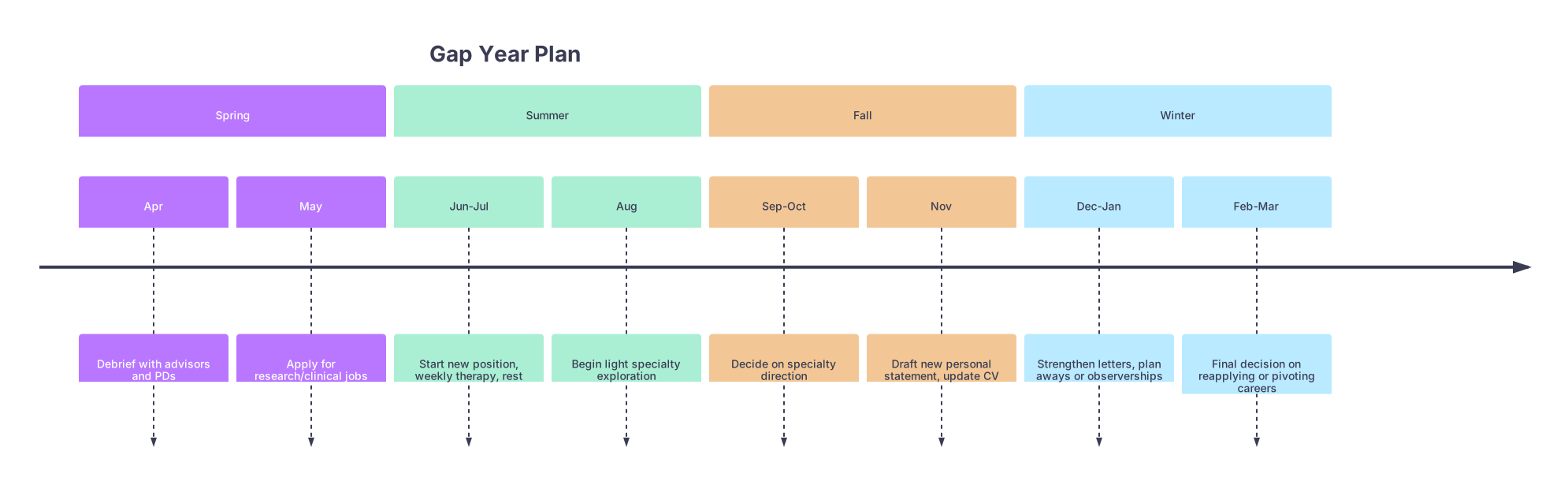
| Period | Event |
|---|---|
| Spring - Apr | Debrief with advisors and PDs |
| Spring - May | Apply for research/clinical jobs |
| Summer - Jun-Jul | Start new position, weekly therapy, rest |
| Summer - Aug | Begin light specialty exploration |
| Fall - Sep-Oct | Decide on specialty direction |
| Fall - Nov | Draft new personal statement, update CV |
| Winter - Dec-Jan | Strengthen letters, plan aways or observerships |
| Winter - Feb-Mar | Final decision on reapplying or pivoting careers |
Now do the same for:
- Immediate reapply same specialty (what changes by when?)
- Switch to new specialty (how will you get exposure, letters, mentorship?)
Once those are sketched, gut check them:
- Which timeline makes you feel tight in your chest just reading it?
- Which one feels heavy but possible?
- Which one, if it magically succeeded, would you actually want the end state of?
Step 8: Protect Your Identity from the “Match Failure” Story
You’re going to hear this voice in your head:
“If I don’t reapply immediately, I’m giving up.”
Or: “If I switch specialties, I failed.”
Or: “If I leave medicine, I wasted everything.”
That voice is lying to you. It’s just internalized training culture.
Reality:
- You applied one cycle. You did not get a position. That’s data, not a life sentence.
- Thousands of excellent physicians didn’t match their first choice or their first attempt.
- Many smart, capable people decide medicine isn’t the right long-term fit and build solid, impactful careers elsewhere.
You’re allowed to:
- Hit pause
- Change directions
- Protect your mental health
- Care about your day-to-day life more than a title on your badge
That doesn’t mean decisions don’t have consequences. They absolutely do. But “I must prove I can grind through this at all costs” is not a healthy life plan.
Step 9: Decide, Then Build a Support Container Around That Decision
At some point—ideally within 6–10 weeks of Match—you make a call:
- Reapply same specialty
- Switch specialty
- Gap year and decide later
- Start deliberate non-clinical path
Once you decide, your job shifts from “agonize” to “execute + protect.”
Non-negotiables for the next year:
One primary mentor for your chosen path
Not five people giving you conflicting advice. One main person who:- Knows your full story
- Has seen other applicants in your position
- Is willing to be honest even when it’s uncomfortable
Scheduled mental health support
If you’re reapplying or staying in medicine:- Therapy if at all possible
- A regular check-in with someone outside medicine (family, partner, friend) who knows you as more than “future doctor”
Clear, written goals with stop-loss points
For example:- “If I don’t secure X type of position by Y date, I’ll pivot to Plan B.”
- “If by [date] I still feel dead inside thinking about clinical training, I will actively explore non-clinical roles instead of defaulting into another cycle.”
Boundaries with toxic comparison
Mute or unfollow:- Classmate Match flex posts
- Subreddits/Discords that spike your anxiety
- People who keep saying, “So when are you reapplying?” every time they see you
You’re not being fragile. You’re protecting a healing wound.
Step 10: What I’d Tell You If We Were Sitting in a Call Room
If you were sitting across from me in a call room at midnight saying:
“I’m burned out. I didn’t match. I don’t know if I should reapply. I feel like I’m failing at life.”
Here’s what I’d say:
- First, you are not making any major decisions in the acute aftermath. You’re too raw. Give it a few weeks.
- Second, we’re going to get brutally honest data on your competitiveness from people who know what they’re talking about.
- Third, we’ll run the numbers on your emotional reserves. If you’re at zero, you are not signing up for another all-out application war this instant. You’re allowed a year to rebuild.
- Fourth, we’re going to expand your mental map. Medicine is not “this one exact specialty or nothing.” Life is not “residency or failure.”
- Finally, whatever you choose, we structure it. Concrete steps, real timelines, actual support. No vague “I’ll just see what happens.”
You’re allowed to change your mind. You’re allowed to rest. You’re allowed to want a life that isn’t Constant Proving Mode.

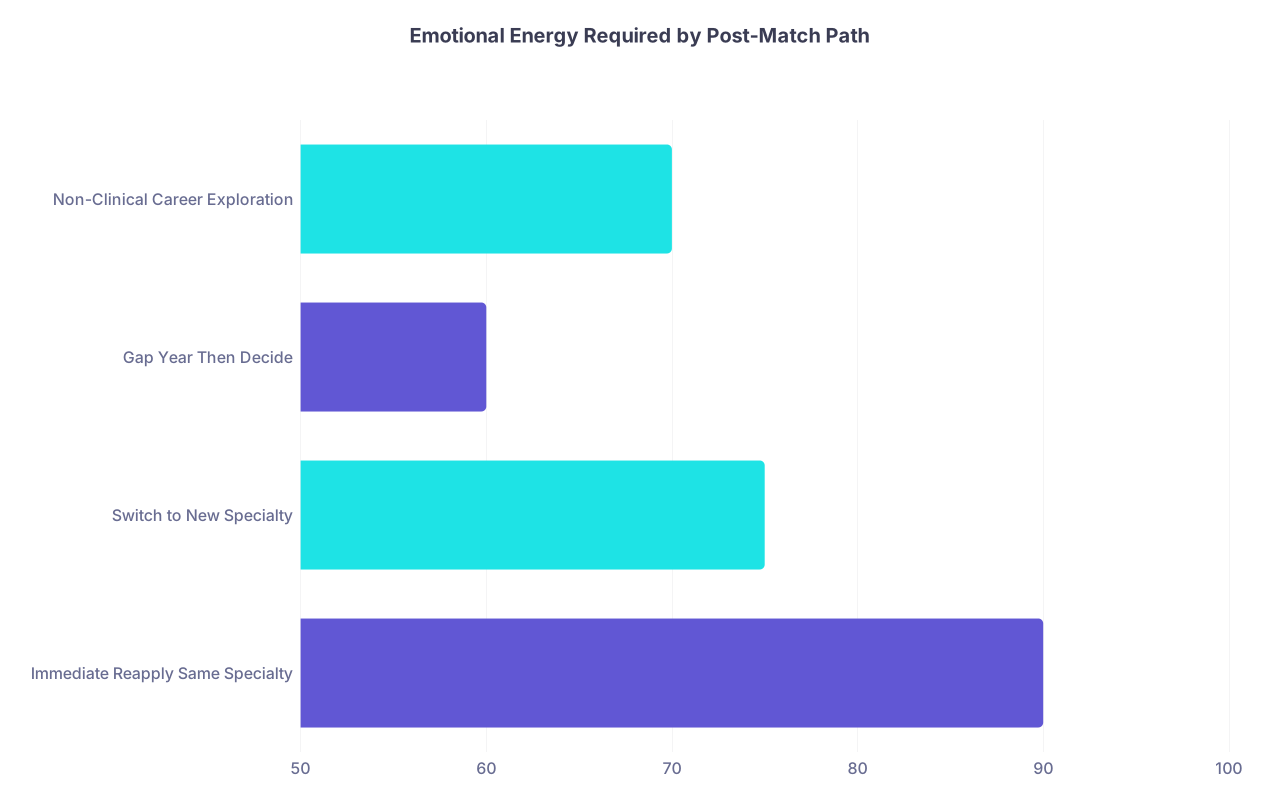
| Category | Value |
|---|---|
| Immediate Reapply Same Specialty | 90 |
| Switch to New Specialty | 75 |
| Gap Year Then Decide | 60 |
| Non-Clinical Career Exploration | 70 |

The Short Version: What to Remember
- Not matching plus burnout is not a signal to grind harder—it’s a signal to pause, assess, and choose deliberately.
- Separate your questions: Do I still want medicine at all? If yes, do I have a realistic, emotionally sustainable path—now or after a gap year?
- Whatever you choose—reapply, switch specialties, pause, or pivot—do it with a plan, a mentor, and guardrails for your mental health. Not out of shame, panic, or sunk cost.
You’re not behind. You’re at a fork in the road. Choose the road you can walk as a whole human being, not just as an applicant ID number.


