

The year after you graduate without a residency offer will make or break your future in medicine.
Used well, it becomes the evidence that convinces programs to take a chance on you. Wasted, it becomes a red flag that follows you for years.
You do not have the luxury of “taking a year off to think” if you want a residency spot. You need a plan. Today.
This is that plan.
First: Stabilize Your Mind And Your Money (Week 1–2)
You’re probably exhausted, embarrassed, maybe borderline numb. Fine. Feel it. But do not stay there.
Here’s what needs to happen in the first 1–2 weeks after you confirm you’re graduating without a spot:
Get brutally clear on your situation.
- Confirm: Are you actually graduating this year? Any chance to delay?
- Check with your dean’s office: exact graduation date, student status end date, access to malpractice coverage, library, email, etc.
- Ask them directly: “What institutional resources are available to unmatched graduates this year?”
Create a 12‑month financial survival plan.
Pull up your loans, your savings, and any support you realistically have. Then answer:- How much do you need per month to survive (rent, food, transport, required payments)?
- When does loan repayment start? Can you apply for income‑driven repayment or forbearance? (Do it now, not when you’re already delinquent.)
- What income can you reliably bring in (scribe, MA, telehealth support, tutoring, Uber, whatever)?
If you need non‑clinical work to keep the lights on while you do clinical/research things, that is fine. But it must be structured around your residency‑relevant activities, not the other way around.
Decide: Are you reapplying this coming cycle, or in 2 years?
If your profile is not catastrophic (e.g., US grad, no failed steps, decent clinical performance), assume you’re reapplying this coming cycle and your 12 months are really 4–8 months of work before applications go out.
Step 2: Diagnose Why You Didn’t Match (Week 1–3)
If you skip this, you will repeat the same cycle with the same result.
You need an honest, data‑driven autopsy of your application. Not vibes. Not “I felt my interviews went well.”
Get at least two external reads:
- One from your school’s dean/Student Affairs or career advisor.
- One from someone outside your school: mentor, program director you know, or a structured advising service if you can swing it.
Ask them for blunt feedback on:
- Scores/academics
- Clinical performance, professionalism flags
- Specialty choice realism
- Number and type of programs you applied to
- Personal statement, letters, and red flags
- Interview performance and signals
Then categorize the problem:
| Primary Issue | Main Fix Over Next 12 Months |
|---|---|
| Low Step/COMLEX score(s) | New strong letters, research, clinical work |
| Limited applications/geography | Broaden program list and regions |
| Weak letters/clinical reputation | New letters from recent supervisors |
| Late application / missing docs | Apply early and completely next cycle |
| Overly competitive specialty | Re-apply strategically or pivot |
If there were professionalism issues (NP/FP evals, mistreatment reports), that is its own category. You must show rehabilitation and trusted supervisors vouching for you over time.
Write your own one‑page “problem list” for your match failure, just like a patient:
- Problem 1: Low Step 1 (205), competitive specialty (Derm).
- Problem 2: Only applied to 40 programs, no community programs.
- Problem 3: No strong home letters, generic comments.
This document will drive everything you choose to do this year.
Step 3: Decide On Specialty Strategy (Week 2–4)
This part is uncomfortable. You have to be honest about how much risk you’re willing to take.
There are three broad paths:
Reapply to the same specialty, smarter.
Works if:- You were borderline but not wildly off target (e.g., IM with 220s, FM with mid‑200s but limited apps).
- You got interviews but did not convert them.
- You can realistically add new strengths (recent clinical work, research, connections) in 6–9 months.
Pivot to a more attainable specialty.
Common pivots:- From competitive (Derm, Ortho, ENT, Plastics, Rad Onc, Ortho, Neuro) to IM, FM, Peds, Psych, Path.
- From IM subspecialty dreams to straight IM with an eye to fellowship later.
This is often the most rational choice, but people resist it because of ego and sunk cost. I’ve seen people stay unmatched for three cycles chasing Ortho when they could have been third‑year IM residents by then.
Two‑year rebuild with major remediation.
If you have:- Multiple failures (Step 1 + Step 2, or repeated COMLEX failures).
- Significant professionalism or academic discipline issues.
- Extremely weak clinical evaluations.
Then a one‑year patch job may not cut it. You might need two solid years of research, structured clinical work, and remediation.
You don’t have to announce your pivot to everyone yet, but by the end of month one, you should know your default plan: same specialty vs pivot.
Step 4: Build a 12‑Month Structure Aligned With Your Weaknesses
The next 12 months should not be random. No “I’ll do some research, maybe a job, we’ll see.”
You should come out of this year with:
- At least one strong, recent clinical letter in your intended specialty or close adjacent field.
- A coherent story of productivity: research, teaching, or clinical work with measurable outputs.
- Clear evidence you stayed in the game (not vanished from medicine).
- A stronger network in the specialty you’re targeting.
Your options fall into a few main buckets.
Option A: Research Year (Paid or Unpaid, 12 Months)
This is the classic choice for many unmatched graduates—if you do it correctly.
Good research years:
- Put you physically inside an academic department.
- Pair you with a PI or attending who writes letters and picks up the phone.
- Lead to tangible output: posters, abstracts, manuscripts.
Bad research years:
- Zoom‑only, never meet anyone.
- Busy work (data cleaning) with no authorship.
- With a mentor in a totally unrelated field to your target specialty.
Ideal use case:
- You’re applying to a moderately or highly competitive specialty.
- Your clinical record is fine, but you lacked depth in research or letters.
- You can live on a research coordinator/assistant salary or stipend.
Concrete steps:
- Email 30–50 faculty in your target specialty:
Subject line: “Med grad seeking research year in [Specialty], available [Month Year].”
Keep it short: 4–5 sentences about your background, scores, why their work interests you, attached CV. - Ask specifically:
- “Is there an opportunity to work with your group full‑time for the coming year?”
- “Would there be chances to be involved in manuscripts or abstracts?”
- Once there, show up like a resident: on time, respond quickly, own projects.
Your goal by next ERAS:
- 1–3 abstracts/posters submitted.
- 1+ manuscript submitted or in serious draft form.
- 1 strong letter from your PI describing you as “indistinguishable from our interns / residents” in work ethic and reliability.
Option B: Clinical Work / Gap‑Year “Prelim” Life (6–12 Months)
You want a year that screams: “I didn’t sit at home. I stayed in clinical medicine.”
Roles that help:
- Clinical research coordinator embedded with a clinical team.
- Medical scribe in ED, primary care, or a specialty clinic related to your target.
- Medical assistant or clinic support staff if you can get hired.
- Telehealth coordinator or care manager where you interact with physicians.
Roles that don’t help much:
- Completely non‑clinical corporate job with no tie to patient care.
- Random retail job (fine for money, but not good as your only activity).
These are okay if they’re part‑time to pay bills, but not enough alone to convince PDs.
If you do clinical work:
- Ask for formal evaluations.
- At 3–4 months in, explicitly ask a supervising physician: “If I continue to perform at this level, would you feel comfortable writing a residency letter of recommendation for me?”
- Keep a small log of what you actually do: number of patients you help room, notes you draft, projects you role in.
Option C: Formal Postgraduate Programs (Prelim Year, Research Fellowships, etc.)
Some paths exist but are limited and vary by country. Examples:
- Transitional or preliminary year (if you were SOAPed into one or find an off‑cycle opening).
- Formal research fellowships in high‑profile academic centers (common in surgical subspecialties, radiology, etc.).
- Teaching fellowships (anatomy, physiology) at some med schools.
If you manage to get a prelim spot starting July:
- Treat it as an extended interview year.
- Show up like the hardest‑working intern on the team.
- Real goal: get PD‑level advocacy, either to retain you or help you match elsewhere.
How To Actually Organize The Year: Month‑By‑Month Framework
Let’s say you’re graduating in May/June and reapplying in September.
You really have 4–5 months before ERAS submission to show a clear new trajectory, then another 6–7 months while programs review, interview, and rank.
Here’s a practical structure:
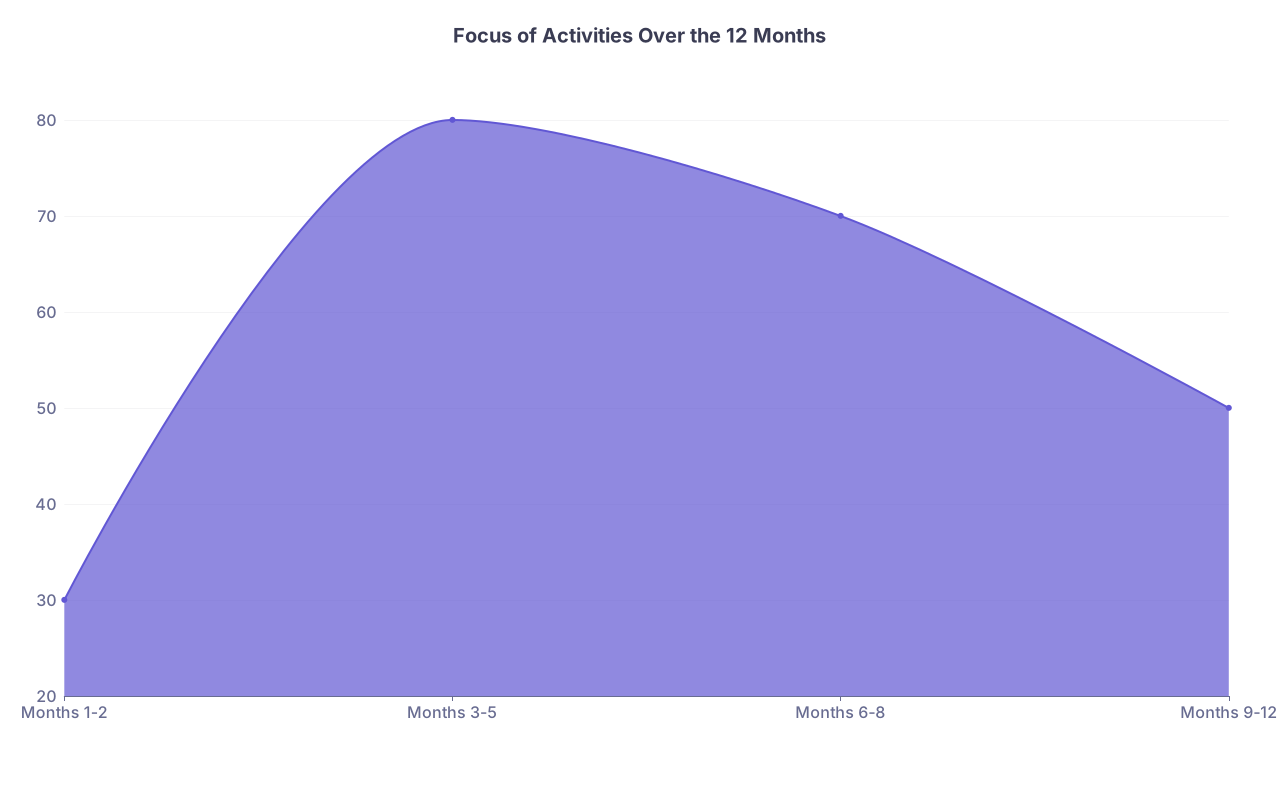
| Category | Value |
|---|---|
| Months 1-2 | 30 |
| Months 3-5 | 80 |
| Months 6-8 | 70 |
| Months 9-12 | 50 |
Months 1–2 (Now – Early Summer):
- Diagnosis of why you did not match.
- Decide specialty plan (same vs pivot).
- Aggressively apply for research / clinical positions.
- Meet with dean, secure any institutional support.
- Start working anywhere clinical you can, even per diem, while you hunt for a stable position.
Months 3–5 (Summer – ERAS Open):
- In research: own 1–2 projects, submit at least one abstract.
- In clinical roles: build trust, ask for letter commitments.
- Draft new personal statement that incorporates your year’s plan honestly.
- Overhaul application: new CV, experiences rewritten, address red flags in a professional way.
- Build a real program list: numbers matter more now. Aim for broad geographic and program mix.
Months 6–8 (Fall – Interviews Start):
- Keep productivity up: don’t coast just because ERAS is submitted.
- Prepare interview answers that clearly explain the gap year and what you learned.
- If research: push to get any “submitted” work updated in emails to programs when accepted or presented.
- If clinical: log specific examples of teamwork, responsibility, and patient interaction to use in interviews.
Months 9–12 (Winter – Match Day):
- Maintain visibility with your current team. PDs talk mid‑year.
- Update programs with any new publications, presentations, or significant achievements.
- Think about Plan B for next year early if interviews are very thin (e.g., start scoping FM, IM, Psych if you were reapplying to a harder specialty).
Telling The Story: How To Frame Your Unmatched Year
Interviewers are going to ask: “So, you graduated in 2025 but are applying for 2026 start. What happened?”
You need a clean, non‑defensive 60–90 second answer:
State the fact without drama.
“I applied to [specialty] last cycle and did not match.”Give the honest, non‑self‑pitying reason.
“My application was not competitive enough because [specific reason: lower score, late application, unrealistic specialty, limited geographic flexibility].”Show what you did about it.
“In response, I spent this year doing [research/clinical work] at [institution], where I [specific responsibilities and accomplishments].”Tie it to your growth and readiness.
“This year clarified that I’m committed to [specialty/field], and it’s given me [skills/insights] that’ll make me a stronger intern, especially in [specific area].”
Do not:
- Blame the Match, programs, or “bad luck” as your central explanation.
- Sound like you still don’t understand why you did not match.
- Pretend it was a “planned gap year” if everyone knows it wasn’t. People see through that.
Programs respect people who get knocked down, analyze the problem, and come back with receipts.
Specialty‑Specific Nuances (Quick Reality Check)
I’ll keep this short but blunt.
Derm, Ortho, Plastics, ENT, Neurosurg, Rad Onc, Urology
Reapplying after going unmatched is an uphill climb. One lost year and you’re already behind the next cohort. You typically need:- A major research year at a name‑brand center.
- Strong new letters from big names.
- Or a willingness to pivot to IM/FM/Psych/Path/Anesthesia realistically.
IM, FM, Peds, Psych
Very possible to match after an unmatched year if you:- Stay clinically and academically active.
- Apply broadly (yes, 100+ programs can be rational now).
- Fix any glaring issues like incomplete apps or late submissions.
EM
Currently volatile. Many EM programs are less competitive than before, but the market is shifting. Have a backup specialty list and be strategic.Path, Neuro, Anesthesia
Often more open to non‑traditional paths, research years, and unique backgrounds. A well‑structured year plus broad applications can go far here.
Red Flag Situations: What To Do Differently
Certain issues require special handling:
USMLE/COMLEX failures
- You need a period of spotless performance after the failure.
- If any exams remain (Step 3, COMLEX Level 3), plan to crush them—but only when fully prepared. A second failure is nearly fatal.
- Build a narrative around improved study methods, accountability (tutor, dedicated schedule), and insight.
Professionalism concerns
- Seek formal mentorship and document it.
- Work in settings where someone can credibly say, “I would trust this person with my patients and team.”
- If there was official remediation, address it directly in your personal statement or a short addendum.
Multiple unmatched cycles
- This is where pivots matter. If you’re unmatched twice in the same hyper‑competitive specialty, the third try in that field is often self‑sabotage.
- Consider IM/FM/Psych/Path seriously, especially if your core issue is specialty competitiveness, not professionalism.
Use Your Network Aggressively (Without Being Annoying)
Hidden truth: a lot of post‑match opportunities never hit a website. They get passed along by email: “Anyone know a grad who can help in our lab/clinic for a year?”
So you need to:
- Email every attending who liked you even a little:
“Dr. X, I worked with you on [rotation]. I unfortunately did not match this year and am looking for [research/clinical] opportunities in [field/location]. If you know of any positions or colleagues who might be open to a committed graduate for a year, I’d really appreciate an introduction.” - Reach out to alums 1–3 years ahead of you who matched in your target specialty. Ask them:
“If you had to rebuild for a year, what would you do? Do you know of any programs that work with unmatched grads?”
You’re not asking for a residency spot. You’re asking for work that proves you deserve one next year.
One Thing You Must Stop Doing
Stop treating this like a personal moral failure.
Programs are full of residents who:
- Failed Step 1 once.
- Did a research year after not matching.
- Switched specialties after realizing their “dream” was not realistic.
What separates those who get back in from those who don’t is not intelligence. It is execution over the next 12 months.
You are not competing with your fantasy ideal self. You are competing with what you can build—concretely—in the year ahead.
Your Next 24 Hours
You don’t need a perfect 12‑month blueprint tonight. You need momentum.
Today, do this:
- Open a blank document and write your “problem list” for why you didn’t match, in brutal, honest bullet points.
- Send three emails:
- One to your dean/Student Affairs asking for a dedicated meeting to discuss a reapplication plan.
- One to a trusted attending you’ve worked with, asking for a frank assessment of your competitiveness and any leads for research/clinical roles.
- One to yourself, with the subject line “Residency Comeback Plan,” attaching that problem list. This is your contract with yourself.
Then schedule 30 minutes tomorrow to expand that into a 12‑month structure—research vs clinical work vs both—and start drafting the list of 20+ people you’ll contact for opportunities.
Open your email right now and send those three messages. That’s how you start using the next 12 months intentionally, instead of letting them happen to you.


