

The wrong dean or advisor can do more damage after you go unmatched than the Match itself.
If you’re reading this, you probably already know that. You went through SOAP or got the “We are sorry” email. You’re raw, exhausted, and looking for a plan. And instead of getting a clear, structured path forward, you got:
- “Maybe this just isn’t for you.”
- “We don’t really have a process for this.”
- “You should probably think about another career.”
- Or worse: silence, delay, or obvious disinterest.
Let me be blunt: an unsupportive dean or advisor is a problem. But it’s not a verdict. You just have to stop expecting them to be the solution and start treating them as one data point in a bigger strategy.
Here’s how to handle this — step by step — so your future doesn’t hinge on one person who’s already checked out.
1. Recognize What Kind of “Unsupportive” You’re Dealing With
Not all bad advising is the same. You need to know which flavor you’ve got, because the response is different.
Common types I’ve seen:
The Ghost
Slow to reply, cancels meetings, “We’ll revisit in a few weeks,” disappears when you need letters or forms. Not openly hostile, just absent.The Gatekeeper
Controls MSPE edits, institutional letter, or reapplication approval. Talks a lot about “protecting the school’s reputation.” Likes to say “we seldom support repeat applications in this situation.”The Pessimist
Focuses on worst-case scenarios. Overemphasizes your weaknesses, underestimates your chances. “With your Step score, I just don’t see it happening.”The Blame Shifter
Subtext (or text): This is your fault. You didn’t apply broadly enough. You chose the wrong specialty. You didn’t listen. Even when that’s partly true, they weaponize it rather than help fix it.The Politician
Overly vague, smiles a lot, says, “We’ll see what we can do,” and then does almost nothing concrete. Loves meetings, hates commitments.
You may have a mix of these in one person.
Your first move is not to argue with their personality. Your first move is to adjust your expectations and your strategy.
- From them, you’re getting only what you absolutely must: signatures, institutional letters, required forms, official statements.
- From elsewhere, you’re assembling your real advisory team: residents, attendings, alumni, specialty advisors at other institutions, mentors outside your school.
Stop making your dean the centerpiece of your comeback plan. Start using them like a limited resource.
2. Stabilize Yourself Before You Walk Back Into That Office
Showing up to an unsupportive dean in an emotionally raw state usually ends in one of two ways: you shut down and accept whatever they say as gospel, or you get defensive and they write you off.
You need a third option: calm, controlled, strategic.
Before the meeting:
Name the loss
Say it out loud or write it down: “I didn’t match. It hurts. I feel embarrassed, scared, and angry.” You’re not being dramatic. You’re acknowledging reality so it doesn’t control the conversation.Decide your short-term goal
For this next conversation, your goal is not to fix your whole life. Your goal is:- To understand what the school requires of you logistically for a reapplication or alternate plan.
- To extract any usable information about how they see your application.
- To get specific commitments (letters, MSPE addenda, timeline) if possible.
Script your opening
Don’t wing it. Use something like:“I’d like to understand concretely what my options are for reapplying next cycle, and what support the school can provide in terms of letters, MSPE updates, and guidance. I have questions about X, Y, and Z.”
You’re signaling: I’m serious, I’m organized, I’m not here to cry in your office (even if you cried yesterday).
Bring data
Have:- Your ERAS application (printed or on a tablet)
- Your score reports
- Your application list from this cycle (specialties, numbers of programs, outcomes)
- Any feedback you’ve already gotten from programs (even a couple of email lines)
That’s your armor. Not to impress them. To keep you grounded.
3. Run the Meeting Like You’re the One in Charge (Because You Are)
You cannot control their attitude. You can control the structure of the conversation.
Walk in with a one-page agenda. Literally. Printed.
Top of the page: “Post-Unmatched Plan – [Your Name] – [Date]”
Underneath, short bullets:
- Clarify eligibility and institutional stance on reapplying
- Identify weaknesses in my application
- Confirm what support the school will/won’t provide
- Clarify timeline for letters/MSPE/other documents
Then:
Open with purpose
“Thank you for meeting with me. I brought an agenda so we can be efficient. My main goal is to come away with a clear plan and understand what support is available.”You’re saying: I respect your time, but I also expect some structure.
Ask direct, closed questions first
Examples:- “Does the school support me reapplying to residency next cycle?”
- “Will you support an application to [same specialty] versus [alternative specialty]?”
- “Can the school update my MSPE to reflect additional work or research I complete this year?”
- “Are there any institutional barriers I should know about?”
If they waffle, pin them down:
“I understand there’s nuance, but I do need a clear answer so I can plan. Is the answer yes, no, or conditional?”Only then move to open questions
- “From your perspective, what were the main factors that led to my not matching?”
- “If I decide to reapply, what would you consider an adequately strengthened application?”
- “In your experience, who at this institution has been most helpful to students in my situation?”
Write things down in front of them
When they commit to something, repeat it:“So, you’re able to write an updated dean’s letter by October 1 if I send you materials by September 1. I’ll note that.”
People are much less likely to flake when they’ve heard themselves say it out loud and watched you record it.
Don’t argue their opinion; just log it
If they say, “With your Step score, I don’t think you’re competitive for internal medicine,” don’t get into a debate on percentile ranks.You say:
“Okay, I hear that you see internal medicine as unlikely. I’d like to get additional specialty-specific feedback as well. Can you connect me with someone in IM? If not, I’ll reach out independently.”Translation: Thanks for your take. I’m not handcuffing my future to it.
4. Use Them for What You Need — and No More
Some things you cannot bypass. MSPE, enrollment verification, institutional letters, sometimes a “permission to reapply” box. You can’t just pretend the school does not exist.
So you treat your dean/advisor like a necessary administrative element, not your career lifeline.
Here’s what you actually need to extract:
| Item | Why It Matters |
|---|---|
| Updated MSPE or addendum | Programs want to know what you did after not matching |
| Institutional support note | Some specialties/programs ask if your school supports reapplication |
| Letters confirming status | For research jobs, prelim years, or observerships |
| Graduation/enrollment docs | For licensing, visas, GME onboarding |
You’re not asking them to be your therapist, strategist, or motivational coach. You’re asking for specific documents, with specific timelines.
Script it:
- “For my reapplication, I’ll need an updated MSPE reflecting my additional year of research/clinical work. Are you willing to do that, and what deadline do you need from me?”
- “Several positions I’m applying for require a letter confirming I’m a graduate in good standing. Can your office provide that, and what’s the process?”
If they try to turn this into a philosophical debate about whether you should reapply, pull it back:
“I understand your concerns about competitiveness. I’m still exploring options and collecting opinions. For now, I need to make sure I know what institutional support is possible should I proceed.”
You’re not asking permission to dream. You’re asking for a form.
5. Build an External Support and Strategy Network — Fast
If your dean is not your person, then you need other people. Plural.
Here’s where to look:
Specialty-specific advisors not tied to your school
- National specialty organizations often have student/resident mentorship programs (e.g., ACP for IM, AAFP for FM, ACOG, etc.).
- Program coordinators at smaller or community programs are often surprisingly candid if you email respectfully and ask, “Would someone be willing to give me feedback on my application profile?”
Residents and recent grads from your school who matched later or into your target field
- Ask alumni services or student affairs for contact info (even if they’re lukewarm about it).
- Or use LinkedIn: search your med school name + specialty.
Faculty who actually know your work
- The attending who loved how you handled nights on wards > the dean who barely remembers your name.
- Ask them: “Given my scores and performance, if you were me, what would you do this year? What kind of experiences would change my application meaningfully?”
Online but curated
- Anonymous forums can be toxic, but there are also credible spaces: specialty-specific Discord/Slack groups, alumni groups, or moderated advising platforms.
- Use them for data points, not for existential judgment of your worth.
You’re constructing your own “advisory committee.” Think 3–5 people, not 20. A mix of:
- One or two who matched into your field of interest
- One who sits in a selection role (PD/APD, selection committee member)
- One who knows you personally and can speak to your growth and resilience
6. Get Real About Why You Didn’t Match — Without Letting It Crush You
Unsupportive deans often jump straight to “you’re not good enough.” That’s not analysis. That’s laziness.
You need a clearer breakdown. Something like this:
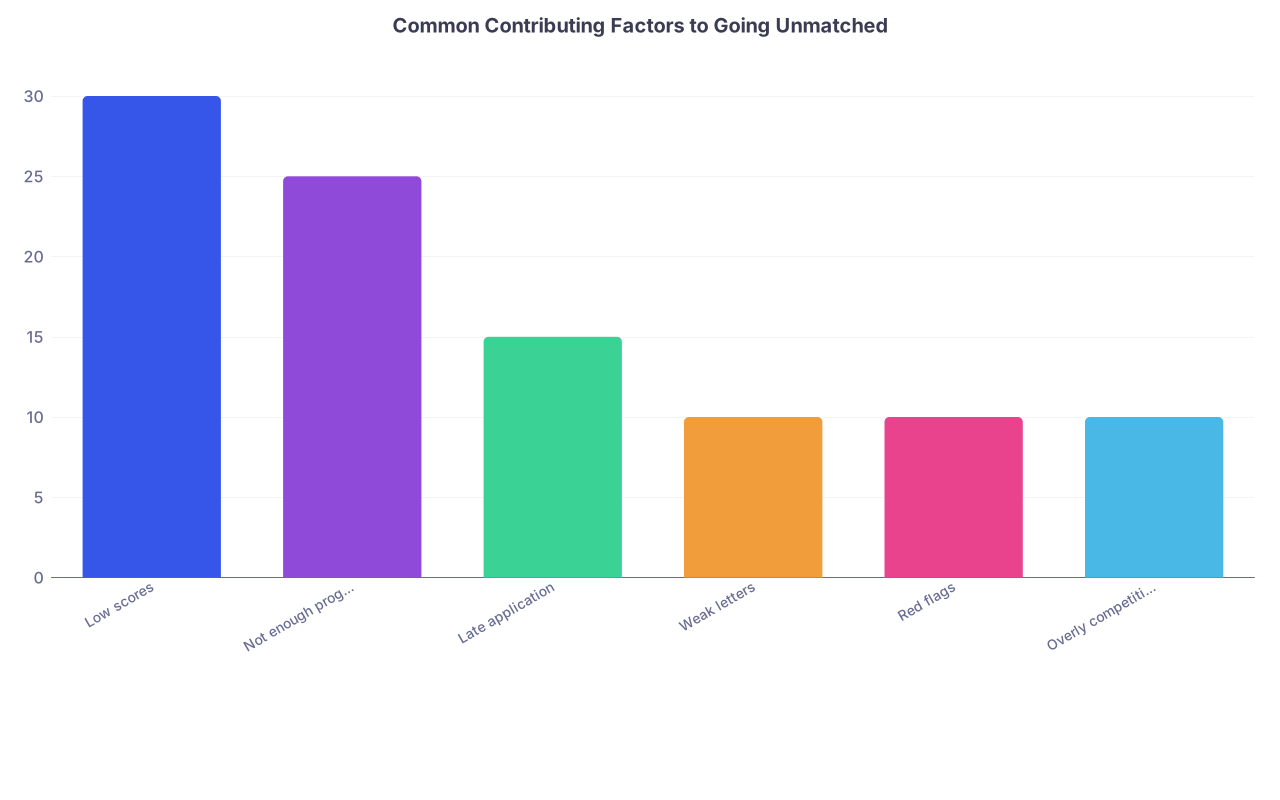
| Category | Value |
|---|---|
| Low scores | 30 |
| Not enough programs | 25 |
| Late application | 15 |
| Weak letters | 10 |
| Red flags | 10 |
| Overly competitive specialty | 10 |
This isn’t your exact pie chart, but you get the idea. You want to know YOUR distribution.
Sit down and, as clinically as possible, go through:
- Scores (Step/COMLEX, failures or low passes, timing)
- Application strategy (how many programs, which tiers, which regions)
- Specialty competitiveness versus your stats
- Letters (who wrote them, how strong were they actually)
- Red flags (LOA, professionalism issues, failed courses, SOAP-only interviews)
- Personal statements and interview performance
If your dean gives you vague blame — “You just weren’t competitive” — push them:
“Can you be more specific? Was it score cutoffs, specialty competitiveness, or concerns about my performance or professionalism? I’m trying to identify what’s modifiable before next cycle.”
If they won’t or can’t, your external advisors will have to do this part with you.
The point is not to wallow in self-critique. The point is to figure out: what lever do I need to pull hardest in the next 6–12 months?
7. Choose Your Next-Year Plan Without Waiting for Their Blessing
Here’s the truth: most schools don’t have a clean, thought-out system for unmatched grads. You’re often building the plane while flying it.
The big buckets of what you can do for the coming year usually look like:
- Research year (basic, clinical, QI)
- Preliminary year in a different specialty
- Non-training clinical role (e.g., research coordinator with clinical exposure, sometimes hospitalist scribe roles for IMGs)
- Advanced degree (MPH, MS) — often overused and not always helpful
- Non-clinical work (consulting, industry, public health) while planning a pivot
What your dean thinks of each of these may not match what actually helps your application.
You evaluate options based on three things:
- Does this strengthen the weakest part of my application?
- Will I get strong, new letters out of it?
- Will programs look at it and think, “This person is active, committed, and has grown”?
If your dean pushes an option that doesn’t hit those marks (“Maybe do an MPH because it’s safe”) but your weak point is clinical performance or specialty-specific exposure, be cautious.
You’re allowed to say, internally: “Thank you for your opinion. I’m going to weigh that against what I’m hearing from people who actually sit in my target specialty.”
Then you make a decision. And you inform the dean of logistics only:
“I’ve decided to pursue a clinical research year in [field] at [institution]. I’ll be reapplying next cycle, likely in [specialty]. I’ll keep you updated on my progress and will reach out when it’s time to update my MSPE.”
You’re not asking for permission. You’re announcing a plan.
8. Protect Yourself From Active Sabotage
Most deans aren’t malicious. They’re just busy, risk-averse, or checked out. But occasionally, you get someone who actively makes things harder:
- Refuses to update your MSPE at all
- Writes a tepid or undermining institutional letter
- Delays paperwork until deadlines are tight
- Uses vague “professionalism concerns” that were never documented
If you suspect this is happening, you treat it like a professional problem, not a personal feud.
Steps:
Document everything
- Keep a log of dates: when you requested things, responses you got, what was promised.
- Save emails, especially anything that sounds like, “We do not normally…” or “We cannot provide…”
Escalate carefully, not emotionally
If the dean is the issue, see if there’s:- An associate dean for student affairs
- A graduate medical education liaison
- An ombuds office or student advocate
Your tone: calm and specific.
“I’m concerned about [specific delay or refusal]. I want to ensure I have a fair chance to reapply. Can we discuss what the school is able to provide and what my options are if certain documents cannot be updated?”
Get external letters that carry weight
If you think your dean’s letter is weak, your best counterweight is:- Strong, detailed letters from faculty who supervised you closely
- A clear, honest personal statement that addresses growth without sounding like you’re blaming your school
- A track record this year (research, clinical work) that speaks for itself
If necessary, adjust strategy
If institutional support is truly weak, your reapplication pool may need to:- Emphasize community programs, smaller institutions, or prelim/transitional programs
- Include more geographically flexible applications
- Possibly pivot to a different, less competitive specialty where updated performance weighs more than legacy narrative
Annoying? Yes. Game over? No.
9. Turn This Into a Professional Story You Can Use Later
Having an unsupportive dean after an unmatched outcome feels deeply personal. Later in your career, it will read as: “Early adversity, imperfect institutional support, still pushed through, built my own network.”
Programs notice that.
Interviewers will ask, “What happened with your first match cycle?” and “How did you handle not matching?”
If your story is:
- “My dean told me I wasn’t competitive. I got angry and gave up.”
That’s one future.
If your story is:
- “My institutional support was limited, so I identified specific weaknesses, found mentors in the specialty, did a focused year of research/clinical experience, and came back stronger.”
That’s entirely different. And fully under your control starting now.
You are not auditioning to be the dean’s favorite student. You’re building a track record that future PDs can respect.
10. What You Can Do Today
Don’t make this theoretical.
Today, do this:
Draft a one-page agenda for your next meeting with your dean or advisor.
Include: your goal, specific questions, and what you need from them (documents, timelines).Identify 3 people outside of your dean who could be part of your real advisory team.
Email one of them today with a short, respectful ask:
“I went unmatched in [specialty], and I’m trying to understand my options. Would you be willing to review my profile briefly or point me to someone who can?”
Open whatever email client you use and write that first message now. One concrete outreach today does more for your future than waiting another week for your dean to suddenly become the advisor you wish you had.


