
You did not match because something in your application ecosystem was weak, misaligned, or invisible. Not because “the match is random.”
If you treat this like bad luck, you will repeat it. If you treat this like a quality-control problem and run a proper audit, you can fix it.
This is a post‑match repair manual for your application. Use it like one.
1. Ground Rules Before You Start the Audit
You need a clear mindset before you start dissecting your application. Otherwise you will either:
- Blame everything on one factor (“USMLE score ruined me”) or
- Blame nothing (“It was just a bad year”)
Both are wrong. Here is how to set yourself up to actually learn something.
Rule 1: Separate emotion from analysis
You are allowed a week to be angry, numb, embarrassed. After that, you need to flip into “QA engineer” mode.
Concrete steps (do these first):
Download everything from this cycle:
- ERAS/CaRMS/NRMP PDF of your entire application
- All personal statements
- CV in the format you submitted
- List of programs you applied to and interview offers
- Emails with advisors, program responses, etc.
Create a folder system on your computer:
/Match_Audit_202X/01_Original_Application/Match_Audit_202X/02_Program_List/Match_Audit_202X/03_Feedback/Match_Audit_202X/04_Revisions
Print your main application PDF and personal statement. Yes, on paper. You catch different errors on paper than on screen. I have watched people find shocking typos this way.
Rule 2: Use data, not vibes
You need numbers. Not feelings.
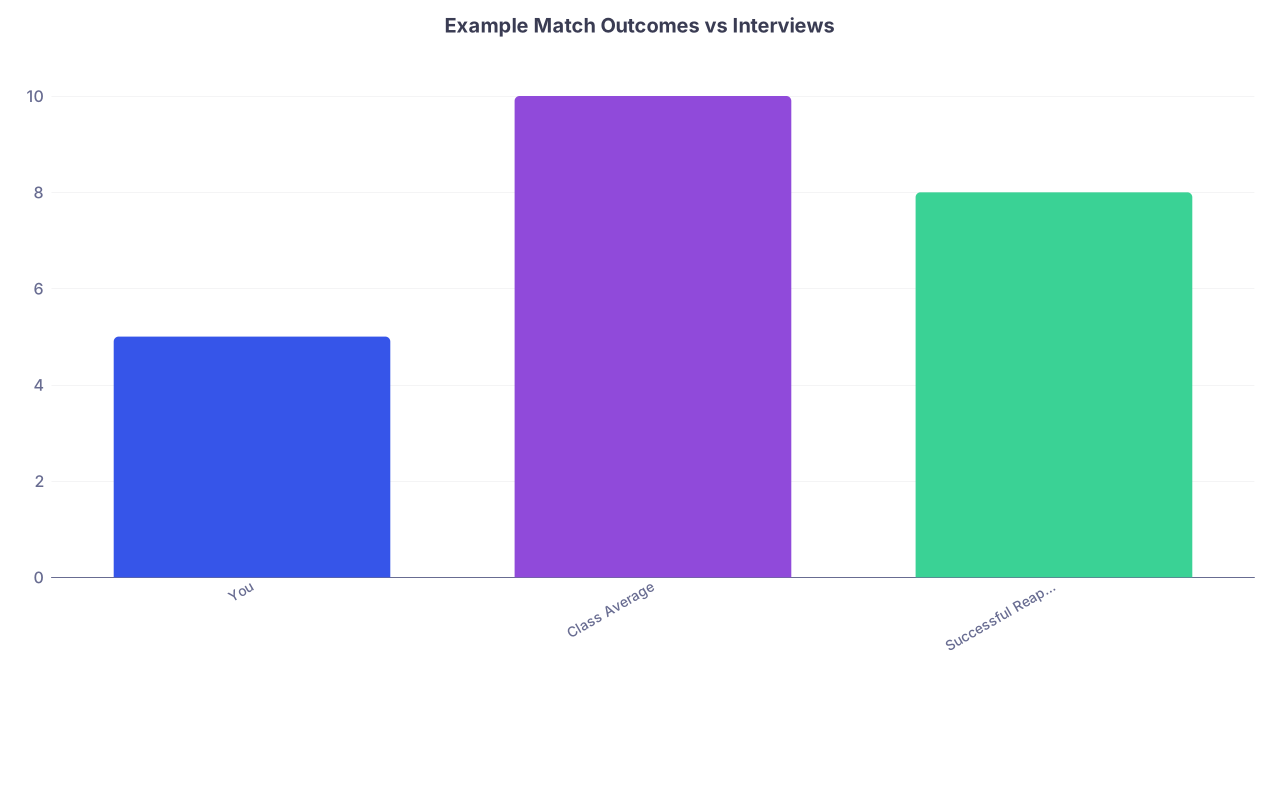
| Category | Value |
|---|---|
| You | 5 |
| Class Average | 10 |
| Successful Reapplicants | 8 |
If you had:
- 0–2 interviews and did not match → mostly a paper application problem.
- 8+ interviews and did not match → mostly an interview / ranking / professionalism problem.
- 3–7 interviews → could be both; you need to audit all layers.
Rule 3: Commit to changing at least 3 major things
If you come out of this audit planning to “tweak a few sentences” and “maybe apply to two extra programs,” you are not serious.
You will need to change big levers:
- Specialty choice or breadth
- Program list strategy
- USCE / research / letters
- Interview skills
- Personal statement and narrative
You are not doing a polish. You are doing a teardown and rebuild.
2. Global Snapshot: What Actually Happened?
Start with a one‑page “match autopsy” before you dive into individual components. You need the bird’s‑eye view.
Step 1: Fill in your numbers honestly
Write this out in a document:
- Specialty applied to:
- US senior / AMG / DO / IMG (US citizen or non‑US):
- USMLE/COMLEX: Step 1 (if applicable), Step 2 CK, COMLEX 1/2, any failures:
- Graduation year and any gaps:
- Total programs applied:
- Programs that sent you interviews:
- Total interviews attended:
- Matched? SOAP outcome? Prelim vs categorical?
Then compare yourself against typical matched applicants in your specialty. Not to feel bad. To see if your profile is structurally competitive.
| Specialty | Step 2 CK Target | Interviews Usually Needed | Notes |
|---|---|---|---|
| Internal Med | 225–235+ | 8–10 | Community vs academic gap |
| Family Med | 215–225+ | 6–8 | Geographic flexibility |
| Psych | 225–235+ | 8–10 | Rapidly more competitive |
| Gen Surgery | 240+ | 10–12 | Strong letters critical |
| Derm/Rad Onc | 250+ | 12+ | Heavy research |
If you are 20+ points below typical matched scores for your specialty and you still applied only to top‑tier academic programs, that is not “bad luck.” That is strategy failure.
Step 2: Identify your failure tier
Brutally categorize your situation:
- Tier A – Under‑screened: Very few interviews relative to number of applications.
- Tier B – Under‑ranked: Reasonable number of interviews, did not match.
- Tier C – Overreach / misaligned specialty: Stronger for another specialty than the one you targeted.
Write the tier at the top of your audit document. Your strategy next year depends heavily on which one you are in.
3. Audit Layer 1: Program List and Strategy
Most people start by nitpicking their personal statement. They should start with their program list. Because if you apply to 40 programs and 30 of them were never going to rank you, nothing else matters.
Step 1: Rebuild your program list with outcomes
Make a spreadsheet with columns like:
- Program name
- Location
- Type (university / community / hybrid / unopposed)
- Applied (Y/N)
- Interview offered (Y/N)
- Outcome (interview, rejection, silence)
Then mark patterns.
Look for:
- Did you get any interviews from academic programs?
- Were nearly all of your interviews from community hospitals?
- Did certain regions consistently ignore you? (e.g., West Coast vs Midwest)
You are looking for signal: where you were actually competitive.
Step 2: Compare your profile to what those programs historically take
Pick 10 programs:
- 5 that interviewed you
- 5 that ignored you completely
Go to:
- Program websites (check resident bios)
- NRMP/Charting Outcomes reports
- Specialty‑specific forums or spreadsheets (yes, they can be noisy, but patterns emerge)
Ask:
- Do they typically take IMGs or DOs?
- Are their residents mostly from top‑20 schools?
- Do they strongly prefer Step 2 scores above a certain range?
- Are they heavy on research / publications?
If you see residents mostly from high‑tier schools with multiple publications, and your CV has none, stop telling yourself you were “unlucky” with that program. You were not in their usual lane.
Step 3: Quantify how “reachy” your list was
Crude but effective breakdown for your next cycle:
- 20–30% “reach” programs
- 50–60% “target” programs (your stats ≈ their average resident)
- 20–30% “safety” programs (you are clearly above their baseline)
For many unmatched applicants, their first list was:
- 60–70% reach
- 30–40% target
- 0–5% true safety
Write out, in your audit:
- How many real safeties did you have?
- How many programs were clearly out of your league as currently built?
- How many geographic “no‑chance” regions did you bet on because you liked the city?
Be specific. For example:
I applied to 15 California IM programs with Step 2 222 and no US research. That was fantasy.
That sentence alone might explain your outcome.
4. Audit Layer 2: The Core Application (Scores, CV, Gaps, Letters)
Now you dig into the skeleton of your application. The part that got screened before anyone ever read your personal statement.
Step 1: Exams and red flags
List your exams:
- Step 1: Pass/Fail? Any failure?
- Step 2 CK: actual score
- COMLEX levels, if applicable
- Any attempts / failures
Then label:
- Structural red flags:
- Exam failure
- Multiple attempts
- Large gap after graduation
- Prior withdrawal / dismissal
These do not automatically doom you, but pretending they are minor is delusional. Programs notice.
For each red flag, answer:
- Did I address this coherently anywhere (PS, advisor letter, dean’s letter)?
- Did I have any compensating strengths? (High Step 2, strong clinical evals, strong USCE)
If you had a Step 1 fail, graduated >5 years ago, and had weak USCE, applying to a hyper‑competitive specialty was a strategic error, not a tragedy.
Step 2: CV content and structure
Print your ERAS CV.
Using two different colored pens:
- Blue: Circle experiences that directly support your specialty choice.
- Red: Underline anything that is fluff, repetitive, or irrelevant.
Ask these brutal questions:
- Did I list generic volunteer roles (“tutored students,” “club member”) that do nothing for my narrative?
- Did I hide my best experiences in the middle of a long list?
- Does someone reading this see a coherent picture in 90 seconds, or a scattered activity dump?
If your CV reads like “I did a little of everything” with nothing anchored to the specialty, that hurt you more than you think.
Step 3: Letters of recommendation (content and strategy)
You probably did not actually read your letters, but you can reconstruct how strong they likely were:
- Who wrote them? (Title, specialty, how well they knew you)
- How long did you work with them?
- Did any of them come from your target specialty?
- Did any come from program leadership (PD, chair, APD)?
Patterns I have seen destroy otherwise solid applicants:
- 3 generic letters from hospitalists for a surgery application
- Letters from people who barely knew the applicant (“worked with for 2 half‑days”)
- Overreliance on letters from home country for US residency, with minimal US writers
For your audit, write:
- Strength of each letter (guess): Strong / Medium / Weak / Unknown
- Specialty match: Same specialty as you applied to? Y/N
- Title: PD, APD, faculty, fellow, etc.
If you had zero letters from your target specialty or program leadership, that is a major structural flaw.
5. Audit Layer 3: Personal Statement and Physician Narrative
Now you get to attack the thing you probably rewrote 47 times. And possibly made worse each time.
Step 1: Print and mark like a reviewer
On paper, do this:
- Read the first two sentences.
- Ask: would a bored PD, skimming 60 files, feel compelled to continue?
- In the margin, write: “Hook?” and answer yes/no.
Then go through and in the margin label paragraphs as:
- Story
- Reflection
- Specialty fit
- Future goals
- Generic fluff
Most unmatched applicants have statements overloaded with:
- Childhood anecdotes
- Patient stories with no reflection
- Generic phrases (“I am passionate about internal medicine…”)
and almost no:
- Clear evidence they understand the specialty’s realities
- Concrete reasons they fit this specialty
- Specific, realistic career goals
Step 2: Content checklist
Your statement should do four things clearly:
- Show a specific, adult‑level understanding of the specialty (not starry‑eyed).
- Show you have actually done the work and liked the day‑to‑day.
- Connect specific past experiences to skills needed in that specialty.
- Outline believable future goals within that field.
If your statement is 80% “Why I love medicine” and 20% “also I like this specialty,” it did not help you stand out at all.
Mark in your PS:
- Where you explicitly mention your specialty and why it fits you.
- Where you demonstrate insight about the specialty (not just admiration).
- Where you actually differentiate yourself from the average applicant.
If you struggle to find any of those moments, the statement needs a complete rebuild for the next cycle.
6. Audit Layer 4: Interview Performance
If you had a healthy number of interviews (8+ in most core specialties) and still did not match, your interviews are suspect until proven otherwise.
Step 1: Recreate what actually happened
Open a document and for each program where you interviewed, write from memory:
- Format (panel, 1‑on‑1, MMI, virtual)
- How you felt it went (1–10)
- Any awkward / challenging moments
- Questions that caught you off guard
- Anything unprofessional (late login, tech issues, background noise)
Then pattern‑spot:
- Did you stumble consistently on “Why this program?”
- Did you have a convincing answer for “Why this specialty, especially given X in your record?”
- Did you ramble?
- Did you over‑share personal issues?
Step 2: Get external feedback if possible
If you had:
- A school advisor who mock‑interviewed you
- A mentor who debriefed with you
- Co‑applicants who heard your practice answers
Ask them, explicitly:
“I did not match. I need you to be blunt. During mock interviews, what were my biggest weaknesses? What worried you?”
You are not asking for comfort. You are asking for diagnosis.
Common recurrent interview problems:
- Sounding rehearsed and fake
- Evading questions about red flags
- Poor eye contact or camera presence
- Negativity about prior institutions
- Giving generic answers that could fit any program
Step 3: Align interview count with outcomes
Use a simple sanity check:
- 10+ interviews → almost always should result in a match, unless:
- You ranked programs unrealistically low / poorly
- Your interview performance was truly problematic
- There were professionalism flags
If you had:
- 0 SOAP offers
- No post‑interview expressions of strong interest from programs
then you should take your interview performance very seriously in your next‑cycle plan.
7. Audit Layer 5: Specialty Fit and Risk Profile
Sometimes the brutal truth is: you chased the wrong specialty for your actual profile in this system.
I am not talking about your worth as a physician. I am talking about an algorithm that sorts thousands of people by crude proxies.
Step 1: Score your fit for your target specialty
Build a simple 1–5 scale (5 = strong) for these:
- Exam scores relative to that specialty’s average
- Clinical evaluations and comments in that specialty
- Letters from that specialty
- Research / scholarly work in that field
- Demonstrated commitment (electives, sub‑internships, related volunteering)
Add them up. If you are scoring 10–12/25 while matched applicants are usually 18–22/25, you have a specialty‑fit problem.
Step 2: Consider adjacent or better‑fit specialties
Many unmatched applicants cling to one specialty as identity. That is understandable. It is also how people end up unmatched twice.
Use this kind of mental map:

| Step | Description |
|---|---|
| Step 1 | Unmatched in Specialty |
| Step 2 | Fix application components |
| Step 3 | Explore related fields |
| Step 4 | Strengthen profile with gap year |
| Step 5 | Apply to combo or backup plan |
| Step 6 | Reassess after year |
| Step 7 | Exam scores close to matched range |
| Step 8 | Open to adjacent specialty |
Ask:
- Is there a less competitive but still satisfying specialty where my specific strengths matter more and my deficits matter less?
- Did any attending this year say something like, “You would be fantastic in X, have you thought about that?” and you ignored it?
I have seen unmatched surgery applicants find excellent fits in anesthesia or radiology. Unmatched psych applicants match strongly in internal medicine with a psych‑focused career. These are not failures. They are course corrections.
8. Turn the Audit Into a Concrete Repair Plan
Once you have filled your documents with red ink and painful insights, you need to translate that into action. Otherwise this was a therapy exercise, not a fix.
Step 1: Summarize your top 5 failure points
Force yourself to list exactly five, no more:
Examples I have actually seen:
- List heavily skewed to academic coastal programs despite mid‑range Step 2.
- No letters from target specialty; all from generalists.
- PS generic and did not address older graduation date.
- Poor virtual interview setup and rambling answers.
- No true backup specialty or prelim strategy.
If your list is all external (“competition high,” “COVID effects”), start over. You are auditing what you control.
Step 2: Map each failure to at least one concrete fix
For every listed issue, attach a specific remediation step for the coming 6–12 months:
Weak or absent US letters in specialty
→ Plan: Arrange 2–3 months of US rotations / observerships / externships in that specialty; target strong faculty for letters.Scores below average for top‑tier programs
→ Plan: Shift list next cycle to more community / mid‑tier; add geographic flexibility; consider prelim year to strengthen application.Poor interview skills
→ Plan: Schedule 3–5 formal mock interviews; record yourself; script but do not memorize answers to core questions; fix camera, lighting, and internet.No scholarly activity in field
→ Plan: Join a resident or faculty project, QI initiative, or small retrospective study; aim for at least a poster or abstract submission.Weak narrative and personal statement
→ Plan: Work with someone who has actual experience editing successful statements (not just a friend); rebuild around 2–3 concrete stories and a clear future plan.
Step 3: Put it on a timeline
Make this real. Put dates.
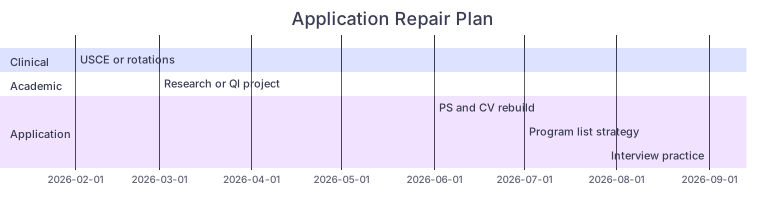
| Task | Details |
|---|---|
| Clinical: USCE or rotations | a1, 2026-02, 4m |
| Academic: Research or QI project | a2, 2026-03, 6m |
| Application: PS and CV rebuild | a3, 2026-06, 2m |
| Application: Program list strategy | a4, 2026-07, 1m |
| Application: Interview practice | a5, 2026-09, 3m |
If you cannot point to your calendar and show when each fix happens, it will not happen.
Step 4: Decide: Reapply same year, wait a year, or pivot
This is the tough one.
Use this quick decision grid:
| Situation | Recommended Action |
|---|---|
| Many interviews, close miss | Reapply next cycle, same specialty, fix interviews and list |
| Few/no interviews, strong graduate | Take a focused gap year to add USCE/research, then reapply |
| Significant red flags, no interviews | Consider alternative specialty and multi-year repair |
| Emotionally burned out, uncertain path | Pause, seek mentorship, delay reapplication by 1 year |
You are not “weak” for delaying. You are strategic.
9. Quick Reality Check: Are You Actually Learning From This?
If you did this audit correctly, you should feel three things simultaneously:
- Embarrassed by at least 1–2 things you submitted
- Relieved that there are clear, fixable issues
- Slightly angry at yourself for not asking for hard feedback earlier
That mix means you are in a good position to not repeat the same mistakes.
If instead you are determined to just “try again and hope” with minimal changes, stop. You are about to burn another year and another round of fees for no reason.
This entire process is not about blame. It is about control.