
It is March. Match Week. Your phone is face down because you already saw the email: “We are sorry to inform you…”
You did not match. Or you partially matched into a prelim spot with no categorical position. Your classmates are posting excited announcements with smiling photos and program logos. You are googling “SOAP strategy” with a pit in your stomach.
Then SOAP ends.
You still do not have a spot.
Now you are here:
- One failed (or shaky) match attempt behind you
- An empty PGY-1 ahead of you
- And the same haunting question: “How do I explain this without sounding like damaged goods?”
This article is about that. Rebuilding your narrative after a failed match. Not vague “stay positive” nonsense. Concrete, stepwise work to turn a loss into a story that programs will actually respect.
Step 1: Get Out of Shock Mode and into Diagnostic Mode
The first 3–7 days after you confirm you will not start residency this July are dangerous. People either:
- Collapse and avoid everything
- Or start firing off random emails and applications with zero strategy
Both are bad. You need a diagnostic phase. Think like a clinician: before treatment, you get a problem list.
1.1 Do a Cold, Brutal Assessment of Your Application
Pull up your ERAS application, your rank list, and your interview spreadsheet. Then answer these questions on paper:
Where did I actually fail in the pipeline?
- No interview invites?
- Some invites, no ranks?
- Ranked but did not match?
What hard metrics might have filtered me out?
- Step 1 / Step 2 CK score(s)
- Fails or repeats
- Gap years, leaves of absence
- Low class rank or no AOA
- IMG / visa issues
What obvious red flags were in my file?
- Failed course or exam
- Unexplained time off
- Weak or generic letters
- Very late application submission
- Limited or mismatched clinical experience
Where did your story fall apart?
- Weak personal statement
- Poor specialty fit (e.g., 2-week rotation then “lifelong dream” of that specialty)
- Misaligned research or extracurriculars
- Poor interview performance (you usually know)
Be clinical, not emotional. Write actual sentences like:
- “I submitted ERAS 3 weeks after opening, when I had a borderline Step 2 score. That killed my chances in a competitive specialty.”
- “I had four interviews but froze on ‘Tell me about yourself’ every time. My story was scattered.”
1.2 Get External, Unfiltered Feedback
Do not rely only on your own perception. You are too close to it.
Get feedback from:
- A trusted faculty advisor who has seen many match cycles
- Your dean’s office / student affairs
- A program director (PD) you know, even if not in your specialty
- If IMG: a mentor who has successfully matched in the U.S.
Ask them directly:
- “If you were a PD reading my last application, what would have made you hesitate or decline?”
- “What would I need to change or strengthen to be competitive next cycle?”
You want specific comments. “You are great, just unlucky” is almost always a lie or a cop-out. I have seen dozens of applicants “unlucky” three years in a row. Luck plays a role. But patterns usually matter more.
Step 2: Define a Clear, Credible Target for the Next Cycle
You cannot rebuild a narrative if you do not know what story you are building toward.
You need three decisions:
- Specialty choice (same vs different)
- Competitiveness tier of programs
- Timeline (this upcoming cycle vs waiting one more year)
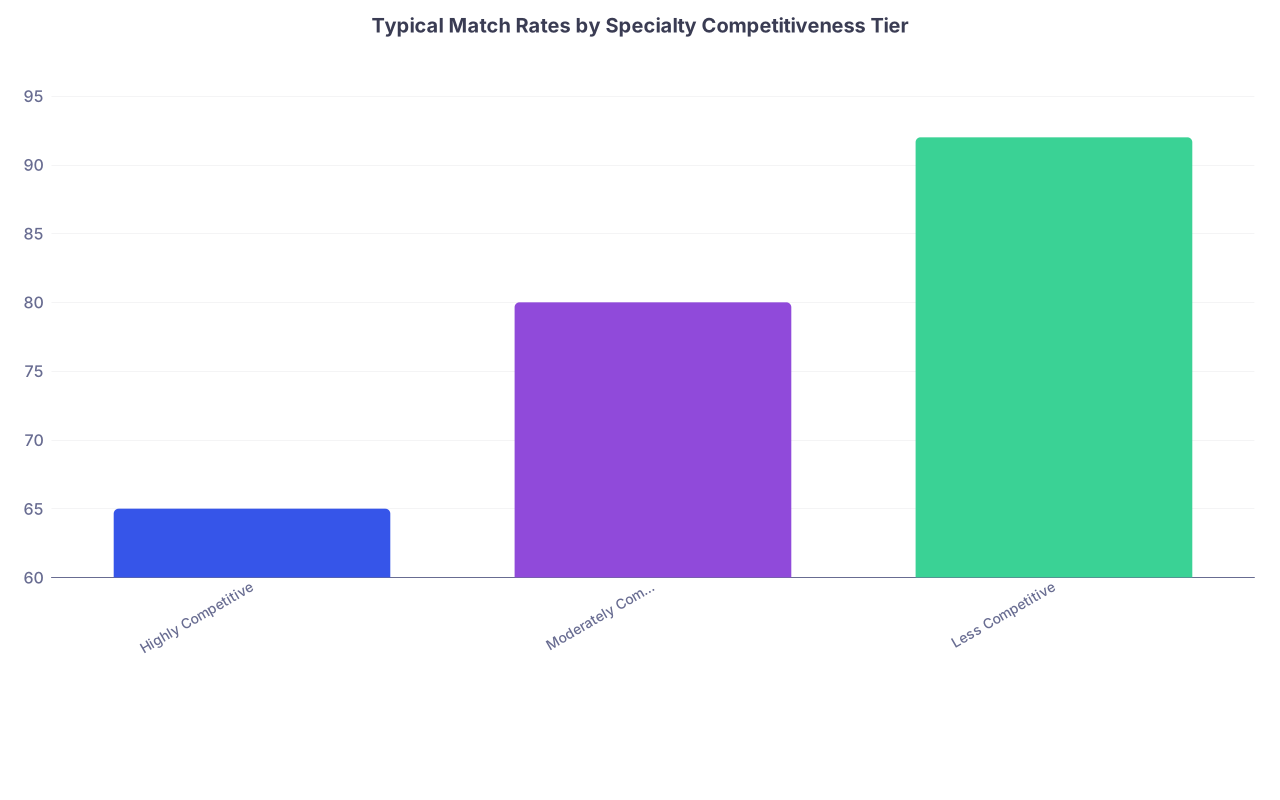
| Category | Value |
|---|---|
| Highly Competitive | 65 |
| Moderately Competitive | 80 |
| Less Competitive | 92 |
2.1 Decide if You Are Reapplying to the Same Specialty
This is the most emotional decision. Many people cling to a specialty that is simply not realistic based on their current profile.
Ask yourself:
- Did I have any interviews in that specialty?
- Did I get feedback like “You’re competitive, just a tough year”?
- Are my scores and experiences even within striking distance for that field?
If:
- You had zero or one interview in a highly competitive field (e.g., derm, ENT, ortho, plastics, neurosurgery)
- And your metrics are below the average for that specialty
Then reapplying in the exact same way is borderline self-sabotage. You either:
- Change specialty
- Or build a dramatically stronger year (research fellowship, away rotations, publications, real mentorship) and accept that it is still an uphill fight
2.2 Consider More Attainable Backup Specialties the Smart Way
Some “backup” moves are smart. Some are fantasy.
Smart pivots:
- From competitive surgical to general surgery, prelim surgery then switch, or anesthesia
- From competitive subspecialty to internal medicine + future fellowship
- From high-bar lifestyle specialty to family medicine, psych, peds, IM, or IM-prelim / transitional
Dumb pivots:
- Saying “I love everything” and shotgun applying to 5 different specialties with a generic story
- Picking a backup specialty you have never rotated in, with zero letters from that field
You need evidence for the pivot:
- At least one rotation in the new field
- Strong letters from attendings in that specialty
- A personal statement that does not read like “I’m only here because I did not match elsewhere”
Step 3: Build a Concrete Gap-Year Plan That Strengthens Your Story
This is the core: what you do between now and September will either confirm every doubt about you or completely change how PDs see you.
You need a structured plan, not vague “I’ll do research and maybe some observerships.”
3.1 Choose a Primary Role for the Year
You want one main identity for the year, not five disjointed things.
Reasonable primary roles:
- Research fellow in your target specialty or a closely related field
- Clinical fellow / post-doc / observer in a department that can write you strong letters
- Non-categorical prelim (IM or surgery) with realistic path to transition into categorical
- Instructor / teaching fellow with heavy clinical exposure if possible (more common outside U.S.)
Bad primary roles:
- Completely unrelated nonmedical job with no clinical or academic link
- Pure “time off to travel and reflect” unless you already have a rock-solid application otherwise
3.2 Supplement with Targeted Components
Around your primary role, you build supporting pieces:
Clinical exposure
- U.S. clinical experience (USCE) if you are an IMG
- Additional sub-internships or audition rotations for U.S. grads
- Volunteer clinical shifts in free clinics, if relevant
Research with deliverables
- Aim for posters, abstracts, or papers you can list
- Work with someone who has a track record of getting things published
- Timeline matters: even “submitted” or “in progress” looks better than nothing
Letters of recommendation
- Identify at least 2–3 potential strong letter writers early
- Work closely with them, show up, be reliable, then ask for “a strong letter” explicitly

3.3 Document Everything as Future Narrative Material
Keep a simple log:
- Dates and duration of experiences
- Specific responsibilities
- Memorable cases or projects
- Times you took initiative or solved a problem
These details will feed your future:
- Personal statement
- Interview answers
- Letters (your writers will often ask for a CV or bullet points)
- ERAS experience descriptions
Step 4: Rewrite Your Story: From “Failed to Match” to “Deliberate Rebuilder”
Programs do not want victims or people who blame “the system.” They want someone who took a hit, analyzed why, and came back sharper.
You must reframe your entire narrative in three key places:
- Personal statement
- ERAS experiences
- Interviews
4.1 Draft the New Core Narrative
Your story should hit these beats:
- Past – How you became interested in the specialty and what you did to prepare
- Setback – You applied and did not match (or partially matched)
- Response – Specific, mature actions you took after that outcome
- Current self – How you are now better prepared and more aligned with the specialty
That middle section (the failed match) must be handled like a complication in M&M: honest, concise, and focused on learning and improvement.
Example structure (same specialty reapplicant):
- “I applied to internal medicine last cycle and did not match. I was disappointed, but I understood that my late application and limited U.S. clinical exposure weakened my file.”
- “Over the past year, I have worked as a research fellow in the cardiology division and completed additional inpatient rotations, which have improved both my clinical confidence and my understanding of longitudinal patient care.”
- “This time, I bring a more mature understanding of the field, as well as clearer evidence of my commitment to internal medicine.”
Example structure (specialty pivot):
- “I initially applied to orthopedic surgery, driven by my interest in procedural work and musculoskeletal anatomy. I did not match.”
- “During a subsequent medicine rotation and a musculoskeletal consult service, I found myself more drawn to diagnostic reasoning, multidisciplinary collaboration, and longitudinal care.”
- “Over this past year, I have deepened my exposure to internal medicine, and I now see it as the best fit for both my strengths and how I want to practice.”
No drama. No self-pity. Just cause → effect → response.
Step 5: Fix the Structural Weaknesses in Your Application
Narrative helps, but it cannot completely override concrete problems. You have to address the actual weak points identified in Step 1.
Here is how to tackle common failure points.
| Weak Point | Targeted Fix This Year |
|---|---|
| Low Step 2 CK score | Dedicated study + strong Step 3 (if allowed) |
| Weak letters | Close work with new mentors + new LoRs |
| Limited USCE (IMG) | Inpatient electives / observerships |
| No research | 1-year research fellowship with outputs |
| Late ERAS submission | Application ready to submit Day 1 |
5.1 If Scores Are the Problem
You cannot magically increase Step 1. But you can:
- Take Step 3 (if eligible) and do very well
- Show strong in-training-type performance if you are in a prelim year
- Build a track record of clinical excellence and reliability
If you have a fail on Step or an exam:
- Address it once, directly: what changed in your approach, how you have not repeated that pattern
- Have concrete evidence: subsequent passes, strong clinical performance, structured remediation
5.2 If Clinical Experience Is Thin or Questionable
For IMGs or those pivoting to a new specialty:
- You need real, recent, relevant clinical work in that field
- Observerships and externships matter, but they must:
- Be hands-on or at least meaningfully involved
- Lead to letters from U.S. faculty in that specialty
For U.S. grads:
- Consider doing sub-Is / audition rotations at realistic target programs
- Aim to be remembered as “the strong sub-I we would be happy to have as a resident,” not “quiet student who blended in”
5.3 If Your Professionalism or Communication Was Questionable
I have seen candidates fail to match not because of scores, but because:
- They bad-mouthed previous programs or faculty
- They sent unprofessional emails
- They had weird behavior on interview day
If there is even a hint of that in your feedback:
- Get a mentor who will be brutally honest about how you come across
- Practice interviews with people who will not sugarcoat it
- Clean up your email tone, social media, and any public presence
Step 6: Build a Rational Application Strategy for the Next Cycle
Last cycle you might have aimed too high, applied too late, or applied too narrowly. You do not repeat that.
You design a chilled, methodical strategy.
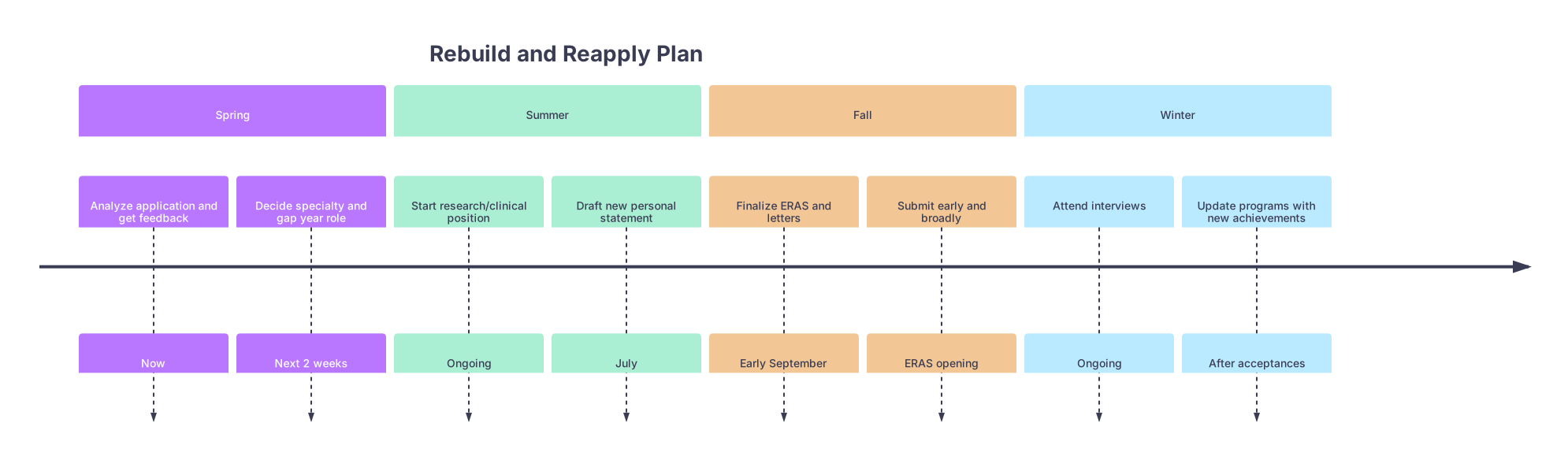
| Period | Event |
|---|---|
| Spring - Analyze application and get feedback | Now |
| Spring - Decide specialty and gap year role | Next 2 weeks |
| Summer - Start research/clinical position | Ongoing |
| Summer - Draft new personal statement | July |
| Fall - Finalize ERAS and letters | Early September |
| Fall - Submit early and broadly | ERAS opening |
| Winter - Attend interviews | Ongoing |
| Winter - Update programs with new achievements | After acceptances |
6.1 Apply Earlier and Broader
Non-negotiables:
- ERAS application and personal statement 100% ready before opening
- Letters requested early so they are in by the time you apply
- Apply broadly to a wide range of programs, especially community and mid-tier academic if your profile is borderline
If you are reapplying to the same specialty, strongly consider:
- A wider geographic net
- Programs with a history of matching IMGs or non-traditional candidates, if that is you
6.2 Use Your Gap Year Strategically in Communications
Throughout the season:
- Update programs if your work leads to new publications, posters, or major responsibilities
- Have a concise “update paragraph” ready for emails:
- “Since submitting my application, I have presented X at Y conference and taken on Z responsibility in our clinic…”
Do not spam programs weekly. But do strategically remind them that you are alive, engaged, and productive.
Step 7: Prepare Direct, Mature Answers for the “Why Did You Not Match?” Question
You will be asked this. On applications. On interviews. In casual conversation with attendings.
If you stumble or get defensive here, you are finished.
You need a rehearsed but genuine 30–60 second answer.
Structure:
- Brief statement of what happened
- Specific, honest reason or two (not blaming others)
- What you did in response
- Why you are a stronger candidate now
Example (same specialty reapplicant):
“I applied to internal medicine last year but did not match. Looking back, I applied late and had limited U.S. clinical experience, which made my application less competitive. I spent this year working as a research fellow in cardiology and completing additional inpatient rotations, which strengthened both my clinical skills and my understanding of the field. I feel much better prepared to contribute as an intern now.”
Example (pivot):
“I initially applied to orthopedic surgery and did not match. That process made me step back and reflect on what aspects of medicine I value most. Through additional rotations and my current role on a hospitalist team, I realized that I am more fulfilled by diagnostic reasoning and longitudinal care, which are central to internal medicine. Since then, I have focused my efforts on IM, and my experiences this year have confirmed that this is the right path for me.”
Key points:
- No blaming “COVID year,” “program bias,” or “they only want 260+”
- No 5-minute monologues
- Calm, factual, forward-looking

Step 8: Maintain Professional Momentum and Psychological Stability
Last piece. Underestimated, but critical.
A failed match can mess with your confidence. Confidence shows in interviews. In emails. In your body language on rotations.
You need to maintain two things:
- Professional momentum – ongoing learning, patient care, academic work
- Personal stability – sleep, relationships, financial reality
Practical moves:
- Set a weekly structure: clinical days, research time, dedicated study (for Step 3 or general knowledge), and one day off
- Build a small support circle: a mentor, one or two peers in the same situation, one non-medical friend who reminds you there is life outside this process
- Manage money: if unpaid, consider part-time work that does not sabotage your main medical commitments; if visa-limited, talk early to legal / institutional resources
You are not “ruined.” But you will feel like you are if you spend a year floating, doomscrolling Reddit, and comparing yourself to every classmate’s Instagram.
FAQ (Exactly 4 Questions)
1. Should I mention my failed match attempt in my personal statement, or only if asked?
Address it briefly in your personal statement if:
- You are reapplying in the same specialty, or
- Your gap year activities are clearly in response to the failed match
One or two concise sentences are enough. Then move quickly to what you have done since. You do not write a grief essay. You write a growth essay.
2. Is it realistic to match after going unmatched once?
Yes. I have seen many applicants match on the second or even third attempt. The difference is usually:
- Honest assessment of why they did not match
- Concrete changes (new letters, stronger clinical experiences, improved scores, better specialty fit)
- Broader and more strategic applications
What does not work is recycling the same application with minor cosmetic edits and hoping for a different outcome.
3. Should I switch to a “less competitive” specialty just to match?
Not automatically. Switching purely out of panic is a mistake. But if:
- Your metrics are far below your original specialty’s norms
- You had almost no interview traction
- And there is another specialty where you can see an authentic fit
Then a pivot can be smart. The key is to build real evidence of commitment to the new field during your gap year: rotations, letters, and experiences that make your application credible.
4. Does doing a prelim or non-categorical year help my chances?
It can, but only if:
- The program has a history of helping prelims transition to categorical spots
- You perform very well and secure strong letters
- You still apply broadly and do not rely on a “maybe we will absorb you” promise
A poorly chosen prelim year where you are overworked, unsupported, and not noticed by leadership can leave you exhausted with no better application than before. If you take a prelim, choose carefully and treat it like a year-long audition.
Key Takeaways
- A failed match is not the end of your career, but it is a loud signal that something in your application or strategy must change.
- You rebuild your narrative by combining honest analysis, a focused gap-year plan, and a clear, mature explanation of what happened and how you improved.
- Programs respect resilience, insight, and concrete growth. If you can show all three, your second attempt can be the one that lands you where you actually belong.