
The worst coordination mistake after you unmatch is trying to “figure it out later.” You do not have that luxury. You must turn a scattered crowd of well‑meaning advisors, mentors, and PDs into a single, coordinated campaign. Fast.
Here is exactly how to do that without losing your mind or burning bridges.
Step 1: Stabilize Your Core Team Before You Start Emailing Everyone
First problem: people start ping‑ponging between twenty “helpers” and end up with twenty conflicting opinions. That kills time and clarity.
You need a small, defined core team. Everyone else is support.
1.1 Define your three core roles
You are looking for three functions. Not fifteen.
Primary Strategy Lead (PSL)
Usually one of:- Your home Program Director (PD) or Associate PD
- Clerkship Director in your desired specialty
- Trusted senior advisor who understands the Match and SOAP mechanics
Their job:
- Help you decide: reapply same specialty, pivot, take research year, prelim, etc.
- Coordinate message to other PDs
- Sanity‑check your overall plan and timeline.
Application Architect (AA)
Usually:- An experienced advisor who has edited a lot of ERAS apps
- Faculty mentor who cares about you and is detail‑oriented
- Sometimes a professional application coach (if your school support is weak)
Their job:
- Fix your CV, personal statement, experiences, and LoRs strategy
- Make sure your narrative is coherent and your weaknesses are addressed, not hidden.
Reality Check Mentor (RCM)
Often:- A resident or recent grad who matched in your specialty of interest
- Someone detached enough to be honest with you
Their job:
- Brutally honest feedback about competitiveness, program lists, and red flags
- Help you see what PDs really think when they see your file.
You might have more people involved, but almost everything should funnel through these three lenses.
1.2 How to choose when everyone has “thoughts”
You probably have:
- A dean of students
- Specialty advisor
- One or two research mentors
- A couple of PDs
- Random residents offering to “hop on a quick call”
You cannot coordinate all of them as equals. Choose your PSL based on this order of priority:
| Rank | Preferred PSL Type |
|---|---|
| 1 | Home program PD or Associate PD |
| 2 | Home specialty advisor with PD ties |
| 3 | Clerkship Director in target field |
| 4 | Strong faculty mentor in specialty |
| 5 | Dean with real Match experience |
If your home PD is unsupportive or absent, go down the list. But do not skip the step. You must know who your PSL is.
Step 2: Do a Fast, Honest Post‑Match Autopsy With Your PSL
Before you coordinate anyone else, you and your PSL need a shared understanding of why you did not match. Otherwise, every mentor will invent their own theory and you will get chaos.
Schedule a 30–45 minute meeting within 72 hours of finding out you unmatched.
2.1 Use a structured “post‑mortem” template
Bring a one‑page worksheet (do not show up empty‑handed). Use headings like this:
- Metrics:
- Step scores (or pass/fail with context), COMLEX, class rank, AOA, etc.
- Specialty targets and program numbers:
- Specialty(ies) applied to
- Number and type of programs (academic vs community, geographic spread)
- Interview data:
- Number of invites, number of interviews attended
- Any cancellations you made
- Red flags:
- Exam failures, professionalism events, leaves of absence, late graduation
- Assets:
- Research, leadership, strong letters, away rotations, niche skills
Then you and your PSL answer three blunt questions:
Was this mainly a volume problem?
- Too few applications, too competitive programs, narrow geography.
Was this mainly a profile problem?
- Scores below usual cutoffs, limited experiences, weak letters.
Was this mainly a signal/strategy problem?
- Poor program list, generic application, unclear story, obvious red flag not addressed openly.
Do not let the meeting drift into “it was just a bad year” without specifics. That is lazy and useless.
Step 3: Decide Your Path Before You Broadcast Your Situation
You cannot coordinate advisors until you know your provisional path. This is not permanent, but you need a working plan.
With your PSL, make a 12‑month plan. Broadly, your options look like this:
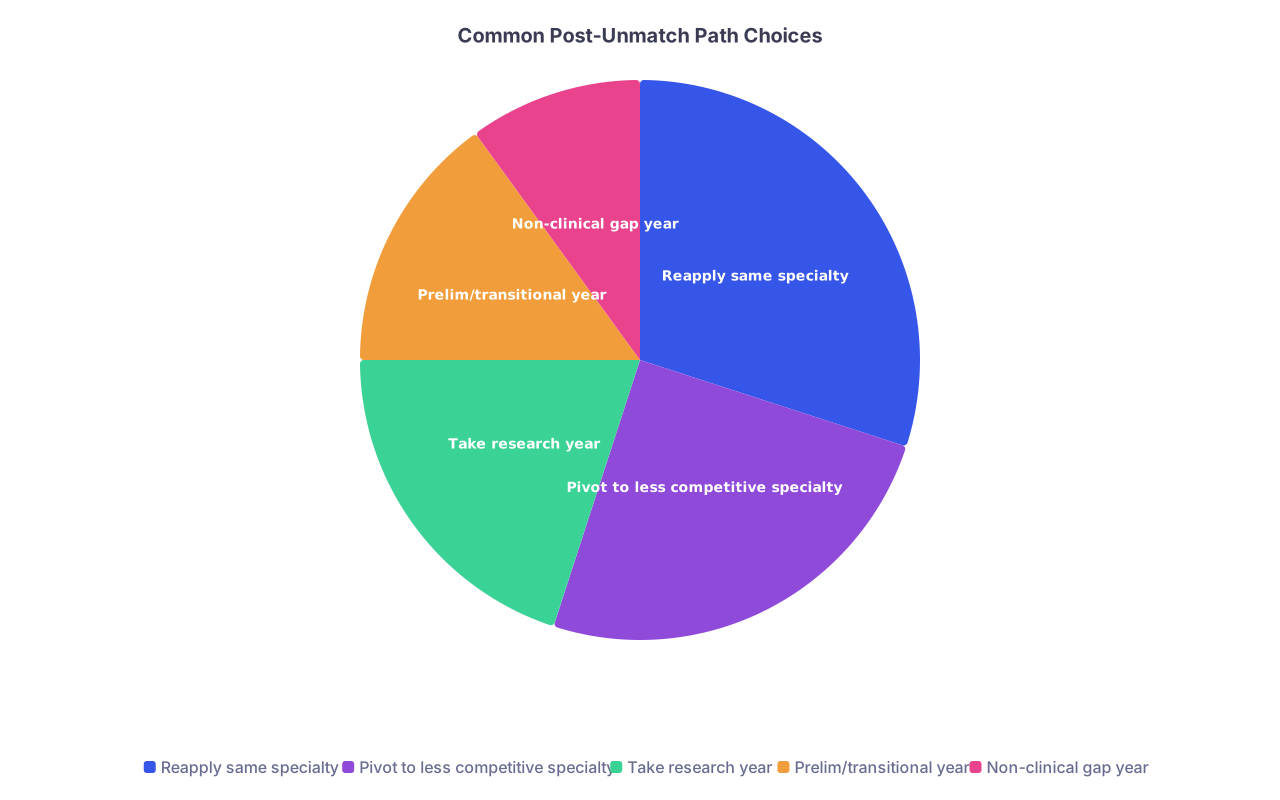
| Category | Value |
|---|---|
| Reapply same specialty | 30 |
| Pivot to less competitive specialty | 25 |
| Take research year | 20 |
| Prelim/transitional year | 15 |
| Non-clinical gap year | 10 |
3.1 Four common frameworks
Use these as decision anchors:
Strong candidate, bad strategy / year
- Decent scores, good letters, 10–12 interviews, no major red flags
- Reasonable choice: Reapply same specialty, fix program list, tighten story, consider small pivot (ex: academic to community focus).
Borderline candidate in hyper‑competitive field
- Limited interviews (0–5), applied mainly to top programs, maybe low Step 1/2
- Reasonable choice: Pivot specialty (e.g., derm → IM, ortho → surgery or prelim), or research year attached to a program.
Major red flag (failures, professionalism, big gap)
- Programs need proof of stability and performance
- Reasonable choice: Prelim year, structured research job with heavy clinical exposure and letters, or an extra degree with clinical integration.
International grad with poor support structure
- Limited US clinical experience, late applications, weak advising
- Reasonable choice: Dedicated USCE year, research, more exams (Step 3), broaden specialty and geography massively.
You will refine this plan as you talk to more people. But start with one working scenario. That is what you present to mentors and PDs.
Step 4: Build a Single, Unified Narrative Everyone Can Use
If every mentor is saying something different about your story, PDs will smell the chaos instantly. You need one core narrative that advisors, letter writers, and advocates repeat with minor variations.
4.1 Draft your “unmatched storyline” in 3–4 sentences
It should answer:
- What happened this cycle without whining or drama.
- What you learned about your application or specialty.
- What you are doing for the next 12 months to become a stronger candidate.
- How the person you are talking to can help.
Example (for an unmatched IM applicant):
I applied internal medicine this year and did not match after receiving 5 interviews. In reviewing my application with my PD, we realized my program list was too top‑heavy and my application did not clearly show my commitment to community‑based IM. I am planning to spend the next year in a clinical research position focused on chronic disease management and aiming to secure stronger letters from community faculty. I would appreciate your guidance on how best to align my experiences with what programs in your setting value most.
Write your version. Bring it to your PSL and AA. Refine until it is sharp and honest.
Step 5: Map Your People: Who Gets Contacted, When, and For What
Now you coordinate. Think of this as a campaign, not random outreach.
5.1 Create a contact map
Use three tiers:
Tier 1 – Core decision influencers
- PSL (home PD or equivalent)
- Specialty advisor
- Key research or clinical mentor who will write strong LoRs
- Dean’s office / student affairs (for institutional advocacy)
Tier 2 – Specialty‑specific mentors and PDs
- PDs at places where:
- You have rotated
- You did research
- Your mentors have strong connections
- Alumni in your target field at target programs
Tier 3 – Support and intel people
- Residents you know
- Faculty who can give honest feedback but will not be writing letters
- Career counseling or wellness
Now the key: you do not let all three tiers freelance. You give them:
- A consistent narrative
- Clear asks
- A shared timeline
Step 6: Control the Message to PDs and Mentors
Here is where people routinely blow it. They email one PD saying, “I am reapplying ortho,” another saying, “Maybe I will switch to FM,” and a third asking about research in radiology. Word travels. You look unfocused and unserious.
6.1 Establish communication rules with your PSL
Have an explicit conversation:
- Which PDs will your PSL contact personally?
- Which PDs or mentors will you contact?
- What template or main points should every outreach cover?
Make a short list of programs/people where:
- Your PSL or dean will call or email directly.
- Your main research mentor will reach out to highlight your work.
- You will email yourself, after they have been warmed up.
6.2 Sample email frameworks
Email to a PD where you rotated (from you):
Subject: Unmatched this cycle – seeking your advice
Dear Dr. [Last Name],
I hope you are well. I rotated with your team in [month, year] on [service], and that experience further confirmed my commitment to [specialty]. I wanted to share that I unfortunately did not match this cycle after receiving [X] interviews.
After reviewing my application with my home program leadership, I am planning to [brief plan: reapply in X, take research/clinical year doing Y]. My goal is to become a stronger candidate for [specialty] through [specific steps].
I would be very grateful for any feedback you might have on my application or what programs like yours look for in reapplicants. If you are open to it, I would appreciate the chance to speak briefly at your convenience.
Thank you for your time and for the teaching you provided during my rotation.
Sincerely,
[Name], [School], [Graduation year]
Email from your PSL to another PD:
Subject: Strong reapplicant for [Specialty] – [Your Name]
Dear Dr. [Last Name],
I am writing about [Your Name], a [year] graduate from [school], who applied to [specialty] this cycle and unfortunately did not match. I know you and I have discussed applicants in the past, and I wanted to highlight [Your Name] as someone I believe will be a strong reapplicant.
[1–2 sentences about your strengths and clinical performance.]
We have discussed a plan for the coming year that includes [research/clinical role, score improvement, additional experiences], with the goal of addressing [main issues] from this cycle. I believe [Your Name] would be a good fit for programs like yours, especially given [specific attribute – work ethic, interest in underserved care, strong team feedback].
If you are open to it, I would appreciate your thoughts on their reapplication strategy or any suggestions for opportunities that might strengthen their candidacy.
Best regards,
[PSL Name, Title, Program]
You see the pattern: consistent story, clear plan, concrete ask.
Step 7: Coordinate Letters of Recommendation Intentionally
Random letters from random faculty are dead weight. You want a coherent set of letters that tell one story, aligned with what your PSL and AA are building.
7.1 Decide your letter strategy early
With your PSL and AA, answer:
- How many letters do you need for the next cycle?
- From which types of people (PDs, chairs, research mentors, clinical attendings)?
- Which old letters are worth reusing, which need updating, and which should be retired?
Then you coordinate:
- Make a prioritized list of 4–6 possible letter writers.
- Assign roles:
- “Clinical performance in specialty” letter
- “Work ethic and character” letter
- “Research and academic potential” letter
Tell each writer explicitly what you hope they can emphasize. They will appreciate the guidance.
7.2 Provide every letter writer with the same packet
To keep your narrative coordinated, give each letter writer:
- Updated CV
- Your 3–4 sentence unmatched storyline
- Your brief 12‑month plan
- Bullet points of experiences with them that they might mention
This is how you avoid the disaster of one letter saying, “She is still deciding between EM and IM,” while your application screams, “I am 100% all‑in on EM.”
Step 8: Keep Everyone Synced With a Simple Tracking System
You are now essentially running a small project. Treat it that way.
Create a simple spreadsheet or document with:
- Columns:
- Name
- Role (PSL, AA, RCM, PD, mentor, resident, admin)
- Relationship (home institution, away rotation, research, etc.)
- Last contact date
- Key points discussed
- Next action / ask
- Who is contacting them (you, PSL, mentor)
Update this weekly. Share only what is appropriate:
- Your PSL: full visibility
- Your AA: application‑related contacts
- Other mentors: only what concerns them
This prevents double‑emails from different people saying different things about you.
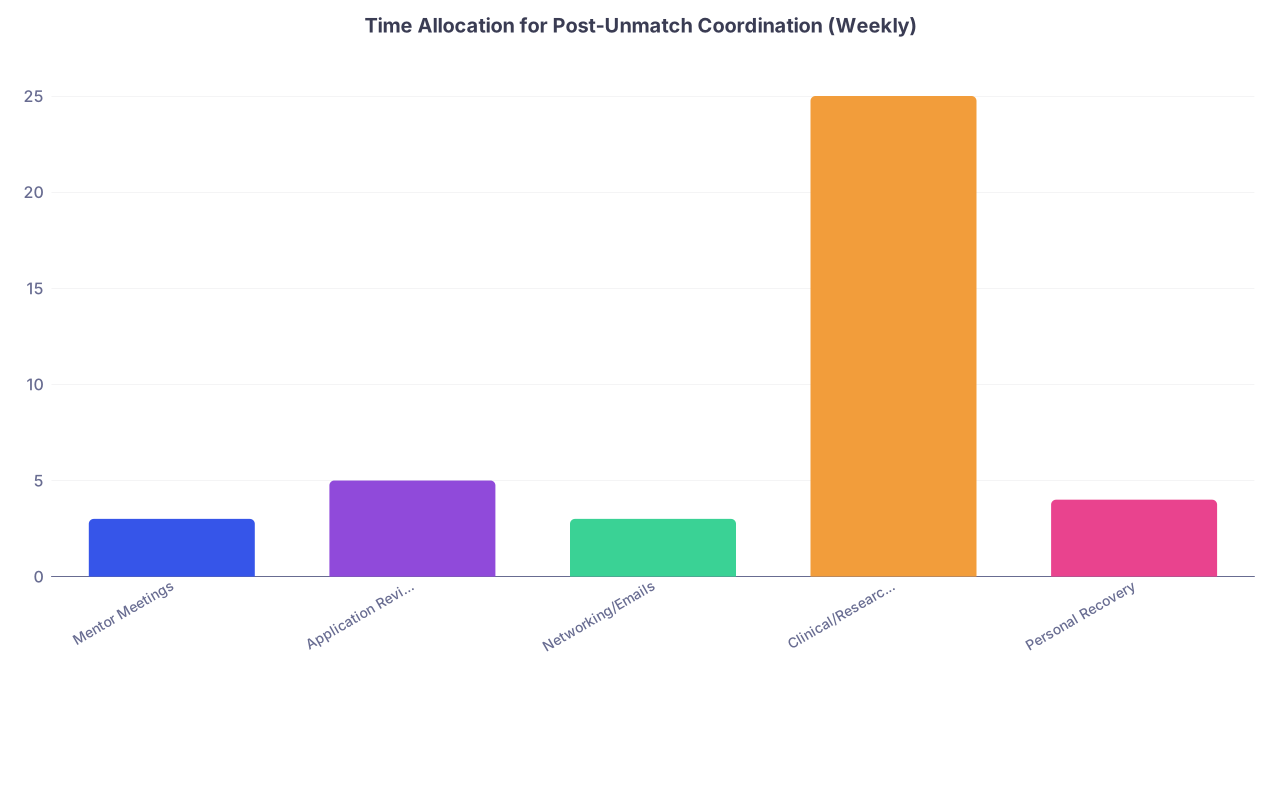
| Category | Value |
|---|---|
| Mentor Meetings | 3 |
| Application Revision | 5 |
| Networking/Emails | 3 |
| Clinical/Research Work | 25 |
| Personal Recovery | 4 |
Step 9: Handling Conflicting Advice Without Losing Control
You will get conflicting advice. Some of it will be flat‑out wrong for you.
Common conflicts:
- Mentor A: “You should definitely reapply derm, you were close.”
- Mentor B: “You need to pivot to IM yesterday.”
- PD C: “You must do a research year.”
- PD D: “Research is useless, get a prelim spot instead.”
Do not treat all advice as equal.
9.1 Use a simple decision hierarchy
When advice conflicts:
Default to your PSL + data (your performance, interview numbers, applicant stats).
Ask: does this advisor really understand:
- My actual application?
- The current competitiveness of this specialty?
- The PD perspective?
Use your RCM (resident/recent grad) to sanity‑check when faculty are out of touch.
9.2 Script for pushing back respectfully
When a mentor gives advice that contradicts your plan, you say:
Thank you, that is really helpful context. I have been working with Dr. [PSL] and Dr. [AA] on a plan that currently involves [brief plan]. Your perspective actually helps me think about [specific part they raised]. I might bring that back to them and see how it could fit into the overall strategy.
You are not obligated to obey every suggestion. Your job is to incorporate the useful pieces without derailing your coherence.
Step 10: Use Time‑Bound Checkpoints So This Does Not Drag On Aimlessly
Unmatched students often drift. Meetings drag on, everyone promises to “circle back,” and suddenly it is August and your new application is half‑baked.
You need fixed checkpoints.
10.1 Core timeline checkpoints
Here is a typical structure for someone reapplying next cycle:
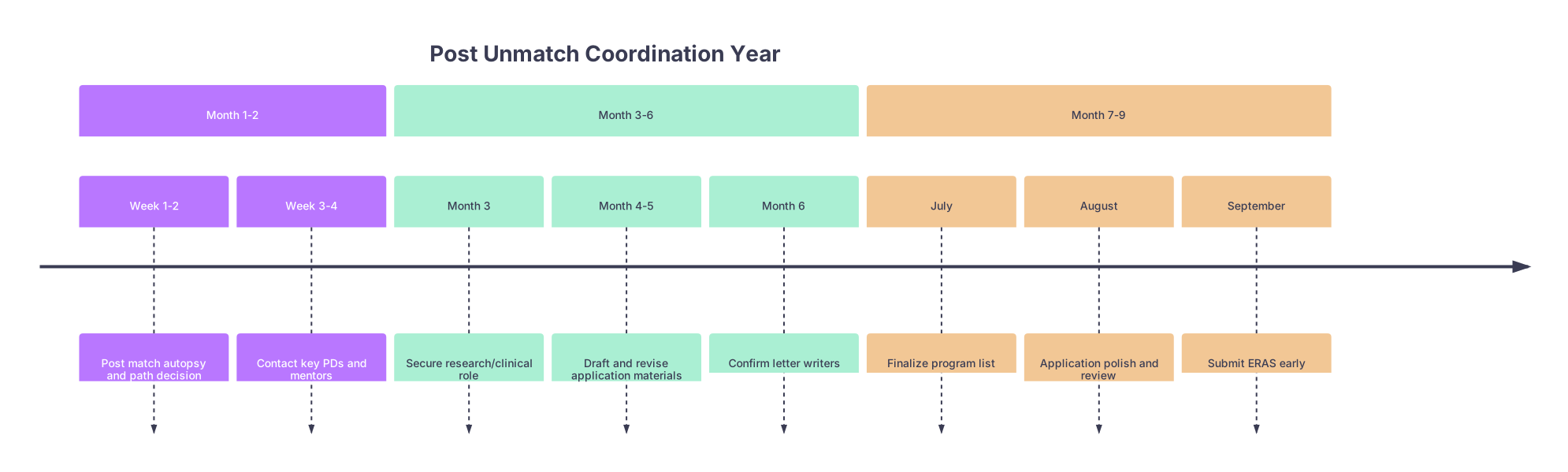
| Period | Event |
|---|---|
| Month 1-2 - Week 1-2 | Post match autopsy and path decision |
| Month 1-2 - Week 3-4 | Contact key PDs and mentors |
| Month 3-6 - Month 3 | Secure research/clinical role |
| Month 3-6 - Month 4-5 | Draft and revise application materials |
| Month 3-6 - Month 6 | Confirm letter writers |
| Month 7-9 - July | Finalize program list |
| Month 7-9 - August | Application polish and review |
| Month 7-9 - September | Submit ERAS early |
At each checkpoint, explicitly:
- Re‑review your plan with PSL and AA.
- Confirm everyone is still on the same narrative.
- Identify which PDs or mentors need updated information.
This way your advice network evolves with your application, rather than diverging.
Step 11: Protect Your Reputation While Being Honest About Unmatching
Last piece that people mishandle: they either hide the unmatch like it is a secret shame, or overshare details that damage them.
11.1 Principles for talking about unmatching
Be factual, not defensive.
“I did not match this year; I had X interviews in Y specialty. After reviewing my application, I am focusing on Z this year.”Do not guess what programs thought.
Avoid: “I think they all rejected me because of my Step 1.”
Stick to: “My Step 1 was below national average, and I am working on demonstrating stronger clinical performance and Step 2.”Own mistakes without self‑destruction.
- Good: “I applied mainly to highly competitive academic programs and did not cast a wide enough net.”
- Bad: “I was stupid and did everything wrong.”
Always include your forward plan.
If you only talk about the failure, people feel awkward and stuck. Give them a constructive direction.
Step 12: A Simple Coordination Playbook You Can Implement This Week
To make this practical, here is a 7‑day coordination play you can execute immediately.

| Step | Description |
|---|---|
| Step 1 | Day 1 - PSL Meeting |
| Step 2 | Day 2 - Draft Narrative |
| Step 3 | Day 3 - Identify Core Team |
| Step 4 | Day 4 - Contact Core Mentors |
| Step 5 | Day 5 - Map PD Outreach |
| Step 6 | Day 6 - Draft Emails and Packets |
| Step 7 | Day 7 - Send First Wave and Set Checkpoints |
Day 1: PSL meeting
- Do your post‑mortem.
- Agree on a provisional 12‑month plan.
- Confirm PSL is willing to be central coordinator.
Day 2: Draft your narrative
- Write your 3–4 sentence unmatched storyline.
- Send to PSL and AA for quick edits.
Day 3: Identify your core team
- Pick AA and RCM.
- Email them your narrative, plan, and ask if they will take on that role.
Day 4: Contact core mentors
- Make a list of 3–5 key mentors who will stay in the loop.
- Send short updates plus your narrative.
- Ask for 15–20 minute calls where needed.
Day 5: Map PD outreach
- With PSL, make a list of PDs to contact in next 2–4 weeks.
- Decide who will contact each (you vs PSL vs other mentor).
Day 6: Prepare materials
- Update CV.
- Draft email templates.
- Create your letter writer packet.
Day 7: Send first wave
- PSL sends 1–3 key emails.
- You send 3–5 mentor emails.
- Schedule your next checkpoint with PSL 2–3 weeks out.
You are now running a controlled process. Not flailing.