
You matched with weak scores. That is not a death sentence. It is a warning label—and you still have time to remove it.
Weak board performance after Match is fixable if you treat it like a clinical problem: define it, risk-stratify it, build a protocol, and execute without excuses. What ruins careers is not a 215 or a borderline shelf. It is denial, vague “I’ll do better next time” promises, and zero structured plan.
Here is the plan. Step-by-step, like an order set.
Step 1: Interpret Your Scores Like a Consultant, Not a Victim
First move: stop catastrophizing and start reading the data. Your score report is a consult note. You are the patient. Do not skim it.
Print everything:
- NBME/COMSAE/COMLEX/USMLE score reports
- Shelf exams
- In‑house exams
- Question bank analytics (UWorld, AMBOSS, Kaplan, etc.)
Then answer four blunt questions.
Is this a global problem or domain-specific?
Look at subscores:- Are you low in everything (systems, disciplines, behaviors)?
- Or is it concentrated (e.g., low in cardiology, high in neuro; low in biostats, solid in path)?
Is this a knowledge deficit or test-taking deficit?
- Low % correct on easy questions → knowledge/retention problem.
- Tons of “changed from right to wrong” answers → confidence and strategy problem.
- Running out of time → pacing problem.
Is your issue acute or chronic?
- Pattern of barely passing everything since MS2 → chronic.
- One bad high-stress exam, others okay → acute.
- Chronic needs system rebuild; acute needs targeted fix.
Are you at risk for real consequences in residency? For example:
- IM resident with a weak Step 3 practice and barely passing medicine shelf → high risk.
- Psych resident with weak Step 1 (now P/F historically) but strong clinical evals and solid Step 2 → moderate.
Write this down, literally:
“My primary issue: [knowledge / test-taking / time / anxiety / combination].
My highest risk domains: [e.g., cardiology, infectious disease, biostats, OMM, etc.].
My next high-stakes exam: [Step 3 / specialty boards / in-training exam] on [date range].”
If you cannot state the problem in two sentences, you are not ready to build a plan.
Step 2: Clarify Your Timeline and Non‑Negotiables
You are about to start—or already in—residency. Your life is not that of a full-time student anymore. You cannot copy your Step 1 study plan. You will fail.
You need the constraint box first:
Map your call and rotation schedule for the next 6–12 months.
- Get the actual call calendar.
- Flag brutal rotations (ICU, nights, trauma surgery).
- Flag lighter rotations (clinic, elective, research).
Mark your real exam deadlines.
- Step 3 window or board exam date.
- In‑training exam month.
- Program’s internal “you must pass by X” policy.
Identify burn‑out risks.
- New resident who just finished a brutal interview season and sub‑Is?
- Family obligations, childcare, chronic health issues?
These are not excuses. They are part of the constraints you must plan around.
Then decide:
- Primary target exam (e.g., “Rescue Step 3” or “Repair weak IM shelf / ITE performance”).
- Realistic weekly study hours, broken down:
- On light rotations: e.g., 8–10 hours/week.
- On medium rotations: 5–6 hours/week.
- On brutal rotations: 2–3 hours/week maintenance only.
Be honest. If you tell yourself you will study 20 hours on an ICU month, you are already lying to yourself. Plan small, consistent, sustainable. That wins.
Step 3: Build a Structured Post‑Match Study Framework
Now you turn this into an actual protocol, not a wish list.
3.1 Choose your primary resources (and ruthlessly cut the rest)
Weak performers often drown in resources. You do not need more. You need fewer and deeper.
Pick:
- 1 primary question bank
- USMLE/COMLEX: UWorld or AMBOSS as primary.
- Specialty boards: specialty-specific Qbank (e.g., MKSAP for IM, PREP for Peds).
- 1 concise reference text or outline
- IM: Step-Up to Medicine, MKSAP text, or similar.
- Surgery: Pestana + SCORE or ABSITE review.
- OB/GYN, Psych, etc.: your board review book + reputable Qbank.
- 1 high-yield review series or lecture set (optional, not mandatory)
- For commuters: audio (e.g., MedStudy audio, OnlineMedEd for general concepts).
Anything else is secondary and only used if you hit a dead zone.
| Scenario | Qbank Primary | Text/Outline | Optional Review |
|---|---|---|---|
| IM intern with weak Step 2 | UWorld Step 3 | MKSAP or Step-Up | OnlineMedEd IM |
| Surgery intern, low ABSITE | SCORE Qbank | ABSITE review book | Selected lectures |
| Peds resident, weak on boards | PREP | Peds board review | MedStudy Peds audio |
| FM resident, Step 3 risk | UWorld Step 3 | Ambulatory text | CCS practice cases |
If you are using more than three core resources, you are spreading yourself too thin.
3.2 Define weekly minimums
You need clear, binary goals. “Study more” is garbage. “Do 80 questions/week and review them fully” is actionable.
Set:
Question volume targets
- Light rotations: 15–20 questions/day on 4–5 days/week.
- Medium rotations: 10–15/day on 4 days/week.
- Brutal rotations: 10–15/day on 2–3 days/week.
Review style
- Time: 2–3 minutes per question you got right, 5–7 minutes for each you got wrong.
- Focus: why the wrong options are wrong, not just why the right answer is right.
- Capture: 2–5 bullet “takeaways” per session in a running document or notebook.
Concept reinforcement
- 20–30 minutes flashcards or spaced repetition (Anki, or your own summary notes) on non-call days.
- 1 longer block (60–90 minutes) per week for deeper content review.
You should be able to write your weekly plan like this:
“On clinic weeks: 15 Qs/day Mon–Thu, review same day; 40 Qs Saturday; 1 × 90‑minute content block Sunday night; 30 minutes Anki on Tues/Thu/Sun.”
That is a study protocol.
Step 4: Prioritize Your Weakest Domains with Surgical Precision
You cannot fix everything at once. You do not need to. You need to fix the things that get tested constantly and that you keep missing.
Lean on your data:
- Score subscores.
- Qbank topic stats.
- Shelf breakdowns.
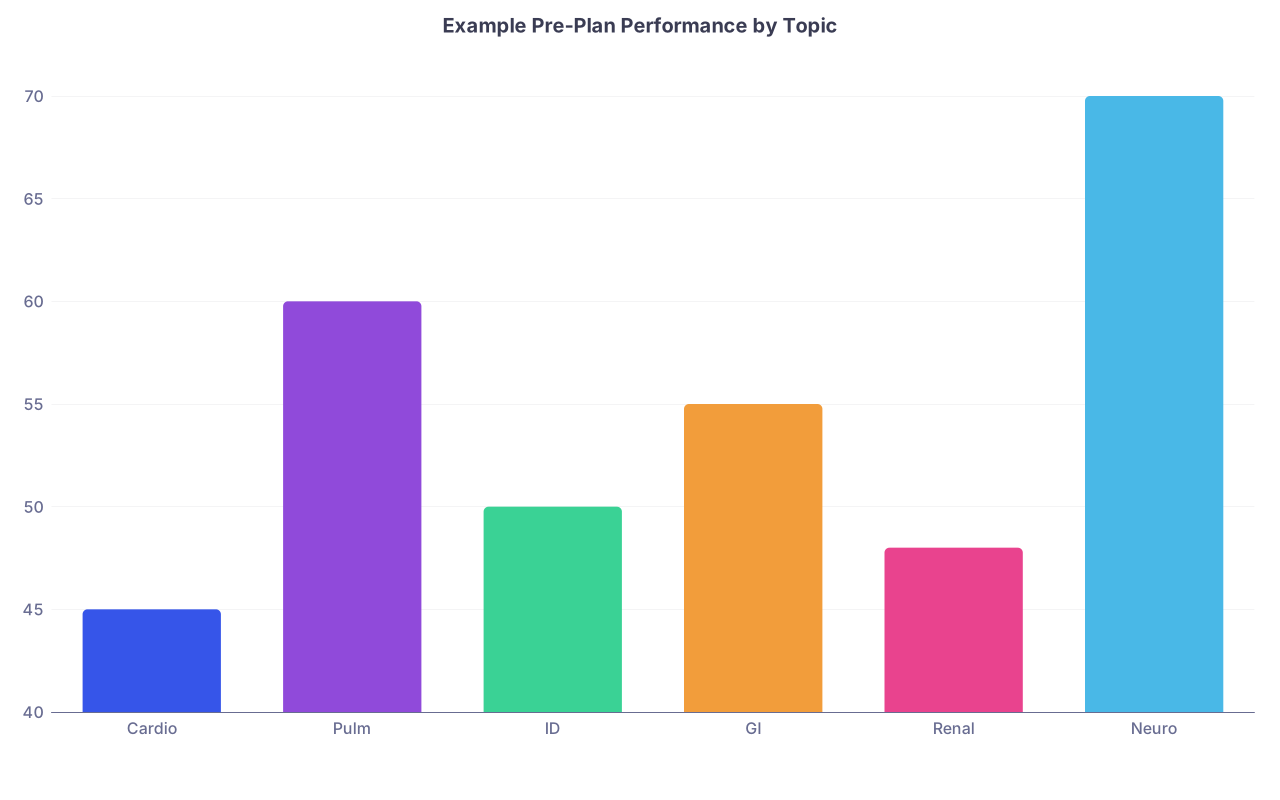
| Category | Value |
|---|---|
| Cardio | 45 |
| Pulm | 60 |
| ID | 50 |
| GI | 55 |
| Renal | 48 |
| Neuro | 70 |
Look at a topic like cardiology at 45%. Bad. That becomes a “priority domain.”
Create a Weekly Priority List:
- Top 2 high-yield, low-score domains (e.g., cardiology, infectious disease).
- 1 moderate domain you want to improve (e.g., renal).
- Everything else just comes up naturally through mixed blocks.
Then implement:
- 50–60% of your questions in random mixed blocks (to prevent gaming the system).
- 40–50% in priority-focused blocks (cardio, ID, etc.), especially on days you have more time.
Always schedule:
- 1 deep dive per week in a priority domain:
- Read 1–2 key chapters / watch 1 short review video.
- Do 10–20 topic-specific questions.
- Make 5–10 specific notes (“post‑MI complications: timelines, management,” not “review MI”).
You are essentially applying targeted therapy instead of broad-spectrum antibiotics.
Step 5: Fix Test-Taking Mechanics, Not Just Knowledge
Many residents with weak scores know more than their performance suggests. Their problem is how they take tests, not just what they know.
Treat test-taking as its own skill set:
5.1 Develop a repeatable question algorithm
You need a fixed sequence for every question:
- Read stem overview quickly (first and last sentence).
- Identify:
- Setting (ED, clinic, ICU).
- Patient demographics (age, sex, pregnant vs not).
- Urgency (acutely ill vs stable).
- Read options once quickly.
- Re-read key lines in the stem with options in mind.
- Force a diagnosis or main decision type:
- Dx? Next step? Most likely complication? Best initial test?
- Eliminate clearly wrong options (2 minimum).
- Choose the best remaining option, not the perfect one that does not exist.
Practice this deliberately:
- During Qbank sessions, say the steps in your head for the first 20–30 questions until it is automatic.
5.2 Pacing strategy
If you ran out of time previously, assign yourself:
- Maximum 75 seconds/question in practice blocks.
- Mark and move on if you are stuck at 60–70 seconds with no progress.
During review, ask:
- Were you slow because of reading inefficiency?
- Or because you did not know the content and kept rereading?
Fix the root cause accordingly.
5.3 Build a “mistake log”
You are not too busy for this. You are too undisciplined if you skip it. Fix that.
Create a simple document with these columns:
- Date
- Question # / Source
- Topic
- Type of error (knowledge / misread / overthinking / time / changed right to wrong)
- Correct takeaway (1–3 lines)
Every 1–2 weeks, review this log for patterns:
- You always misread “best next diagnostic step” vs “best next treatment step.”
- You ignore age or pregnancy status.
- You miss “most appropriate next step” vs “most definitive test.”
Then turn common errors into rules:
- “If patient is unstable, never pick imaging before stabilization.”
- “Always recheck the question wording (diagnostic vs treatment) before choosing.”
These “rules” raise scores faster than reading another textbook chapter.
Step 6: Integrate Studying into Resident Life Without Burning Out
Post‑match, your real enemy is not lack of motivation. It is fatigue and chaos. You will not get long, quiet six-hour blocks. You get fragments.
So you build a micro‑study system:
6.1 Use time fragments aggressively
- 10–15 minutes between patients → 2–3 questions (timed, single‑mode).
- Post‑sign‑out but pre‑collapse → flashcards for 10 minutes.
- Commute (not driving) → audio review.
Do not wait for “when I have a free half-day.” You will not.
6.2 Protect 2–3 “anchor blocks” per week
Even in brutal rotations, you need:
- 2–3 blocks of 45–90 minutes/week that are sacred.
- Early morning before ward chaos.
- Late evening on non‑call nights.
- Weekend one longer block.
These are scheduled like consults:
- In your calendar.
- With a clear task attached: “Saturday 9–10:30: 40 random questions + full review.”
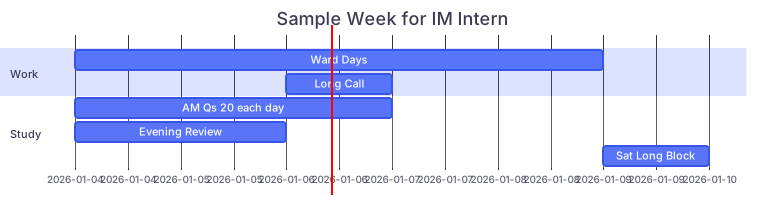
| Task | Details |
|---|---|
| Work: Ward Days | a1, 2026-01-04, 5d |
| Work: Long Call | a2, 2026-01-06, 1d |
| Study: AM Qs 20 each day | s1, 2026-01-04, 3d |
| Study: Evening Review | s2, 2026-01-04, 2d |
| Study: Sat Long Block | s3, 2026-01-09, 1d |
The structure matters more than the total hours.
6.3 Plan explicitly for bad weeks
You will have:
- Night float.
- 28‑hour calls.
- Family emergencies.
So write a minimum baseline plan:
- On disaster weeks: “5 questions/day × 4 days, no long blocks, 15 minutes Anki twice.”
This prevents the on/off cycle that kills consistency.
Step 7: Track Progress and Adjust Every 4–6 Weeks
Studying without follow‑up data is like treating sepsis without rechecking lactate.
You need:
- Baseline assessment
- 1 NBME/COMSAE, CCS cases, ITE, or serious block of 80 random timed questions.
- Mid‑course checks every 4–6 weeks
- Smaller self‑assessment or timed blocks.
- Trend tracking, not obsession over every fluctuation.
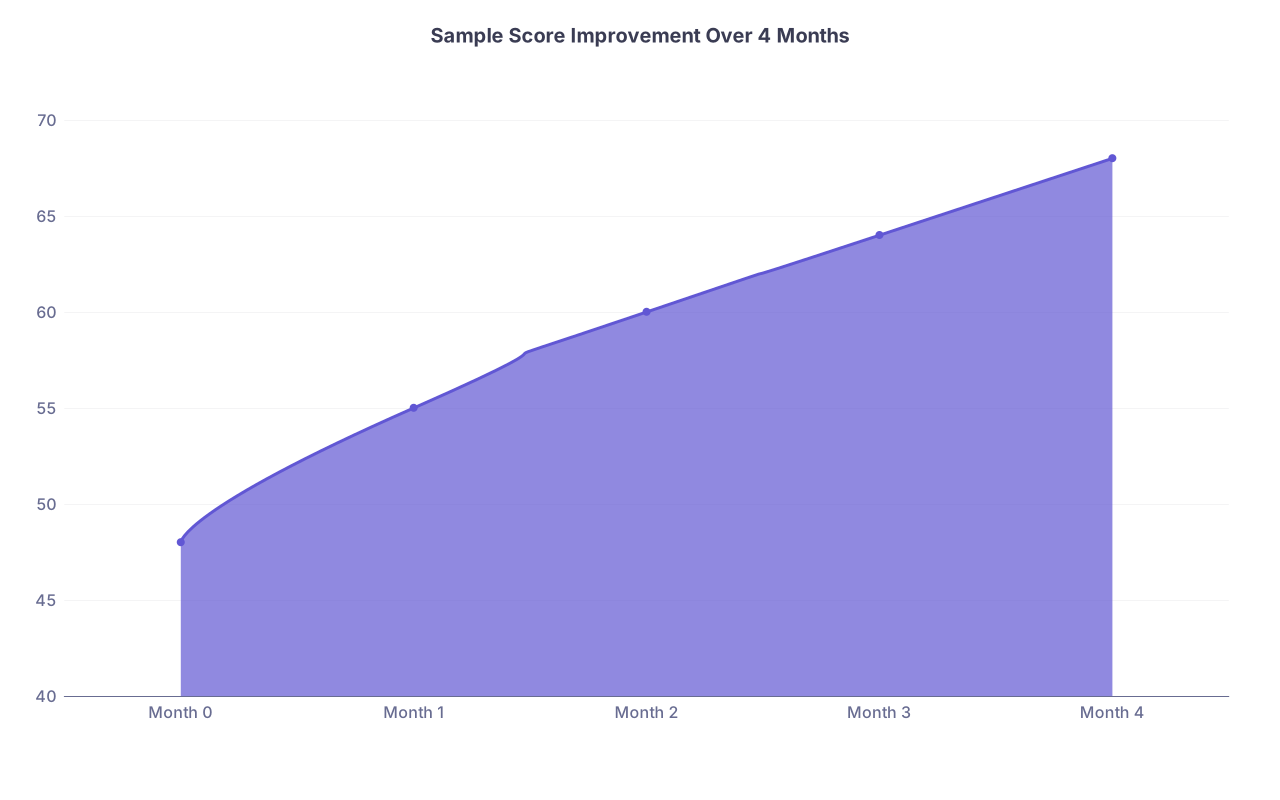
| Category | Value |
|---|---|
| Month 0 | 48 |
| Month 1 | 55 |
| Month 2 | 60 |
| Month 3 | 64 |
| Month 4 | 68 |
Ask yourself at each checkpoint:
- Are priority domains improving? (E.g., cardio from 45% to 60%.)
- Are test-taking errors decreasing? (Fewer misreads, fewer rushed questions.)
- Is the plan realistic with your schedule?
Then modify one variable at a time:
- If progress is slow because review is superficial → spend more time dissecting wrongs.
- If you are missing too many questions due to pure ignorance in one system → add 1–2 focused reading sessions/week just for that system.
- If fatigue is killing adherence → slightly lower question volume but insist on quality.
Do not blow up the whole plan after one bad practice test. Look at the trend.
Step 8: Use Your Program as a Resource, Not a Judge
Residents hide weak scores out of shame. That is how they end up on probation later.
Handled correctly, your program can become an ally.
8.1 Have a targeted, mature conversation with your PD or APD
Do not walk in saying “I suck at tests.” Walk in with a short briefing:
- “My Step 2 score was X, and my subscores show particular weakness in cardiology and ID.”
- “I have structured a plan: 80–100 Qs/week, focused on these domains, with a 4–6 month timeline before Step 3.”
- “I am asking if the program offers any support: question bank discounts, faculty tutoring, conference time for board prep on lighter rotations.”
You will sound like a responsible adult instead of a problem.
8.2 Use faculty strategically
Find:
- A senior resident who had to rescue scores and succeeded.
- A faculty member who runs board review or has rep for good teaching.
- “Can we review 10–15 of my missed questions together sometime? I want to see how you think through these.”
- “Do you have a list of ‘must master’ topics for our boards?”
You do not need weekly tutoring. You need 2–3 high-yield sessions and some direction.
Step 9: Address the Psychological Side Before It Sabotages You
Weak exam performance often creates a self-fulfilling narrative:
“I am a bad test-taker.”
“I am just not smart enough.”
“I always choke.”
This is nonsense, but it is powerful nonsense.
You do not need therapy speeches from me. You do need a few hard rules.
No identity labels.
- Not “I am bad at tests.”
- Replace with: “Historically I have underperformed on standardized exams, and I am building systems to fix that.” Long, clunky, but accurate.
Detach ego from single practice scores.
- Your worth ≠ your UWorld % yesterday.
- Your job is not to “be smart.” Your job is to execute your plan.
Manage pre‑exam physiology.
- Sleep: protected 2–3 nights pre‑exam.
- Stimulant use: consistent; do not double your caffeine the day of.
- Simple morning routine for exam day:
- Wake 3 hours before the test.
- Eat something you have tolerated on call days.
- 5–10 warmup questions, not full blocks.
If panic or ADHD is clearly a problem, stop DIY diagnosing.
- Talk to a real physician or mental health professional.
- Many residents stabilize scores dramatically once they treat untreated anxiety, depression, or ADHD properly.
This is not weakness. It is risk management.
Step 10: Build a 3–6 Month Sample Rescue Plan
Let me give you a concrete model. You will adapt it, but do not reinvent across-the-board.
Scenario:
- Internal medicine intern.
- Step 2 CK: 218.
- Matched at a solid community IM program.
- Step 3 needed by end of PGY1.
- Weakness: cardio, ID, biostats; slow on long question stems.
Goals (6 months):
- Raise practice performance from ~50% to 65–70% on mixed Step 3-style blocks.
- Pass Step 3 comfortably on first attempt.
- Show improving ITE performance to reassure program.
Resources:
- UWorld Step 3 Qbank (main).
- MKSAP or equivalent for IM content gaps.
- Short biostats review PDF or videos.
- 1 notebook or digital note document for mistake log + key concepts.
Plan Outline:
Months 1–2 (Foundation and habits)
- Rotations: wards + nights mixed.
- Weekly:
- 80 Qs/week (mainly random, some cardio/ID focused).
- 1 × 60–90 minute weekly block for deep dive (alternating cardio, ID, biostats).
- Mistake log maintained daily.
- Focus:
- Get consistent with the question algorithm.
- Identify top 5 recurring mistake types.
Months 3–4 (Targeted improvement)
- Rotations: wards, clinic, 1 elective.
- Weekly:
- 100–120 Qs/week.
- 2 × 60–90 minute deep-dive blocks focusing on worst systems.
- Start CCS practice if Step 3 (as applicable).
- Every 4 weeks:
- 80-question timed block as a mini-assessment.
- Focus:
- Aggressive correction of repeated errors.
- Tight pacing and endurance.
Months 5–6 (Exam‑focused polishing)
- Step 3 scheduled near end of month 6.
- Weekly:
- 120–160 Qs/week, mostly random.
- Full-length practice (or two half days) 4–5 weeks before exam.
- Taper to lighter review in final 3–4 days pre-exam.
- Focus:
- Exam conditions simulation.
- Sleep, routine, and anxiety control.
This is realistic. Not glamorous. It works if you stick to it.

Common Traps That Will Derail Your Rescue Plan
You want to avoid the dumb mistakes I have watched smart people repeat year after year.
“I will just read more first, then start questions.”
Wrong order. You do questions now. Reading fills gaps revealed by questions.Constantly switching resources.
A month with UWorld, then jump to AMBOSS, then a new board review book…
You never get deep. You just get tired.Studying only on off-days.
Massive 6‑hour cram sessions once every 2 weeks are inferior to 30–60 minutes 4–5 days/week.Refusing to look at wrong questions because they hurt.
Your wrongs are where the points live. Avoiding them is emotional self‑protection disguised as “efficiency.”Keeping your struggles secret.
By the time your PD finds out, it might be after you fail Step 3 or your boards. Tell them early, with a plan in hand.

Converting Weak Scores into a Professional Asset
Here is the part no one tells you: if you handle this correctly, your prior weak performance can eventually become a strength in your narrative.
Years later, as an attending or senior fellow, you can honestly say:
- “I struggled with standardized exams in training. I built a structured system to overcome it. I now help my residents do the same.”
But that only works if you actually build that system now.
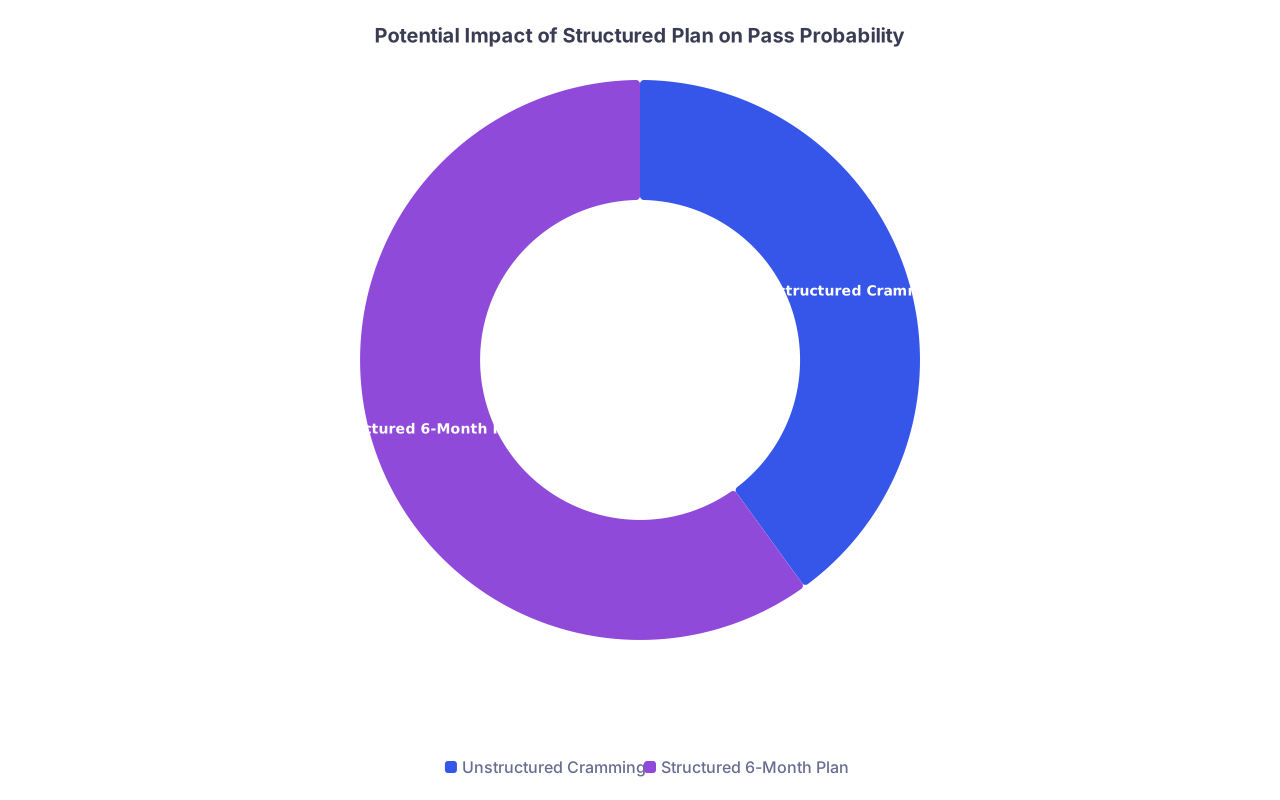
| Category | Value |
|---|---|
| Unstructured Cramming | 60 |
| Structured 6-Month Plan | 90 |
You are not trying to become a test-taking god. You are trying to:
- Clear the minimum thresholds safely.
- Build habits that protect you through boards and beyond.
- Prove to yourself that you can respond to a real threat like a professional.
Do that, and the weak scores become a solved problem, not a permanent label.
Key points to leave with:
- Treat weak exam performance like a clinical problem: define it precisely, set a timeline, and apply a structured intervention (questions first, targeted content second, constant review of mistakes).
- Build a realistic, rotation‑aware study protocol anchored in consistent weekly minimums rather than fantasy marathon sessions.
- Use data and support: track progress every 4–6 weeks, adjust the plan instead of panicking, and involve your program early with a concrete strategy rather than waiting for failure to force the conversation.