
Waiting a full year to decide on a specialty change after going unmatched is a mistake. You need a clear, time-bound decision process, not twelve months of vague “keeping options open.”
Here’s how to structure that decision, step by step, from Match Week through the end of the cycle, so you actually move forward instead of drifting.
Week 0–1: Match Week – Do Not Decide Your Future Specialty Yet
At this point you should not be committing to a specialty switch. Your brain is in triage mode, not strategy mode.
Day 0–3: Shock, scramble, SOAP
Your only job for these first few days:
- Survive the shock
- Maximize immediate options
- Gather raw information, not make big decisions
Concrete actions:
Fully commit to SOAP (if applicable)
- Apply widely to:
- Preliminary medicine/surgery
- Transitional year
- Less competitive categorical spots if available
- This is not “choosing” internal medicine or surgery for life. This is choosing not to sit on your hands for a year.
- Apply widely to:
Notify key faculty
- Email:
- Your dean’s office / student affairs
- Your specialty advisor (even if you’re thinking of leaving that field)
- At least one trusted attending who knows you well
- Script:
“I did not match into [specialty]. I’m participating in SOAP and also want to start planning for next steps, including the possibility of reapplying or switching specialties. I’d appreciate a brief meeting next week.”
- Email:
Start a simple reality log
- One page, three sections:
- What went wrong (scores, red flags, late applications, limited programs)
- What went right (interviews, strong letters)
- Questions I need answered (about reapplying vs. switching)
- One page, three sections:
No decisions yet. Just facts.
Week 2–4: Post-Match Month 1 – Initial “Stay or Switch” Assessment
At this point you should force yourself to do a brutally honest diagnostic of your last application cycle. The goal here is not to switch yet; it’s to figure out whether a re-application in the same specialty is realistically salvageable.
Week 2: Debrief with people who actually see your file
Schedule and complete:
Dean / student affairs meeting
- Ask:
- “If you saw my ERAS today with no changes, how would you rate my match chances next cycle in [specialty]?”
- “What 2–3 things would have to change to make me a solid applicant?”
- Push for numbers.
- “Are we talking 10–20% chance? 50–60%?”
- Ask:
Specialty advisor meeting
- Bring:
- Your application data:
- USMLE/COMLEX scores
- Clerkship grades
- Honors/AOA/Gold Humanism status
- Research, leadership, volunteer activities
- Interview count
- Your application data:
- Ask them to compare you honestly to matched applicants they’ve seen this year.
- Bring:
One trusted attending in that field
- Show them your ERAS (or at least your CV and personal statement).
- Ask:
- “If I do everything right this year (research, gap year work, new letters), do you believe I can match in [specialty] next cycle?”
You’re looking for consistent messages. If three people in that specialty all hesitate, that’s a data point.
Month 2–3 (April–May): Decision Window #1 – Conditional Commitment to Stay
By the end of Month 3 after the Match, you should make your first real fork-in-the-road decision:
“I will re-apply to the same specialty if I can meet these specific conditions by September,”
or
“I’m opening a serious, structured exploration of switching specialties.”
This is where people screw up. They vaguely “keep options open” and wind up doing neither track well.
Step 1: Build a concrete “same-specialty rescue plan”
If you’re considering reapplying, you need hard requirements, not wishes.
Examples (modify to your reality):
Scores / exams
- Step 2 CK ≥ 240 (for competitive fields) or ≥ 220–230 (for less competitive), if not already taken.
- Remediation of any failed Step/COMLEX attempt with clear explanation and strong subsequent scores.
Year-out activity
- Full-time research position in that specialty at an academic center
- Or a year-long clinical job with direct exposure (prelim year, transitional year, or funded fellowship-like role for FM/IM)
-
- At least 2 new letters from well-known faculty in that specialty.
- A meaningful research product in progress (submitted paper, abstract, or poster – it does not need to be published yet, but it must be real).
Write these as checklist items with deadlines. If you cannot plausibly hit those marks, that’s your early signal that a switch might be smarter.
Step 2: In parallel, start targeted exploration of 1–2 alternative specialties
By end of Month 3, you should not be “considering everything.” That’s chaos. You should be exploring 1–2 specific alternatives where your profile makes sense.
Typical pivot options:
| Original Specialty | Common Switch Targets | Primary Reasons |
|---|---|---|
| Ortho / Neurosurg | IM, FM, Anesthesia | Competitiveness, Step cutoffs |
| Derm / Plastics | IM, Path, Psych | Research-heavy, score barriers |
| EM | IM, FM, Anesthesia | Market saturation, interview scarcity |
| OB/GYN | IM, FM, Psych | US clinical need, broader programs |
| Surg prelim | Categorical Surg, IM | Need categorical spot, broader pool |
Actions during Month 2–3:
- Shadow at least one day in each possible pivot specialty.
- Have a proper conversation with:
- The program director (PD) for that specialty at your home institution, or
- At least one core faculty member heavily involved in residency selection.
Ask them directly:
“If you saw my file tailored to [new specialty], do I look competitive here in the next cycle? What would you need to see changed or added in 6–9 months?”
Month 4–5 (June–July): Decision Window #2 – Commit to a Primary Track
By the start of ERAS season for the next year, you should have chosen:
- Track A: All-in re-apply to the same specialty, with or without a parallel backup
- Track B: Primary switch to a new specialty, possibly with a small number of “hail Mary” applications to the original one
Dragging the decision later than this usually leads to a scattered, weak application in both directions.
How to decide at this point
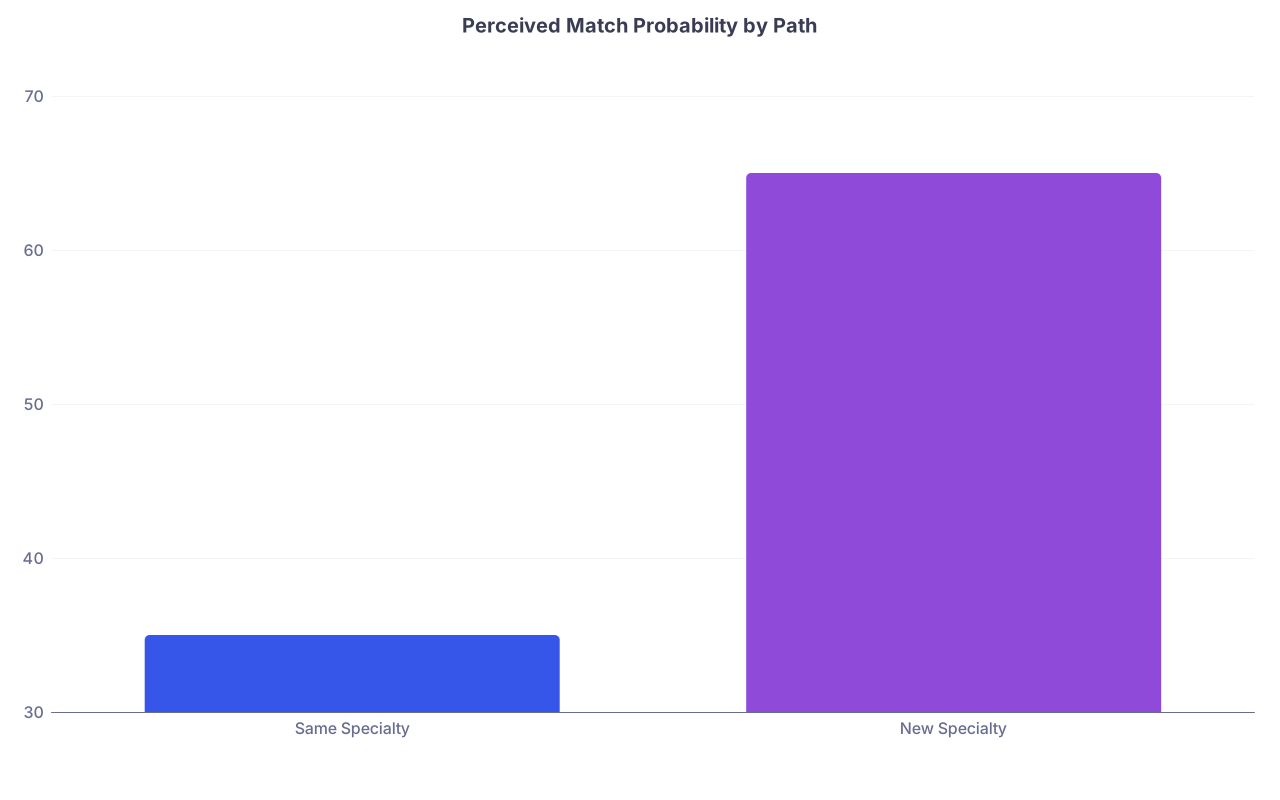
Use a simple 2x2 reality grid. Very rough but honest.
| Category | Value |
|---|---|
| Same Specialty | 35 |
| New Specialty | 65 |
If, based on advisor input and your own upgrades, your chances look like this:
- Same specialty: 10–30%
- New specialty: 50–70%
Then staying in the same field “because you’ve always wanted it” becomes a bad strategic choice unless you’re willing to risk multiple unmatched cycles.
Track A: You stay in the same specialty
At this point you should:
- Lock in your year-out position (research, prelim year, or structured clinical job).
- Set an ERAS completion timeline:
- Personal statement draft: by mid-July
- Letters requested: by early July
- Application data (experiences, publications) updated: by August 1
- Decide on a backup strategy:
- Will you also apply to prelim IM or TY?
- Are you open to applying to a smaller number of programs in a second specialty?
You want this decided by early July, not in a panic in September.
Track B: You commit to switching specialties
At this point you should:
Declare your intent to key people
- Email your old specialty advisor:
“After careful consideration and multiple conversations, I’m planning to apply primarily to [new specialty] this coming cycle.” - Meet with new specialty leadership and say it out loud:
“I’m switching to [new specialty] and want to be a strong applicant for the upcoming Match.”
- Email your old specialty advisor:
Map your rebranding tasks (Month 5–8):
- New letters of recommendation from the new specialty (ideally 2–3).
- At least one focused elective or shadowing block in the new field if possible.
- Revised CV and personal statement that clearly explain:
- Why you’re switching
- What you bring from your prior interest/experience
- Why you’re not just fleeing failure
Decide on whether to keep a foot in the original field:
- Some people still apply to 5–10 programs in the old specialty as a long shot.
- Many PDs prefer clarity. A strong, focused application in the new specialty often beats a scattered dual-identity application.
Month 6–8 (August–October): ERAS Season – Your Decision Must Be Solid
By ERAS submission time, the specialty decision should be done. No more wavering. No more “maybe I’ll add 30 more of X specialty in a week.”
At this point you should be executing, not deciding.
If you stayed in the same specialty
Your focus:
Fix prior weaknesses:
- If poor Step 2: show improved clinical performance, strong letters attesting to growth.
- If limited geographic reach: apply more broadly.
- If weak letters: highlight new, stronger advocates.
Avoid repeating core mistakes:
- DO NOT:
- Apply to the same small list of hyper-competitive programs.
- Use the same personal statement.
- Assume “I was close last year so I’ll naturally match this year.”
- DO NOT:
Prepare your narrative:
- You will be asked: “Why do you think you didn’t match last cycle?”
- Your answer needs to be:
- Specific
- Non-defensive
- Paired with concrete changes you’ve made
If you’ve switched specialties
Your focus:
Lean into your pivot narrative
- Frame it as:
- “Here’s what I learned from not matching.”
- “Here’s why [new specialty] actually fits me better.”
- “Here’s what I’ve already done in the last 6–9 months that proves this isn’t impulsive.”
- Frame it as:
Avoid the “rebound” vibe
- PDs hate the sense you’re just逃ing a competitive field.
- Make sure your:
- Personal statement
- Letters
- Interview stories
…show authentic interest and specific experiences in the new field.
Coordinate your letter writers
- They should:
- Explicitly mention your prior path only briefly.
- Focus heavily on your current performance and fit for the new specialty.
- They should:
Month 9–12 (Interview Season): Handle Specialty Questions Cleanly
By the time interviews hit, the decision to switch or stay should be a settled issue emotionally, not an open wound you’re processing in real time with PDs.
At this point you should have:
A short, clean answer about the unmatched cycle:
- “I applied to [specialty] last year and did not match. My application had [specific weaknesses]. Since then, I’ve [specific improvements]. I’m genuinely excited to be applying in [current specialty] now because [clear reasons].”
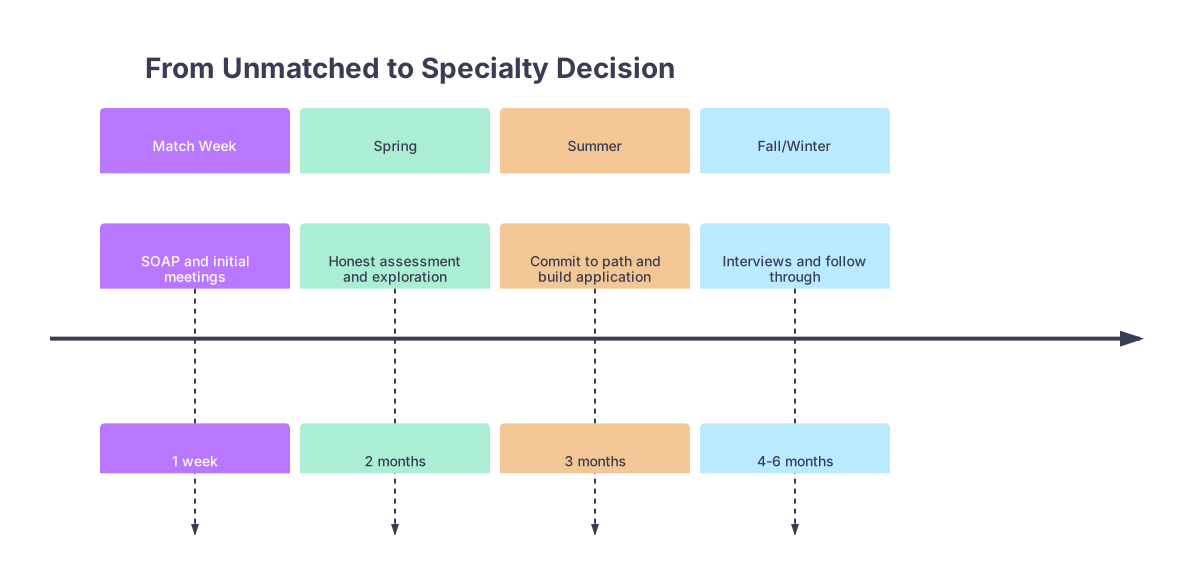
A timeline story that sounds intentional, not chaotic:
| Period | Event |
|---|---|
| Match Week - SOAP and initial meetings | 1 week |
| Spring - Honest assessment and exploration | 2 months |
| Summer - Commit to path and build application | 3 months |
| Fall/Winter - Interviews and follow through | 4-6 months |
Avoid:
- Over-explaining your pain.
- Bad-mouthing your prior specialty, mentors, or programs.
- Acting like the new specialty is “easier to get into” (yes, people actually say this).
Year 2+: When to Consider a Second Switch (Rare, but it happens)
Sometimes you:
- Go unmatched in your original specialty
- Switch to another
- Then realize you’re actually miserable there too
At this point you should stop and look for a pattern, not immediately reach for another specialty.
- If you’ve already:
- Gone unmatched once
- Switched once
Then a second specialty switch should be exceptional and data-driven (new insights about yourself, not just “this is harder than I thought”).
Strong rule of thumb:
If you’re thinking about a second switch, you should involve:
- Your PD
- Your dean’s office (if still affiliated)
- A neutral mentor outside both specialties
Because by this stage, the risk of becoming permanently unemployable as a trainee is real.
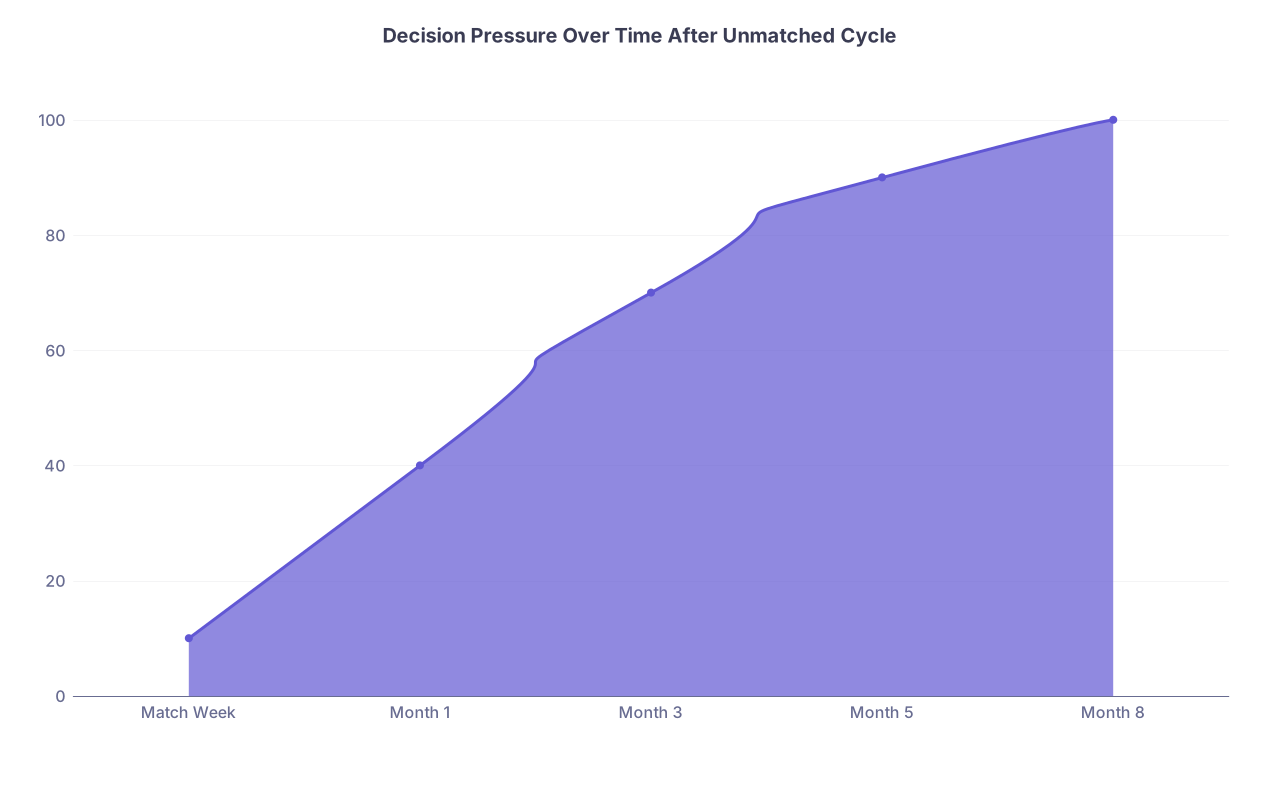
Visual Summary: When to Decide on a Specialty Switch
| Category | Value |
|---|---|
| Match Week | 10 |
| Month 1 | 40 |
| Month 3 | 70 |
| Month 5 | 90 |
| Month 8 | 100 |
Pressure to finalize your specialty direction ramps sharply by Month 3–5. If you’re still undecided after that, you’re pushing your luck.
Quick Chronological Checklist
Match Week (Week 0–1)
- Participate fully in SOAP
- Notify dean, advisors, key attendings
- Start a one-page “what went wrong / what went right” log
Month 1 (Weeks 2–4)
- Debrief with:
- Dean
- Original specialty advisor
- Trusted attending
- Get honest estimated match probabilities if you reapply as-is vs. with improvements
Month 2–3
- Define a same-specialty rescue plan with specific targets
- Explore 1–2 credible alternative specialties with:
- Shadowing
- Meetings with PDs/faculty
By End of Month 3
- Decide:
- “I’ll stay in original specialty if I can achieve X by fall”
- Or “I’m seriously opening a switch to [new specialty].”
Month 4–5
- Commit to:
- Track A: Primarily reapply to same specialty
- Track B: Primarily switch specialties
- Lock in year-out job or research
- Start rebranding your application accordingly
Month 6–8
- ERAS: finalize one clear identity
- Submit a coherent application in your chosen specialty
- Ensure letters, PS, and experiences all support that choice
Month 9–12
- Interviews: use a clean, honest, short story about:
- Why you didn’t match
- Why this specialty now
- What’s different this time


, Geographic restriction, Interview performance, Other](https://cdn.residencyadvisor.com/images/articles_svg/chart-common-reasons-for-unmatched-outcome-3522.svg "Common Reasons for Unmatched Outcome")
| Category | Value |
|---|---|
| USMLE/COMLEX scores | 30 |
| Late application/limited programs | 20 |
| [Weak letters](https://residencyadvisor.com/resources/post-match-options/letters-of-recommendation-mistakes-reapplicants-keep-repeating) | 15 |
| Geographic restriction | 15 |
| Interview performance | 10 |
| Other | 10 |

| Step | Description |
|---|---|
| Step 1 | Unmatched |
| Step 2 | SOAP |
| Step 3 | Month 1 Assessment |
| Step 4 | Track A - Reapply same specialty |
| Step 5 | Explore new specialties |
| Step 6 | Track B - Switch specialty |
| Step 7 | Focused ERAS same field |
| Step 8 | Focused ERAS new field |
| Step 9 | Same specialty viable |
FAQ (Exactly 2 Questions)
1. How many cycles should I give my original specialty before I switch?
If you were reasonably competitive and came close (multiple interviews, a few waitlist conversations), one well-planned reapplication can be justified. If your first cycle was weak and your realistic match probability after major improvements is still low (say under 30–40% by advisor estimate), switching after one unmatched cycle is often smarter. Two unmatched cycles in the same highly competitive field, without any clear upward trajectory, is usually a signal to move on.
2. Will switching specialties after going unmatched permanently hurt my career?
Not if it’s done early, deliberately, and coherently. PDs see this every year. A candidate who went unmatched once, then made a thoughtful switch and built a strong, focused application usually does fine. The red flag is not the switch itself; it’s the pattern of indecision, repeated unmatched cycles, or an application that looks like you’re just running away from difficulty. Your job is to make your timeline look intentional: one setback, clear reflection, decisive pivot, steady follow-through.
Key points:
- You should not decide your specialty in Match Week; your first real decision window is Month 2–3, and you should commit to a main track by Month 4–5.
- A switch makes sense when honest advisors agree your same-specialty reapplication odds are low even with upgrades; don’t cling to a dream field for three cycles.
- Whatever you choose, by ERAS submission you must present one clear specialty identity, not a confused backup-driven mess.