The days after an unsuccessful Match or SOAP are the most dangerous days of your early career—not because you failed, but because drifting for 3–6 months will quietly wreck your next application cycle.
You cannot “figure it out later.” From the week after SOAP until June, every few weeks there is a specific move you should be making if you want a meaningful gap year job or research position, not just random locums scribe work you found in July.
Here is the timeline. Week by week, then month by month. Follow it and you will have options on the table by early summer.
Match Week + 1: Stabilize, Debrief, and Set Direction (Mid–Late March)
At this point, you have one job: move from emotional chaos to a concrete plan.
Days 1–3 after SOAP
You should:
- Stop doom-scrolling Reddit and WhatsApp groups.
- Tell your core people what happened (family, partner, maybe 1–2 close classmates).
- Protect your schedule from well-meaning but useless conversations.
Then, quickly:
Book three conversations within 5–7 days:
- Your Dean of Students or Director of Student Affairs
- A specialty mentor (IM, FM, surgery, whatever you applied into)
- A different specialty mentor you respect (for brutally honest perspective)
Gather your data:
- ERAS application PDF
- Score report(s) (USMLE/COMLEX)
- Programs applied to and interviews received
- Any feedback you received during interviews
Decide on a default path (you can still adjust later, but pick a working plan):
- Reapply to the same specialty next cycle
- Pivot to a less competitive or different specialty
- Consider a 2-year plan (significant research or an additional degree)
Do not spend a week “processing.” I have watched people lose April that way.
Late March (Match Week + 2–3): Build Your “Pitch” and Target List
By the end of March, you should be able to explain your situation in 2–3 sentences that do not sound like an apology.
At this point, you should…develop your narrative and your hit list.
Step 1: Define your reapplication strategy
Write out, in plain language:
- What went wrong (examples):
- “Applied only community IM, but only 30 programs, scores borderline, 2 low Step attempts.”
- “Late Step 2 score, applied to EM in a hyper-competitive year, weak SLOEs.”
- What you are going to fix over the next 12–15 months:
- More targeted letter writers
- U.S. clinical experience if IMG/DO
- Gap year research in the field
- Stronger Step 2 CK or Step 3 if appropriate
This matters because every potential gap-year supervisor will ask some version of: “So what is your plan?” You need a clear answer.
Step 2: Rough target list for gap-year work
You are not looking for “any job in medicine.” You are looking for roles that:
- Keep you clinically adjacent or academically visible
- Generate letters of recommendation
- Give you specific bullets for next year’s personal statement
Start with a 3-column spreadsheet:
| Category | Examples | Primary Benefit |
|---|---|---|
| Clinical-adjacent | Research fellow, prelim spot, scribe | LORs, clinical storylines |
| Academic research | Lab RA, outcomes research, QI | Pubs, posters, networking |
| Teaching/service | Preclinical tutor, pipeline teacher | Leadership, mentorship |
By March 31, you should have:
- 15–20 research groups or divisions (e.g., IM, cards, heme/onc, EM) at 3–5 institutions
- 5–10 hospital-based roles to watch (gap year programs, “junior faculty” research positions, clinical research coordinators)
- A short list of geographic realities (where you can realistically live)
Early April (Weeks 1–2 of April): Aggressive Networking + Materials
Early April is when most competitive applicants either lock in research fellowships or at least get their names into the right inboxes.
At this point, you should…have your documents draft-ready and start controlled outreach.
Documents to finalize by April 10
Updated CV (2–3 pages)
- Move away from “student CV” layout. Lead with:
- Education
- Exams
- Clinical experience
- Research / QI
- Teaching and leadership
- Include Match/SOAP status subtly, e.g., “2025 NRMP applicant (unmatched)” only if directly asked or in cover letter, not as a bold header.
- Move away from “student CV” layout. Lead with:
One-page “gap year cover letter” template Brief, structured:
- Who you are (MS4/grad, school, intended field or interests)
- One-line summary of Match outcome (if needed)
- Your plan for next year and why you are contacting this group
- Availability (start date, duration)
- Attach CV + references upon request
Email templates
- Faculty you know
- Faculty you do not know at your school
- Cold emails to outside institutions
Write them once; reuse them with intelligent customization.
Networking moves for the first half of April
By April 15, you should have completed:
3–5 Zoom or in-person meetings with your home department:
- Program director
- Associate program director
- Clerkship director
- A research-heavy attending
Systematic emails to:
- All faculty who wrote you letters this Match cycle
- Attendings from your sub-internships and key rotations
- Any alumni a year or two ahead who matched in your target field
Keep the ask simple:
“I did not match this cycle and am planning to reapply in X. I am looking for 1-year research or clinically-oriented positions that would keep me involved with the field and strengthen my application. Do you know of any opportunities locally or elsewhere I should explore?”
Do not ask, “What should I do with my life?” Ask for specific leads.
Mid–Late April: Systematic Applications and Cold Outreach
This is the window where institutions start knowing their July staffing and grant budgets. It is not too late; it is actually prime time.
At this point, you should…be sending applications weekly, not “when you have time.”
Where to look (every 3–4 days)
Rotate through these sources:
- Your institution’s HR job board (search “clinical research coordinator,” “research assistant,” “project coordinator,” “postdoctoral fellow”)
- Nearby academic centers’ job boards
- Specialty society job boards and newsletters:
- American College of Physicians (ACP)
- Society of Hospital Medicine (SHM)
- American Academy of Family Physicians (AAFP)
- Specialty-specific research networks
- Institutional “gap year research” programs (a few IM, neuro, cards, EM groups run structured 1-year programs)
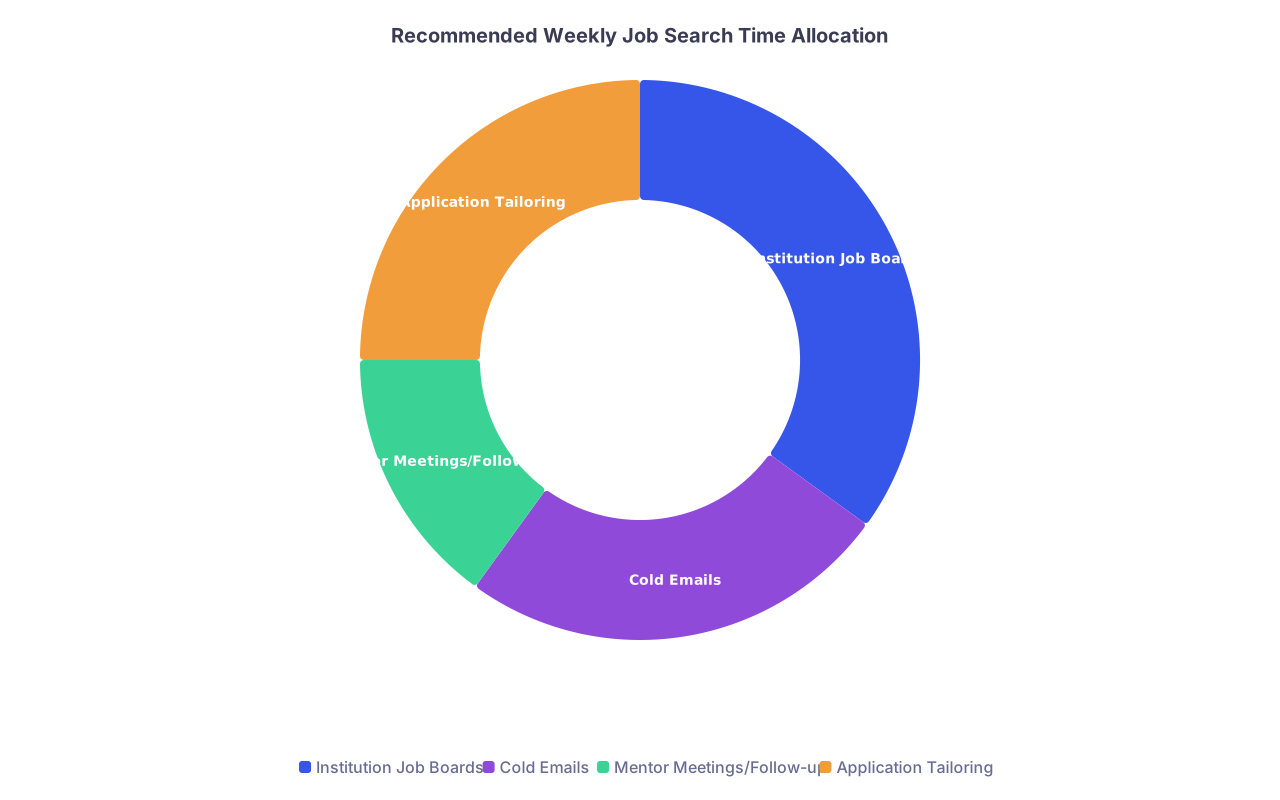
| Category | Value |
|---|---|
| Institution Job Boards | 35 |
| Cold Emails | 25 |
| Mentor Meetings/Follow-up | 15 |
| Application Tailoring | 25 |
Aim for:
- 5–10 formal applications per week (HR portals, posted roles)
- 10–15 targeted cold emails per week (faculty or PIs)
How to cold email effectively (April 15–30)
Target assistant and associate professors in your field of interest with active publications in the last 2–3 years. Senior full professors are often too removed from day-to-day hiring.
Your email should:
- Be under 200 words
- Mention one specific paper or project of theirs you read
- State your timeframe clearly (e.g., “available July 1, 12-month commitment”)
- Offer concrete value (data entry, patient recruitment, chart review, QI)
If you are an IMG or DO with weaker scores, do not hide that you went unmatched. Just do not lead with an essay on it. One line is enough:
“I applied to IM this year and did not match; I am planning to reapply in the next cycle and hope to spend this year in a research-focused role within internal medicine.”
By April 30, you should have:
- Sent at least 40–60 emails
- Logged responses in your spreadsheet (yes / no / maybe, follow-up dates)
- Identified at least 3–5 “warm” leads (someone asked for CV, a call, or to check back in May)
Early May: Convert Interest into Offers
By early May, people who were serious in April start moving. You need to move with them.
At this point, you should…be on the phone and Zoom, not just in inboxes.
Week 1–2 of May: Interview mode
When a PI or department responds with:
- “Let’s talk”
- “We may have something”
- “Can you send your CV and availability?”
Treat that like any other interview.
Prepare:
- 2–3 specific reasons their projects interest you
- A 60-second version of your story:
- Who you are
- What happened this Match
- What you want from the year
- How it supports your reapplication
Have ready answers for:
- “Why did you not match?”
- “What are you planning for USMLE/COMLEX / Step 3 / additional exams?”
- “Can you commit for 12 months?”
- “Do you need visa support?” (for IMGs)
Parallel track: provisional backup work
While you are interviewing for ideal roles, you should also be lining up backup employment in case nothing academic pans out by June.
Examples:
- Scribe positions (ED or specialty clinic)
- Hospitalist service coordinators
- Telemedicine support roles
- MCAT/USMLE tutoring (through a company or independently)
- Community clinic positions (care coordinator, volunteer physician-extender type roles depending on region/legal limits)
You are not signing yet. Just:
- Submit a few applications
- Get a sense of starting dates, pay, and flexibility
- Identify the best “floor” option you can live with
By May 15, you should have:
- 2–4 serious leads for meaningful gap-year work
- At least one realistic backup job path
Mid–Late May: Evaluate and Commit (Without Trapping Yourself)
This phase is where I see bad decisions. People panic, grab the first offer, then realize in August it gives them no time for interviews or Step 3.
At this point, you should…prioritize alignment over ego.
Evaluate offers using a simple scoring grid
Use something like this—quick and dirty:
| Factor | Weight (1–5) | Job A Score (1–5) | Job B Score (1–5) |
|---|---|---|---|
| LOR potential | 5 | ||
| Specialty relevance | 4 | ||
| Schedule flexibility | 4 | ||
| Pay / cost-of-living | 3 | ||
| Research / publications | 3 | ||
| Geography / support | 2 |
Be ruthless. A “prestigious” basic science lab that never lets you see a patient and gives you no flexible time in fall interview season might score lower than a modest clinical research coordinator position that has you shoulder-to-shoulder with the IM attendings who will write your letters.
Key questions to ask before accepting:
- “How many gap-year students have you had before? Where did they end up?”
- “Do you anticipate I will be able to attend residency interviews in the fall?”
- “Will I have chances to present or be on manuscripts?”
- “Who would be my direct supervisor?”
If they flinch or waffle at all about interviews, be careful.
Decision timing
Ideally:
- First serious offer: late April – mid May
- Decision: by end of May for July 1 start
If you have one solid offer that is good enough (strong LOR potential, reasonable pay, flexible for interviews), do not drag it out waiting for a fantasy NIH slot that may never call.
By May 31, you should:
- Have accepted a meaningful gap-year position
- Or be in final-round conversations with a clear timeline
If you have nothing by late May, that is the time to widen your net hard:
- Consider moving locations
- Add more general clinical roles
- Ask your school explicitly about internal funded positions (some deans can create short-term roles if pushed)
June: Lock In Logistics and Set Up Your “Next Match” System
You are not done when you sign. June is where people either set themselves up for a strong reapplication…or repeat the same mistakes.
At this point, you should…have both your gap year and your next ERAS cycle sketched.
Early June (June 1–15): Logistics and boundaries
Once you accept:
- Confirm start date (often July 1 or mid-July)
- Clarify hours and expectations in writing
- Discuss time off ahead of time:
- 5–10 days for interviews (say this explicitly)
- Dedicated time blocks for exams (Step 3, etc., if relevant)
Lock in essentials:
- Housing and move dates
- Financial plan (salary vs loans vs savings)
- Health insurance coverage gaps
Mid–Late June (June 15–30): Build your reapplication calendar
Do not wait until September to think about ERAS.
By June 30, you should have:
Timeline for exams
- Step 2 CK or Step 3 retake or first take if needed
- Target score and 6–10 week study/refresh plan built around your new job schedule
Letter strategy
- Which new letter writers you aim to get from this gap year
- Which old letters you will reuse or update
- When you will ask (often ~6 months into the role, around Nov–Dec)
ERAS timeline overlay
Here is a simple view of how your gap year and reapplication should coexist:
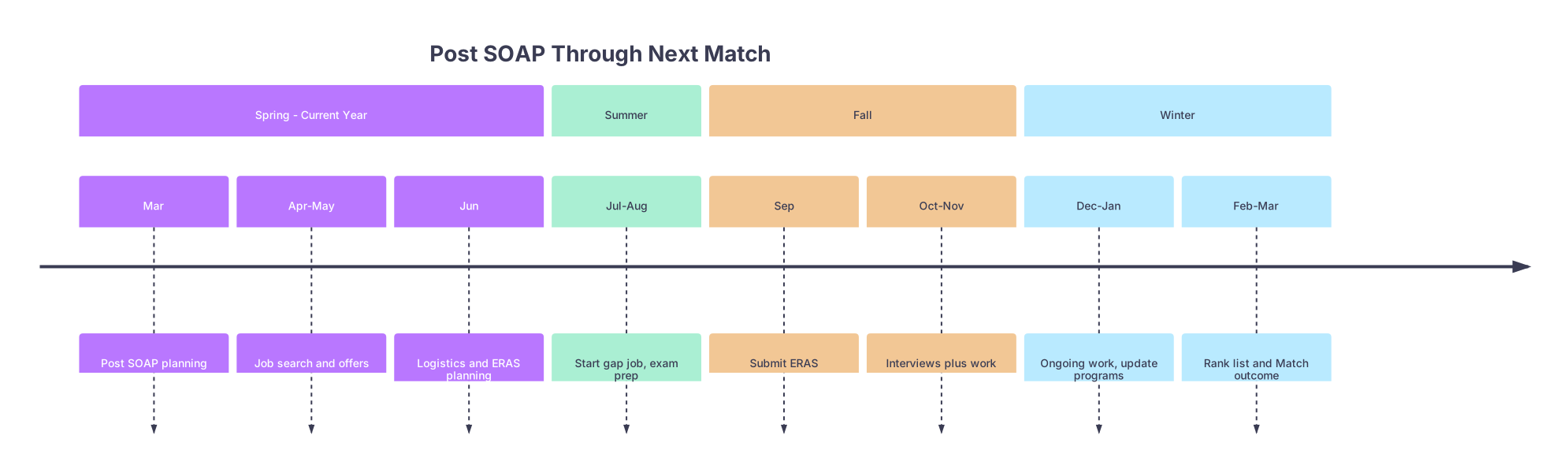
| Period | Event |
|---|---|
| Spring - Current Year - Mar | Post SOAP planning |
| Spring - Current Year - Apr-May | Job search and offers |
| Spring - Current Year - Jun | Logistics and ERAS planning |
| Summer - Jul-Aug | Start gap job, exam prep |
| Fall - Sep | Submit ERAS |
| Fall - Oct-Nov | Interviews plus work |
| Winter - Dec-Jan | Ongoing work, update programs |
| Winter - Feb-Mar | Rank list and Match outcome |
- Monthly “checkpoints” with a mentor
Set recurring 30–45 minute check-ins with:
- A faculty mentor in your intended specialty
- Or your Dean’s office advisor
Agenda each month:
- What you actually did (projects, clinics, patients, papers)
- How that maps to your reapplication story
- Any red flags at work (performance, attendance, communication)
Daily and Weekly Habits During This March–June Window
You are juggling grief, logistics, and future planning. The only way this does not swallow you is small, repeatable habits.
Weekly (March–June):
- 2–3 hours dedicated to job search and outreach
- 1–2 hours on exam planning or light studying (even before your job starts)
- One conversation with someone in your corner who is not panicking
Daily (especially in April and May):
- Send 2–5 messages (emails, LinkedIn, texts to mentors)
- Track every lead in your spreadsheet
- Do one action that supports your mental stability (walk, gym, therapy, journaling—whatever is real for you)
Here is how your effort should ramp, not fade:
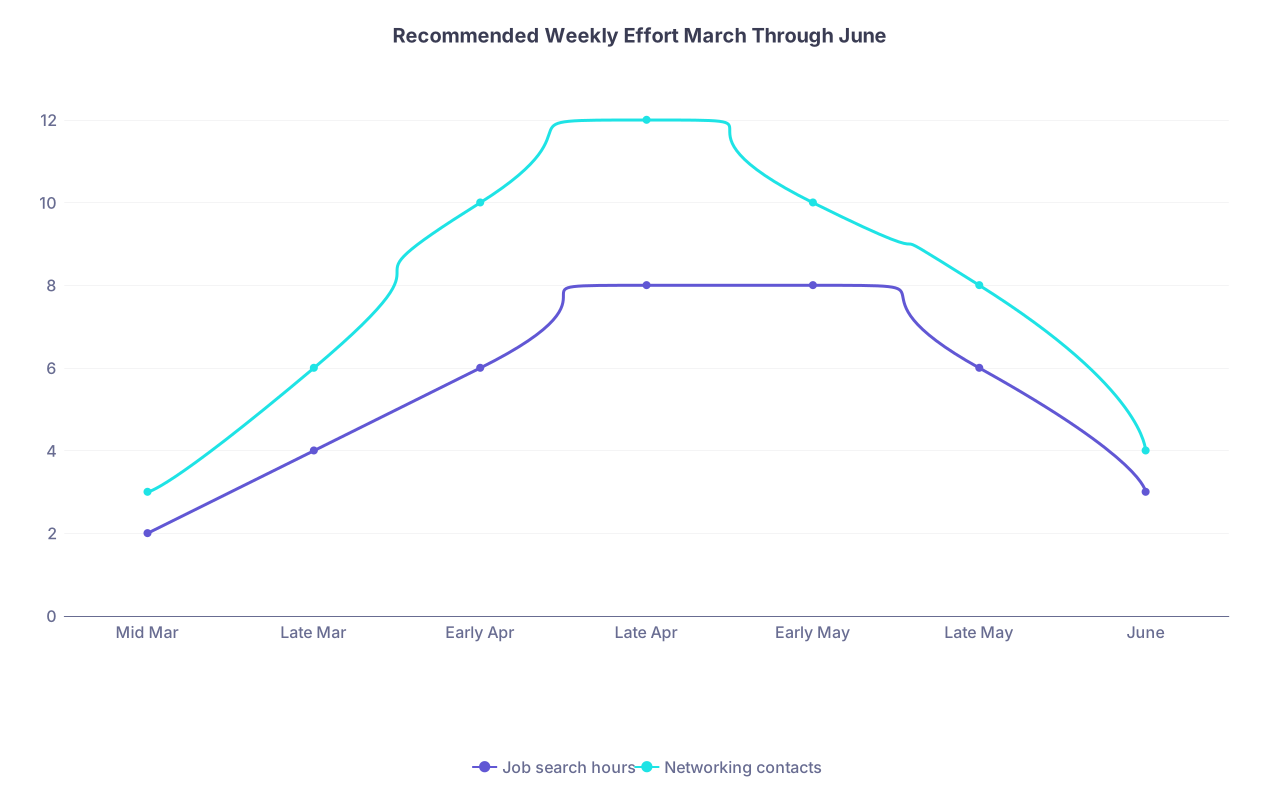
| Category | Job search hours | Networking contacts |
|---|---|---|
| Mid Mar | 2 | 3 |
| Late Mar | 4 | 6 |
| Early Apr | 6 | 10 |
| Late Apr | 8 | 12 |
| Early May | 8 | 10 |
| Late May | 6 | 8 |
| June | 3 | 4 |
You start slower while you stabilize, peak in late April–early May, then taper as offers solidify and logistics take over.
What “Meaningful” Actually Looks Like (Realistic Examples)
To ground this, here are patterns I have watched work:
Internal Medicine reapplicant
- April: Cold emails to hospitalist and cardiology groups
- May: Accepts a 1-year clinical research coordinator role in a heart failure program, 60% time clinic recruitment, 40% data
- Outcome: 2 abstracts, 1 strong letter from HF attending, matched IM the following March at a mid-tier academic program
Pediatrics pivot from failed EM attempt
- April–May: Uses home institution contacts to get a 0.6 FTE job in a community pediatric clinic plus 0.4 FTE as preclinical tutor for first-years
- Outcome: Constant pediatrics exposure, narrative pivot to child health, strong PD call on Match Day praising consistent story
IMG with Step challenges
- April–June: Many rejections. Eventually secures unpaid but structured observership + part-time paid scribe role in IM clinic
- Outcome: Key LORs on U.S. letterhead, better understanding of system, matched FM after second cycle; not glamorous, but it worked
None of these required an NIH R01 or a Harvard-branded fellowship. They required early, focused effort from post-SOAP through June.
Final Thoughts
Three points, and then you can go start your spreadsheet.
- The six weeks after SOAP are not a “recovery period.” They are the highest-yield window to shape your gap year and your next Match.
- You need a clear narrative, a structured outreach plan, and the discipline to send dozens of emails and applications even when you are tired of explaining yourself.
- A meaningful gap year is built, not found: proximity to attendings, letters, and flexible time for interviews matter far more than the brand name on your ID badge.
Use March to decide. April to knock on doors. May to choose wisely. June to lock it in and build your reapplication plan.