
The worst timing mistake after not matching is easy to name: rushing into an exam retake without a ruthless timeline. The second worst is waiting so long that the next cycle is basically dead before you move.
You’re not just “retaking an exam.” You’re rebuilding your entire candidacy on a clock.
This guide walks you month-by-month and then week-by-week through when to retake USMLE/COMLEX (or equivalent) after not matching, and how that timing actually plays with the next application cycle.
Big Picture: Your 12–18 Month Clock
Before we break this down, anchor yourself to the reality of the match calendar.
For a typical US cycle:
- ERAS opens for applicants: June
- Programs start reviewing apps: September
- Interviews: October–January
- Rank list due: late February
- Match Week: March
Your exam timing has to serve one of three strategic goals:
- Be ready for the next match cycle (fast turnaround, tighter schedule)
- Be ready for the following cycle (slower, more thorough rebuild)
- Salvage this cycle post-failed attempt (rarely ideal, sometimes necessary)
Let’s map those options with a concrete timeline. Assume you did not match in March 2026. Here’s how your exam decision windows actually look:
| Strategy Goal | Latest Safe Exam Date | Cycle You Target |
|---|---|---|
| Aggressive - Next Cycle | Late July 2026 | Match 2027 |
| Balanced - Next Cycle | Early June 2026 | Match 2027 |
| Rebuild - Skip One Cycle | Jan–Apr 2027 | Match 2028 |
| Emergency Late Score | Aug–Oct 2026 | Match 2027 (weaker) |
Now we go phase by phase, starting immediately after you don’t match.
Phase 1: Match Week to End of March – Stop the Panic, Build the Plan
At this point you should not be booking an exam date yet.
You just found out you did not match. Emotions are high. Your judgment is usually low. Your job for these 2–3 weeks is diagnosis, not action.
Week 1 (Match Week)
At this point you should:
- Get your full performance data together
- USMLE/COMLEX score reports (including failed attempts)
- How many programs you applied to, where, and which specialty
- Interview invites you received (if any), and how many
- Confirm policies that will control your timing
- School or dean’s office: are there graduation deadlines? Enrollment rules while you’re studying?
- State licensing or visa constraints (for IMGs/FMGs, this can dictate how long you have)
- USMLE/COMLEX attempt limits and mandatory waiting periods between attempts
Week 2
At this point you should do an honest exam autopsy:
Were you:
- Underprepared conceptually?
- Under-practiced with questions?
- Burnt out and unfocused?
- Over-committed with rotations/work while studying?
Pull your:
- NBME/COMSAE history
- UWorld percent correct / Q-bank stats
- Practice test trends vs. real score
You’re trying to answer one question:
“Was my failure mostly about time, or mostly about foundation?”
Because:
- If it was mostly time/strategy → 8–12 week dedicated window might be enough.
- If your foundation was weak → you’re looking at a 4–8 month rebuild, minimum.
Week 3
Now you choose your global strategy:
Aggressive (Next Cycle, Faster Retake)
You target Match 2027 with an earlier exam date (May–July 2026).Best for:
- One failed attempt or low score but strong improvement potential
- Reasonable question bank stats but bad test-day execution
- You’re graduating or already graduated and need to move fast
Rebuild (Skip One Cycle, Stronger Retake)
You target Match 2028, plan a slower retake (early 2027).Best for:
- Multiple prior attempts
- Very low baseline (e.g., <210 Step 2, <400 COMLEX Level)
- You’re changing specialties and need a huge jump in competitiveness
Do not pick an exam date until you’ve chosen which cycle you’re aiming for.
Phase 2: April–May – Decide When to Retake, Not Just If
Now the clock is real. Decisions here determine whether your score returns in time to matter.
If You’re Targeting the Very Next Match (Aggressive Path)
You need your new passing/competitive score in hand by the time most programs start reviewing.
That means:
- Ideal: Score released by early August
- Acceptable: Score released by early September
- Risky: Score released after mid-September
Most USMLE/COMLEX results take about 2–4 weeks to post (sometimes longer in summer batch periods). So work backward:
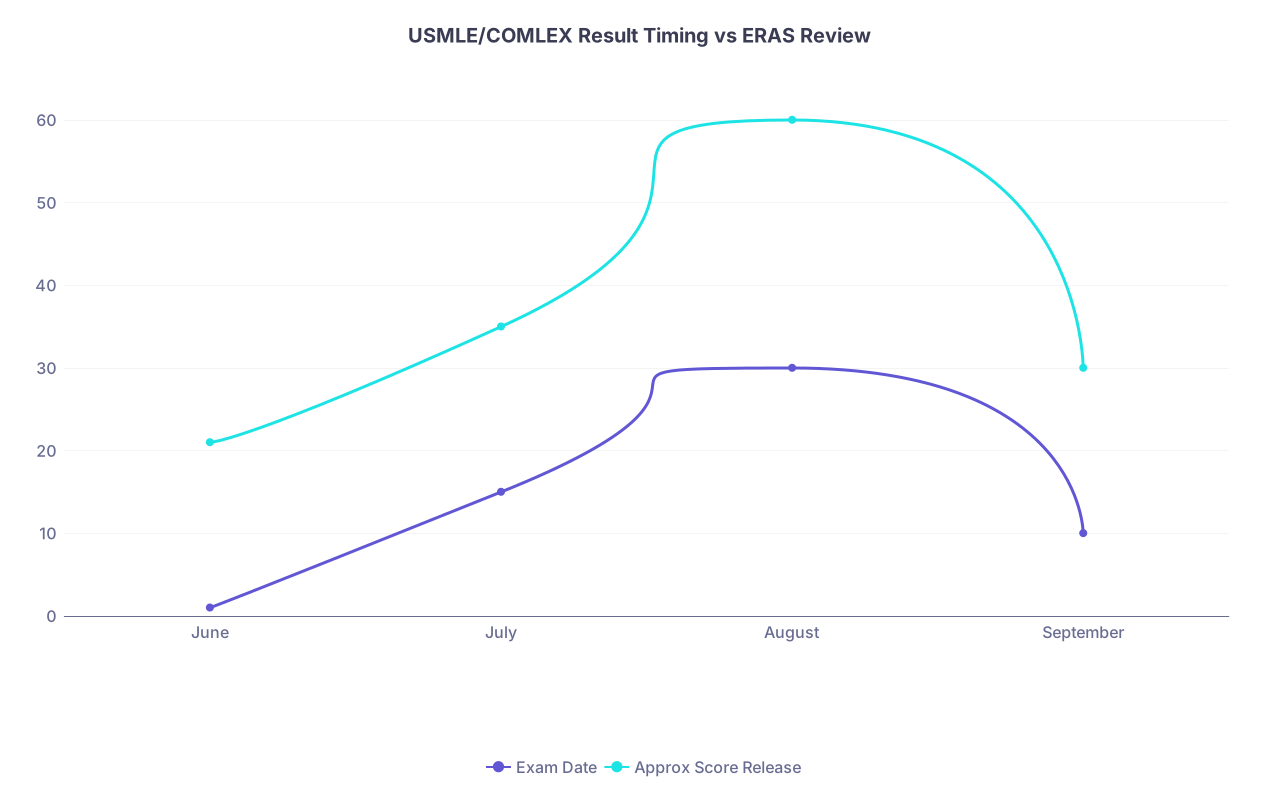
| Category | Exam Date | Approx Score Release |
|---|---|---|
| June | 1 | 21 |
| July | 15 | 35 |
| August | 30 | 60 |
| September | 10 | 30 |
The exact numbers aren’t literal calendar days; the point is: later exam = later score, and late scores get ignored by many programs.
April: Commitment Month
At this point you should:
Set your exam window (not exact date yet)
- Fast review candidates: exam between late June and late July
- Slower review but still next cycle: exam between mid May and late June
Do a baseline self-assessment:
- 1 NBME/COMSAE or practice assessment, under test conditions
- Look at section-level scores, not just the total
If your baseline is within ~15–20 points (USMLE) or ~60–80 points (COMLEX) of your target, a 10–12 week plan is plausible.
If you’re 30+ points or 100+ points away? You should seriously consider skipping a cycle.
If You’re Choosing the Rebuild Path (Skips Next Cycle)
April–May is not about the exam date yet. It’s about stabilizing your life to create a sustainable study year:
At this point you should:
- Decide your primary commitment:
- Research position
- Preliminary year / non-categorical residency
- Clinical job (scribe, hospitalist extender, etc.)
- Design your weekly study bandwidth:
- Realistic hours per week (not fantasy “I’ll do 6 hours after a 12-hour shift” nonsense)
- First-pass content review schedule (often 4–6 months)
You’ll likely plan your retake for Jan–Apr of the following year, with a goal to have a strong score on file before June ERAS opens for the cycle you’re actually targeting (Match 2028 in our running example).
Phase 3: June–September – How Exam Timing Interacts with ERAS
This is where people blow it. They schedule an exam because “I want it done before ERAS” without respecting how programs actually behave.
Key Principle
At this point you should assume:
- Most programs will screen your application once, when it’s first complete.
- Late-arriving scores may never get truly reconsidered, especially in competitive specialties.
So the question is not:
“Can I physically get my exam done before September?”
It’s:
“Will the score be visible and usable when programs are screening?”
Scenario 1: Exam Before ERAS Opens (Ideal for Next Cycle)
If you take the exam:
- By mid-May → Score likely posts by mid-June. Great.
- By mid-June → Score likely posts by mid-July. Still good.
- By early July → Score likely posts by early August. Starting to cut it close, but usually workable.
At this point you should:
- Take a practice exam 3–4 weeks pre-test
- If your score is still below passing or well below your goal → you consider pushing the exam and possibly adjusting your match-cycle target.
Sacrificing one match cycle to avoid another failed attempt is painful but sometimes correct.
Scenario 2: Exam Between ERAS Opening and Program Review (High-Risk)
People do this every year: schedule the exam for August “so I’ll have it in September.”
Reality:
- Some programs start filtering applicants in late August
- If your score posts in mid-September, you’ve already lost opportunities
- If you fail again, your application is basically burned for that cycle.
At this point, if you’re thinking August exam and you have no passing score yet, you’re gambling.
I’ve watched applicants with a failed Step 2 and an August retake plan:
- Score posts mid-September
- A small subset of programs see the new pass
- Most competitive places already filled most interview spots
You can match with a September score, but your odds drop in many specialties.
Scenario 3: Exam During Interview Season (Bad Strategy Except in Special Cases)
Sometimes people push the retake to October–December thinking, “I’ll apply now, fix the score later.”
That might work if:
- You already have one solid passing score and this is a minor upgrade
- You’re in a less competitive specialty and most programs will still consider late score updates
But if you’re trying to convert a fail into a pass, an October exam is usually strategically wrong for the immediate cycle.
At this point you should only be doing this if you’ve decisively chosen to aim for the following cycle and are just using the time productively.
Phase 4: Detailed Week-by-Week for a Fast Retake (Next-Cycle Plan)
Let’s say:
- You didn’t match in March 2026
- You choose the aggressive path
- Your goal: June 30 exam, score by late July, ready for Match 2027
Here’s how your 12 weeks should actually look.
Weeks 1–2 (Early April): Reset and Structure
At this point you should:
Pick 1 primary resource set (e.g., UWorld + main text/video, not 6 different books)
Build a weekly skeleton:
- 5–6 days of study
- Daily question blocks (timed)
- Scheduled NBME/COMSAE every 3–4 weeks
Do 1 baseline practice:
- Below passing by a little → OK to proceed
- Way below → re-evaluate whether June 30 is realistic
Weeks 3–6 (Late April–May): Heavy Content + Practice
At this point you should:
- Hit 40–80 questions/day, timed, exam-like
- Review each question thoroughly—your review time > question time
- Track:
- Percent correct
- Weakest systems/subjects
- Common error types (rushing, misreading, knowledge gap)
End of Week 6: take another full-length practice exam.
- If you’re still failing hard, and it’s late May, you should strongly consider:
- Pushing to a late July test date, or
- Accepting that you might skip the next cycle
Weeks 7–10 (June): Sharpening and Simulation
At this point you should:
- Shift focus:
- Less new content, more integration and timed blocks
- Practice at the same time of day as your real exam
- Take at least 2 more full-length practices
- You want them at or above your target in the final 2–3 weeks
If practice scores repeatedly lag 15+ points below your target late in June, pushing the exam is usually smarter than stubbornly walking into another bad score.
Weeks 11–12 (Late June): Final Tuning and Logistics
At this point you should:
- Confirm all logistics: test center, IDs, travel
- Taper slightly (do not cram at 1 a.m. every night)
- Keep question volume but shorten review sessions a bit to maintain stamina
You’re not redesigning your knowledge base now. You’re consolidating and protecting test-day performance.
Phase 5: Month-by-Month for the Rebuild Path (Skipping a Cycle)
Now assume:
- You didn’t match in March 2026
- You decide: “I’m skipping Match 2027 to fully rebuild and aim for Match 2028.”
- You’ll retake between Jan–Apr 2027
Here’s what your longer arc looks like.
April–June 2026: Stabilize and Plan
At this point you should:
- Lock in a 6–12 month position:
- Research assistant, postdoc, clinical job, prelim/transitional spot
- Define a realistic weekly study quota:
- Example: 15–20 hours/week if you’re working full-time
- Start slow, thorough content review:
- 2–3 subjects per month
- Lower daily question volume, higher emphasis on true understanding
July–September 2026: Build Depth and Endurance
At this point you should:
- Increase question volume:
- 20–40 questions/day, 4–5 days/week
- Start periodic practice exams:
- Every 6–8 weeks, just to gauge trend
You’re not racing ERAS now. You’re trying to graduate from “fragile knowledge” to “automatic recall.”
October–December 2026: Transition Toward Dedicated Mode
At this point you should:
- Decide on your dedicated study window for Jan–Apr 2027
- Can you reduce work hours for 6–8 weeks?
- Do you need vacation or unpaid leave?
- Take a practice exam in early December
- If you’re still far below passing, you may need to push your retake even further
January–April 2027: Dedicated and Retake
At this point you should:
- Enter a true dedicated phase of 4–8 weeks
- Plan your exam date:
- January/February if you’re already near target
- March/April if you’re still building
You want the score back by May–June 2027, so you’re solid when you open ERAS for Match 2028.
Special Case: Multiple Failed Attempts – Timing Becomes Survival
If you’ve already failed a major exam more than once, your retake timing is not just strategy. It’s reputation management.
At this point you should:
- Check official attempt limits (many programs hard-screen multiple failures)
- Accept that another fail may effectively end eligibility for most competitive programs
For you, conservative timing beats aggressive every time:
- Longer content rebuild
- Later exam date
- Possibly even skipping two cycles if needed
You’d rather show:
- “I failed, then took a serious pause, then passed solidly”
than - “I failed three times in 18 months.”
Visual Timeline: Aggressive vs Rebuild Paths
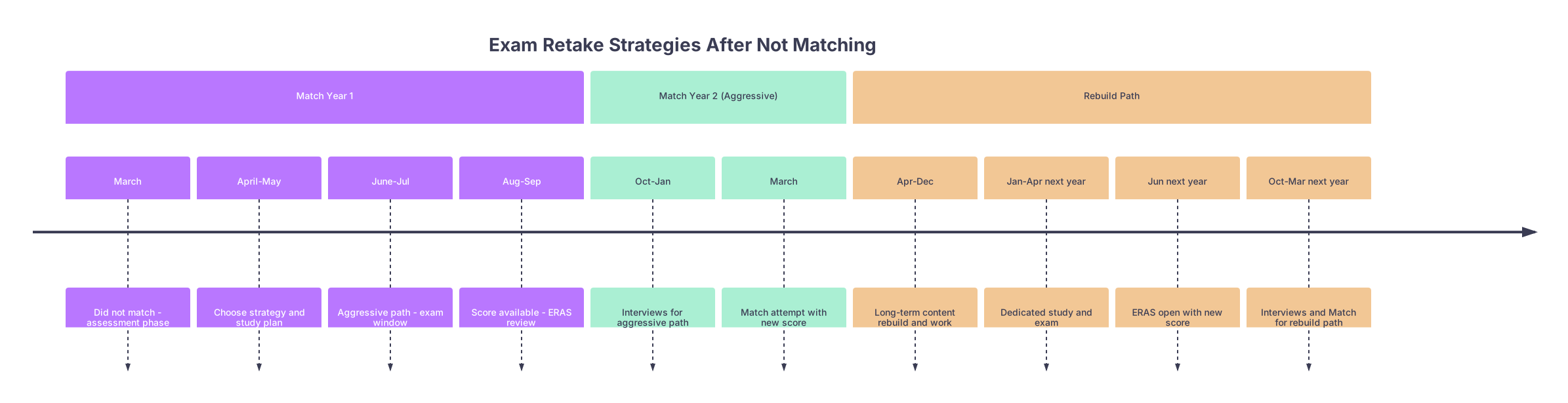
| Period | Event |
|---|---|
| Match Year 1 - March | Did not match - assessment phase |
| Match Year 1 - April-May | Choose strategy and study plan |
| Match Year 1 - June-Jul | Aggressive path - exam window |
| Match Year 1 - Aug-Sep | Score available - ERAS review |
| Match Year 2 (Aggressive) - Oct-Jan | Interviews for aggressive path |
| Match Year 2 (Aggressive) - March | Match attempt with new score |
| Rebuild Path - Apr-Dec | Long-term content rebuild and work |
| Rebuild Path - Jan-Apr next year | Dedicated study and exam |
| Rebuild Path - Jun next year | ERAS open with new score |
| Rebuild Path - Oct-Mar next year | Interviews and Match for rebuild path |
When Not to Retake Before the Next Match
There are a few clear “do not do this” timing scenarios:
At this point you should NOT sign up for an early retake if:
- Your baseline practice scores are far below passing within 8–10 weeks of your desired test date
- You’re working a full-time clinical job and cannot carve out at least 15–20 focused hours/week
- You’re considering an exam date that would post a score after mid-September and you still need a first-time pass
In those cases, a delayed but solid pass next year is usually more valuable than a rushed, shaky attempt now.
Concrete Next Step
Open a calendar for the next 18 months and do this right now:
- Mark:
- This March (your “did not match” point)
- Next June and September (ERAS open and review)
- Your ideal exam result month (when you want the new score in hand)
Then ask: “Is my current knowledge level and life reality compatible with that exam result month?”
If the honest answer is no, move the exam result month forward on the calendar—and commit to the cycle that new date implies.