
Most prelim residents wait far too long to move on their reapplication plan.
By the time they “feel settled,” the application cycle is already halfway over. That is a mistake. If you are in a prelim year and even vaguely considering reapplying, your window runs from July to December. After that, the market moves on without you.
Here is the month‑by‑month, then week‑by‑week breakdown of what you should actually do from July through December: when to network, when to ask for letters, when to write, and when to pull the plug or pivot.
Big Picture: Your July–December Reapplication Timeline
At this stage you are juggling two full‑time jobs:
- Survive intern year.
- Rebuild and relaunch your application.
You cannot “see how intern year goes and then decide.” The residency application calendar does not care how tired you are.
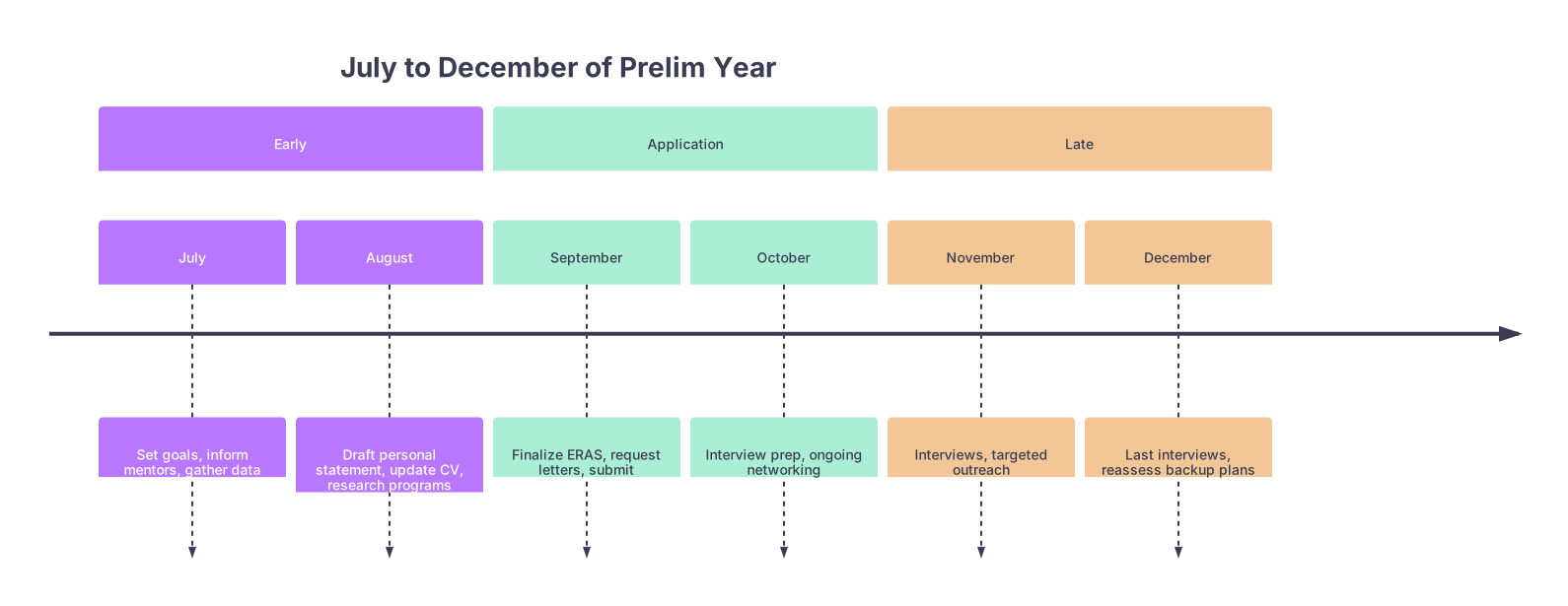
| Period | Event |
|---|---|
| Early - July | Set goals, inform mentors, gather data |
| Early - August | Draft personal statement, update CV, research programs |
| Application - September | Finalize ERAS, request letters, submit |
| Application - October | Interview prep, ongoing networking |
| Late - November | Interviews, targeted outreach |
| Late - December | Last interviews, reassess backup plans |
Core rule:
If there is any chance you will reapply, you start acting like an applicant again by mid‑July. Not October. Not “after my ICU month.” July.
July: Reality Check and Foundation
By July, you have orientation, the first weeks of call, and a solid dose of “what did I get myself into.” This is when you stop fantasizing and decide whether reapplication is on the table.
Week 1–2 of July: Decide Your Path
At this point you should:
Be brutally honest: Are you trying to:
- Transition into a categorical spot in the same specialty?
- Switch specialties (prelim surgery → categorical IM, prelim medicine → neuro, etc.)?
- Stay in your current field but at a different program?
Pull up your original application:
- USMLE/COMLEX scores
- Number and strength of letters
- Research, leadership, red flags (gaps, failures, remediation)
If you matched prelim but not categorical, programs already told you something about your file: competitive enough to be safe service labor, not competitive enough for a long‑term marriage. Your reapplication plan has to fix that.
By the end of week 2 in July, you should:
- Commit to a target specialty (primary and, if needed, a backup).
- Decide: “I am reapplying this cycle” or “I will finish prelim and look for a PGY‑2 spot later.”
Anything vaguer than that and you will drift into September with nothing ready.
Week 3–4 of July: Quiet Networking and Information Gathering
This is not the time to blast emails to random programs. It is the time to start quietly building your network.
At this point you should:
Identify 2–3 key people locally
- Your prelim program director
- Your associate program director / site director
- A faculty member in your desired specialty who seems sane and respected
Schedule short meetings
- Goal: “I am considering reapplying. I want honest feedback and a plan.”
- Do not ask for letters yet. Ask for critique.
Collect specific feedback
- “Your scores are fine. You need stronger specialty letters.”
- “You applied too top‑heavy; expand to community programs.”
- “Your personal statement was confusing and your CV did not highlight X.”
Write this down. You will forget details at 2 a.m. on night float.
By end of July you should:
- Know your top weaknesses (letters, scores, late application, poor specialty exposure).
- Have at least one faculty ally who knows your goal.
August: Build Credibility, Then Ask for Support
August is where serious networking starts. Not through mass emails. Through showing up and then asking.
First Half of August: Perform, Then Position
Your full‑time job this month is still patient care. But now you do it strategically.
At this point you should on your target specialty rotations (or any high‑visibility month):
- Show up early, leave late when needed.
- Know your patients cold.
- Make it very obvious that you are reliable and teachable.
Then you translate that into networking:
- End of week 1–2 on a rotation:
- Ask, “Could I meet with you briefly to get feedback on my performance and talk about my career plans?”
- In that meeting:
- Explain clearly: “I am in a prelim year and plan to reapply to [specialty] this cycle.”
- Ask directly: “If I continue to perform at this level (or better), would you feel comfortable supporting my application with a strong letter?”
Faculty hate vague fishing. Be specific.
Second Half of August: Documents and Program List
You cannot wait until September to start writing.
By the end of August, you should have:
Personal statement – version 1
- Focus on:
- Why this specialty
- What you have done since graduation (now including intern experience)
- How the prelim year has sharpened your goals
- Drop the melodrama; increase the maturity.
- Focus on:
Updated CV
- Add:
- Prelim program
- Any QI projects, teaching, or early involvement
- Specific skills (procedures, call responsibilities)
- Add:
Rough program list
- Categories:
- Programs where your home faculty have contacts
- Programs that historically take prelims into categorical (ask seniors; they know)
- A mix of university‑affiliated and community programs
- Categories:
| Program Type | Target Count |
|---|---|
| Home / Affiliated | 5–10 |
| Regional University | 10–15 |
| Community Programs | 20–40 |
| “Reach” Programs | 5–10 |
If you are switching specialties (e.g., prelim surgery → neurology), August is when you prove commitment:
- Attend specialty conferences or noon conferences.
- Ask to shadow in clinic on your days off or post‑call.
- Start 1 small specialty‑relevant project (chart review, case report) with a faculty member.
September: Letters, ERAS, and Smart Networking
September is not about thinking. September is about executing.
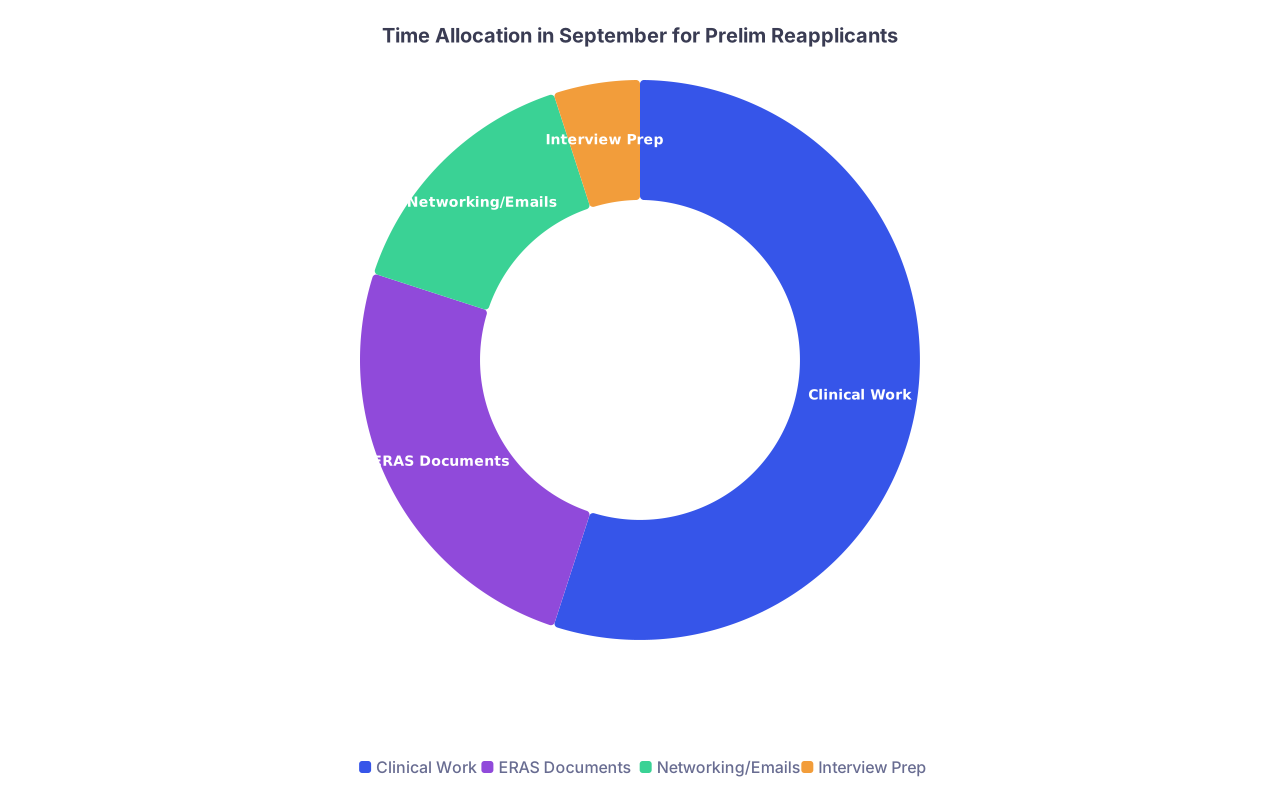
| Category | Value |
|---|---|
| Clinical Work | 55 |
| ERAS Documents | 25 |
| Networking/Emails | 15 |
| Interview Prep | 5 |
Early September (Before ERAS Submission Opens)
At this point you should:
-
- Minimum for most fields:
- 2 specialty letters (from attendings in your target field, ideally from this year)
- 1 department/program letter (PD or APD)
- If switching specialties:
- 1–2 letters from new target specialty
- 1 “character / work ethic” letter from current PD or senior faculty
- Minimum for most fields:
Have your PD conversation (if not already)
- This is non‑negotiable. Programs hate surprises.
- Script:
- “I want to be transparent. I am planning to reapply to [specialty] this cycle. My preference would be to continue here if that is an option, but I also plan to apply broadly.”
- Then shut up and listen.
- You need their:
- Honest take on feasibility
- Willingness to write a letter or at least not sabotage you
Polish personal statement and CV based on feedback
- Ask 1–2 trusted people to mark them up. Not ten.
Mid–Late September: Submit Early, Then Start Targeted Outreach
ERAS opens. The clock starts.
By the end of the ERAS submission week, you should:
- Have your ERAS application submitted, not “almost done.”
- Have at least 2 letters uploaded or clearly in progress.
- Double‑check all:
- Employment dates
- Program names
- Certification statuses
Then, and only then, do you start active networking with other programs.
Smart networking in late September looks like this:
- Short, individualized emails to:
- Programs where your faculty have contacts (“Dr. X suggested I reach out…”)
- Programs that historically accept prelims into categorical positions
- Regional programs where you have a geographic tie
Content of a good email (5–7 sentences, max):
- Who you are (prelim at X, applying to Y specialty).
- Why this specific program (ties, interest in their focus areas).
- One line about your improvement or added value since graduation.
- Mention of mutual connection if applicable.
- Attach CV; ERAS ID in the signature.
Bad networking:
- Mass emails. Generic flattery. “I would be honored.” Programs delete those.
October: Interviews Start, Networking Intensifies
By October, invitations start dripping in. For a prelim reapplicant, the volume will likely be lower and later than your categorical classmates. You counter that with precision networking.

Early October: Monitor, Adjust, Push
At this point you should:
- Track:
- How many interview invites you have
- From which type of programs (academic vs community)
- Compare to:
- Your original application cycle
- Your current competitiveness
If by mid‑October you have zero or almost zero interviews, you need to:
- Ask a trusted advisor: “Is my specialty choice realistic this cycle?”
- Consider:
- Expanding your program list (community, smaller cities, less glamorous)
- Officially embracing a backup specialty if you have not already
Networking moves for October:
Program‑linked outreach
- For programs that emailed “we have received your application” but no invite:
- After 2–3 weeks, 1 polite update email with:
- Any new CV updates (presentations, projects)
- Brief reiteration of interest
- After 2–3 weeks, 1 polite update email with:
- For programs that emailed “we have received your application” but no invite:
Faculty‑driven advocacy
- Ask your strongest letter writers:
- “Would you feel comfortable reaching out to 1–2 programs where you know the PD or faculty on my behalf?”
- One personal call from a respected attending does more than 50 applicant emails.
- Ask your strongest letter writers:
Late October: Interview Prep and Reputation Management
You cannot afford to bomb the few interviews you do get.
At this point you should:
Do at least 2–3 mock interviews
- With your PD, faculty, or senior residents
- Focus on:
- Why a prelim year?
- What changed since your last application?
- Why this program?
Prepare clear, concise answers to:
- “Why did you not match categorical initially?”
- “Why should we invest a categorical spot in you now?”
Bad answer: anger, blaming previous programs, or vague “bad luck.”
Good answer: accountability + growth.
Example frame:
“I applied very top‑heavy and had a weaker specialty track record then. This year, I have completed a demanding prelim year, earned strong evaluations from [specialty] attendings, and focused my applications on programs like yours where I know I will be a strong fit for the clinical mission.”
November: Peak Interview Season and Surgical Networking
November is where the main outcome gets shaped. You are tired, but this is the stretch where small networking moves actually change results.
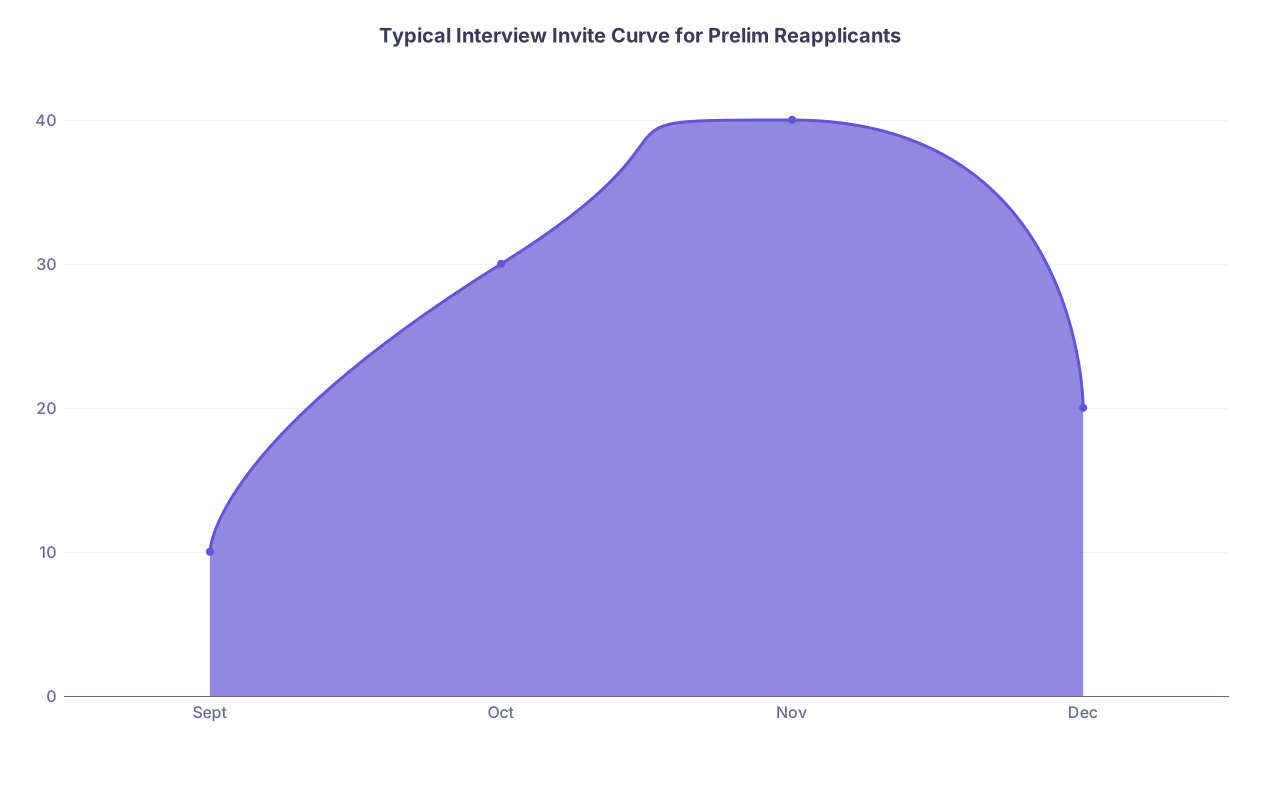
| Category | Value |
|---|---|
| Sept | 10 |
| Oct | 30 |
| Nov | 40 |
| Dec | 20 |
Early–Mid November: Execute Interviews, Make Targeted Asks
At this point you should:
- Be on your best, least bitter version of yourself at interviews. Programs can sniff resentment.
Specific networking tactics:
Same‑system programs
- If your hospital system has sister sites or affiliated programs:
- Ask your PD or specialty lead: “Are there categorical positions at [sister hospital] where I could be considered as a PGY‑2 or advanced spot?”
- These “within‑system” moves often happen off‑ERAS and quietly.
- If your hospital system has sister sites or affiliated programs:
Post‑interview thank‑you with substance
- 24–48 hours after each interview:
- Send short, specific notes to:
- PD
- Anyone you connected with strongly
- Mention one concrete detail from your conversation.
- Send short, specific notes to:
- 24–48 hours after each interview:
This is light networking, but it signals professionalism and interest.
- Reinforcement via mentors
- For your top 5–8 programs:
- Ask a mentor to send a brief advocacy email or make a call after your interview.
- For your top 5–8 programs:
Do not fake “number one” promises everywhere. But you can say “top choice” or “very high on my list” honestly where appropriate.
Late November: Contingency Planning
Here is the uncomfortable part. By late November you have a decent sense of your trajectory:
- Count interviews:
- ≥ 10 in your target specialty with a reasonable distribution → you are likely in the game.
- 3–6 interviews, mostly community → borderline but possible.
- ≤ 2 interviews → you need a serious backup plan.
At this point you should:
- Clarify:
- Would you do another prelim year?
- Would you switch specialties if a categorical IM or FM spot appears?
- Are you open to SOAP, or are you planning to seek off‑cycle PGY‑2 openings?
These are not December conversations. They are late November conversations with:
- Your PD
- Trusted faculty
- Possibly GME office
December: Final Push, Then Reassessment
December is quieter on the surface. But behind the scenes, rank list decisions and off‑cycle opportunities start to take shape.

Early December: Last‑Chance Networking
At this point you should:
- Follow up once with any programs where:
- You interviewed but have not heard anything in a while.
- You were told they might have unadvertised PGY‑2 spots.
Email template (short):
- Thank them again for the interview.
- Briefly restate why you fit their program.
- Update with any new achievements (presentations, awards, major rotation feedback).
If you still have open interview dates in December or January, you:
- Confirm logistics early (coverage, PTO, schedule swaps).
- Protect your clinical reputation. Colleagues will tolerate some swaps; they will not tolerate chaos.
Mid–Late December: Prepare for Two Divergent Paths
By the end of December, you prepare for either:
- Match success in your targeted specialty, or
- Plan B if Match goes badly.
For Path 1 (likely match):
At this point you should:
- Keep grinding clinically. A bad December eval can poison letters and PD perception.
- Keep PD updated:
- “I have completed X interviews so far, mostly [type]. I am very grateful for your support.”
For Path 2 (high risk of not matching):
You prepare now, not in March:
- Update a separate document listing:
- All PGY‑2 or off‑cycle positions you would consider.
- States/regions where you absolutely will not move (everyone has some).
- Decide:
- Would you enter SOAP for:
- Another prelim?
- A different categorical specialty?
- Or would you finish prelim year and then step out to do research / a non‑clinical year?
- Would you enter SOAP for:
These decisions are painful. I have seen people make them in tears at 2 a.m. But doing this thinking in December saves you from catastrophic panic in March.
When Networking Actually Matters Most (And When It Is Noise)
Let me be very direct:
Most reapplicants waste time on symbolic networking and ignore the moves that actually change outcomes.
High‑yield networking windows:
- July–August: Internal — PDs, faculty who actually see your work.
- Late September–October: External — PD‑to‑PD contacts, targeted emails after ERAS submission.
- November–December: Advocacy around interviews, exploring within‑system PGY‑2 options.
Low‑yield noise:
- Generic “I am very interested” emails to 80 programs.
- DMing residents on social media for “insider tips” and hoping that counts as networking.
- Dropping into random virtual open houses with no follow‑up, no substance.
If you have an hour free, you are almost always better off:
- Doing a stellar job on your rotation so your attending will actually fight for you.
Rather than… - Attending a third “why our program is great” webinar.
Visual Snapshot: Key Actions by Month
| Month | Primary Focus | Networking Priority |
|---|---|---|
| July | Decide path, get feedback | Internal PD/faculty meetings |
| August | Build performance, draft docs | Ask for letters, specialty |
| September | Submit ERAS, finalize letters | Targeted program emails |
| October | Interviews start, adjust list | Mentor advocacy to programs |
| November | Peak interviews, backup plans | Within‑system opportunities |
| December | Final pushes, contingency prep | Post‑interview follow‑ups |

FAQ (Exactly 4 Questions)
1. Should I tell my prelim program I am reapplying, or keep it quiet?
Tell them. Early. Hiding your plans almost always backfires. PDs talk. When they feel blindsided, they become less inclined to help and sometimes actively block opportunities. A straightforward conversation in July or August allows them to plan coverage, write an honest (and often supportive) letter, and possibly help you find positions within their network.
2. Is it realistic to switch specialties during a prelim year and still match that same cycle?
Yes, but only if you move aggressively and have a coherent story. You need at least 1–2 strong letters from the new specialty, clear evidence of commitment (rotations, conferences, small projects), and a program list that is not fantasy. I have seen prelim surgery interns match neurology or IM when they made the switch in July–August and had mentors backing them hard. Waiting until October to “consider” switching is usually too late.
3. How many programs should I apply to as a prelim reapplicant?
More than you did the first time, and with a smarter mix. For many prelim reapplicants, 40–80 programs in a single core specialty is reasonable, heavily weighted toward community and mid‑tier academic programs, plus any place with personal or institutional ties. If you are switching fields, err on the higher side. Casting a wide net without addressing application weaknesses is useless; fix the file, then widen the reach.
4. When should I give up on this cycle and focus on PGY‑2 or off‑cycle spots instead?
If by late November you have close to zero interviews despite broad applications and genuine advocacy from mentors, you should seriously explore PGY‑2 pathways, internal transfers, or a longer‑term plan (research year, another prelim, or specialty change). That does not always mean giving up on the Match entirely, but it means not betting your entire future on a clearly failing strategy. At that point, your energy is better invested in targeted PGY‑2 networking and positioning yourself for the next realistic opening.
Remember:
- Decide early, not “when things calm down.” They never calm down.
- Network where your work is seen; leverage those people outward.
- Use each month from July to December intentionally, or the calendar will make decisions for you.