
Failing Step 1 or Step 2 did not end your career. But a vague, generic “I’ll just try again next year” plan will.
Let me be blunt: after an unmatched cycle with a failed Step on your record, you are now in a data-driven game. Emotion still matters for you as a human being. Program directors do not care about that. They care about risk, evidence, and signal. Your job now is to build a ruthless, targeted plan that flips you from “risky applicant” to “known quantity with clear upward trajectory.”
I will walk you through how to do that. Step by step. No fluff, no magical thinking.
1. Understand Exactly How Programs See You Now
You cannot build a post‑Match plan until you understand how you look on the other side of the table.
Here is how program directors roughly categorize an applicant with a failed Step 1 or Step 2, after an unsuccessful Match:
Academic risk:
“Can this person pass boards on time and become board certified?”Reliability risk:
“Will they complete residency without extra remediation, delays, or drama?”Bandwidth risk:
“Will they require more faculty time, more monitoring, more hand‑holding than we can afford?”
They are not sitting there dissecting the philosophy of assessment. They are asking: If I take this person, am I going to regret it?
Now add the “unmatched” label. That tells them:
- Your initial application package did not clear the bar in at least one critical dimension:
- Scores / exam history
- Clinical performance / LoRs
- Specialty choice realism
- Application strategy (too few programs, poor targeting, weak personal statement, late completion)
- You have one full cycle of feedback baked into your record. If nothing changes, they assume your outcome will not change either.
Your mission: show clear remediation in every area that was a liability last cycle. Not hand‑waving. Concrete, documentable change.
2. Diagnose Your Actual Problem (Not the One You Prefer)
Most unmatched applicants anchor on one narrative: “I failed Step 1” or “My Step 2 is low.” Sometimes that is the core issue. Often it is not the only problem.
You need a brutally honest “post‑mortem” on your application.
2.1 Build an Application Autopsy
Pull out last cycle’s ERAS application. Capture this in writing:
- Exam history:
- Step 1 result (Fail / Pass, score if applicable)
- Step 2 result (Fail / Pass, score)
- Number of attempts
- Timing (late Step 2 score hurt you? Passed after rank lists?)
- Specialty and competitiveness:
- Which specialty did you apply to?
- How many programs did you apply to?
- Did you apply broadly geographically or just to a few cities/regions?
- Interview data:
- Number of interview offers vs total applications
- How many interviews you attended
- Any programs that explicitly commented on concerns (via advisors, emails, or post‑interview feedback)
- Application content:
- Personal statement: generic vs targeted vs weak vs clearly addressing failure
- Letters of recommendation: from whom (titles), and in what specialty
- Research, leadership, volunteer work: relevant to your chosen specialty or random / scattered?
- Timing / logistics:
- Were you late on ERAS submission?
- Were your letters delayed?
- Was your Step 2 score released after most invites had already gone out?
If you do not already see patterns, that is a red flag. Bring this summary to someone who does this routinely: student affairs dean, residency advisor, trusted faculty member who actually participates in a residency selection committee.
2.2 Ask for Uncomfortable Feedback
You need real feedback, not emotional support. That means asking:
- “If you were a PD in my desired specialty, would you rank me?”
- “If not, what would need to change in 12–18 months for that answer to become yes?”
- “If I insisted on reapplying to this specialty, would you consider that realistic or unwise?”
Program directors and serious advisors usually fall into three buckets when they look at an applicant like you:
| Advisor View | What It Really Means | Your Likely Path |
|---|---|---|
| Optimistic but conditional | Potential is there if you fix clear deficits | Stay in specialty with **heavy** remediation |
| Neutral / cautious | Possible but odds are modest at best | Consider rebrand to less competitive programs |
| Pessimistic | Very low probability even with improvements | Pivot specialty or consider alternative careers |
You want that classification. It shapes your next moves.
3. Decide: Stay the Course or Pivot?
This is the section people hate. Because it might mean giving up a dream specialty. But ignoring this decision is how you waste 2–3 years reapplying with the same outcome.
3.1 If You Failed Step 1 but Passed Step 2 Strongly
With Step 1 pass/fail now (for most recent grads), Step 2 is usually the stronger signal. If you:
- Failed Step 1 once
- Then passed on second attempt
- And now have a solid Step 2 (for primary care / less competitive fields often >235–240; for competitive fields higher)
You can sometimes stay in your original specialty, if:
- Your specialty is not hyper‑competitive (FM, IM, Peds, Psych, maybe Neuro in some settings)
- You show clear remediation: tutoring, documented improvement, maybe honors in key clerkships
You still need to explicitly address the failure in your personal statement and interviews. You “own it, fix it, prove it.”
3.2 If You Failed Step 2 (Especially Multiple Attempts)
This is a much bigger problem for PDs. Step 2 predicts:
- Your ability to pass Step 3
- Your probability of on‑time board eligibility
- How much monitoring and remediation you might require
Multiple Step 2 failures, or a very low Step 2 score even after passing, often forces a specialty pivot conversation.
You have three realistic buckets:
- Reapply to the same specialty, but open to community / less competitive programs and less desirable locations.
- Pivot to a less competitive specialty where your profile is more acceptable: FM, Psych, Peds, IM, Pathology in some regions.
- Consider non‑residency clinical or quasi‑clinical careers if odds are extremely low (I will touch on this later, but we will prioritize salvageable residency paths first).
You need an advisor to help you map which bucket you are in. Do not trust your own optimism.
4. Build a Targeted 12–18 Month Post‑Match Plan
This is where most candidates blow it. They do “some research,” “maybe a volunteer project,” retake an exam, dabble in a few observerships, and then reapply.
That is not a plan. That is activity.
You need a coordinated strategy across four domains:
- Exam remediation and timing
- Clinical credibility and recency
- Specialty signaling and networking
- Application mechanics and narrative
4.1 Exam Strategy: You Cannot Afford a Second Casualty
If you failed Step 1 or Step 2 and have not yet remediated, this is your highest‑stakes project.
You need:
- A structured curriculum (not just “more UWorld”):
- Formal course or tutor if you can afford it
- Weekly schedule with study blocks and regular assessments
- Documentation of effort:
- Some PDs do care that you took this seriously and did not just wing it again
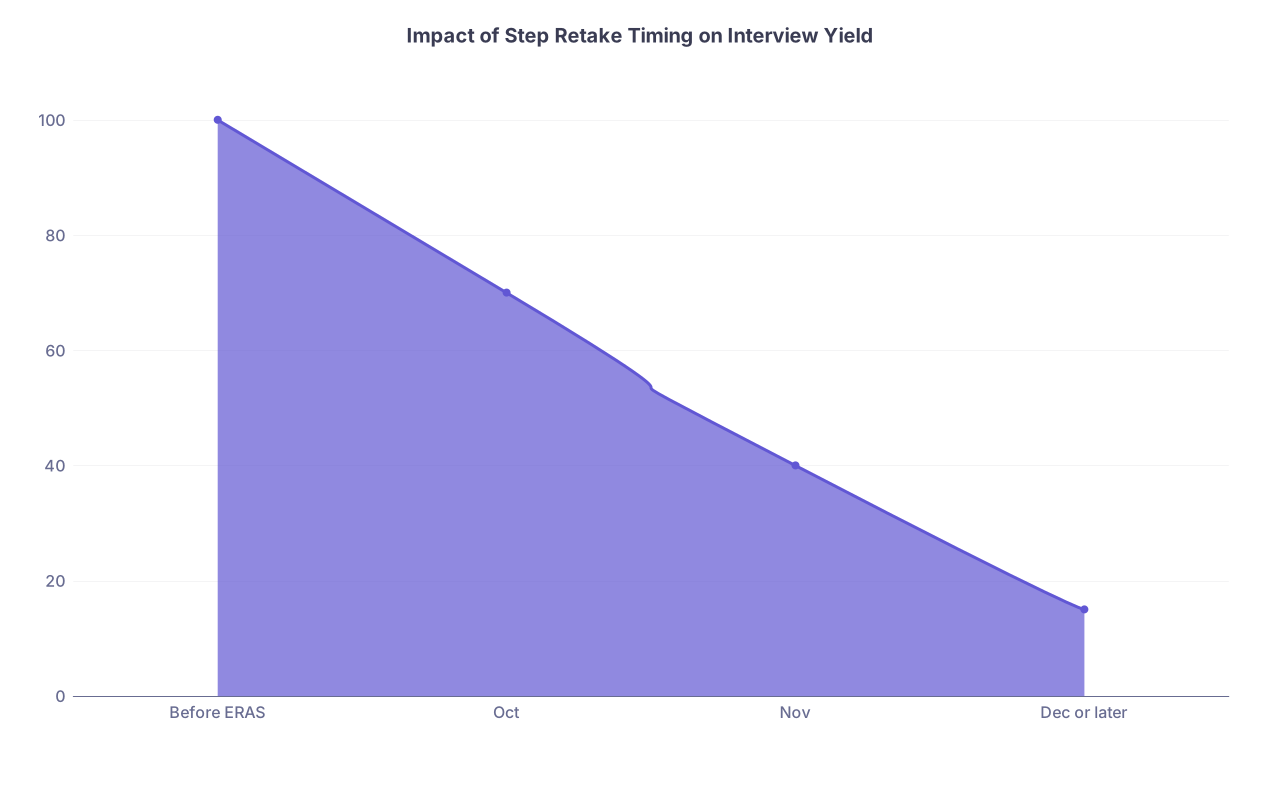
And you must avoid one massive mistake: taking the retake late in the cycle.
If your improved score arrives after most interview offers are out, you have essentially wasted that improvement for another year.
| Category | Value |
|---|---|
| Before ERAS | 100 |
| Oct | 70 |
| Nov | 40 |
| Dec or later | 15 |
This is not exact data from a single study. It reflects the pattern many of us see cycle after cycle: earlier remediation → more interviews.
Plan backwards:
- Identify the latest safe date to have your passing score reported before programs start sending invites (usually by September for most specialties).
- Build a 3–4 month intensive study plan counting back from that reporting date.
- If you cannot be realistically ready by that timeline, you might need to delay reapplication a full year and use that time strategically (research year, prelim year, etc.).
4.2 Clinical Credibility: Fresh, U.S.-based, Specialty-Aligned
After a failed Step and no Match, the clock on your “clinical recency” is ticking. PDs get nervous about applicants whose last hands‑on clinical work was 2–3 years ago.
You want:
- Recent U.S. clinical experience (within 1 year of reapplication, if at all possible)
- In the field you are targeting (unless you are forced into a generic role)
- With faculty who are willing to write specific, strong letters
If you are an IMG or have limited access, consider:
- Paid roles:
- Research fellow with embedded clinical duties
- Clinical assistant / scribe roles in academic or large community practices
- Hospitalist service assistant roles in some systems
- Unpaid / observer roles (less ideal, but better than nothing):
- Longitudinal observerships where you become part of the team and earn trust
- Rotations with alumni of your school now in U.S. programs
You are not just trying to “stay busy.” You are trying to generate three concrete outputs:
- Strong new letters of recommendation (ideally at least 2 in your target specialty or in core fields close to it).
- Specific performance commentary: work ethic, teachability, patient care, improvement over time.
- Network anchors: attendings who will answer emails / calls from PDs on your behalf.
5. Choose the Right “Gap Year” Position: Research, Prelim, or Other
Here is where the post‑Match options actually branch out.
5.1 Research Year: Good, Bad, and Delusional Uses
A research year can help. Or it can be pure résumé decoration.
A good research year after failing Step / not matching:
- Is in the specialty you are now targeting (or directly related).
- Embeds you in a department with a residency program you can realistically match into.
- Gives you consistent visibility to faculty who sit on the selection committee.
- Yields tangible output:
- Abstracts, posters, manuscripts (even if not all accepted within the year)
- Presentations at local or national meetings
- Your name on projects that faculty actually remember
A wasteful research year:
- Is in a specialty you are abandoning.
- Is remote / purely data entry with no clinical exposure, no faculty contact.
- Produces “4 posters at tiny unknown meetings” but zero depth of relationship.
5.2 Prelim or Transitional Year: Hidden Gold, If Used Correctly
Taking a prelim medicine or surgery spot after failing a Step is risky if you have not yet remediated the exam problem. But in many cases, a prelim or TY year can:
- Give you robust U.S. clinical experience
- Generate strong letters from core specialties
- Lead to an in‑house categorical position if your performance is outstanding and a spot opens
The catch: if you still need to pass Step 3 or retake Step 2, your bandwidth during intern year is limited. You must time your exams realistically.
For some, the best sequence is:
- Use the post‑Match year to:
- Remediate and pass your exam(s)
- Build clinical and research credibility
- Then start a prelim year with exams already behind you, reapplying from a position of strength.
5.3 Other Roles: Hospital Jobs, Teaching, or Non‑Clinical Work
Not everyone has access to research years or prelim spots. You might end up in:
- Hospital‑based roles:
- Scribe, case manager assistant, quality improvement analyst, clinical documentation specialist
- Academic roles:
- Anatomy or physiology teaching fellow, simulation lab instructor
- Non‑clinical, but health‑adjacent:
- Pharma, health tech, consulting, public health jobs
These are not meaningless. But for residency reapplication, they are secondary to:
- Exam remediation
- Specialty‑relevant clinical experience
- Strong letters
If you take these roles, pair them with targeted clinical observerships and ongoing academic involvement.
6. Rebuild Your Narrative: From “Failure” to “Trajectory”
By the time you reapply, your raw data might look like this:
- One failed Step 1 or Step 2, then a pass (possibly with a modest score)
- 1–2 gap years
- Research / prelim / clinical support roles
- A mix of new and old letters
Alone, that does not sell itself. You must tie it together coherently.
6.1 Your Core Story
You are telling a simple, specific story:
- I encountered a major setback (failed Step X, unmatched).
- I took ownership and analyzed why.
- I implemented concrete changes:
- Structured studying
- Time management
- Wellness / mental health support if that was a component
- Mentorship and feedback
- These changes worked:
- Passed the exam(s) on subsequent attempt(s)
- Succeeded in rigorous clinical or research roles
- Earned strong letters attesting to consistency and growth
- I am now better prepared for residency than I would have been without that failure.
You do not over‑therapize it. You do not write a memoir about burnout. This is not a personal essay contest. You show cause → action → result.
6.2 Personal Statement: Specific, Not Self‑Pitying
A targeted post‑Match personal statement after a failure should:
Acknowledge the failure directly in 1–2 paragraphs.
“During my third year, I failed Step 1. This was the result of [brief, specific factors—poor planning / underestimating test, etc.].”Emphasize changes in process, not just emotions.
“I developed a weekly schedule, used NBME forms to guide studying, and met with a learning specialist regularly.”Point to outcomes.
“These changes allowed me to pass Step 1 on my second attempt and later Step 2 on my first attempt, while also performing strongly on my sub‑internship in internal medicine…”Return to your specialty motivation and clinical experiences.
Do not let the failure dominate the entire statement. It is one chapter, not the whole book.
7. Rebuild Your Application Mechanics: Numbers, Targeting, and Timing
Your post‑Match plan lives or dies with execution on three mechanical fronts:
- Program list strategy
- Application timing
- Communication and networking
7.1 Program List: Drop the Ego, Maximize Real Options
Too many reapplicants use the same list that failed them last time. That is malpractice on yourself.
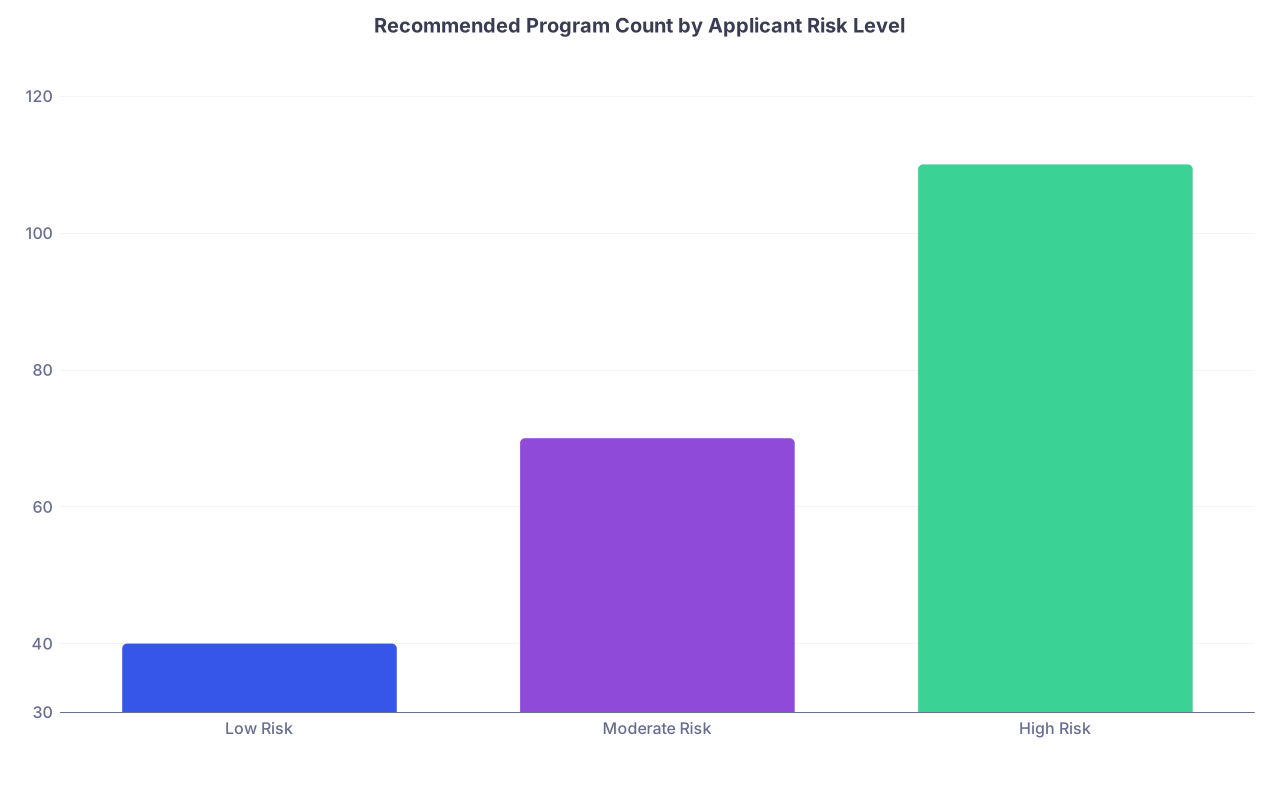
For a high‑risk applicant (failed Step history, unmatched), your list should:
- Include a much higher proportion of:
- Community programs
- “Off‑the‑radar” academic programs
- Less desirable locations (rural, smaller cities, states with physician shortages)
- Be broad enough:
- 80–120+ programs in primary care / IM / FM / Peds for many IMGs or high‑risk AMGs
- 60–100+ programs in Psych depending on credentials
- Fewer if you are a strong U.S. grad with robust remediation, but still broader than last cycle
| Category | Value |
|---|---|
| Low Risk | 40 |
| Moderate Risk | 70 |
| High Risk | 110 |
If you are reapplying to a competitive specialty after failure and a non‑match, you must be prepared for very high application numbers and a realistic backup specialty.
7.2 Timing: You Cannot Be Late. At All.
After a failed Step and no Match, you are already behind. Any further delay is self‑sabotage.
Your goals:
- ERAS submitted as close to opening day as humanly possible.
- Letters uploaded early, or with explicit confirmation from letter writers that they will meet early timelines.
- Step results posted before most interview offers are made.
- If you are doing a prelim year, request time off for interviews early and communicate your plan clearly to your program.
7.3 Networking: Stop Sending Generic “I Am Very Interested” Emails
Targeted post‑Match networking is not spamming program coordinators with copy‑paste emails. It is:
Identifying:
- Programs where your school has alumni
- Places where you have done rotations, observerships, research
- Institutions where your mentors or recommenders have contacts
Asking your advocates to:
- Email or call PDs directly with a brief, specific note
- Mention your failure and remediation factually, then vouch for your performance
You can send personal emails too, but they must be:
- Program‑specific (“I have worked in your system / my mentor Dr. X trained there…”)
- Concise (3–5 sentences)
- Attached to something real:
- A connection
- An away rotation
- A research collaboration
- A presentation at that institution’s conference
8. Psychological Reality: How to Survive the Waiting
I have watched extremely capable students implode not from the academic work, but from the 12–18 months of uncertainty and shame after failing a board and going unmatched.
Here is the unvarnished truth:
You will compare yourself to classmates who matched on time. Stop. Their trajectory is irrelevant to the decisions PDs will make about you now.
Some family members will not understand why you “aren’t a doctor yet.” Learn a short script and use it repeatedly:
“I had a major exam setback, I am fixing it, I am working in X role and reapplying to residency next year.”You must treat this gap not as a void, but as a job. Structure your weeks:
- Dedicated exam study blocks
- Clinical / research / work hours
- Weekly meetings with a mentor or accountability partner
- Protected time for sleep, exercise, something that is not medicine
Here is a rough, sanity‑preserving weekly structure for a post‑Match, exam‑remediating year:

| Step | Description |
|---|---|
| Step 1 | Mon AM - Study |
| Step 2 | Mon PM - Research or Clinical |
| Step 3 | Tue AM - Study |
| Step 4 | Tue PM - Work or Clinical |
| Step 5 | Wed - Full Clinical or Research Day |
| Step 6 | Thu AM - Study |
| Step 7 | Thu PM - Meetings or Mentoring |
| Step 8 | Fri - Mixed Study and Work |
| Step 9 | Sat - Light Study or Rest |
| Step 10 | Sun - Off or Brief Review |
Is it perfect? No. But it keeps you moving forward in multiple domains without burning out again.
9. When To Consider Alternative Career Paths
I am not going to pretend residency is always salvageable. A subset of applicants, especially with:
- Multiple Step 1 and Step 2 failures
- Long gaps in clinical work (4+ years)
- Repeated unsuccessful Match cycles despite substantive improvements
will find the door gradually closing.
Before you throw years at a low‑probability outcome, have a frank conversation with two groups:
- A brutally honest advisor who understands Match data.
- Yourself.
Non‑residency paths that still leverage your training include:
- Clinical research management
- Medical education roles (simulation, curriculum design, teaching faculty with graduate degrees)
- Pharma / biotech (medical affairs, clinical operations)
- Health policy, public health, informatics
- Industry roles where medical background is an asset but board certification is not strictly required
These paths are not “failure” careers. They are different careers. But they only make sense to pivot to after you have done a serious, data‑driven assessment of your residency odds.
FAQs
1. Should I delay reapplying to the Match until after I pass Step 3?
If you already have a failed Step 1 or Step 2, passing Step 3 before reapplying can be a strong positive signal, especially for IM, FM, and certain community programs. It demonstrates that the exam problem is truly under control. However, Step 3 is not a magic eraser. If delaying for Step 3 means another full year of waiting with no strong clinical / research role, that is a poor trade. Best scenario: combine a structured role (research / prelim / clinical) with Step 3 prep, and take it early enough that the pass is visible in your next ERAS cycle.
2. Is it realistic to reapply to a competitive specialty like dermatology, ortho, or plastic surgery after failing Step?
Usually not. There are rare exceptions—outstanding research portfolios, strong home‑institution advocacy, or extremely unusual circumstances—but for most applicants with a failed Step and an unmatched cycle, ultra‑competitive fields become functionally closed. Your energy is better spent pivoting to a specialty where your profile can realistically compete, rather than burning years chasing a 1–2% outcome.
3. How many years after graduation is “too late” to match with a failed Step on my record?
Programs vary, but many become cautious once you are >3–5 years from graduation without residency training, especially if your clinical experience is not recent. That does not mean impossible, but the bar rises. If you are >5 years out, you need very strong recent U.S. clinical work, fresh letters, and fully remediated exams (including Step 3 in many cases) to remain viable. Past a certain point, switching to alternative careers may be the more rational option.
4. Should I explain personal issues (illness, family crisis, mental health) as the cause of my failure?
Yes, but in a controlled, professional way. One or two sentences acknowledging a concrete challenge can give context. The danger is turning your explanation into an extended narrative of victimhood or instability. Programs want to see that you faced adversity, took appropriate support (therapy, accommodations, schedule adjustments if needed), and then demonstrated sustained recovery—through a passed retake, strong clinical performance, and stable functioning. The emphasis must always land on what changed and how you are performing now, not on how bad things were then.
Key takeaways:
- A failed Step and an unmatched cycle are survivable, but only with a targeted plan that fixes exams, rebuilds clinical credibility, and retools your application strategy.
- You must be brutally honest about specialty choice and competitiveness; stubbornly clinging to an unrealistic target can waste years.
- Every move in your post‑Match year should generate tangible outputs—improved scores, fresh letters, real relationships—not just “staying busy.”