
Leveraging Away Rotations After an Unmatched Cycle: Advanced Tactics
It is March 20th. Match Week is over. Your phone did not light up with “Congratulations!” texts. You have an email from NRMP with the word “unmatched” in it that you have already read too many times.
Fast‑forward three months. You are staring at a VSLO portal, an email from a program coordinator, and a calendar where the next real thing on it is an away rotation you essentially hope will rescue your application.
This is exactly where away rotations become a weapon instead of just “more clinical exposure.” After an unmatched cycle, you are not doing aways for fun, for “broader experience,” or because “everyone does a Sub‑I.” You are doing them to repair your file, change how PDs talk about you in meetings, and give programs a safe excuse to move you from the “No” pile to the “Maybe” or “Yes, but” pile.
Let me break this down specifically.
1. Reframing Your Situation: What Programs See After You Go Unmatched
Program directors are not mysterious. They are risk managers. After an unmatched cycle, your name in ERAS comes with silent questions:
- Why did this person not match?
- Is there a professionalism, performance, or personality issue?
- If we rank this applicant, will they struggle, quit, or bring drama?
- Will this applicant hurt our board pass rate or service coverage?
If you pretend those questions do not exist, you are already behind.
You need to make your away rotations do three things simultaneously:
- Generate new, strong, recent clinical data that contradicts whatever narrative led to “unmatched.”
- Convert program faculty into advocates, not just letter writers.
- Provide specific, program‑level evidence that you can step into their workflow on July 1 without being a headache.
Away rotations are your chance to show, not just tell.
2. Choosing Away Rotations Strategically (Not Desperately)
Most unmatched applicants are too passive in how they pick aways. “Wherever accepts me fastest” is not a strategy. It is triage. Triage might be necessary, but if you want to change your odds, you have to be more deliberate.
A. Goal‑First: What Are You Trying to Fix?
Identify your biggest liabilities from the previous cycle. Be brutally honest.
Common patterns I see:
- Mediocre or low Step 2 score.
- Weak third‑year evals or no strong Sub‑I performance.
- Late switch into the specialty, so no meaningful specialty letters.
- Red flags: remediation, professionalism notes, gap in training.
- IMG / DO with thin U.S. clinical experience in that specialty.
You pick rotations to directly attack those issues. Examples:
- Weak pre‑clinical narrative, decent scores, no red flags → you need high‑acuity, busy services where evals are very performance‑based. Think county hospitals, safety‑net systems.
- Limited home exposure in the specialty → rotate at programs that function as de facto “home programs” for unmatched or non‑traditional applicants (many community‑academics do this quietly).
- Red flag / prior professionalism concern → rotate in a setting where attendings actually see you work closely and write detailed evaluations, e.g., small‑to‑mid sized programs where residents and faculty are not anonymous.
You are not picking “brand name.” You are picking winnable battlefields.
B. Understand Program Types and What They Signal
Here is how different types of programs tend to view an unmatched applicant doing an away:
| Program Type | Value of Away After Unmatched | Why It Matters |
|---|---|---|
| Top academic (T10) | Low–Moderate | Prestige, but risk-averse, small classes |
| Mid-tier academic | High | Need service, open to strong redemption |
| Community-academic | Very High | Often hire from rotators |
| Pure community | Variable | Some never take rotators, others heavily |
| County / safety-net | High | Lots of responsibility, performance-based |
Chasing a single 4‑week rotation at a top‑3 academic program while ignoring three mid‑tier or community‑academic programs that actually take rotators into their ranks is a common, costly mistake.
If you are post‑unmatched, you prioritize programs where:
- Rotators historically match there.
- The program director actually reads and trusts rotation feedback.
- There is a track record of taking “second‑chance” applicants.
You often learn this by asking residents bluntly: “How many of your interns rotated here as students?” If the answer is “Oh, like half of us,” that is where you want to be.
C. Timing: When Do Away Rotations Actually Matter For You?
For someone who already went unmatched, the timing is different than for a rising MS4.
You have three realistic timing windows:
- Pre‑ERAS opening (May–July):
Best window for generating strong letters in time for applications. You want at least one away completed by early August so letters can be uploaded for Sept 15. - Early application season (Aug–Oct):
These rotations are less about letters (they will be late) and more about live auditions for programs that might consider you for unfilled positions (or rank you highly despite weaknesses). - Late fall / winter (Nov–Jan):
Higher risk. Letters may not help the current cycle much, but these rotations can set you up for:- SOAP opportunities.
- Off‑cycle PGY‑1 openings.
- Next year’s cycle, if you end up needing a re‑apply.
If you only have bandwidth or finances for 2 away rotations, I usually tell unmatched applicants: do one pre‑ERAS (May–July) and one Aug–Sept at a top choice that historically takes rotators into their intern class.
3. Pre‑Rotation Work: Re‑Engineering Your Story Before You Show Up
If you walk onto an away and the only thing anyone “knows” about you is that you are a year out from graduation and unmatched, they will make up the rest. Often incorrectly.
You want to set a controlled narrative before the first day.
A. Email the PD or Clerkship/Away Director Before You Start
Not a long confessional. A deliberate, professional frame. Something like:
Dr. Smith,
I am very grateful for the opportunity to rotate with your program this July. I graduated from [School] in 2024 and participated in the 2024 Match in [Specialty]. I did not match last cycle, primarily because my application was late and I had limited exposure and letters in [Specialty].
Over the past several months I have worked in [research/clinical role] and focused on strengthening my clinical skills, especially in [relevant domain]. My goal during this rotation is to demonstrate that I can function at the level of a strong incoming intern in [Specialty], and to earn the trust of your residents and faculty.
I welcome any feedback during the month on how I can best meet that standard.
Sincerely,
[Name]
You have now:
- Owned the unmatched status without drama.
- Framed it on fixable issues (letters, exposure, timing) rather than “I am fundamentally broken.”
- Declared your goal: intern‑level performance.
Programs remember applicants who are this clear.
B. Know the Program Cold
You are not a typical MS4 “exploring.” You are a job candidate.
Before day one:
- Know the program size, structure, call system.
- Know their major clinical sites and which months are heavy vs light.
- Identify at least 2–3 faculty whose clinical or research work aligns with your interests.
- Read their residents’ backgrounds: DO/IMG ratio, where people went to med school, how many are former rotators.
This is not for small talk. This tells you how to behave. A small, tight community program where half the interns are locals is very different politically from a big tertiary academic.
C. Fix the Basics So They Cannot Be Used Against You
Painfully obvious but often neglected by post‑unmatched grads:
- Be proficient with EMR before you arrive (practice via any access you have).
- Review core guidelines / algorithms for the specialty. Literally sit down with first‑year resident handbooks or pocket guides.
- Have your note templates, sign‑out structure, pre‑rounding workflow dialed in.
You are not “learning how hospital medicine works” anymore. You are proving you already know.
4. On-Rotation Tactics: How to Perform Like a “Safe Bet” Intern
On an away, you are auditioning. PDs care about three big buckets:
- Clinical performance and growth.
- Professionalism and reliability.
- Fit and teachability.
Let’s get specific on how to hit these.
A. Clinical Performance: What They Actually Watch For
You are not expected to know everything. But you are expected to think and act like someone on the verge of being an intern.
Concrete expectations:
- Own your patients.
Not “I saw this guy and wrote a note” but “I know his overnight events, labs, imaging, plan, family context, and barriers to discharge.” - Anticipate next steps.
On rounds: “For this new CHF patient, I have ordered echo, trend BMP, started diuresis, and checked with case management about home support.” - Communicate crisply.
Concise, problem‑based presentations. If residents are editing your SOAP from scratch on day 10, you are behind.
If you had weaker clinical evals before, you tell residents explicitly on day 2 or 3: “I really want to leave this rotation having proven I can manage a full panel at intern level. Please push me toward that and tell me where I am falling short.” Then you actually listen.
B. Professionalism: Small Things That Matter Disproportionately
After an unmatched cycle, you cannot afford “little” professionalism dings. They will write those down.
Do the basics flawlessly:
- Show up early. I mean early enough that if rounds start at 7:30, you are ready with pre‑rounds done, not walking in at 7:28 with coffee.
- Never disappear. Tell someone where you are at all times — “I am going to radiology to follow up this scan, I will be back in 15.”
- Document AND communicate. If a nurse is worried, you move. If you are worried, you tell someone with a pager who can act.
What gets people quietly blacklisted: complaining, gossiping, eye‑rolling, acting like this rotation is a burden rather than your shot. Residents will absolutely share “gut feel” feedback with the PD afterward.
C. Being “The Unmatched Applicant”: Addressing, Not Hiding
You do not need a T‑shirt, but people will notice the timing and wonder.
When it comes up:
- Keep it short and fact‑based.
- Own your part.
- Pivot to how you have improved.
For example:
I applied last year but did not match. My initial application was late and I underestimated how much this specialty prioritizes strong letters from home and away rotations. Since then I have focused on getting more direct clinical experience, tightening my knowledge gaps, and making sure my performance now reflects where I am, not where I was last year.
Do not blame “the system,” “bad luck,” or “my advisor.” That reads as lack of insight.
5. Advanced Letter‑Generation Strategy: Getting the Letters You Actually Need
Aways after an unmatched cycle are not just generic LOR factories. You are trying to generate decision‑changing letters.
A. Who Should Write Your Letters From Aways?
Best‑case hierarchy:
- Program Director or Associate Program Director who actually supervised or directly heard about your performance.
- Service or rotation director who attended your case presentations and saw you on rounds.
- Senior faculty who worked closely with you and is known by name in the field.
- Chief resident letters can be helpful as an extra upload, but rarely replaces 1–3.
The difference between a generic attending and the PD is huge. If the PD writes “I would be happy to have this applicant in our program,” that line will echo in many rank meetings.
B. How to Earn a Strong, Specific Letter (Not “Hardworking and Pleasant”)
You want letters with verbs and comparisons. Not adjectives.
To get that, you must:
- Ask for ongoing feedback halfway through the rotation:
“If I keep performing at my current level, where would you place me among students you have worked with this year? What would I need to do in the next 2 weeks for you to feel comfortable writing that I performed at or above intern level?” - Identify 1–2 discrete growth points and then visibly improve on them.
For instance, after feedback that your presentations lack concise assessment, you return the next day clearly sharper, and keep that up.
When it is time to ask:
Dr. Lee,
I wanted to ask if you would be willing to write a strong letter of recommendation for my application to [Specialty] this year. I learned a tremendous amount on the [service] rotation and tried to incorporate your feedback on [X and Y].
I am especially hoping for a letter that speaks to my ability to function at or near intern level and addresses concerns programs may have since I went unmatched last year. If you feel you can comment in that way, I would be grateful. If not, I completely understand and still appreciate the chance to have worked with you.
Sincerely,
[Name]
You have given them an exit if they cannot write strong. That alone filters out weak letters.
C. Managing Letter Logistics as a Reapplicant
You will need a mix of:
- 1–2 new letters from aways or your current clinical role.
- 1 solid anchor letter from your home program (if you have one).
- Optional supplemental letter from research PI if they know you clinically (not just pipetting).
Time your aways such that at least 2 key letters are uploaded by ERAS opening. The rest can follow; strong late letters still get read before rank meetings.
6. Using Away Rotations to Access Hidden Doors: SOAP, Off-Cycle Spots, and Backdoor Paths
If you think the only outcome of an away is “match or not next March,” you are missing other levers. Post‑unmatched, you must be opportunistic.
A. SOAP and the “We Know This Person” Advantage
Programs hate blind SOAP hires. A known quantity, even if not perfect on paper, is vastly safer.
During your away, you want the PD to think:
- “If we do not fill all our spots, I would be comfortable grabbing this person in SOAP.”
- “If our categorical slots are full, this person could be a strong prelim or TY applicant for us.”
You do not say, “Hey, can you keep me in mind for SOAP?” That is premature and desperate. But you do:
- Express clearly that their program is a top choice.
- Let them know you will apply broadly but would prioritize them for any opportunity, including prelim or off‑cycle.
B. Off-Cycle PGY1 or PGY2 Openings
Residents leave. Visas fall through. Life happens. Programs scramble.
An away rotator they already saw perform is the first person they often think of. I have seen this play out in July and August more times than people realize.
Your job is to remain in their mental and email inbox:
- Send a professional update email in:
- Late fall (after interviews start).
- Immediately post‑Match (whether you matched or not).
- Let them know you remain very interested in any open positions and are reachable on short notice.
Do not send monthly “just checking in” spam. Twice a year is enough.
C. Specialty Switching and “Bridge” Rotations
Some unmatched applicants pivot specialties entirely. For example: EM → IM, Ortho → FM, Gen Surg → Anesthesia.
In that case, away rotations can serve as:
- Proof that you actually understand the new specialty’s reality.
- Fresh letters untainted by a previous specialty’s politics.
In a switch scenario, I often suggest:
- One rotation in your target new specialty at a program that is realistic for your metrics.
- One rotation at a program that has both specialties in‑house, where leadership can cross‑advocate for you (e.g., IM and Pulm/CC, Surgery and Anesthesia).
This can be the difference between being seen as “fleeing after a failed match” vs “re‑aligning to a better‑fit specialty with evidence.”
7. Targeting and Tracking: Where to Rotate, Where to Apply, How to Align Them
You cannot rotate everywhere. You need to be deliberate about where your away time overlaps with your application strategy.
A. Match Your Away Targets to Your “Realistic + Aspirational” Tier
A simple way to organize this:
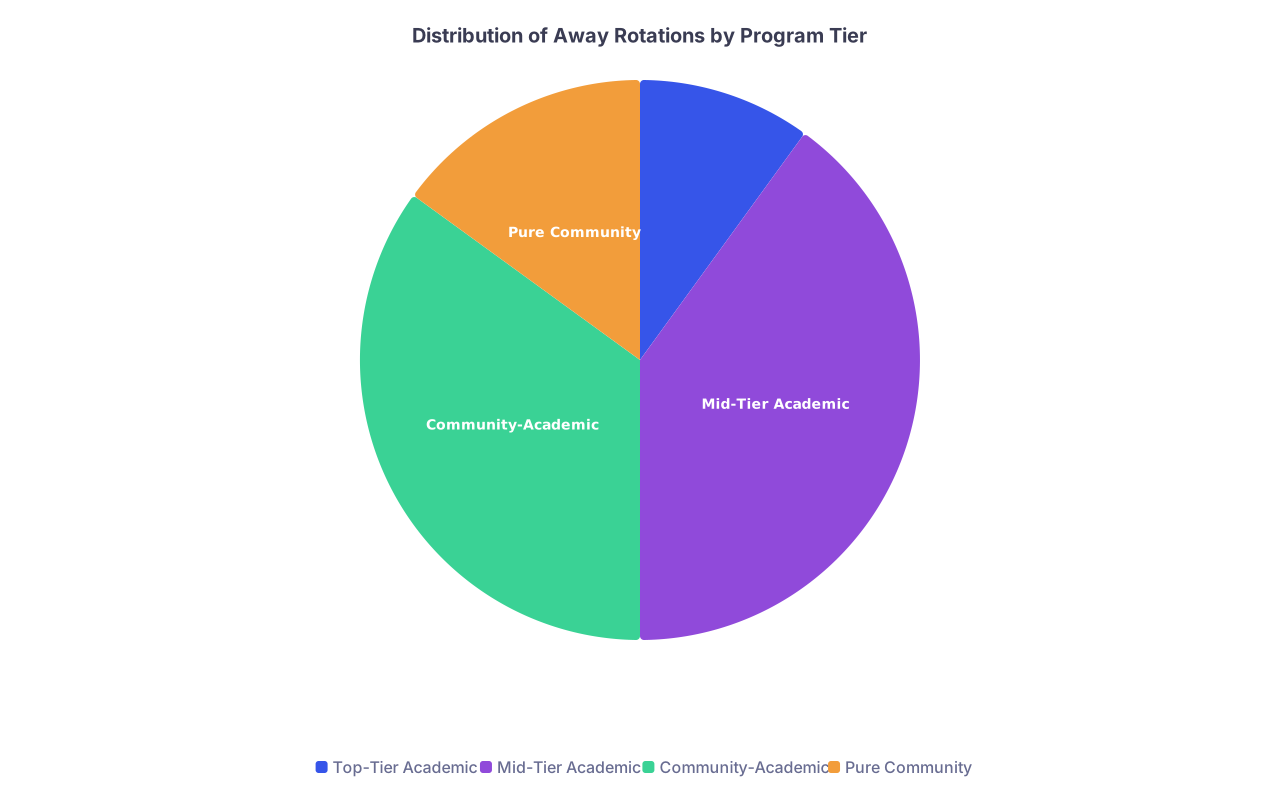
| Category | Value |
|---|---|
| Top-Tier Academic | 10 |
| Mid-Tier Academic | 40 |
| Community-Academic | 35 |
| Pure Community | 15 |
For most unmatched reapplicants, a smart away portfolio might be:
- 1 mid‑tier academic program where your metrics are slightly below average but not absurdly so, and where rotators often match.
- 1 community‑academic or strong community program that historically loves rotators and participates in SOAP or takes off‑cycle folks.
You then apply broadly, but you weight your personal outreach (emails, updates, interview prioritization) toward programs in those same tiers.
B. Use Residents as Your Intel Network
Residents will say things in call rooms that PDs will not say in emails. Examples:
- “We almost never take rotators into our program” → do not waste an away here if your primary goal is rescue.
- “Our PD loves to ‘save’ a strong reapplicant” → this is your place.
- “We are always short on prelims / TYs” → good for a foothold year if categorical is out of reach this cycle.
During your away, have a direct, humble conversation with at least one senior or chief:
I went unmatched last cycle and I am very serious about trying to join a program like this. From your perspective, what does our PD actually care about in rotators who later apply? Are there recent residents who came through a similar path?
Document what you learn. It matters later when you prioritize interview invitations.
C. Map Rotations to Your Rank Strategy
Your rank list next cycle should not be a random pile. The ideal:
- Programs where you rotated and were strongly supported sit near the top.
- Programs similar in profile and geography to your aways, where your letters will “translate,” follow.
- Programs with no exposure or weak fit drop down unless you have some other hook.
Do not rank a random big‑name program where you did a token 2‑week observership over a smaller program where the PD told you, to your face, “We would be happy to have you here.” I see people self‑sabotage this way every year.
8. Common Pitfalls I See Unmatched Applicants Make With Away Rotations
Let me be blunt about patterns that sink people.
A. Trying to “Hide the Gap”
You are one year (or more) post‑grad, but you ask everyone to act like you are a standard M4. It always leaks.
Own your PGY‑0 status. That means:
- Taking slightly more responsibility, not less.
- Admitting when you forgot something basic, then not repeating it.
- Behaving like someone who understands the stakes.
Programs are more forgiving of a 23‑year‑old MS4 “learning.” They are harsher on a 27‑year‑old unmatched grad who still shrugs at missed doses or late notes.
B. Over-Rotating at One Institution While Neglecting Breadth
I occasionally see people do 3–4 rotations at the same hospital system, hoping sheer exposure will force them into a spot.
It does not work that way. After 1–2 aways, either:
- They like you enough to seriously advocate.
- Or you are saturating diminishing returns and should take your talents to another shop.
Two strong advocates at two different institutions beat six generic “good job” comments from one.
C. Doing Observerships and Calling Them Rotations
If you are an IMG especially: pure observerships with no direct patient care, no notes, no orders, no responsibility — these have very limited value for your reapplication.
Without:
- Hands‑on patient care.
- Real evaluation forms.
- LORs that speak to your clinical decision‑making.
an “away” is decoration. Clarify, before you accept, exactly what you are allowed to do and how evaluation works.
9. Putting It All Together: A Concrete Example Path
Let me sketch an example to show how this can look when done well.
You: US MD, applied to Internal Medicine, Step 1 pass, Step 2 CK 222, average third‑year evals, one borderline professionalism comment about late notes. Applied to 30 mid‑tier academic programs late (October). Unmatched.
You decide to reapply IM.
Plan:
April–May:
Secure July Sub‑I at a strong community‑academic IM program that matches rotators frequently. Also line up a September rotation at a mid‑tier academic IM program in a region you like.June:
Email both programs’ PDs with a brief, honest explanation of your unmatched cycle and your goals for the rotation. Review IM inpatient basics, EMR practice, and note templates.July Away #1:
- Hit the ground running on wards.
- Mid‑rotation, ask attending and PD for feedback and specifically state your hope to perform at or above intern level and earn a strong letter.
- End of month: PD says explicitly “We would be happy to have you here” and agrees to write a strong LOR.
August:
Submit ERAS early with:- 1 strong new LOR from July away PD.
- 1 prior home IM faculty letter.
- 1 letter from your current clinical/research role if applicable.
September Away #2:
- Rotate at the academic program, again aiming for intern‑level performance.
- Build rapport with residents and chief; they tell you PD trusts their input.
- Attend clinic with APD, present several complex follow‑ups you have pre‑read guidelines for.
Late September:
Ask APD for letter. They say they can describe you as functioning at intern level and overcoming previous concerns. Excellent.Interview Season:
- Both away programs offer interviews; you schedule them early.
- On interviews, your story is aligned: prior match failure due to weak early letters and timing; now backed by two PD/ APD letters saying you are ready.
Rank List:
- Rank Away #2 academic program #1, Away #1 #2, then a spread of community‑academic and community programs where your profile fits.
Result: You match at your September away program. Not because you “deserved a second chance,” but because your away rotation performance gave PDs permission to ignore an older, weaker narrative.
10. Final Thoughts: What Actually Moves the Needle
Away rotations after an unmatched cycle are not a magic reset button. They are leverage. Used correctly, they give selection committees new data powerful enough to override old doubts.
If you remember nothing else, keep these three points:
- Be intentional: Choose rotations that directly address the reasons you went unmatched and where rotators realistically match or get hired.
- Perform like an intern, not a student: Own patients, invite feedback, and fix deficits visibly and quickly. Letters must say you function at or near PGY‑1 level.
- Convert exposure into opportunity: Stay on the radar of PDs and programs where you performed well for SOAP, off‑cycle spots, and a higher place on their rank lists.
Everything else — the VSLO forms, travel logistics, minor annoyances — is noise. Your job now is to turn each away from “another month of experience” into an explicit, observable argument for why taking a chance on you this time is a smart decision, not a favor.