
The biggest mistake reapplicants make is lying badly or oversharing emotionally. You need to avoid both.
You absolutely can match after going unmatched or through SOAP. Many do. The question is not “do I tell them?” The real question is “how, when, and how much do I say so it helps me instead of hurting me?”
Let me walk you through it like I would with a fourth-year who just got burned by the Match and is gearing up for another cycle.
1. Do I have to tell programs I previously went unmatched or through SOAP?
Here’s the blunt answer:
- Programs often already know or can easily infer it.
- You don’t need to blast it in your opening line, but you cannot lie or try to hide it when asked.
- Handled well, it becomes a story about growth instead of failure.
ERAS exposes a lot:
- Your med school graduation year
- Gaps in training
- Previous NRMP violations (if any)
- Prior residency positions (if you SOAP’ed in and attended)
So if you graduated 2 years ago, never started a residency, and your CV is mostly research or prelim work, most PDs will already assume you either went unmatched or matched into something you did not continue.
Trying to “avoid the topic” often backfires. Faculty are not stupid. When they see:
- Gap year(s) post‑grad with no accredited training, or
- A prelim year with no categorical position afterward,
they’ll wonder. If you don’t address it, they’ll create their own explanation. That’s usually worse than the truth.
Bottom line:
You are not required to volunteer it in your first sentence, but you must:
- Answer honestly if asked directly
- Be ready with a clear, calm, scripted explanation
- Take control of the narrative rather than acting defensive or vague
2. When should I bring it up—and when should I not?
You have three main “moments” where this comes up:
- Your personal statement / application
- The “Tell me about yourself” or “Walk me through your journey” question
- Direct questions about prior Match cycles or SOAP
Here’s how I’d handle each.
Personal statement: brief, factual, and forward-looking
You do not need a trauma memoir about your SOAP week. Programs want to know:
- What happened (at a high level)
- What you learned
- Why you’re now a safer, stronger bet
One tight paragraph is usually enough. Something like:
When I first applied for residency in 2023, I did not match. I participated in SOAP but did not secure a position. That experience forced me to reassess my application, seek more structured mentorship, and focus on strengthening my clinical performance and communication skills. Over the past year, I have completed [X work: a research year, a prelim year, advanced electives, focused clinical work], obtained stronger evaluations, and gained a clearer sense of the type of team and training environment where I will thrive.
That’s it. No drama. No self-pity. No blaming.
In the interview: only when it’s relevant
If they ask open-ended:
- “Walk me through your path since medical school.”
- “Tell me about your journey to this specialty.”
You should include it briefly and confidently as part of your timeline. For example:
I graduated from X in 2023. I applied to internal medicine that year but did not match and went through SOAP. I did not secure a position, so I focused the past year on [X: a transitional year, research, hospitalist work as a grad, etc.], which helped me improve my clinical skills and get clearer career direction. Now I’m applying again with [specific strengths you built].
If they do not ask and your gap is small and already clearly addressed in your application, you don’t need to repeatedly drag them back to it.
When they ask directly about SOAP or going unmatched
You’ll see questions like:
- “What happened with your previous match cycle?”
- “Why do you think you went unmatched?”
- “Did you participate in SOAP? What was that experience like?”
Here, you should absolutely acknowledge it, but the key is structure. Use a three-part formula:
- What happened (brief, specific, factual)
- What you learned / changed
- How that makes you a stronger resident now
Example:
I applied broadly to categorical internal medicine in 2023 but did not match. I participated in SOAP and interviewed, but I did not receive an offer. In retrospect, my application had two weaknesses: limited U.S. clinical experience and letters that were not specialty-specific. Since then, I have completed a year of inpatient hospitalist work under close supervision, rotated at X and Y programs in IM, and obtained strong letters from core IM faculty. That year also made me more resilient and more realistic about residency demands, and I feel much better prepared now than I did the first time.
No self-flagellation. No blaming the system, your school, or “bad luck.” Programs want insight and accountability, not excuses.
3. What exactly should I say—and not say—about being unmatched?
You need ready-made scripts. When you’re under pressure, you don’t want to improvise.
Good elements to include
Ownership of real weaknesses
Examples:- “I applied late and to too few programs.”
- “My Step 1 failure overshadowed the rest of my file.”
- “My letters weren’t from the specialty I applied in.”
- “I didn’t have any home program advocacy or strong mentors.”
Evidence of concrete improvement
This is what PDs actually care about. Specifics like:- New or stronger letters from recognizable faculty
- Additional U.S. clinical experience / sub-I’s
- Improved Step 2 scores or fresh exam success (for an earlier failure)
- A successful prelim year with solid evaluations
- Research or QI projects with output (presentations, publications, posters)
Emotional maturity and insight
Show you didn’t crumble permanently:- “Initially, it was very difficult, but it pushed me to seek mentorship and honest feedback.”
- “It taught me to ask for help earlier and to be more strategic instead of just hopeful.”
Things that will tank your credibility
Avoid these like they’re contaminated needles:
“I don’t know why I didn’t match.”
(Tells them you lack insight or haven’t done the work.)“It was just bad luck.”
(Bad luck exists, but if that’s all you can say, they’ll pass.)Blaming others:
- “My advisor didn’t help me.”
- “The program I rotated at misled me.”
- “The Match is broken.”
Excessive emotional dumping:
- “I was devastated… I couldn’t function for months…”
You can acknowledge difficulty, but keep it professional and show recovery.
- “I was devastated… I couldn’t function for months…”
You’re not in therapy. You’re in a job interview.
4. How much detail should I give about SOAP specifically?
SOAP is tricky. Programs know it’s brutal. Some faculty have been on the other side making those 3-minute phone calls all week. They understand.
You do not need to detail every offer you did or didn’t get, or rank what you “settled” for. The more you talk about chaos and desperation, the less stable you sound.
Reasonable, safe level of detail:
I did participate in SOAP. I prioritized programs that aligned as closely as possible with my long-term goal of [specialty X or Y], but ultimately I did not receive an offer. That experience made it very clear that I needed to [improve X, get more U.S. experience, clarify my specialty choice, etc.], which is exactly what I’ve focused on this year.
If you did SOAP into a prelim or different specialty and attended:
After going unmatched, I SOAP’ed into a prelim medicine year at [Hospital]. That year gave me strong experience in inpatient care and confirmed that I’m most motivated by [X aspect] of [current specialty]. I completed the year in good standing, and my attending evaluations reflect real growth in [relevant skills]. Now I’m looking for a categorical home where I can continue that trajectory.
That shows: you worked, you learned, you weren’t kicked out, and you’re now making a thoughtful decision—not bouncing randomly.
5. How do programs actually view previous unmatched/SOAP cycles?
Here’s the unvarnished truth:
Being unmatched or SOAP-only is a risk flag, not an automatic disqualifier.
Programs will ask three questions:
Is this person likely to struggle here the same way?
That’s why you must show: new scores, stronger letters, better prep.Is there something professionalism-related we’re not seeing?
Any sign of blame, excuse-making, evasiveness, or attitude will inflame this fear.Has time helped or hurt?
- If you used the time for clinical work, research, or a strong prelim year → helps.
- If it’s 3 years of “preparing for exams” with no concrete output → hurts.
Programs also quietly know this:
Plenty of excellent residents matched on their second try. Especially in competitive specialties or for IMGs.
If you show:
- A realistic application strategy this time
- Evidence you can do the job on day 1
- A stable, teachable personality
Your previous unmatched status becomes a footnote, not the headline.
6. Decision guide: how should you handle it specifically?
Use this quick framework.

| Step | Description |
|---|---|
| Step 1 | Previous Unmatched or SOAP |
| Step 2 | Address briefly in personal statement |
| Step 3 | Optional to mention in PS |
| Step 4 | Prepare 3-part explanation for interviews |
| Step 5 | Answer clearly with growth focus |
| Step 6 | Only mention if explaining timeline or gap |
| Step 7 | Gap or non-traditional path visible? |
| Step 8 | Interviewer asks directly? |
Now break it down by scenario.
| Scenario | How Open Should You Be? |
|---|---|
| Recent grad, 1 missed Match, doing strong prelim year | Be open; highlight prelim performance |
| 2–3 years post-grad, no residency, inconsistent activities | Be very structured; emphasize improvement and stability |
| IMG with clear exam or visa barrier previously | Openly address barrier and how you overcame or mitigated it |
| Switched specialties after SOAP into something else | Explain switch clearly and without trashing previous specialty |
| Prior professionalism or remediation issues | Must address concisely and demonstrate sustained change |
If you’re not sure which bucket you’re in, assume you need at least a short, honest explanation ready for every interview.
7. Concrete examples: bad vs. good answers
This is where people actually blow it. Let’s fix that.
“Why do you think you went unmatched?”
Bad:
Honestly, I’m not really sure. My school doesn’t have a strong advising system and I think the year was super competitive. I didn’t get the interviews I deserved.
Good:
I applied late and too narrowly, and my application wasn’t strong enough in two key areas: my Step 1 failure and lack of specialty-specific letters. After I didn’t match, I sat down with two faculty mentors who gave me very direct feedback. I addressed those points by [specific actions]. My current evaluations and letters reflect that improvement.
“Did you participate in SOAP? How was that?”
Bad:
Yeah, it was awful. Total chaos. I felt like I was begging for any spot and nobody was really looking at me as a person.
Good:
I did participate. It was obviously a stressful week, but it also forced me to get very honest feedback quickly. While I didn’t secure a position, the conversations I had with program leadership helped me understand where my file was weak and what I needed to do over the next year. I took that seriously and that’s why my recent experiences have been so focused on [skills or areas improved].
8. Final practical tips before interview day
Three things you should actually do this week:
Write and rehearse your 3–4 sentence “what happened” story.
Say it out loud until you can deliver it calmly, without your voice tightening or apologizing for existing.Line up at least one mentor who can vouch for your growth.
Programs trust faculty-to-faculty conversations. Make sure someone senior can honestly say, “This applicant had a setback, responded maturely, and is ready now.”Make sure the rest of your file shows forward motion, not drift.
If your CV looks like a holding pattern, your explanation—no matter how polished—will sound hollow.
And remember: they invited you. That means at least one person read your history, saw your gaps, and still said, “I want to talk to this person.” Don’t act like you snuck in through a side door. You’re there because they think you might be worth the bet.
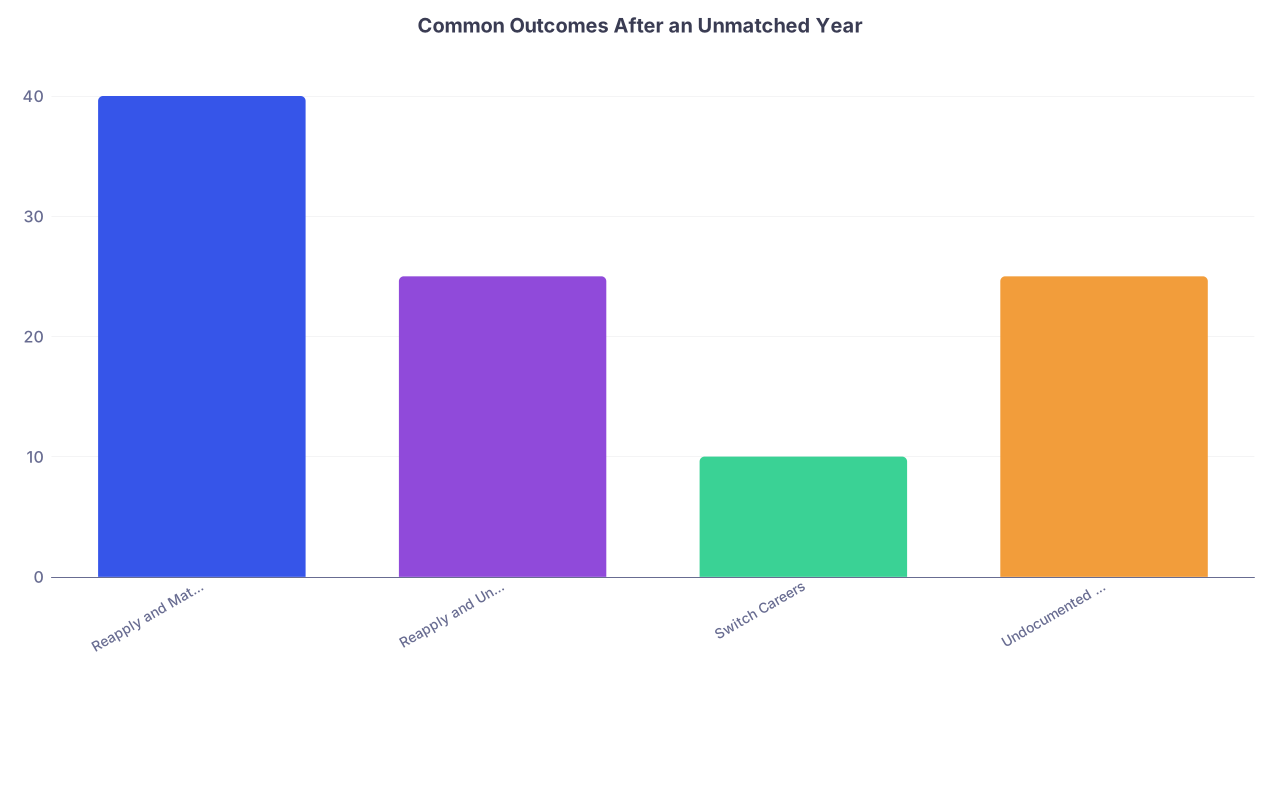
| Category | Value |
|---|---|
| Reapply and Match | 40 |
| Reapply and Unmatched | 25 |
| Switch Careers | 10 |
| Undocumented Outcome | 25 |


FAQ: Previous SOAP / Unmatched and Interviews
Should I directly say, “I went unmatched last year,” or phrase it more vaguely?
Be direct but concise. Saying “I did not match in 2023 and participated in SOAP” is better than dancing around it. Then immediately pivot to what you learned and how you improved. Vagueness makes people suspicious.Will programs see that I was previously unmatched just from ERAS?
They’ll see your graduation year, any prior training, and gaps. While ERAS doesn’t stamp “UNMATCHED” in red, experienced PDs can easily infer it. Assume they either already know or will ask if it’s not obvious why you have no prior residency.If I SOAP’ed into a prelim year, do I have to explain why I’m reapplying?
Yes. They’ll want to know why you’re leaving that path. Explain what you gained from the prelim year and why a categorical position in this specialty is a better long-term fit—without trashing your current program or specialty.Can I say I withdrew from the Match instead of saying I went unmatched?
If you truly withdrew before rank lists were certified, you can say that. If you stayed in and didn’t match, calling it “withdrawing” is lying. NRMP violations and dishonesty spread quickly. Don’t play games with factual history.How much emotional detail is appropriate when talking about going unmatched?
One sentence is enough: “It was very difficult at first, but it pushed me to seek feedback and grow.” Anything more starts to sound like you’re still stuck in it. They want to see resilience and recovery, not raw distress.Will being previously unmatched automatically disqualify me from competitive programs?
It definitely makes matching into ultra-competitive specialties harder, but it’s not an automatic “no” everywhere. Strong, recent performance (especially in a prelim year or robust U.S. clinical experience) plus realistic targeting can absolutely get you interviews and a match.Should I mention my unmatched/SOAP history in every interview answer where it could fit?
No. Mention it where it logically belongs: your journey, gaps, or when directly asked. Over-referencing it makes it the center of your identity. You want programs leaving the interview thinking about your current strengths and fit, not just your prior setback.
Key points to walk away with:
- Do not hide or lie about going unmatched or through SOAP—address it briefly, clearly, and with evidence of growth.
- Script your story: what happened, what you learned, and how you’re now stronger; then keep moving forward in the conversation.
- Make sure your current year actually backs up your explanation—strong recent performance and maturity matter far more than the scarlet “unmatched” label from last cycle.