
Most gap years hurt applicants more than they help. Not because the time is bad, but because the plan is vague, unfocused, and clearly thrown together after a bad Match Day.
You want the opposite of that.
You want a gap year that makes program directors say: “This person got hit, stood up, and came back sharper. We should interview them.” That is absolutely doable. But only if you treat this year like a structured intervention, not a 12‑month apology tour.
I am going to walk you through exactly how to build a targeted, program‑impressive gap year plan. Step by step. No fluff.
Step 1: Diagnose Why You Did Not Match (Ruthlessly, Not Emotionally)
You cannot build a targeted plan if you are not brutally clear on what went wrong.
Skip the ego‑preserving stories. “The Match is random” is not a plan. You need a working diagnosis.
Use this simple triage:
Objective metrics
- USMLE/COMLEX scores (especially Step 1 pass/fail context and Step 2 CK).
- Class rank, GPA, failed courses / remediation.
- Number and types of programs applied to.
Application strength
- Letters of recommendation (specialty‑specific? from known faculty? generic vs strong?).
- Personal statement (coherent narrative or generic/rambling).
- CV depth in the specialty (research, electives, leadership, sustained interest).
Strategy and fit
- Overly competitive specialty with mediocre stats (e.g., 215 Step 2 trying for derm).
- Too few applications or wrong mix (only top‑tier programs, no community / safety).
- Geographical restrictions that made you high‑risk to programs.
Interview performance
- Few invites: screening problem.
- Many invites, no rank/match: interview or professionalism issue.
- Feedback from advisors, mentors, or even faculty who interviewed you (if you can get it).
Do a hard, written self‑audit. Literally write this out:
- “Metrics issues: …”
- “Application / narrative issues: …”
- “Strategy issues: …”
- “Interview / professionalism issues: …”
Then, get external review:
- Trusted faculty advisor.
- Program director or APD if you can get one to look at your application.
- Your Dean’s office / career advisor.
If two or more people point to the same thing (weak Step 2, weak letters, unclear commitment to specialty, poor interviewing), that is your primary problem set. Your gap year plan must directly attack those issues.
Step 2: Decide Your Core Goal for the Gap Year
A gap year that impresses programs does one primary thing extremely well:
- Fix the biggest red flag that blocked you from matching.
Everything else is secondary.
Common primary goals:
Boost clinical credibility
“I need recent, strong clinical experience in the US, ideally in my specialty.”Repair academic / exam profile
“I need to prove I can handle boards and clinical knowledge now, not three years ago.”Demonstrate sustained specialty commitment
“I was a generic applicant. I need to look like someone who is clearly ‘one of us’ in this field.”Fix professionalism / maturity concerns
“I need a track record of reliability, teamwork, and responsibility with people who will vouch for me.”
You can have one primary and one secondary goal. But not five. Programs want a coherent story, not a random collection of activities.
So pick:
- Primary: __________________________
- Secondary: ________________________
Write it down. Every major decision you make this year must justify itself against those two lines.
Step 3: Map Your Options – What Actually Impresses Programs
Not all gap year activities are equal. Some scream “serious, committed, improving applicant.” Others scream “I panicked and took whatever fell into my lap.”
Here is the hierarchy, based on what I have seen programs actually respect.
| Activity Type | Typical Impact on Programs |
|---|---|
| Transitional year / prelim year in same field or related | Very High |
| Clinical research with direct faculty contact | High |
| Full-time clinical job (scribe, MA, hospitalist extender) | Moderate–High (if well-structured) |
| Research-only role with publications | Moderate–High (specialty-dependent) |
| Observerships / externships with letters | Moderate |
| Non-clinical job unrelated to medicine | Low (unless framed extremely well) |
Now, let’s turn this into something useful.
Option 1: Preliminary / Transitional Year
If you already matched into a prelim or TY but not an advanced spot, or you can secure a PGY‑1 position off‑cycle, this is often the most impressive thing you can do.
Why programs like it:
- Shows you can function as a physician in the US system.
- Provides fresh, detailed letters from attendings.
- Gives you real clinical growth, not just theoretical improvement.
Best for:
- Internal medicine, family med, neurology, anesthesia, radiology, PM&R, etc.
- Applicants with older graduation dates who need recent clinical work.
Pitfalls:
- Crushing yourself with 80‑hour weeks and doing nothing extra. You still need to:
- Build relationships with faculty.
- Ask early for targeted letters.
- Keep your original specialty visible if you are switching later.
Option 2: Structured Clinical Research Year (Ideally in Your Target Specialty)
This is the workhorse of targeted gap years, especially for competitive specialties and IMGs.
What “impressive” looks like:
- Full‑time research position at an academic center in your specialty or a closely related one.
- Direct supervision by a faculty member who writes letters.
- At least a few concrete outputs by the time ERAS opens:
- Abstracts, posters, manuscripts (submitted / accepted).
- Named role on ongoing projects.
- Presentations at departmental conferences or regional/national meetings.
Weak version (what you must avoid):
- Unpaid “volunteer” research where you are basically a data-entry ghost.
- No real interaction with attendings.
- Nothing with your name on it by application time.
Programs can tell the difference.
Option 3: Clinical Gap Jobs That Actually Count
Working for a year can be powerful if you choose carefully and frame it correctly.
High‑value versions:
- Inpatient or ED scribe for a busy service in your specialty of interest.
- Clinical research coordinator with heavy patient contact.
- Medical assistant or care coordinator in a subspecialty clinic (e.g., cardiology, rheumatology, psych).
What programs want to see from these:
- Concrete skills: communication, documentation, systems navigation, multidisciplinary teamwork.
- Strong, specific letters from supervising physicians: reliable, proactive, clinically minded.
- A clear line connecting the job to your desired specialty and growth as a future resident.
Low‑value version:
- Vague “healthcare adjacent” job with no physician oversight, no letter, and no story.
Option 4: Observerships / Hands‑On Externships
These help more for:
- IMGs needing US clinical exposure.
- Applicants who changed specialties and need new specialty‑specific letters.
To make observerships actually count:
- Aim for longer blocks (e.g., 4–8 weeks in one place) rather than a collection of 1‑week tours.
- Work closely enough with one or two attendings that they can write a detailed letter.
- Participate actively: presentations, case discussions, clinic sessions (within legal limits).
Observerships alone rarely save an application. But as part of a broader plan, they can fill a critical letter or clinical gap.
Option 5: Non‑Traditional or Non‑Clinical Paths
These can impress if:
- They solve a real narrative problem.
- They connect clearly to your specialty or to skills relevant to residency.
- You back them with a serious letter from a supervisor.
Examples:
- Public health degree with clear link to your specialty (e.g., MPH with health policy work for someone aiming at IM or EM).
- Health tech or quality improvement roles within a hospital system.
- Global health work with clinical and systems responsibilities.
But do not kid yourself: a random unrelated job you did to pay rent is not a strength on its own. It is neutral at best unless you frame the story correctly and still address your core weaknesses.
Step 4: Build a 12‑Month Timeline (Not a Wishlist)
Programs hate vague “I plan to do some research and some clinical work” statements. They want to see structure and follow‑through.
Design your year in phases. Here is a concrete template you can adapt.
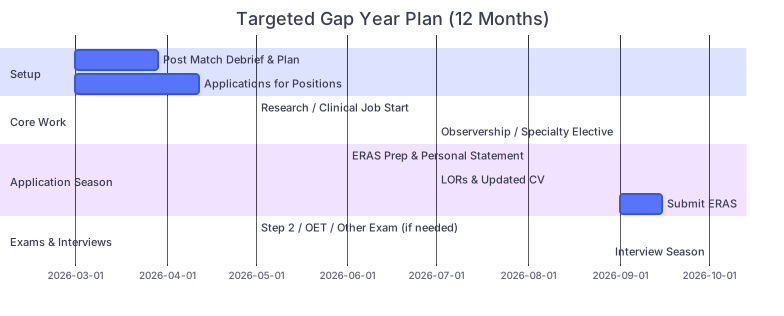
| Task | Details |
|---|---|
| Setup: Post Match Debrief & Plan | a1, 2026-03, 4w |
| Setup: Applications for Positions | a2, 2026-03, 6w |
| Core Work: Research / Clinical Job Start | b1, 2026-05, 7m |
| Core Work: Observership / Specialty Elective | b2, 2026-07, 2m |
| Application Season: ERAS Prep & Personal Statement | c1, 2026-06, 3m |
| Application Season: LORs & Updated CV | c2, 2026-07, 3m |
| Application Season: Submit ERAS | c3, 2026-09, 2w |
| Exams & Interviews: Step 2 / OET / Other Exam (if needed) | d1, 2026-05, 3m |
| Exams & Interviews: Interview Season | d2, 2026-10, 5m |
You do not need this exact schedule, but you need a schedule. Break it down:
Month 0–2 (Immediately after not matching)
- Honest debrief with advisor / PD / Dean.
- Decide whether to reapply to same specialty or switch.
- Aggressively apply for:
- Research positions.
- Clinical jobs with physician supervision.
- Observerships / externships.
- Book any exams you must retake or take for the first time (e.g., Step 3, OET for some IMGs).
Month 3–9 (Core Productivity Window)
- Execute your primary role (research, prelim year, clinical job).
- Aim for tangible outputs:
- Manuscripts submitted.
- Abstracts accepted.
- Quality improvement project started and presented.
- Meet with supervisors early about letters (by month 6 latest).
- Start personal statement and ERAS revisions.
Month 6–9 (Application Build and Polish)
- Lock in letter writers with explicit requests.
- Update CV with real outcomes from your work.
- Rewrite personal statement to incorporate:
- What went wrong.
- What you did about it.
- How you are different now.
- Confirm programs list based on new reality, not old fantasies.
Month 9–12 (Applications and Interviews)
- Submit ERAS as early as possible with updated content.
- Continue your core role – do not “coast” because interviews started.
- Keep generating small wins (presentations, projects) and update programs as appropriate.
The calendar is how you force yourself to move from intention to proof.
Step 5: Select Activities That Directly Fix Your Specific Problems
Let’s make this more concrete with scenarios. Choose the one that looks most like you and see how the gap year should be built.
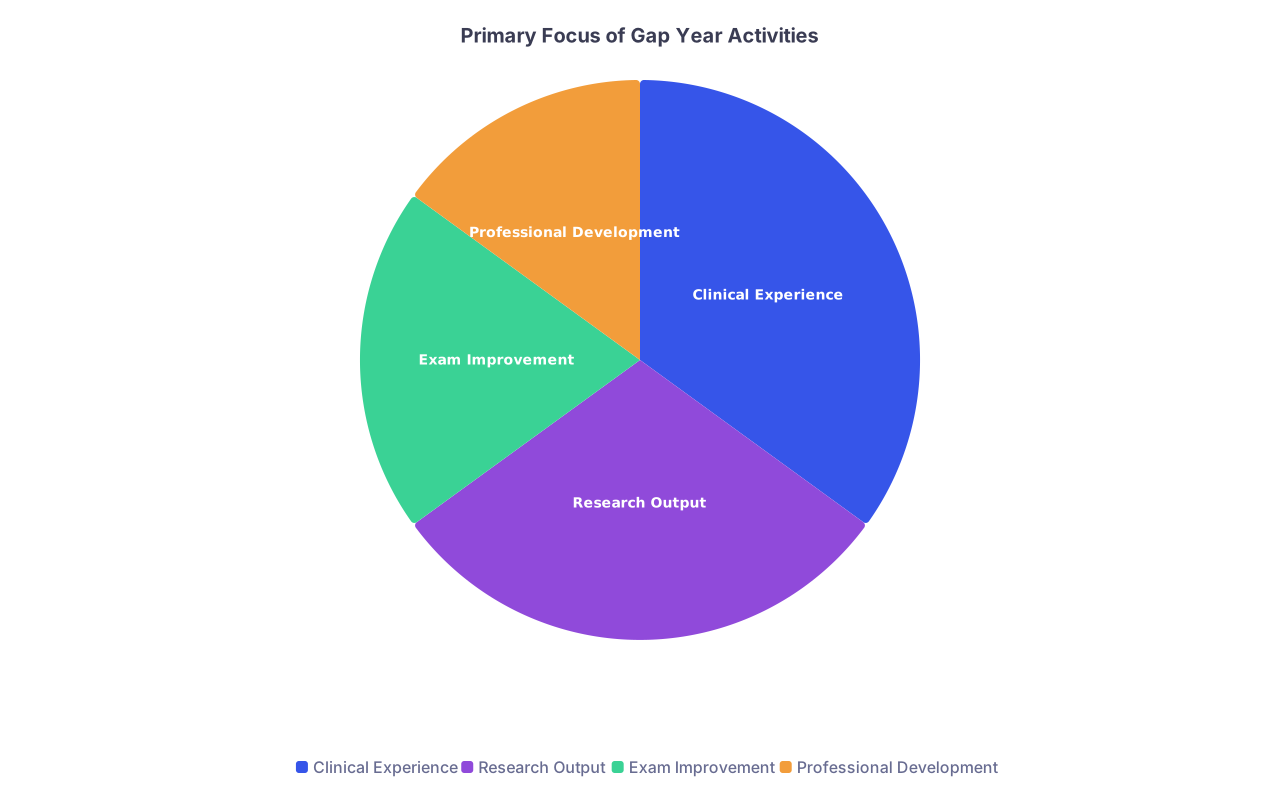
| Category | Value |
|---|---|
| Clinical Experience | 35 |
| Research Output | 30 |
| Exam Improvement | 20 |
| Professional Development | 15 |
Scenario A: Weak Step 2 CK, Limited Research, No Specialty Signal
Problem set:
- Step 2 CK 217.
- Two generic letters from core rotations, none in desired specialty (IM).
- No research, no QI, no sustained interest in IM on paper.
Targeted gap year:
- Core role: Full‑time IM research assistant / coordinator at an academic hospital.
- Secondary: Structured study plan for Step 2 retake or Step 3 if feasible and advised.
Concrete plan:
- Join an IM research group with outpatient and inpatient exposure.
- Take on at least two projects where you are first or second author.
- Give two internal presentations (journal club, QI meeting).
- Get letters from:
- Research PI.
- One inpatient IM attending who sees you function clinically (even if loosely).
- Schedule exam retake with:
- Dedicated 8–10 weeks of part‑time work and 4–5 focused study days per week.
- NBME practice tests to show improvement.
How this reads to programs:
- Weakness: Step 2 and unclear IM commitment.
- Fix: Improved exam + year working deeply in IM with tangible output and faculty vouching for you.
That is impressive.
Scenario B: Good Scores, Poor Interview Skills, “Flat” Application
Problem set:
- Step 1 pass, Step 2 245, solid transcripts.
- Multiple interviews last cycle, no match in internal medicine.
- Feedback: came off stiff, generic, lacked clear story.
Targeted gap year:
- Core role: Clinical job in IM or hospital medicine (scribe, clinical assistant) or prelim year if available.
- Secondary: Intentional personal development and narrative building.
Concrete plan:
- Work closely with attending physicians in IM.
- Take on small leadership roles (e.g., scribe supervisor, QI liaison).
- Enroll in:
- Formal communication / presentation skills course.
- Mock interview series with:
- Your school’s career office.
- Faculty who will treat it like the real thing.
- Present at least twice in front of groups (M&M assistance, nursing in‑service, or journal club, depending on role).
- Build stories from your actual patients and work to use in interviews next cycle.
How this reads to programs:
- Weakness: Interview performance and generic story.
- Fix: Real patient‑facing work with clear growth in communication and ownership, plus mentors who can vouch for your interpersonal skills.
Scenario C: IMG, No US Letters, Older Graduation Date
Problem set:
- Graduated 4–5 years ago.
- Good scores, but no US clinical experience, no US letters.
- Applied broadly, few or no interviews.
Targeted gap year:
- Core role: US‑based clinical research + observerships in your specialty.
- Secondary: Examination currency (Step 3, OET where relevant).
Concrete plan:
- Secure a research role in your specialty (or IM if broad).
- Arrange:
- 2–3 long observerships (4–8 weeks each) in settings that actually write letters.
- Make yourself indispensable:
- Show up early.
- Ask for responsibility that is allowed.
- Volunteer for talks.
- Take Step 3 (if advised) while in a supportive academic environment.
How this reads to programs:
- Weakness: Old grad, no US track record.
- Fix: Recent, US‑based experience with strong letters and evidence that you can function in the US system now.
Step 6: Engineer Strong Letters of Recommendation (Do Not Just Hope)
Gap year letters are often more powerful than your original MSPE or old rotation letters. They show what you did after failing. That matters.
Here is a simple protocol:
Pick 2–3 potential writers early
- Clinically oriented:
- Supervising attending (research with clinic exposure, observership, prelim year).
- Academically oriented:
- Research PI who knows your work habits and growth.
- Specialty‑specific if at all possible.
- Clinically oriented:
Make their job easy
- Around month 5–6, request a meeting:
- “Dr. X, I am reapplying to residency this year. I respect your opinion and was hoping you might be willing to support my application with a strong letter if you feel you can.”
- Give them:
- Updated CV.
- Draft of your personal statement.
- Bullet list of:
- Projects you worked on with them.
- Clinical cases or moments that show responsibility / growth.
- Specific weaknesses you are addressing and how.
- Around month 5–6, request a meeting:
Aim for specific content
- Ask them (gently) to comment on:
- Reliability and work ethic.
- Adaptability and improvement.
- Fit for the specialty.
- Growth since you failed to match (if they knew about it).
- Ask them (gently) to comment on:
A “gap year” letter that says, “They show up and are nice” is useless. You want: “This applicant took a setback and turned it into a period of intense growth. I would not hesitate to have them on my service.”
Step 7: Rewrite Your Narrative – How You Talk About the Gap Year
Programs do not just look at what you did. They listen to how you explain it.
You must thread a narrow needle: honest but not self‑pitying, accountable but not self‑destructive.
Structure your narrative like this:
Brief acknowledgment of the prior result
- “I applied to X last cycle and did not match. Reviewing my application with mentors, we identified weaknesses in Y and Z.”
Clear, intentional plan
- “I decided to spend this year doing A and B in order to strengthen those areas.”
Specific actions and outcomes
- “I joined the cardiology outcomes research group at [Institution], where I have worked on three projects, presented at our departmental conference, and submitted a manuscript as first author.”
- “I worked as a night‑float scribe on the internal medicine service, which gave me extensive exposure to managing complex inpatients and communicating with multidisciplinary teams.”
How you are different now
- “This year has made me more deliberate, more resilient, and more grounded in why I want to pursue [specialty]. I have had to earn back my confidence by doing the work, day after day, and I believe that will make me a better resident.”
That is how you turn a red flag into a maturity signal.
Step 8: Avoid the Common Gap Year Traps
I have watched people waste their gap year. Do not repeat these mistakes:
Passive research roles
- “I was in a research lab” with no posters, no manuscripts, no letters = wasted time.
Unstructured “studying”
- “I took the year to focus on my exams” but did not dramatically improve scores or complete them early in the cycle.
Last‑minute scrambling
- Realizing in July that you need letters and no one knows you well enough.
Ignoring strategy
- Reapplying to the exact same tier of programs with the exact same specialty when the field has moved, your profile has not, and you have no backup approach.
Hiding the failure
- Trying to pretend the prior non‑match did not happen or refusing to talk about what you learned.
You do not get credit for surviving a bad year. You get credit for designing a smart one.
Step 9: Sanity‑Check Your Plan Against What Programs Actually Value
Before you commit, run your draft plan through this lens:
Does it fix my main red flags in a way programs can see on paper?
New scores, new letters, new experiences, new outputs?Would a program director in my specialty look at this year and say:
- “This person is better clinically.”
- “This person is more committed to our field.”
- “This person has people I trust vouching for them.”
Is my plan realistic given time and logistics?
If you plan to publish 4 first‑author RCTs in one year, be serious. Pick goals that are ambitious but believable.
If the honest answer is “no” to any of those, adjust the plan now, not next February.
Step 10: Treat Your Gap Year Like PGY‑0
This is the mindset shift that separates the people who match on the second try from the ones stuck in limbo.
Behave like a resident before someone pays you to be one:
- Show up early. Stay a bit late.
- Own your tasks. Do not wait to be chased.
- Ask for feedback and adjust without being defensive.
- Document your work: presentations, projects, exam scores, roles.
A strong gap year is not about magic bullets. It is about a year‑long pattern of deliberate, visible growth.
Key Takeaways
- A gap year that impresses programs is targeted, not busy. It directly fixes the specific weaknesses that kept you from matching.
- Structure the year with a clear primary goal, a concrete 12‑month timeline, and roles that produce visible outputs: stronger letters, better scores, documented clinical or research work.
- Rewrite your narrative to show you took a hit, designed a plan, executed it, and came back stronger. Programs respect that more than a “perfect” straight path.