

You’ve made it through Match week. Maybe you went through SOAP. Maybe you watched the email come in on Monday that said “You did not match.” And now you’re staring at a list of programs that rejected you—SOAP rejections, post-interview rejections, or just silence—and you’re asking:
Can I reapply to those same programs next year, or are those doors permanently closed?
Here’s the direct answer and then the nuance.
Short Answer: Yes, You Can Reapply. But It’s Not That Simple.
Technically, yes. You can absolutely reapply to programs that:
- Did not rank you in the Main Match
- Rejected you during SOAP
- Ignored your application completely
There’s no NRMP or ERAS rule that “blacklists” you from a program forever. Programs don’t see a big red flag that says “REAPPLICANT – DO NOT CONSIDER.”
But whether you should reapply—and how to do it intelligently—is a different question.
Let me break this down the way program directors and coordinators actually see it.
How Programs View Reapplicants
Programs fall into a few predictable buckets when it comes to reapplicants.

1. Reapplied and Clearly Improved = Positive
If you reapply and your file is clearly stronger, many programs actually like that. It reads as persistence and growth, not desperation.
Strong improvements look like:
- New or stronger US clinical experience (especially for IMGs)
- A year of solid work: prelim year, research year, chief year, or meaningful clinical job
- New Step 2 CK score that’s significantly better than Step 1 or more in line with their usual cutoffs
- New letters from well-known faculty, especially in that specialty
This is the scenario where a program director might say in a selection meeting:
“We saw this applicant last year. They did a research year with us, their letters are much stronger, and they clearly want this specialty. Let’s bring them in.”
Reapplying here is not only fine. It can work in your favor.
2. Reapplied and Nothing Changed = Neutral to Negative
If your application is basically identical to last year—same scores, same letters, no new experiences—reapplying to the same programs is usually a waste of time and money.
Why? Because from the program’s point of view:
- They saw your file last year.
- They made a conscious decision not to invite/rank you.
- Nothing has changed to make them reconsider that decision.
I’ve heard more than one PD say bluntly: “If it’s the same application, it’ll get the same result.”
Not necessarily hostile. Just uninterested.
3. Specific Negative History = Usually Not Worth Reapplying
There are a few situations where reapplying to a specific program is usually dead on arrival:
- You no-showed or canceled a SOAP or interview last minute without a real reason.
- Major unprofessionalism was reported on rotation, interviews, or communication.
- Someone at the program explicitly told you they would not consider you in the future.
Residency is small. People remember this stuff.
SOAP vs Main Match Rejections: Does It Matter?
You’re probably sorting it like this in your head:
- Programs that rejected me during SOAP
- Programs that didn’t rank me in the Main Match
- Programs that never gave me an interview
Let’s unpack each.
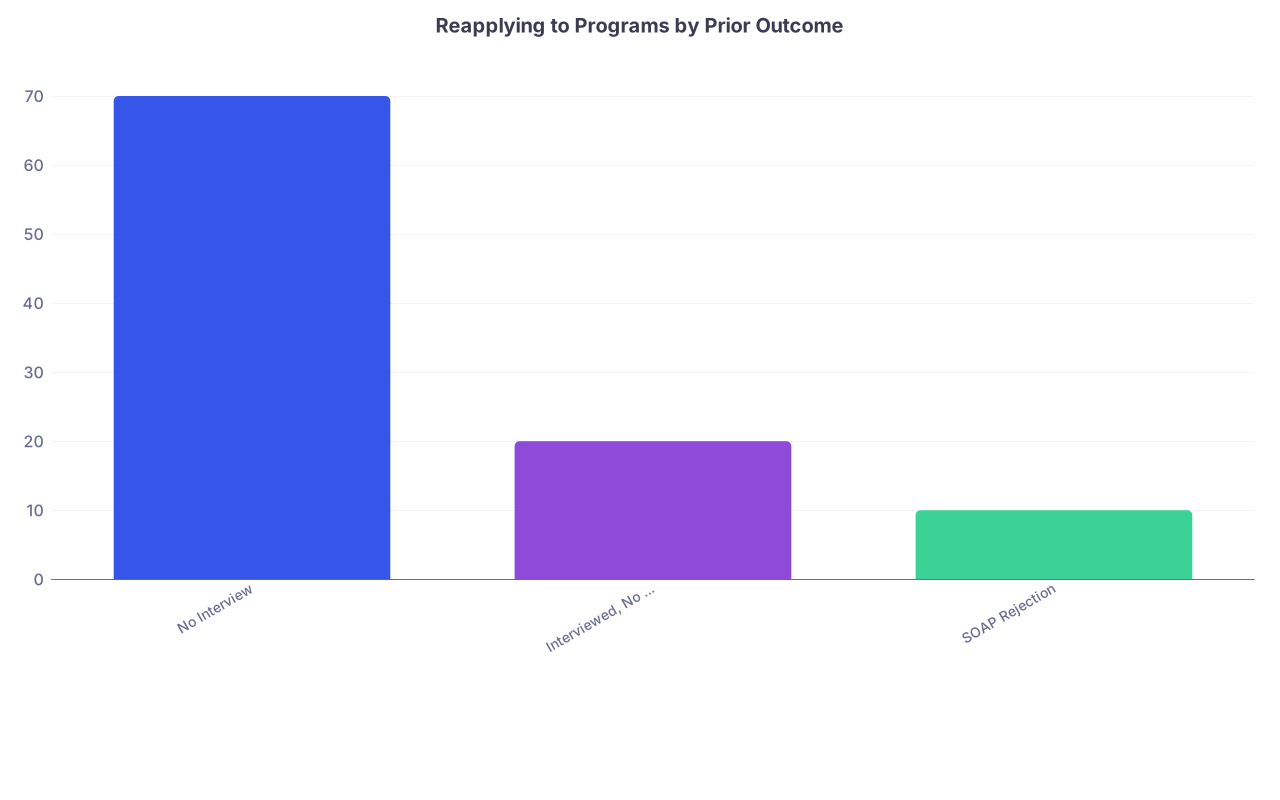
| Category | Value |
|---|---|
| No Interview | 70 |
| Interviewed, No Rank | 20 |
| SOAP Rejection | 10 |
1. Programs That Never Interviewed You (Main Match)
Reapplying here can still make sense if you changed something meaningful.
You don’t know why you didn’t get an interview. Could’ve been:
- Score filter
- School bias
- Late application
- Weak letters
- Poor personal statement
If you fix one or more of those and expand your geographic or program tier expectations, some of these may reconsider you. Especially if your profile now fits their “usual” applicant better.
2. Programs That Interviewed You But Didn’t Rank You (or Ranked You Low)
This group is trickier.
If they met you and still didn’t rank you high enough to match, a few possibilities:
- They liked you but had too many strong candidates.
- You were fine but not a fit given their priorities that year.
- There were concerns they just didn’t want to put in writing.
Should you reapply?
- Worth considering if: you’ve improved your application plus you can add a targeted cover letter/email that acknowledges your continued interest and growth.
- Less worth it if: you had clear red flags brought up during interview season (unexplained failures, awkward behavior, vague answers about your career plans) and you haven’t seriously addressed them.
3. Programs That Rejected You in SOAP
SOAP is blunt and chaotic. Programs are moving fast, screening on simple metrics, and filling as quickly as possible.
Rejection in SOAP ≠ “We hate you forever.” It often just means:
- They had dozens or hundreds of applicants for very few spots.
- Your scores/visa status/IMG status/grad year pushed you below their quick filter.
- You applied to a program way outside your realistic competitiveness zone.
Can you reapply there next year? Yes.
Should you? Depends:
- If you were wildly misaligned (low scores applying to a very competitive university program in a big city), no. Stop wasting applications there.
- If you were borderline and your profile improves (better Step 2, stronger USCE, good gap year), then yes, reapplying is reasonable.
What Actually Needs To Change Before You Reapply
Here’s the blunt truth: reapplying with the same application is like sending the same joke to someone who didn’t laugh the first time.
You need at least one meaningful upgrade. Ideally more.
| Change Type | Impact on Reapplication |
|---|---|
| New higher Step 2 score | High |
| Strong new US LORs | High |
| US clinical experience | High |
| Research in specialty | Medium |
| Better personal statement | Medium |
| Different photo only | Low |
| Reworded CV only | Low |
High-Yield Changes
These are the ones that move the needle with program directors:
- Step 2 CK improved to or above their usual cutoff
- Completed a prelim year with strong evaluations
- Completed a structured research year, especially at a known academic center
- New letters from US faculty in the specialty you’re applying to
- Substantial US clinical experience (4–6+ months for IMGs is a game changer)
Medium-Yield Changes
Helpful, but usually not enough by themselves:
- Stronger, more specific personal statement that explains your path clearly
- Better explanation of gaps, failures, or switches between specialties
- Meaningful volunteer work or leadership, especially if it directly supports your narrative
Low-Yield Changes
These alone won’t flip a prior “no” into a “yes”:
- Slightly cleaner CV format
- New ERAS photo
- Changing one or two words in your personal statement
Use these, but don’t count them as your main reason for expecting a different outcome.
How To Decide: Reapply to a Program or Drop It?
You shouldn’t just reapply everywhere by default. That’s lazy and expensive. You need a filter.

| Step | Description |
|---|---|
| Step 1 | Program from last cycle |
| Step 2 | Reapply |
| Step 3 | Only reapply if program is realistic |
| Step 4 | Maybe reapply with caution |
| Step 5 | Do not reapply |
| Step 6 | Did I interview here? |
| Step 7 | Did my profile improve a lot? |
| Step 8 | Did I fix weaknesses? |
| Step 9 | Was it a strong fit? |
Ask yourself these 5 questions for every program from last cycle:
Did I realistically fit their usual profile?
Look at their residents: US vs IMG, Step scores, visa policy, DO vs MD mix. If you were an outlier then and nothing major has changed, drop them.Did anything substantial improve in my application?
If yes, that’s a vote to reapply. If no, that’s a vote to move on.Was there any explicit or implicit negative feedback?
An attending saying “This program probably isn’t the right fit for you” is a polite no. Take it seriously.Is this a geography or program type I truly want, or just ego?
Reapplying every year to the same 5 big-name programs “just because” is how people end up with 3 unmatched cycles.Would I actually go there if they offered me a spot?
If the honest answer is no, don’t reapply. You’re wasting everyone’s time.
How To Approach Programs You’re Reapplying To
If you decide to reapply, don’t pretend it’s your first time knocking on the door. Programs have your old ERAS in their system. They know.
What you should do:
Update your personal statement to explicitly reflect growth.
Example line: “Since last cycle, I have completed a full year as a medicine prelim, strengthened my clinical skills, and confirmed my commitment to internal medicine as a career.”Consider a brief, targeted email to a small number of priority programs
Not a mass email. Not spam. Something like:Dear Dr. Smith,
I interviewed with your program in 2024 and greatly appreciated the opportunity to learn more about it. Over the past year I have completed a preliminary year in internal medicine at X Hospital, improved my Step 2 score from 220 to 240, and obtained new letters from my inpatient faculty. I remain very interested in your program and have reapplied this cycle.
Sincerely,
[Name], AAMC ID #######Align your narratives
Your ERAS activities, personal statement, and letters should all tell the same updated story: what you did this year, what you learned, and why you’re a stronger candidate now.
What you should not do:
- Beg or guilt-trip (“I was really hoping to match with you last year…”).
- Ask why they didn’t rank or choose you. Most won’t answer, and it puts them in an awkward spot.
- Harass coordinators for “feedback” they are not allowed or have no time to give.
If You’re Switching Specialties
If you’re changing fields (say, from surgery to FM or from IM to psych), your relationship with prior programs changes a bit.
- The old specialty programs: generally, no need to reapply unless you’re still open to that field and significantly improved.
- The new specialty programs: they mostly don’t care that you were rejected previously in a different field. They care about:
- Does your current story make sense?
- Do your letters support your commitment to this specialty?
- Did you use your gap/prelim year in a way that makes sense for this new field?
Reapplying to programs in a new specialty is essentially like applying for the first time, with one caveat: they will look closely at “Why the switch?” Make sure that answer is clean, honest, and mature.
Common Strategic Mistakes With Reapplying
I’ve watched this play out more times than I’d like:
- Reapplying with the same app, to the same over-reach list, and being shocked by the same result.
- Refusing to broaden geography (e.g., only California/New York) despite being an average or below-average applicant.
- Refusing to apply community or less-known programs out of pride, then ending up unmatched again.
- Not using the gap year productively—no new letters, no new scores, nothing substantial added.
If your plan for this year is “I’ll just try again and hope for better luck,” that’s not a plan. That’s roulette.
FAQ: Reapplying to Programs After Main Match or SOAP
1. Can I reapply to a program that rejected me in SOAP?
Yes. SOAP rejection does not permanently blacklist you. But you should only reapply if your application is stronger and the program is realistically within your range (scores, IMGs, visa, etc.). If nothing meaningful has changed, their answer is likely to be the same.
2. Do programs see that I applied or went through SOAP last year?
They can see prior ERAS applications if they choose to, and they absolutely remember repeat names, especially if you interviewed. They don’t automatically see “SOAP” stamped on your file, but they can infer you went unmatched or used a prelim year when they look at your timeline.
3. If a program interviewed me but didn’t rank me, is it worth reapplying?
It can be—if you’ve addressed your weaknesses. If you improved your Step 2, gained a strong clinical year, or got better specialty-specific letters, reapplying with a short, respectful email can make sense. If nothing changed, chances are they’ll just react the same way again.
4. Should I email programs I’m reapplying to?
For your top few realistic choices, yes—briefly. A short, targeted email that (1) reminds them you applied/interviewed before, (2) highlights what has changed, and (3) reaffirms your interest can help. Do not mass email 80 programs or send long personal essays; that just irritates people.
5. Is a SOAP rejection worse than not matching in the Main Match?
Not really. SOAP is just a faster, more brutal mini-cycle. A SOAP rejection usually reflects numbers and rapid filtering, not some deep judgment about your worth. From a PD’s perspective next year, “went through SOAP” is simply part of your history, not a permanent stain.
6. How much improvement do I need before it’s worth reapplying?
You need at least one substantial upgrade: higher Step 2, a solid prelim year, several months of US clinical experience, or strong new letters. Ideally more than one. If all you’ve done is tweak your CV and change your photo, that’s not improvement—that’s cosmetics.
7. Should I reapply to every program I applied to last year?
No. That’s lazy strategy. Cut the obvious long-shots, programs that clearly don’t take applicants like you (e.g., visa policies, no IMGs), and any place where there were professionalism issues or clear misfit. Focus your reapplications on programs where your newly improved profile actually fits.
Two things to walk away with:
- Yes, you can reapply to programs that rejected you in SOAP or the Main Match. There’s no hard rule against it.
- But unless your application is meaningfully stronger and your target list is more realistic, you’ll just get the same answer again—while losing another year.
Fix the application. Tighten the target list. Then reapply where it actually makes sense.


