When Your Post-Bacc GPA Looks Strong But Your Lab Grades Are Mixed
You're sitting on a 3.8 post-bacc GPA. Solid. Then you look at the lab column and see a B-minus in organic chemistry lab, a C-plus in physics lab, and a B in general chemistry lab. Your stomach drops. You start wondering if admissions committees will zero in on those lab grades and ignore everything else.
They usually won't. But it depends on the pattern.
Here's what a strong post-bacc GPA actually signals to an admissions committee: recent academic readiness. You've shown you can walk back into a classroom after time away, handle upper-level science, manage your time, and perform. That matters enormously, especially for career-changers and nontraditional applicants. A 3.7 or 3.8 post-bacc GPA tells a story of someone who figured out how to study effectively and execute under pressure.
Mixed lab grades tell a different, narrower story. Labs are weird. They're not just exams, they're four-hour blocks of manual precision, following multi-step procedures, writing pre-labs and post-labs, dealing with equipment that doesn't work, partners who don't show up, and TAs who grade inconsistently. A smart student can ace the lecture and fumble the lab for reasons that have nothing to do with scientific aptitude. Time crunch. Group dynamics. Grading variability. A bad week.
What admissions readers usually do is look at the trend across the whole record, not a single number in isolation. One rough lab grade in a strong overall performance? Noise. Multiple low lab grades clustered across core sciences? Signal.
The problem most applicants create for themselves is treating every grade as equally weighted. It's not. A high post-bacc GPA with a couple of uneven lab grades is a very different application than a mediocre GPA with a clean lab record. The GPA carries more of the load. But the lab trend still gets read, and if it tells a story of inconsistency, that story needs to be addressed.
What Admissions Committees Usually Read Into the Trend
Admissions committees read transcripts the way a hiring manager reads a resume: they're looking for patterns, not isolated data points. A single grade rarely moves the needle. What moves it is the shape of the record, whether performance is improving, stable, or erratic.
An upward trend gets read as growth. You struggled early, figured it out, and finished strong. That's a compelling narrative. Committees like it because it mirrors what happens in medical school: you will struggle, and what matters is whether you adapt. A post-bacc student who starts with a B-minus in a lab and finishes with an A in biochemistry lab is telling a better story than someone who was steady at a B the whole time.
Stable performance gets read as reliability. If your labs are consistently in the B to B-plus range and your GPA is strong, that's fine. Boring, maybe, but fine. It tells committees you're dependable in hands-on settings. No red flags.
Isolated dips get read as context. A C in one lab during a semester where you were working full-time, dealing with a family issue, or adjusting to a new city? That's explainable. Committees don't expect perfection. They expect coherence.
Where lab trends start to matter more is when the weakness is repeated. Two C's in core lab sciences, chemistry, biology, physics, starts to look like a pattern of struggle with hands-on execution. It raises questions: Can this person follow detailed protocols? Will they be careful in a clinical setting? Do they finish what they start? These are fair questions, and if your transcript invites them, you need to be ready to answer.
A high post-bacc GPA can offset a few lower lab marks if the rest of the record shows consistency and rigor. But if the lab weakness is clustered, repeated, or concentrated in the most recent coursework, the offset gets weaker. Committees weigh recency heavily. A lab struggle from your first post-bacc semester that you corrected later is much less concerning than the same struggle in your last semester before applying.
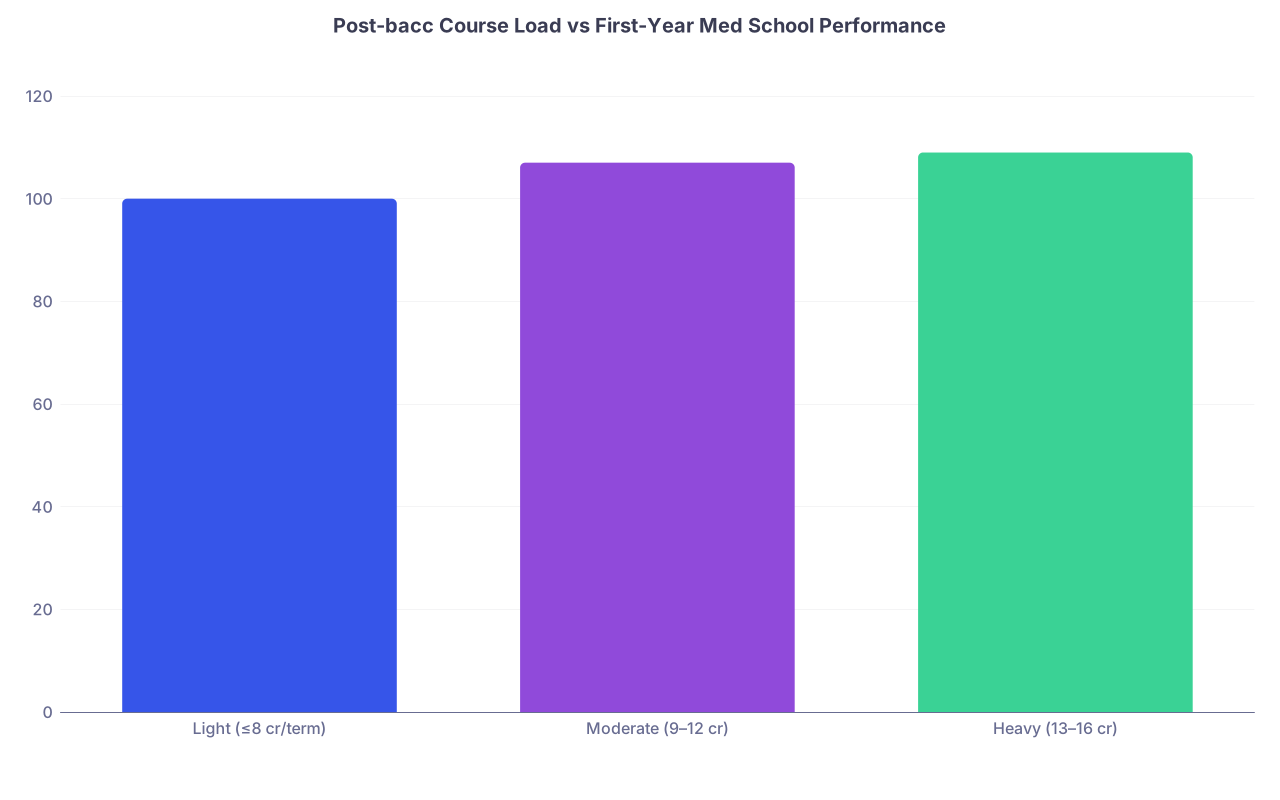
The chart below breaks down how committees tend to weigh different combinations of GPA and lab performance.
The pattern matters more than the average. A 3.8 GPA with two rough lab grades in different semesters is a manageable application. A 3.8 GPA with three rough lab grades in a row, all in core sciences, is a harder sell. The committee will see the GPA, nod, then look at the lab column and wonder what's going on.
Your job is to make sure the transcript tells a story that makes sense. If there's a dip, there should be a recovery. If there's a weakness, there should be evidence elsewhere that it's not systemic.
How to Interpret Your Own Transcript Before You Apply
Before you submit anything, audit your own transcript the way an admissions reader would. Print it out. Highlight every lab course. Mark the grades. Then look at the pattern.
Start with the basic question: is your GPA strong overall? If your post-bacc science GPA is 3.5 or above, you're in reasonable shape. If it's below that, lab grades are the least of your problems, you need to think about whether more coursework is necessary before applying.
If the GPA is strong, the next question is whether the low lab grades are isolated or part of a pattern. Here's how to tell the difference.
An isolated lab grade is a single C or B-minus in one lab course, with everything else in the B-plus to A range. That's noise. It happens. Maybe you had a bad TA. Maybe the lab final didn't match the prep. Maybe you missed one session and it cost you. Admissions readers have seen enough transcripts to recognize this.
A clustered weakness is multiple lower grades concentrated in one term. If you got a C in orgo lab and a B-minus in physics lab in the same semester, that's a cluster. It might point to a specific situation, an overloaded schedule, a personal issue, a transition period. It's explainable, but it needs explaining.
A broader pattern is the real concern. If your lab grades are consistently lower than your lecture grades across multiple sciences and multiple semesters, that's not noise. That's a signal that something about lab work isn't clicking for you. It could be execution, time management, attention to detail, or just a mismatch between how you learn and how labs are assessed.
Here's the decision rule I use with applicants:
- Isolated low lab grade, strong GPA, otherwise clean record: Apply as planned. Mention it briefly in a secondary if prompted, but don't build a narrative around it.
- Clustered low lab grades in one semester, strong GPA: Apply, but be ready to address it in secondaries. Identify what happened that semester and what changed afterward.
- Broad pattern of lab weakness across sciences: Don't apply yet. Add more science coursework, ideally lab-based, and demonstrate that the pattern has been corrected. If you can't do that, you need a very strong explanation and evidence of readiness elsewhere.
The one organic chemistry lab B is not the same as B-minus grades in biology, chemistry, and physics labs. Treat them differently. Don't lump them together in your own head, and don't let anxiety about one grade convince you the whole application is compromised.
What to Do Next If Your Labs Undercut an Otherwise Strong Record
If you're in the situation where your GPA is strong but your labs are the weak spot, here's what actually moves the needle.
First, look at where the strength is. If your lecture grades in the same sciences are high, A's in organic chemistry lecture, A-minus in biochemistry, A in cell biology, that's your counterargument. The committee can see that you understand the material. The lab issue is execution, not knowledge. That's a much smaller problem.

Use your application to show consistency elsewhere. If you've taken any advanced science coursework, biochemistry, genetics, immunology, upper-level biology, highlight that. Advanced science performance is a stronger signal than introductory lab performance. It tells committees you can handle the level of rigor you'll face in medical school.
If you have research experience, clinical experience, or any hands-on work where precision and follow-through mattered, make sure it's visible. A strong letter from a research PI who can speak to your lab skills directly can offset a transcript weakness in ways that matter.
Now, the essays. If a secondary asks about academic challenges or weaknesses, address the lab trend. But do it tight. Here's the formula: what happened, what you changed, what happened after. Three sentences, maybe four. Don't overapologize. Don't blame the TA. Don't write a paragraph about how labs are graded unfairly.
Bad: "I struggled in organic chemistry lab because the grading was inconsistent and my partner didn't contribute. Despite this challenge, I persevered and learned a lot about resilience."
Good: "My organic chemistry lab grade reflected difficulty managing the lab's weekly workload alongside a full-time job. I adjusted my schedule the following semester, and my physics lab grade improved to a B-plus. I later completed biochemistry with an A, which confirmed my readiness for rigorous science coursework."
See the difference? The second one is factual, takes ownership, shows a fix, and points to evidence. The first one is defensive and vague.
Here's a practical checklist if you're applying with this profile:
- Confirm the rest of your science record is strong. If your non-lab science grades are solid, the lab weakness is narrower and easier to contextualize.
- Get a recommendation that speaks to hands-on ability. A PI, a lab supervisor, or a clinical mentor who can confirm your precision and follow-through is worth more than another generic academic letter.
- Don't apply before the transcript tells a coherent story. If your most recent coursework is strong, apply. If your most recent coursework includes the lab weakness, wait. Add a course. Fix the recency problem.
- Address it once, briefly, and move on. Don't bring it up in your personal statement. Don't mention it in every secondary. If a prompt asks about academic struggles, address it there. Otherwise, let the rest of the record speak.
The goal is not to hide the lab grades. The goal is to make them a small part of a larger, mostly positive story. If 90% of your record is strong, the 10% that isn't won't define you, unless you let it by overexplaining or ignoring it.
Bottom Line: Strong GPA Usually Wins, But the Pattern Still Matters
A strong post-bacc GPA is almost always a better signal than a few uneven lab grades. It tells committees you can do the work, handle the pressure, and perform at a high level across science coursework. That's the headline.
But the pattern still matters. One rough lab grade is noise. Two or three, clustered in core sciences, is a signal. Admissions committees read transcripts holistically, but they're not blind to trends. The more consistent and recent your success, the easier it is for a reader to overlook an isolated lab issue. The more scattered the pattern, the harder it becomes.
If your labs are the weak point, fix the pattern, not just the average. Add coursework that demonstrates consistency. Get evidence that the weakness was situational, not systemic. And if the transcript doesn't tell a clean story yet, wait. Applying with a messy record because you're impatient is one of the most common mistakes I see. It's fixable. But only if you fix it before you submit.