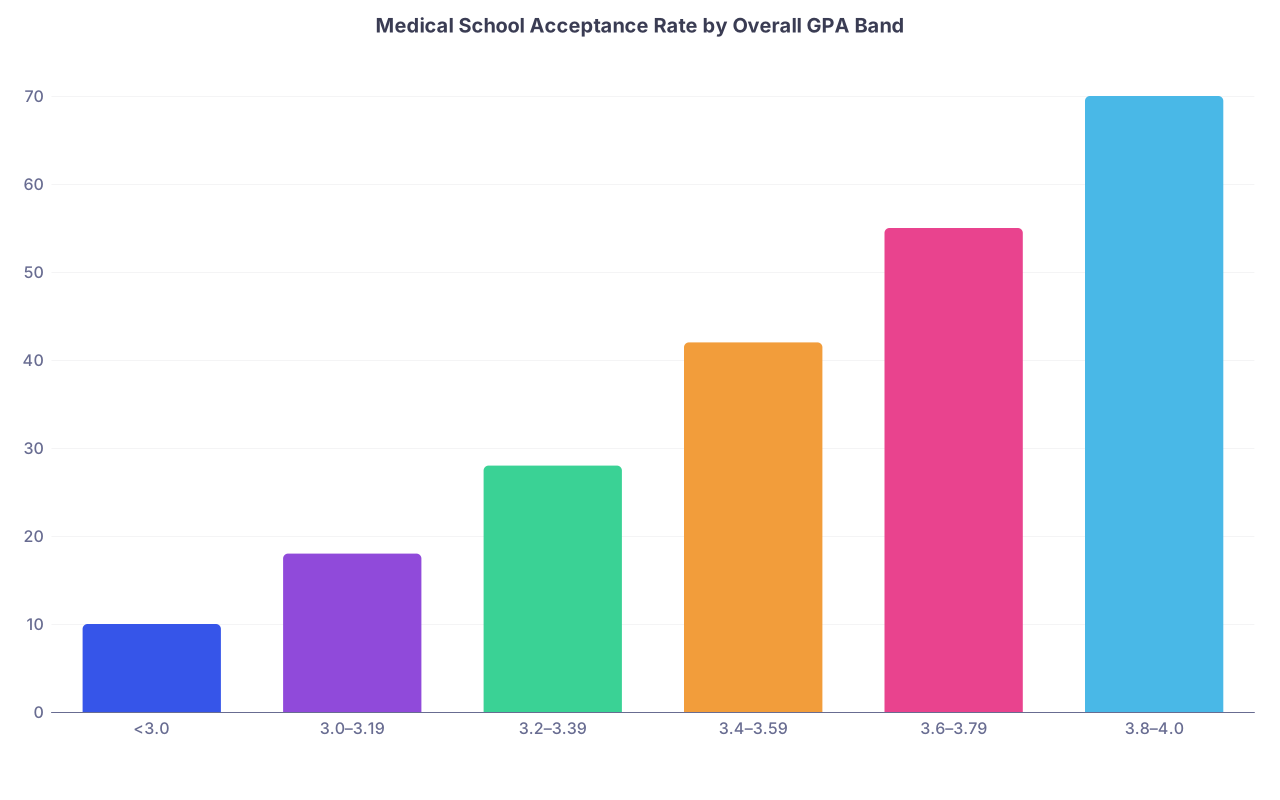
| Category | Value |
|---|---|
| <3.0 | 10 |
| 3.0–3.19 | 18 |
| 3.2–3.39 | 28 |
| 3.4–3.59 | 42 |
| 3.6–3.79 | 55 |
| 3.8–4.0 | 70 |
The myth that “any upward trend is enough” is statistically false. Medical school admissions behave like step functions around GPA thresholds, not smooth curves. If you are using a post‑bacc, the data show there are very clear inflection points where your odds jump—and places where more coursework barely moves the needle.
Let me be blunt: a 3.3 post‑bacc GPA sitting on top of a 2.9 undergraduate record does not magically turn you into a competitive MD applicant. You are fighting the numbers. But the numbers also show exactly where things start to change.
This is about understanding where post‑bacc performance starts to rescue an applicant and when it just decorates a weak file.
1. The Baseline: What the National Data Actually Show
You cannot talk about post‑bacc GPA without anchoring to the AAMC and AACOM data sets. Everything else is just vibes.
The most useful public sources:
- AAMC “FACTS” tables: GPA–MCAT–acceptance rate matrices for MD schools.
- AACOMAS data: similar trends for DO schools.
- Published averages from actual SMP/post‑bacc programs and linkage outcomes.
Pull these together and a few hard patterns emerge.
Across recent AAMC cycles (numbers vary slightly year to year, but the structure is consistent):
- Overall GPA < 3.0: MD acceptance rate hovers roughly 5–10%.
- 3.0–3.19: roughly 15–20%.
- 3.2–3.39: roughly 25–30%.
- 3.4–3.59: roughly 35–45%.
- 3.6–3.79: roughly 50–60%.
- 3.8–4.0: often 65–75%, depending on MCAT.
That bar chart at the top roughly summarizes this. Important nuance: those are cumulative GPAs, not post‑bacc specific. But they set the target zone you must reach after a repair job.
For DO, the slope is more forgiving:
- Applicants with 3.0–3.19 cumulative GPAs are already in a zone where acceptance can exceed 25–30% with a solid MCAT.
- By 3.3–3.4, odds can be quite reasonable, especially for in‑state or mission‑fit applicants.
So the question becomes: if your undergraduate record is damaged, at what post‑bacc GPA does your cumulative profile start to line up with the bands that actually get admitted?
2. How Post‑Bacc GPA Interacts With Old Damage
Admissions committees do not throw out your original GPA. They usually see:
- Overall undergraduate GPA
- Science GPA (BCPM)
- Post‑bacc and/or graduate GPAs, often broken out
The data pattern I see in actual outcomes looks like this:
- If your original GPA is ≥ 3.3, a strong post‑bacc (3.7–4.0) acts as an amplifier. It moves you into safer territory.
- If your original GPA is 3.0–3.29, a very strong post‑bacc (≥ 3.8) can effectively “recast” you as a credible candidate, especially for DO and some MD.
- If your original GPA is < 3.0, you are trying to drag a heavy anchor. The required post‑bacc performance and credit volume both go way up.
You cannot talk thresholds without talking credit weighting. A single 24‑credit post‑bacc with a 4.0 sitting on an 80‑credit 2.7 does not compute to a 3.5 cumulative. Let me show you.
3. The Math: Where Cumulative GPA Actually Moves
Let us run some quick, realistic numbers.
Say you finished undergrad with:
- 120 credits
- 2.8 cumulative GPA
You do 30 credits of post‑bacc at 3.9.
New cumulative GPA:
[ GPA_{new} = \frac{(2.8 \times 120) + (3.9 \times 30)}{120 + 30} = \frac{336 + 117}{150} = \frac{453}{150} = 3.02 ]
You just worked your tail off and barely crossed 3.0. That might help for DO. It does not suddenly place you in the 40–50% MD acceptance band.
What if you push harder?
- Same 2.8 × 120
- 40 credits at a 4.0
[ GPA_{new} = \frac{(2.8 \times 120) + (4.0 \times 40)}{160} = \frac{336 + 160}{160} = \frac{496}{160} = 3.10 ]
Still low. The point: for very damaged starts, the volume of high‑GPA coursework matters almost as much as the post‑bacc GPA itself.
Now flip it:
Undergrad:
- 3.1 GPA
- 120 credits
Post‑bacc:
- 36 credits at 3.9
[ GPA_{new} = \frac{(3.1 \times 120) + (3.9 \times 36)}{156} = \frac{372 + 140.4}{156} = \frac{512.4}{156} \approx 3.29 ]
Again, you are barely touching 3.3—right at a threshold where MD odds start to become non‑trivial if the MCAT is strong. But not “safe.”
This is why many nontrads are shocked when they realize a gorgeous post‑bacc line does not erase years of mediocre grades. The denominator is ruthless.
So, any threshold discussion must split by starting GPA bracket. The same post‑bacc performance means different things depending on where you started.
4. Thresholds by Starting Point: Where Odds Actually Jump
Case 1: Starting GPA 3.3–3.4
This is the “light cleanup” crowd. Not catastrophic, but below typical MD matriculant averages (3.7ish overall, 3.65+ science).
Data pattern from real applicants and program outcomes:
- Post‑bacc GPA ≥ 3.5: Mild benefit. Shows some maturity, but does not radically move your file unless credits are 30+ and science‑dense.
- Post‑bacc GPA ≥ 3.7: This is where MD odds clearly improve. Your recent work now resembles successful matriculants.
- Post‑bacc GPA ≥ 3.8–4.0: Strong positive signal. Many admissions committees treat this as evidence that “the earlier 3.3 was due to whatever; they can now perform at a high level.”
Credit volume still matters. A 12‑credit 4.0 means less than 32+ credits of upper‑division bio, biochem, physiology, etc.
For this group, the GPA threshold where acceptance odds meaningfully climb is:
- 3.7+ in ≥ 24–30 post‑bacc credits.
At that point, with a 510+ MCAT, you approximate the profile of a mid‑tier MD matriculant and hit very competitive DO territory.
Case 2: Starting GPA 3.0–3.29
This is the core post‑bacc audience. You are below the “comfort zone” for most MD schools and borderline for more selective DO programs.
Here’s what I see in the data and outcomes:
- Post‑bacc GPA 3.3–3.5: Too weak. You look like the same student, just with more time.
- 3.6–3.7: Some positive impact, but you are still straddling the line. Helpful for DO, not transformative for MD.
- 3.8–4.0: This is the inflection point. A long run of 3.8+ in hard science courses is what actually changes the narrative.
With 30–40 credits at 3.8–4.0, two things happen:
- Your recent academic performance looks like that of accepted students.
- Your science GPA frequently moves into the ~3.4–3.5 range, even if overall sits closer to 3.3.
That combination, plus an MCAT 510–515, moves you from “long shot MD / maybe DO” to “realistic MD at less selective schools / strong DO”.
For this starting bracket, the real threshold is:
- Post‑bacc GPA ≥ 3.8 over ≥ 30 credits of rigorous science.
Anything less than 3.7, especially with < 24 credits, has marginal impact on acceptance odds for MD.
Case 3: Starting GPA 2.7–2.99
Now you are working against the historical distribution. Very few MD matriculants sit below 3.0 cumulative. DO schools will still consider you seriously, but only with clear redemption.
You need both:
- Very high post‑bacc GPA
- Substantial credit volume
From data across SMPs and strong post‑baccs:
- 4.0 in 24 credits: good start, but not enough to offset a long 2.7–2.8 history.
- 3.8–4.0 in 36–45 credits: this is roughly where DO acceptance odds start climbing significantly, provided MCAT is solid (505+).
MD from this starting point typically requires either:
- A near‑perfect post‑bacc (3.9–4.0) over 40–60 credits, or
- A formal SMP where you place near the top of the class, often with MCAT 515+.
Anything below ~3.8 in the repair phase keeps you in the “statistical outlier” bucket for MD.
For this group, I would call the thresholds:
- DO: Post‑bacc ≥ 3.6 in 30+ credits starts to help; ≥ 3.7–3.8 is where odds jump.
- MD: Post‑bacc ≥ 3.8–3.9 in ≥ 40 credits is where files start to get real consideration, especially if MCAT > 515 and there is a clear upward trend.
Below that, you might still succeed, but you are outside the main probability mass.
Case 4: Starting GPA < 2.7
Here we are in statistical rescue territory. The denominator, again, kills you.
For example:
- 2.6 GPA, 120 credits
- 45 post‑bacc credits at 4.0
[ GPA_{new} = \frac{(2.6 \times 120) + (4.0 \times 45)}{165} = \frac{312 + 180}{165} = \frac{492}{165} \approx 2.98 ]
After an excellent 45‑credit run, you still haven’t crossed 3.0. That is why people in this bracket often need:
- Extensive work (60+ credits post‑bacc/SMP combined), and
- Near‑perfect performance (3.9–4.0)
For DO schools:
- I start to see decent outcomes when post‑bacc/SMP work hits ≥ 3.7 over 45–60 credits and MCAT is ≥ 505–507.
For MD:
- This is outlier territory. People match from here, yes, but usually with extreme performance (4.0 in SMP, 520+ MCAT, powerful story, strong institutional support). That is not a “threshold”; that is an exception.
5. MD vs DO: Different Thresholds, Same Logic
MD and DO schools respond differently to post‑bacc GPA, but the structure is similar: thresholds, not smooth gradients.
MD Programs
Median MD matriculant stats cluster around:
- 3.75 overall, ~3.7 science
- 511–512 MCAT
For a reformed applicant:
- You rarely see stable MD acceptances when the most recent science GPA (post‑bacc or SMP) is < 3.6.
- When recent science is between 3.7–3.8 with a 510+ MCAT, odds become real, even if cumulative sits in the low 3.3–3.4 range.
- Above 3.8–3.9 recent science with MCAT 515+, the file reads like “former underachiever who clearly figured it out.” Many adcoms like that story—up to a point.
The key MD threshold from a post‑bacc lens:
- 3.7+ post‑bacc/SMP in substantial recent credits (≥ 30) + MCAT ≥ 510.
That is where acceptance probabilities start to look meaningful.
DO Programs
DO matriculants commonly have:
- 3.5–3.6 overall, slightly lower science averages than MD
- 503–506 MCAT averages (varies by school)
DO schools historically have been more forgiving about earlier missteps if the recent work is strong.
The data pattern:
- Post‑bacc ≥ 3.4–3.5: Some benefit. You look competent, but not obviously fixed.
- Post‑bacc ≥ 3.6–3.7: This is where the “you’re safe” feeling starts. Especially with MCAT 500–505.
- Post‑bacc ≥ 3.7–3.8 with 30+ credits and MCAT 505–508: Very strong position at many DO schools.
For DO, I would mark the threshold as:
- 3.6+ post‑bacc (science‑heavy) in ≥ 24–30 credits.
Below that, you remain in a risky category. Above that, odds improve sharply.
6. Linkage and Formal Programs: Their Implied Cutoffs
Look at how formal post‑bacc and SMPs define “success” for their own linkage agreements. Those internal thresholds reveal what med schools actually care about.
Common published conditions for MD linkage or “strong” committee letters:
- Minimum GPA in the program: 3.6–3.7
- Often no grade lower than B or B+
- Sometimes explicit: “Students with ≥ 3.7 and MCAT ≥ 510 will receive our highest recommendation”
Translation: from the medical school’s perspective, 3.7 is the unofficial “this student is safe” number for recent rigorous coursework. Many SMPs report match/acceptance rates that climb steeply once students cross that threshold.
For DO‑linked programs, you often see:
- 3.4–3.5 minimums for conditional acceptances
- But their strongest outcomes usually cluster around ≥ 3.6
So, the programs that live and die by their match rates are quietly telling you: 3.6–3.7 is where things get much better.
7. Trend vs Threshold: Why “Upward” is Not Enough
You will hear this line a lot: “Admissions committees love an upward trend.” True. But incomplete.
If you go from a 2.7 undergrad to a 3.3 post‑bacc, the slope looks nice. The level is still low. The AAMC data do not care about your derivative; they care about your final value.
Here is the way I think about it, and the way many adcoms implicitly do:
- Trend: buys you forgiveness, makes people re‑read your file, softens earlier zeros and Ds.
- Threshold: gets you past the risk filter. This is where actuarial reality—the likelihood you fail out or struggle academically—becomes acceptable.
The numbers show that threshold for recent rigorous work is around:
- 3.7+ for MD viability
- 3.6+ for DO comfort
Below that, the trend helps, but it does not fully offset earlier damage.
8. Where a “Good Enough” Post‑Bacc GPA Actually Lives
Let me put concrete cut points on this, since that is what you came for.
Assuming at least ~24–30 credits of solid, upper‑division science in your post‑bacc:
Post‑bacc < 3.4
Signals: You have not changed much. Odds improvement: minimal for both MD and DO, unless your original GPA was already high.3.4–3.59
Signals: Mild improvement. Better than your older self, but still below typical matriculant science averages. Helps mainly if your original GPA is ≥ 3.3 and you are targeting DO.3.6–3.69
Signals: You are now performing at roughly the lower end of accepted students academically.- For DO: threshold where odds start climbing meaningfully.
- For MD: still borderline, but helps if original GPA was 3.3+ and MCAT strong.
3.7–3.79
Signals: Competitive academic performance.- For DO: strong position at many schools with MCAT around or slightly above average.
- For MD: real improvement in odds, especially if your initial GPA was not catastrophically low.
3.8–4.0
Signals: Top‑tier recent performance.- For DO: excellent. Your prior GPA will matter less.
- For MD: this is where redemption stories truly work, especially paired with a 510–515+ MCAT.
Think of ≥ 3.7 as the statistical dividing line between “we are taking a risk” and “this person can clearly handle the curriculum.”
9. How to Use These Thresholds in Your Own Planning
You do not need a theoretical lecture. You need a decision rule.
Here is the practical version.

| Step | Description |
|---|---|
| Step 1 | Starting GPA? |
| Step 2 | Target Post-bacc ≥ 3.7 |
| Step 3 | Target Post-bacc ≥ 3.8, 30+ credits |
| Step 4 | Target Post-bacc ≥ 3.8–3.9, 40–45+ credits |
| Step 5 | Consider long-term plan: 60+ credits/SMP, strong DO focus |
| Step 6 | ≥ 3.3? |
| Step 7 | 3.0–3.29? |
| Step 8 | 2.7–2.99? |
Layer the MCAT on top:
- Lower post‑bacc GPA (3.5–3.6) demands higher MCAT to compensate (515+ for MD, 505+ for DO).
- Stellar post‑bacc (3.8–4.0) gives you a bit more MCAT flexibility, but not by much for MD. A 505 with a 3.9 post‑bacc still struggles at MD schools.
And then acknowledge reality:
- Aiming for “just above 3.5 so I can show an upward trend” is a losing strategy from a numbers perspective.
- Aiming for “3.7+ and as many credits of A/A‑ level science as I can reasonably manage” aligns with what the data say medical schools actually reward.
To make that target concrete, spread the work across terms:
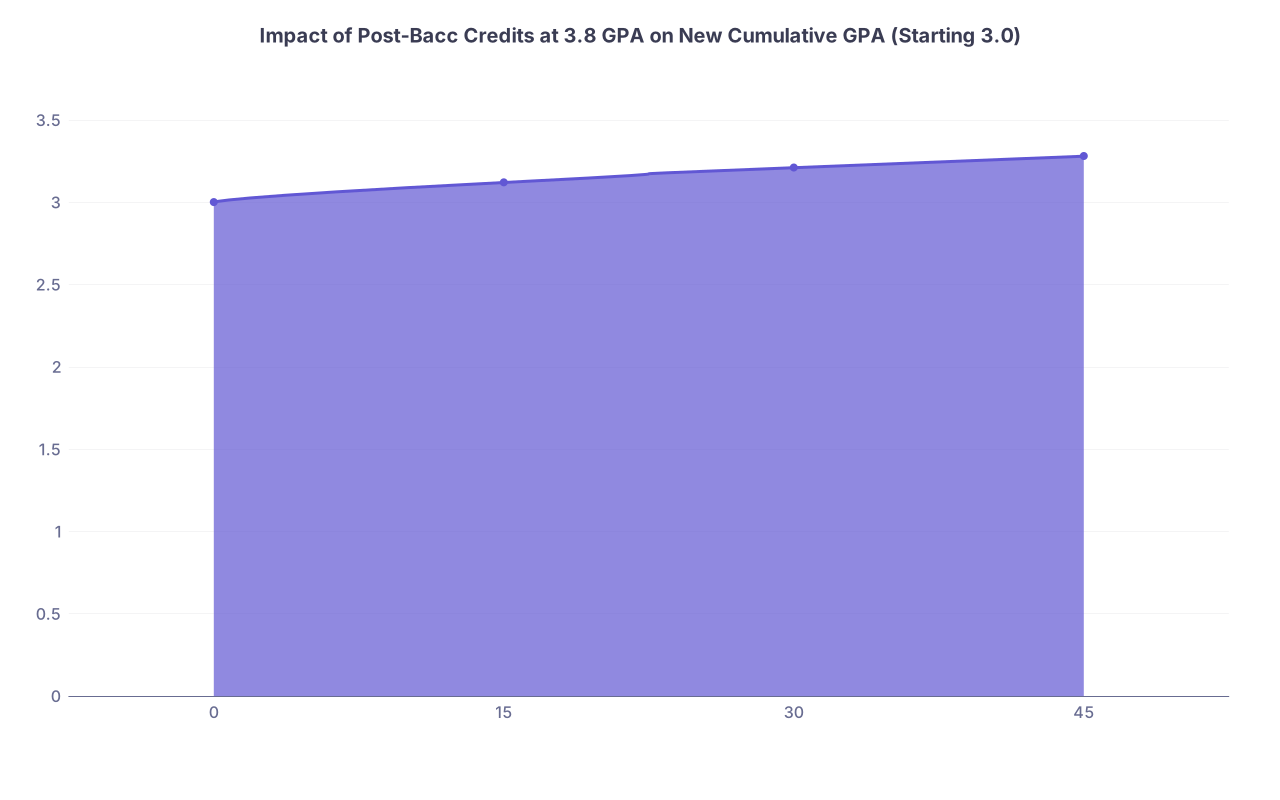
| Category | Value |
|---|---|
| 0 | 3 |
| 15 | 3.12 |
| 30 | 3.21 |
| 45 | 3.28 |
That chart assumes a starting 3.0 with 120 credits and shows the new overall GPA after stacking 3.8‑level work. Notice: the cumulative barely scratches 3.3 even after 45 credits. Which is exactly why committees care so much about the recent segment. Your post‑bacc GPA is effectively your “second attempt” at showing you can perform like a future physician.
10. The Short List: Where Acceptance Odds Actually Climb
Strip away the noise and you get a small set of usable rules.
You start to see meaningful jumps in acceptance odds at these breakpoints:
Post‑bacc ≥ 3.6
- Real benefit for DO, limited but positive for MD.
- Suggests you are at least in the ballpark academically.
Post‑bacc ≥ 3.7
- This is the main MD-relevant threshold.
- MD: your file starts to look like a reformed but capable applicant, especially with MCAT ≥ 510.
- DO: strong competitiveness at many programs.
Post‑bacc ≥ 3.8
- The redemption zone. If backed by 30–45+ credits and a strong MCAT, this is where earlier 3.0–3.2 undergrad GPAs are often forgiven, especially for DO and mid‑tier MD.
Below 3.6, you may still win. People do every year. But they are not playing on the main statistical field. They are succeeding despite their numbers, not because of them.

Two closing points.
First, post‑bacc GPA is not a vibe check. It is a quantifiable risk metric for schools that spend tens of thousands of dollars per seat. The data show they like 3.7+ in recent science work. You either hit that, or you compensate with insane MCAT scores and compelling context.
Second, set your target like a statistician, not like an optimist. Do not ask “What is the minimum I can get away with?” Ask “At what point do the historical acceptance curves finally bend in my favor?” For most serious repair jobs, that point is a post‑bacc GPA in the 3.7–3.8 range over a substantial number of credits.
That is the line in the sand. Everything else is just arguing with the numbers.