

Yes, required sign-out delays can count toward residency duty hours. But only when they're actually required, tied to patient care, and you're not free to leave.
That's the whole game. If you're stuck because a patient is crashing, the cross-cover resident hasn't arrived, the handoff is mandatory, or you still have to complete required transition tasks, that time is work. It belongs in duty hours. If sign-out is done and you're hanging around finishing random inbox cleanup, waiting for your favorite senior to show up, or chatting in the workroom because everyone's too tired to move, that's not the same thing. Late doesn't automatically mean countable.
I've seen residents get this wrong in both directions. Some underreport because they think "it was only sign-out." Bad idea. Others log every extra 20 minutes after shift end, even when the real reason was drift, not duty. Also bad. The fix is simple: stop guessing and use a clean rule.
This article gives you that rule. We'll use the ACGME framework, the reality of how sign-out actually works on the ground, and a practical documentation method you can use on your next shift. No vague hand-waving. Just how to decide what counts and how to report it without creating a mess.
What counts as duty hours under ACGME rules
Duty hours are not just bedside minutes. They include the full package of training-related work: clinical care, required handoffs, patient documentation, care coordination, conferences, and other educational or service activities your program expects you to do.
That matters because sign-out is not some weird side category. A required handoff is part of clinical work. If your residency or rotation requires you to stay until safe transfer of care is complete, that time is duty time.
Here's the practical definition I use:
Count it as duty hours if all three are true:
- The task is required by the program, service, or attending.
- The task is related to patient care or mandatory residency work.
- You are not actually free to leave yet.
If those boxes are checked, it counts. Pretty straightforward.
Common examples of duty hours:
- Pre-rounding and work rounds
- Notes, orders, discharge work
- Required sign-out and handoff preparation
- Transition-of-care communication with covering teams
- Educational conferences required by the program
- Time spent staying late because patient care responsibilities are still active
Common examples that usually do not count:
- Commute time
- Off-duty sleep time
- Voluntary social events
- Meals when you're genuinely off duty
- Personal errands
- Hanging around after the required work is finished
The biggest source of confusion is this: residents assume anything happening physically in the hospital must count. No. Location doesn't decide it. Obligation does.
If you're still in the hospital because you must complete a safe handoff, that's work. If you're still in the hospital because you got pulled into a casual post-call debrief that nobody required, that's not duty hours. Hospitals are full of gray-looking moments that become much less gray once you ask one blunt question:
Could I have left without dropping a required responsibility?
If the answer is no, log it. If the answer is yes, don't pretend it was all protected duty time.
When sign-out delays can be counted
This is where most residents need a real-world filter, not policy poetry.
A sign-out delay can be counted when the delay is driven by required patient-care work and you must remain engaged until it's finished. The reason matters. A lot.
Countable sign-out delay scenarios
These usually belong in duty hours:
- You're waiting for the covering resident because formal handoff is mandatory before you can leave.
- An unstable patient requires an updated sign-out, and the clinical picture changed right before shift end.
- You must finish required sign-out documentation, including an updated patient list or handoff tool.
- The team is short-staffed, and the transition takes longer because there's no available receiver yet.
- The attending or service structure requires direct verbal handoff for specific patients before departure.
- You're answering handoff-related questions necessary for safe transfer of care.
Example: it's 6:55 p.m., your shift ended at 6:30, and your cross-cover resident is tied up admitting a sick patient. You can't leave because two of your patients are tenuous and require direct sign-out. That 25 minutes is not "you being slow." That's duty time.
Another one: your intern sign-out starts on time, but one patient develops chest pain while you're wrapping up. You reassess the patient, update the plan, and then revise the handoff to the night team. That extra time counts. Obviously. Patient care didn't stop because the clock hit the end of the shift.
The key test
The cleanest test is this:
Were you still obligated to perform a required work task?
If yes, count it.
This is especially true when the delay comes from:
- workflow failure,
- delayed coverage,
- acuity,
- patient safety demands,
- required documentation,
- or the structure of the service itself.
None of that is "optional staying late." It's work imposed by the system or the patient's needs. Residents should not eat that time just because it happened during sign-out.
And let me say the quiet part out loud: programs sometimes benefit when residents underreport these delays. It makes schedules look cleaner than they are. Don't help bad systems hide.
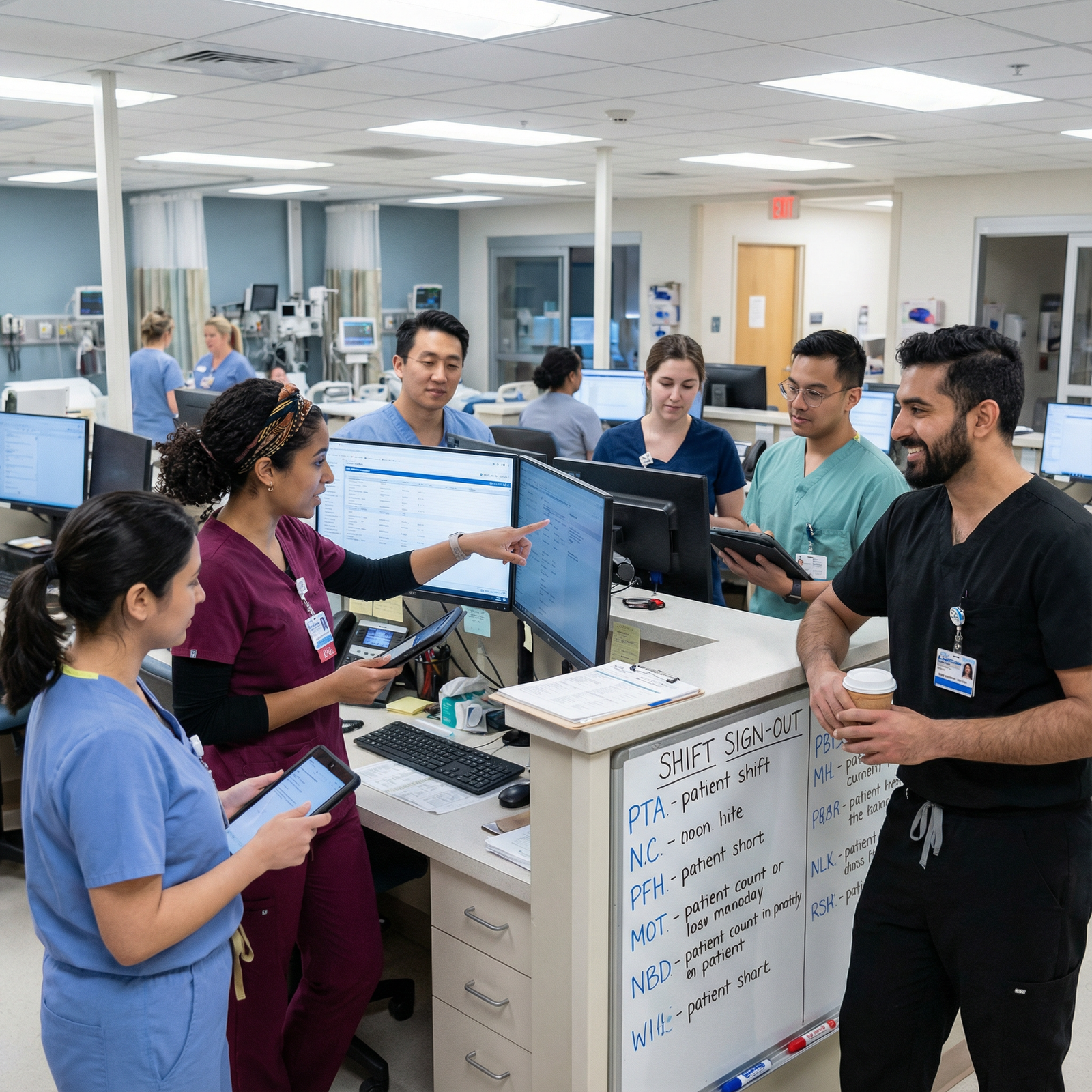
When sign-out delays should not be counted
Here's the part people like to blur. Don't.
Once required handoff duties are finished, the clock doesn't keep running just because you're still physically there. If you're free to go and choose not to, that extra time usually should not be logged as duty hours.
Non-countable situations
These generally do not count:
- Sign-out is complete, but you stay to finish nonurgent emails
- You linger in the workroom talking with the night team
- You wait for a specific resident or attending because you prefer giving sign-out to them, even though another appropriate receiver is available
- You stay to "just clean up a few things" that are not required before leaving
- You're decompressing, eating, scrolling your phone, or venting after your clinical duties are done
That's not a duty-hour protection issue. That's workflow, boundaries, or habit.
I've seen this on inpatient services all the time: sign-out ends at 7:05, but half the team is still there at 7:30 tweaking lists, talking about fellowship plans, or finishing low-priority admin junk they could handle the next day. That may feel like work-adjacent suffering, but it's not all reportable duty time.
Also, don't use duty-hour logging as a protest tool for every annoying minute in the hospital. If the true problem is inefficient sign-out culture or poor team discipline, call it that. Fix the process. Don't just inflate the log and hope someone decodes the message.
Programs may view repeated post-shift lingering as a systems or professionalism issue, not a duty-hour issue. And honestly, sometimes they're right.
How to document and report sign-out delays correctly
If sign-out runs late, document it cleanly. Sloppy reporting creates two bad outcomes: either your legitimate extra duty time gets dismissed, or your logs look inflated and people stop trusting them.
Use this protocol.
Step 1: Record the exact time
Write down:
- your scheduled end time,
- the actual time you were done,
- and the total delay.
Don't estimate three days later. That's how every late sign-out magically becomes "about 30 minutes." Keep it precise.
Step 2: Write the reason in one sentence
Be specific. Good examples:
- "Stayed 22 minutes for required verbal handoff because covering resident was delayed in ED."
- "Stayed 18 minutes to update sign-out after acute change in patient status."
- "Stayed 15 minutes to complete mandatory handoff documentation before transfer of care."
Bad examples:
- "Had to stay late."
- "Sign-out took forever."
- "Busy shift."
Those tell nobody anything.
Step 3: Ask the freedom-to-leave question
Document whether you were actually free to go.
Use this standard:
- Not free to leave = likely countable
- Free to leave but chose to stay = usually not countable
That one distinction solves most disputes.
Step 4: Enter it in the official duty-hour system
Use the actual system your program requires. Not a text to your co-resident. Not a private note that never goes anywhere. If it counts, log it where the program tracks duty hours.
Step 5: Separate work time from personal time
If sign-out ended at 7:10, then you ate dinner in the call room until 7:40, don't log all 40 minutes as duty time. Split it accurately.
That means separating:
- required clinical work,
- educational requirements,
- meal time,
- decompression time,
- and random post-shift drift.
Accuracy protects you better than exaggeration.
Step 6: Escalate patterns, not just isolated events
One delayed sign-out happens. Repeated delays are a systems problem.
Bring recurring issues to:
- chief residents,
- program leadership,
- rotation directors,
- or the program coordinator if that's your local pathway.
Frame it the right way:
- "Our night handoff routinely starts 20-30 minutes late because coverage arrives after the scheduled transition."
- "The current sign-out workflow regularly pushes residents past scheduled duty end times."
- "This is affecting duty-hour compliance and patient handoff safety."
That language gets traction. Complaining that "sign-out sucks" does not.
A simple documentation template you can copy
Use something like this:
- Scheduled shift end: 18:30
- Actual sign-out completion: 18:52
- Delay length: 22 minutes
- Reason: Required verbal handoff delayed because incoming cross-cover resident was managing acute admission
- Free to leave before completion? No
- Logged in duty-hour system? Yes
That's clean. Defensible. Easy for leadership to interpret.
What residents should do if the rule seems unclear
If your program is fuzzy about sign-out delays, don't stay fuzzy. Get the rule in writing.
Here's how to fix ambiguity
Ask for the written duty-hour policy. Not the hallway version. Not "what we usually do." The actual policy.
Ask specifically how your program defines countable handoff time. Force the issue into examples:
- waiting for night float,
- updating unstable patient sign-out,
- delayed receiver arrival,
- post-sign-out chart cleanup.
Ask who decides when a late sign-out should be logged. Chief? Program coordinator? You? Clarify it now, not after an audit.
Request examples of correct logging. This is one of the easiest fixes and one of the most ignored.
Raise recurring delays as systems issues. Don't present it as "I can't handle sign-out." Present it as "the current handoff structure repeatedly creates duty-hour overages and avoidable inefficiency."
That's the adult way to do it. And it works.
Here's the closing framework I want you to remember:
- If it's required, work-related, and you cannot leave, it probably counts.
- If it's optional, social, or the real work is done, it probably doesn't.
That rule cuts through most of the nonsense.
Summary
Required sign-out delays can count toward residency duty hours when they are part of mandatory clinical responsibility and you're still on the hook for patient care. The deciding factors aren't how tired you feel or whether you're still in the building. They're whether the task is required, clinically tied to the job, and whether you were actually free to leave.
So do this:
- Log required late handoff time accurately
- Separate true duty time from post-shift drift
- Use your program's official reporting system
- Escalate repeated sign-out delays as workflow problems
That's how you protect yourself, protect the data, and expose broken systems instead of quietly absorbing them.


