
The way most residents handle 28‑hour call is broken. You are not “pushing through.” You are degrading your brain in slow motion and hoping no one notices.
Let me be blunt: on a 28‑hour call, your only sustainable strategy is deliberate fatigue management. That means micro‑breaks and naps are not luxuries. They are survival tools and patient safety interventions.
This is the manual you should have been given on day one.
1. The Real Problem: You Are Not Just Tired, You Are Impaired
You already know call is rough. What most residents underestimate is how early they become unsafe.
By hour 16–18 of sustained wakefulness, your cognitive performance is roughly equivalent to a blood alcohol level of 0.05–0.08. That is “would not drive a car” territory. Yet you are writing orders, running codes, and consenting people for surgery.
Here is what actually fails first:
- Executive function: prioritizing, planning, switching tasks
- Working memory: holding lab values, med changes, and orders in your head
- Vigilance: catching subtle changes in vitals or mental status
- Emotional regulation: becoming irritable, snappy, or numb
You feel “tired but fine.” You are not fine.
The good news: short, well‑timed breaks and naps dramatically improve performance. Even in brutal schedules.
The bad news: You must fight the culture, your own guilt, and sometimes bad workflows to get them.
Let us fix that.
2. Core Principles: How Micro‑Breaks and Naps Actually Work
You do not need eight hours. You need strategic, structured doses of rest that fit into chaos.
Micro‑breaks: 30 seconds to 5 minutes
Goal: reset attention, posture, and stress response without losing momentum.
What they actually do:
- Improve accuracy and reduce errors on repetitive tasks
- Prevent “tunnel vision” on the EMR screen
- Reduce musculoskeletal strain and headaches
- Give your sympathetic nervous system a tiny reset
Key rules:
- Frequency beats length
- 1–3 minutes every 45–60 minutes is more powerful than 20 minutes every 4 hours.
- Change one major variable
- Posture (sit → stand), environment (nurses’ station → hallway), stimulus (screen → distant gaze).
- No phone scrolling
- Social media is cognitive noise, not rest.
Naps: 10 to 90 minutes
Goal: restore alertness and maintain safe functioning over long shifts.
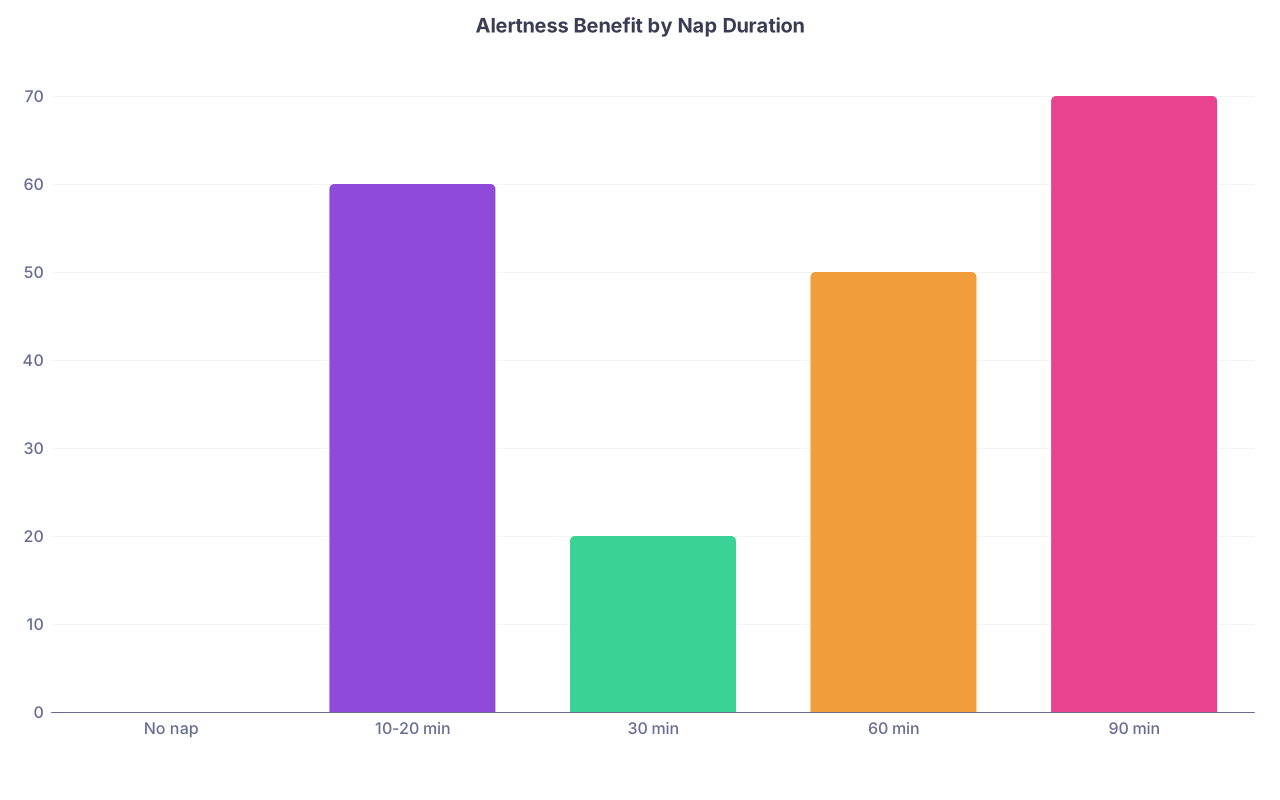
Different nap lengths do different jobs:
- 10–20 minutes (“power nap”)
- Best for: quick alertness boost, low risk of grogginess.
- Use: when you have a small window (between admissions, after a lull).
- 30 minutes
- Often worst choice. You are likely to wake in deep sleep → heavy sleep inertia, feel worse.
- 60 minutes
- Includes more slow‑wave sleep. Better for memory consolidation, but groggier on waking.
- 90 minutes
- Roughly one full sleep cycle. Less sleep inertia, good cognitive reset if you can get this length safely.
Critical timing principles:
- The later in your circadian night you nap (2–5 a.m.), the more you need it and the more likely deep sleep will kick in.
- A 15–20 minute nap around 1–3 a.m. is often the highest‑yield investment for 28‑hour calls.
- Always assume you may be interrupted. Plan short, safe, repeatable naps, not a single mythical “solid 2 hours.”
3. Pre‑Call Setup: Stack the Deck Before You Walk In
You do not “out‑willpower” a 28‑hour call. You engineer it.
A. Decide your fatigue strategy before the shift
Do this the day before:
- Choose your targets:
- 3–5 micro‑breaks per daytime stretch
- 1–2 planned micro‑naps (10–20 minutes) overnight if possible
- Look at the call pattern on your service:
- Typical admission surges?
- Predictable lulls (e.g., 3–5 a.m. on some services, never on others)?
- Rounds time the next morning?
You want a rough “default plan” like:
- Day: micro‑breaks every 1–2 hours, no naps.
- Night: 10–20 min nap around midnight if possible, another 10–20 min between 3–5 a.m.
- Post‑call: safe commute strategy (more on that later).
B. Pre‑call sleep: do not sabotage yourself
The day before a 28‑hour call:
- Structure:
- Prior night: aim for 7–9 hours. Non‑negotiable.
- Day of call: if starting in the morning, a 60–90 minute afternoon prophylactic nap is ideal.
- Caffeine:
- Stop heavy caffeine intake at least 6 hours before that pre‑call nap.
- Do not rely on a massive caffeine load immediately before call. You will pay for it at 3 a.m.
C. Set up your environment on arrival
First 30–60 minutes of call, when you are still fresh:
- Identify actual nap locations:
- Call room? Empty family consult room that nurses know you can use briefly? Quiet reading room?
- Find:
- Light switch or dimmer you can easily reach in the dark
- A flat surface or recliner
- A blanket or extra warm layer
- Pre‑stage:
- Phone charger in that location
- Eye mask and earplugs in your bag (yes, actually buy them; $5 can save your brain)
If there is no call room and nowhere to lie down, you still plan for chair naps (I will walk through how).
4. Micro‑Break Protocol: What To Do, Minute By Minute
You are on hour 9. You have 3 admission notes open, your pager is chirping, your neck is locked, and your brain feels like static.
You do not have 20 minutes. You have 90 seconds.
Here is the bare‑bones micro‑break that works even in full chaos:
The 90‑Second Reset
Step away from the screen (15 seconds)
- Push your chair back. Stand.
- If you can, walk 10–20 steps down the hall and back.
Posture + breath reset (45 seconds)
- Stand tall, roll shoulders back.
- Inhale slowly through nose for 4 seconds.
- Hold for 2 seconds.
- Exhale through mouth for 6 seconds.
- Repeat 4–5 breaths.
Eye + focus reset (20–30 seconds)
- Look at a point 20+ feet away (down the hall, out a window).
- Let your gaze soften. No focusing on details.
- This relaxes eye muscles and shifts your attention from micro to macro.
You just bought yourself a small but measurable improvement in alertness, with zero drama.
The 3–5 Minute Deep Micro‑Break
When your attending is in the OR, your senior is handling a page, and you have a small gap:
Move and stretch (2 minutes)
- Walk briskly around the unit once.
- Basic stretches: neck side to side, shoulder rolls, arm cross‑body stretches, gentle back extension.
Light snack + water (1–2 minutes)
- 8–12 ounces of water.
- Small, lower‑sugar snack with some protein/fat: a handful of nuts, cheese stick, half a sandwich.
- Skip the candy machine spike‑and‑crash cycle late at night.
Micro‑mindfulness (30–60 seconds)
- Stand or sit. Close your eyes if it feels safe.
- Notice 3 things you hear, 3 things you feel (feet on floor, stethoscope on neck), 3 breaths.
- This is not “being Zen.” It is preventing your brain from spinning out.
When To Force a Micro‑Break
You make yourself step away when:
- You have re‑read the same note sentence 3+ times.
- You find yourself clicking “refresh” on labs or vitals without a clear plan.
- You are snapping at nurses or co‑residents for minor questions.
- You almost made a mistake and caught it at the last second.
Those are red flags. A 60–90 second break can prevent the next near‑miss from becoming an actual error.
5. Nap Protocol: How To Actually Sleep On Call Without Wrecking Yourself
This is where most residents fail. They either:
- Never nap and white‑knuckle the night.
- Or collapse for 90 minutes at 4 a.m., wake up in slow‑motion hell, and decide “naps make me worse.”
You need a disciplined nap protocol.
| Category | Value |
|---|---|
| No nap | 0 |
| 10-20 min | 60 |
| 30 min | 20 |
| 60 min | 50 |
| 90 min | 70 |
Step 1: Choose your nap window
Best initial targets (adjust for your service pattern):
- Window 1: 11 p.m.–1 a.m.
- Goal: quick top‑up before circadian low point.
- Duration: 10–20 minutes max.
- Window 2: 3–5 a.m.
- Goal: survive the worst period of biologic night.
- Duration: 10–20 minutes if call is unpredictable; 60–90 minutes only if coverage and culture allow.
If your service never quiets (e.g., busy ED, trauma), you still aim for multiple 10–15 minute micro‑naps instead of one longer block.
Step 2: Prepare a 20‑minute power nap
Goal: asleep for ~10–15 of those minutes.
Coverage and expectations (1–2 minutes)
- Tell your co‑resident or senior:
- “I am going to lie down for 20 minutes. I have my pager on vibrate. Text me if anything comes up.”
- If there is no co‑resident, coordinate with nurses:
- “I will be in the call room for 20 minutes. If there is anything unstable, please page twice.”
- Tell your co‑resident or senior:
Set a hard alarm
- 20 minutes on your phone.
- Put it across the room or on the far edge of the bed so you must physically move.
Optimize for speed of sleep onset (2–3 minutes)
- Dark: lights off or eye mask.
- Sound: earplugs if safe, or white noise app at low volume.
- Position: whatever is fastest for you (on back with one pillow, side‑lying, even head on folded arms at a desk if that is all you have).
Mental “off switch”
- Give your brain one job: count slow breaths from 50 down to 1.
- Every time your brain thinks about patients, you bring it back to breath count.
- This is not relaxation fluff. It is a practical, repeatable pattern that speeds sleep onset.
If you sleep 5–10 minutes, that is enough. If you do not sleep at all, you still lay still with eyes closed, which provides partial recovery.
Step 3: Waking and re‑entering safely
The first 3–5 minutes after a nap are dangerous for decisions.
Use a 3‑step wake protocol:
Physical activation (1 minute)
- Stand up immediately.
- Walk briskly to the sink or hallway.
- Cold water on face or wrists.
Light exposure (1–2 minutes)
- Turn on a brighter light if in a dark room.
- Go near a window or into a well‑lit hallway if possible.
Cognitive warm‑up (1–2 minutes)
- Before making any big decisions, do a simple mental task:
- Read one patient’s last vitals and labs out loud to yourself.
- Quickly review your to‑do list.
- This is your equivalent of “warming up the engine” before pulling onto the highway.
- Before making any big decisions, do a simple mental task:
Only after that do you answer non‑emergent pages or write important orders.
Chair naps when there is no bed
You are in the ED or ICU with no call room. Fine. Here is the chair nap protocol:
- Find the least chaotic corner you can (back of resident room, empty consult space).
- Sit in a chair with:
- Back support
- Head support if possible (lean against wall or back of chair)
- Cross your arms lightly over your chest or rest on the desk with a folded jacket as a pillow.
- Same 20‑minute alarm, same breath‑count method.
Is it ideal? No. But 10 minutes of dozing in a chair still improves performance compared to grinding nonstop.
6. Integrating Breaks and Naps into a 28‑Hour Call
Let me lay out a realistic skeleton schedule and then we will adjust for different services.
Example: 28‑hour call, inpatient medicine
Assume:
- Start: 7 a.m. Day 1
- End: 11 a.m. Day 2
- Admissions overnight
| Time Block | Strategy |
|---|---|
| 07:00–12:00 | 1–2 micro-breaks per 2 hours |
| 12:00–13:00 | Eat + 5 min walk |
| 13:00–18:00 | Micro-breaks q1–2h |
| 18:00–22:00 | Light meal + 1 power nap try |
| 23:00–01:00 | 10–20 min nap if lull |
| 01:00–04:00 | Micro-breaks q60–90 min |
| 03:00–05:00 | Second 10–20 min nap window |
| 05:00–07:00 | No naps – pre-round work |
| 07:00–11:00 | Rounds, micro-breaks as able |
Overlayed on this, you adapt to reality:
- Admissions surging at 9 p.m.? Move the first nap window later.
- 3 a.m. septic shock admission? Micro‑break immediately afterward once stable.
Key mindset:
Your plan is a default, not a rigid schedule. You hold the intention: “As soon as there is a medically safe lull, I will take the next micro‑break or nap on my list.”
For surgical or OB call
Your constraints are different: more OR time, unpredictable cases.
Adjustments:
- Use turnover times as micro‑break windows:
- While anesthesia is setting up, step back, breathe, hydrate.
- Use post‑case lulls for 10–15 minute naps:
- If your attending is dictating or scrub techs are cleaning, ask your senior if you can lie down for 10 minutes with pager on.
- Avoid napping <1 hour before a major case if possible:
- You want to be fully awake and warmed up for intubations, central lines, or critical portions.
7. Culture, Guilt, and Not Being the Martyr
You know the hidden rules:
- “Real” residents do not sleep.
- The intern who is always in the workroom looks “hard‑working.”
- Saying “I am going to lie down for 20 minutes” feels weak.
That culture is outdated and frankly dangerous.
Here is how you push back without making it a crusade.
A. Use the right language
You are not “sleeping.” You are:
- “Resetting for 20 minutes so I can be sharp for overnight admissions.”
- “Taking a quick power nap to stay safe. Pager is on if anything comes up.”
You frame rest as patient safety and performance, not self‑indulgence.
B. Pair naps with reliability
If you say you will be back in 20 minutes and always return in 35, your team will stop trusting you.
So you:
- Set multiple alarms if needed.
- Always check in with the team when you are back:
- “I am back on. What is the top priority right now?”
- Be the person who handles business when awake. Hard‑working, responsive, organized.
People respect residents who clearly perform better after small, predictable breaks.
C. Support each other
You are not the only one dying at 4 a.m.
- Offer: “I will cover your pager for 15 minutes if you want to lie down after this admission.”
- Normalize: “Let me grab 15 now, then you grab 15 after the next page flurry.”
Call is survivable when the team behaves like a team, not four solo martyrs in the same hallway.
8. Caffeine, Food, and Light: Your Supporting Cast
Micro‑breaks and naps work better when you manage the other levers.
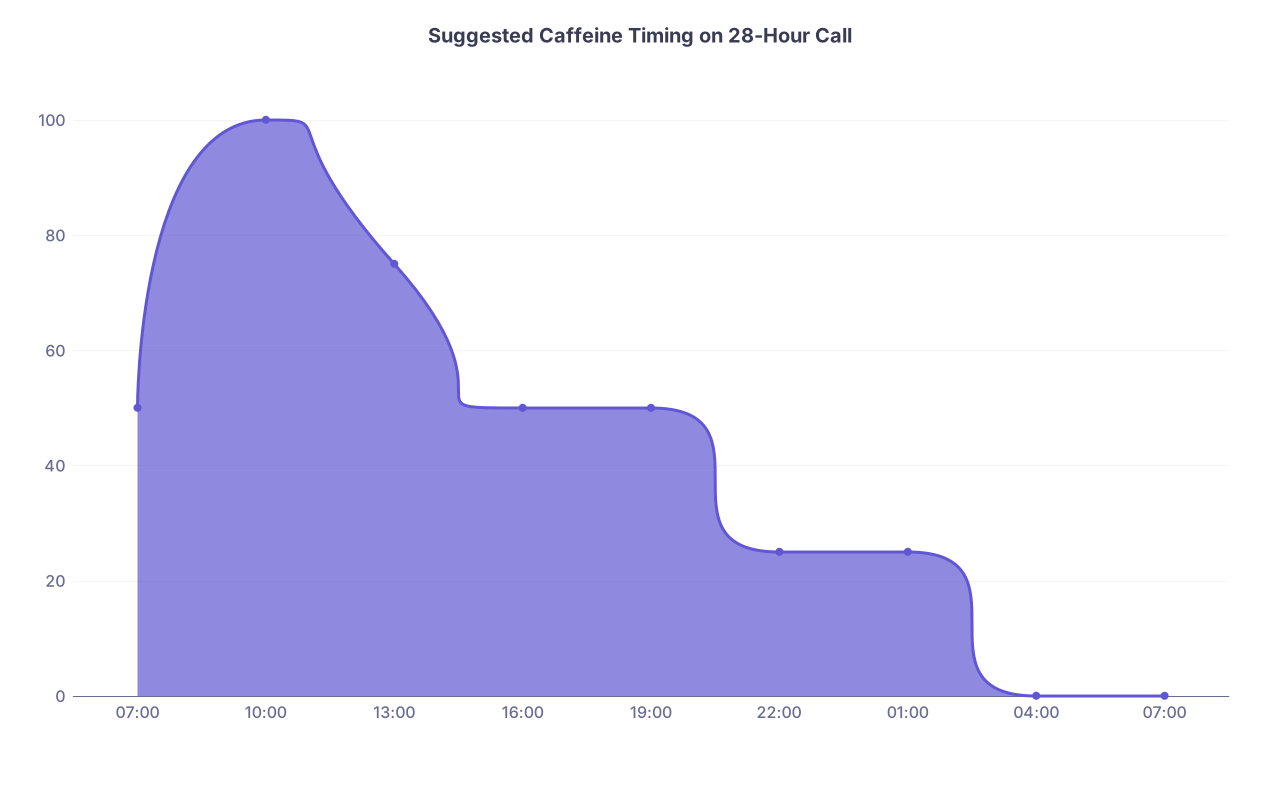
Smart caffeine strategy
Stop drinking coffee like a panicked pre‑med.
| Category | Value |
|---|---|
| 07:00 | 50 |
| 10:00 | 100 |
| 13:00 | 75 |
| 16:00 | 50 |
| 19:00 | 50 |
| 22:00 | 25 |
| 01:00 | 25 |
| 04:00 | 0 |
| 07:00 | 0 |
- Morning (7–11 a.m.):
- 1–2 modest doses (e.g., 8–12 oz coffee) spaced out.
- Afternoon (12–5 p.m.):
- Small top‑ups only if sleepy.
- Night (after ~1 a.m.):
- Avoid large doses that will wreck any chance of effective napping and post‑call sleep.
- If you must, use 50–75 mg (half coffee, small tea) strategically.
Pair caffeine with short naps when possible:
- Drink coffee.
- Immediately lie down for a 15–20 minute nap.
- Caffeine kicks in as you wake → “caffeine nap,” surprisingly effective.
Food and blood sugar
Nighttime carb binges will crush you at 3 a.m.
Aim for:
- Smaller, more frequent meals:
- Light dinner at 6–8 p.m.
- Small snack around midnight.
- Include:
- Protein (nuts, yogurt, eggs, hummus)
- Some fat (peanut butter, cheese)
- Complex carbs (whole grain crackers, fruit)
Skip:
- Heavy, greasy takeout at 1–2 a.m. (you will feel like concrete by 4 a.m.)
- Constant candy and soda “for energy”—that is not energy, that is a roller coaster.
Use light intentionally
Your brain uses light as its main clock.
- During call:
- Keep work areas decently lit. Bright light in the early part of the night can help maintain alertness.
- During naps:
- Dark as possible. Eye mask if no control.
- Post‑call:
- If you will sleep soon after getting home, avoid bright sunlight on the commute (sunglasses, hat) so you can fall asleep more easily once home.
9. Post‑Call: Do Not Crash the Car
You survived 28 hours. You are exhausted, a little proud, and possibly stupid. That is a dangerous mix.
A. The commute rule
If you are nodding off in pre‑rounds, you are not safe to drive.
Your options, in order of safety:
- Post‑call nap before driving
- 20–30 minutes, in a call room or quiet space, alarm set.
- Then reassess. If still very sleepy, do not drive.
- Get a ride
- Co‑resident, friend, partner, rideshare.
- This is not overkill. Residents die every year in post‑call car accidents.
- Public transit / walking
- Only if you are alert enough not to stumble into traffic.
B. Post‑call sleep strategy
The worst mistake: going home at 11 a.m., sleeping until 8 p.m., then wrecking your sleep for days.
Better pattern:
- At home:
- Eat something light.
- Darken your room (curtains, eye mask).
- Sleep 3–5 hours max.
- Wake by early evening:
- Light exposure.
- Normal dinner.
- Aim for a shorter, earlier bedtime (e.g., 9–10 p.m.) to reset.
It feels brutal to limit that post‑call sleep. But chronic circadian chaos is worse.
10. Putting This Into Practice: A Simple Implementation Plan
You do not need to implement everything at once. Start with a three‑call experiment.

| Step | Description |
|---|---|
| Step 1 | Call 1 - Observe |
| Step 2 | Call 2 - Add Micro-breaks |
| Step 3 | Call 3 - Add Planned Naps |
| Step 4 | Review What Worked |
Call 1: Observe and measure
You change nothing. You just track:
- When your alertness drops hardest (note times).
- When there were natural lulls that you did not use for rest.
- How long you actually slept, if at all.
Write quick notes in your phone after the shift.
Call 2: Add structured micro‑breaks
Same call pattern, but now:
- You commit to a 60–90 second reset every 1–2 hours when possible.
- You practice the 90‑second protocol from Section 4.
After the shift, note:
- Did you feel less fried at 3–5 a.m.?
- Did you make fewer annoyingly dumb errors (e.g., misclicks, redoing orders)?
Call 3: Add planned micro‑naps
You keep micro‑breaks and add:
- One 10–20 minute nap window early night.
- One 10–20 minute nap window during circadian low.
Then assess:
- Were you more functional on rounds?
- Was your commute safer and less miserable?
- What barriers did you run into (coverage, guilt, physical space)?
Tweak from there. This is a skill set you refine, not a binary you “achieve.”
11. The Bottom Line
You cannot change the fact that 28‑hour calls exist. You can absolutely change how you go through them.
The essentials:
Micro‑breaks keep you from sliding into the ditch.
60–90 seconds away from the screen every 1–2 hours will pay off more than any extra 60–90 seconds of half‑awake charting.Short, disciplined naps are performance tools, not weakness.
10–20 minute power naps, used twice on a 28‑hour call, will do more for patient safety and your sanity than another coffee and a donut.You must plan this on purpose.
Pre‑call sleep, defined nap windows, coverage conversations, and post‑call commute safety are not “nice to have.” They are the difference between survival and slow, accumulated burnout.
Use this as a playbook, not theory. On your next call, pick one concrete change—a single 20‑minute nap window, or four 90‑second micro‑breaks—and run the experiment.
You will feel the difference. More importantly, your patients will too.