
The moment you realize your residency work hours are already over the limit is not the time to panic. It is the time to execute a clear, ruthless plan.
This happens more than programs like to admit. You are midway through a call month, or closing out a rough week, and you finally run your hours. The number on the screen is not “close.” It is bad. You are over an 80‑hour average or blew the 24+4 cap or the 1‑day‑off‑in‑7 rule. And you have already worked the hours. You cannot un‑see it and you cannot undo it.
You can, however, fix what happens next.
Below is an urgent, practical protocol for what to do today, what to do for the rest of the block, and how to build a system so you are never blindsided by this again.
Step 1: Confirm the Damage — Precisely
Do not guess. Do not “eyeball” it. You need hard numbers before you talk to anyone.
1. Pull exact duty hour data
Use whatever your program uses (MedHub, New Innovations, institutional system, or your own spreadsheet).
Check these, separately:
- 80‑hour rule (averaged over 4 weeks)
- 24+4 rule (24 hours clinical work + 4 hours transitions/education)
- 8‑10 hours off between shifts (depending on specialty/PGY, ACGME’s “must have 8, should have 10”)
- 1 day off in 7 (averaged over 4 weeks)
- Night float / in‑house call specific rules for your specialty
| Rule | Typical Limit |
|---|---|
| Maximum hours per week | 80 hours, averaged over 4 weeks |
| Max continuous duty | 24 hrs patient care + 4 hrs wrap |
| Minimum time off between | 8 hrs (goal 10), some exceptions |
| Days off | 1 day off in 7, averaged over 4 w |
| In-house call frequency | No more than every 3rd night |
Look at rolling 4‑week windows, not just “this Monday to Sunday.” Many residents miss violations because they only think in calendar weeks while ACGME review often uses rolling periods.
2. Identify which rules are broken and when
Write this down in plain language:
- “Over 80‑hour average by 6 hours in weeks 2–5”
- “24+4 violation on 7/2 — worked 29 hours straight”
- “No day off in week 3, 1 day off in week 4 = borderline over 4‑week span”
You are going to need that clarity when you talk to leadership. “I think I might be over” is vague and easier to dismiss. “I’m at 86 hours/week averaged over the last 4 weeks” is not.
3. Capture the context — fast, factual, no drama
On a blank note (paper or phone), jot:
- Which rotation
- Why the hours piled up:
- “Two admissions after sign‑out every call”
- “ICU understaffed, one resident out sick”
- “No time to leave post‑call because of late add‑on cases”
- Any patient‑safety relevant issues:
- “Managing critically ill patient alone at 26th hour”
- “Drove home after 28 hours awake”
You are not writing a manifesto. You are building a tight factual record. Stick to times and tasks, not feelings.
Step 2: Stop the Bleeding Today
You already violated. Your next job is to prevent further damage and get back inside the lines as fast as possible.
1. Do a rapid forecast of the rest of the week
Look realistically at the next 7–10 days:
- How many hours are you scheduled?
- Are there call shifts, night float, late cases, clinics?
- If you worked all of that, where would your 4‑week average land?
If you are already over, the math is not complicated:
- To bring an 86‑hour average back to 80 over 4 weeks, you need lower hours going forward.
- That almost always means you must miss or shorten future shifts. Not “maybe.”
Make a rough plan:
- “Need to cut ~8–10 hours this week to get back to 80 average.”
- Concrete version:
- Leave exactly on time two days
- Hand off late admissions
- Convert one call or weekend day to protected off if possible
2. Identify immediate off‑load options on this shift
Before you talk to anyone, know what you can off‑load now:
- Can sign‑out happen 30–60 minutes earlier if seniors attend?
- Can routine discharges be prepped by the day team before you come in?
- Can overnight admissions have basic orders written by attendings or nocturnists before your arrival?
- Are you staying late doing work that can reasonably be handed off?
Do not martyr yourself. If you keep doing all the extra work “because no one else will,” you will continue to violate. And you will be the one on record.
Step 3: Escalate — The Right Way, To the Right People
This is where people freeze. They either:
- Hide it and underreport
- Or send a vague whiny message with no plan
Both are bad. You need a grown‑up, targeted escalation.
1. Who you tell — and in what order
The hierarchy is usually:
- Chief resident / senior resident
- Rotation director or site director
- Program director (PD) / associate program director
You rarely start by emailing the PD alone at 2 am. You start where real schedule changes can happen fastest: chiefs and rotation leadership.
2. How to say it (use this template)
Keep it short, factual, and solution‑oriented.
Subject: Duty Hour Violation on [Rotation] – Need Plan to Correct
Hi [Chief/Dr. X],
I reviewed my duty hours and I am currently over the ACGME limits:
– 4‑week average is [X] hours/week (over 80)
– I had a [24+4] violation on [date] with [Y] continuous hours workedThe main contributors have been [brief cause: e.g., back‑to‑back late add‑ons, covering extra nights due to sick call, etc.].
Based on the schedule, I project I will remain out of compliance unless we adjust upcoming shifts. I want to get back within duty hour requirements and keep patient care safe.
I have a few concrete ideas that might help:
– [Example: Convert my post‑call clinic this week to protected post‑call time]
– [Example: Have cross‑cover take new admissions after 6 pm on my last call]
– [Example: Shift one weekend day to off‑service coverage by another resident]Can we discuss a short‑term plan to correct this and prevent further violations? I can meet [today between X–Y or after sign‑out].
Thank you,
[Your Name], PGY‑[X]
Notice a few things:
- You state the violation clearly.
- You show you already thought about solutions.
- You signal you care about both compliance and patient care.
- You are not apologizing for something that is structurally impossible for you to fix alone.
3. What to say in real time (if you are on service)
Sometimes you need a hallway conversation:
“I ran my hours and I am over 80 on the 4‑week average. I also had a 29‑hour shift last week, so that is a 24+4 violation. If we keep the current plan, I’ll stay out of compliance. I need help adjusting the schedule so I can be within duty hours.”
If they brush you off with “Just don’t log all of it,” that is a problem. Do not argue on the spot. Say:
“I am not comfortable under‑reporting. I am going to log accurately and I would like to involve the chiefs so we can fix the schedule.”
Then actually loop in the chiefs/PD. In writing.
Step 4: Document — To Protect Yourself and Help the Program
You are not building a lawsuit file. You are building a sane record that:
- Shows you tried to correct things early
- Helps program leadership adjust rotations
- Protects you if questions come up during reviews or site visits
1. Write a tight, factual summary
One short page max. Include:
- Dates and type of violations
- Basic schedule context (ICU, wards, nights, etc.)
- When you notified leadership (date/time)
- What was decided, if anything
Example:
“On 7/12, I calculated my hours and found my 4‑week average was 86 hours/week with one 29‑hour continuous shift on 7/3. I emailed the chiefs and rotation director on 7/12 at 10:15 am. We met later that day; the plan was to cancel my 7/14 post‑call clinic and have another resident cover my 7/16 weekend shift to bring my average down.”
Screenshot that and store it somewhere off institutional email if you want redundancy.
2. Log hours accurately from this point forward
Do not try to “fix” the past by lying in the system. That helps no one.
- Log what you actually worked.
- If the system does not allow fractional time or specific shifts easily, use the comments field where allowed to clarify anomalies.
- If pressured to change entries to avoid violations, respond with a calm written line:
- “I am required to log actual duty hours; happy to work together to change the schedule so I am compliant going forward.”
You are not their compliance shield.
Step 5: Execute the Short-Term Recovery Plan
You talked. Now something actually has to change.
Here is what realistic, short‑term correction looks like.
1. Cut upcoming hours where it hurts least
Common levers:
- Post‑call clinics or electives
- Convert to protected post‑call time. You are not learning internal medicine in clinic at hour 27.
- Weekend “extra” coverage
- Reassign to another resident, moonlighter, or attending.
- Non‑essential educational activities
- Missing one noon conference is not the issue. But cutting 4–6 hours of “extra” weekly duties may be necessary.
Be explicit: “To get back to 80 average, I need to be off completely on X day and leave at Y time on Z day.”
2. Redistribute workload within the team
This part is uncomfortable because it affects colleagues. But it is still necessary.
Tactical shifts:
- Cap your list size (if your program has caps) and enforce it
- Senior takes new admits late in the shift so you can leave on time
- APPs or hospitalists pick up some admits or discharges temporarily
- Night float starts earlier or day team leaves earlier to even out hours
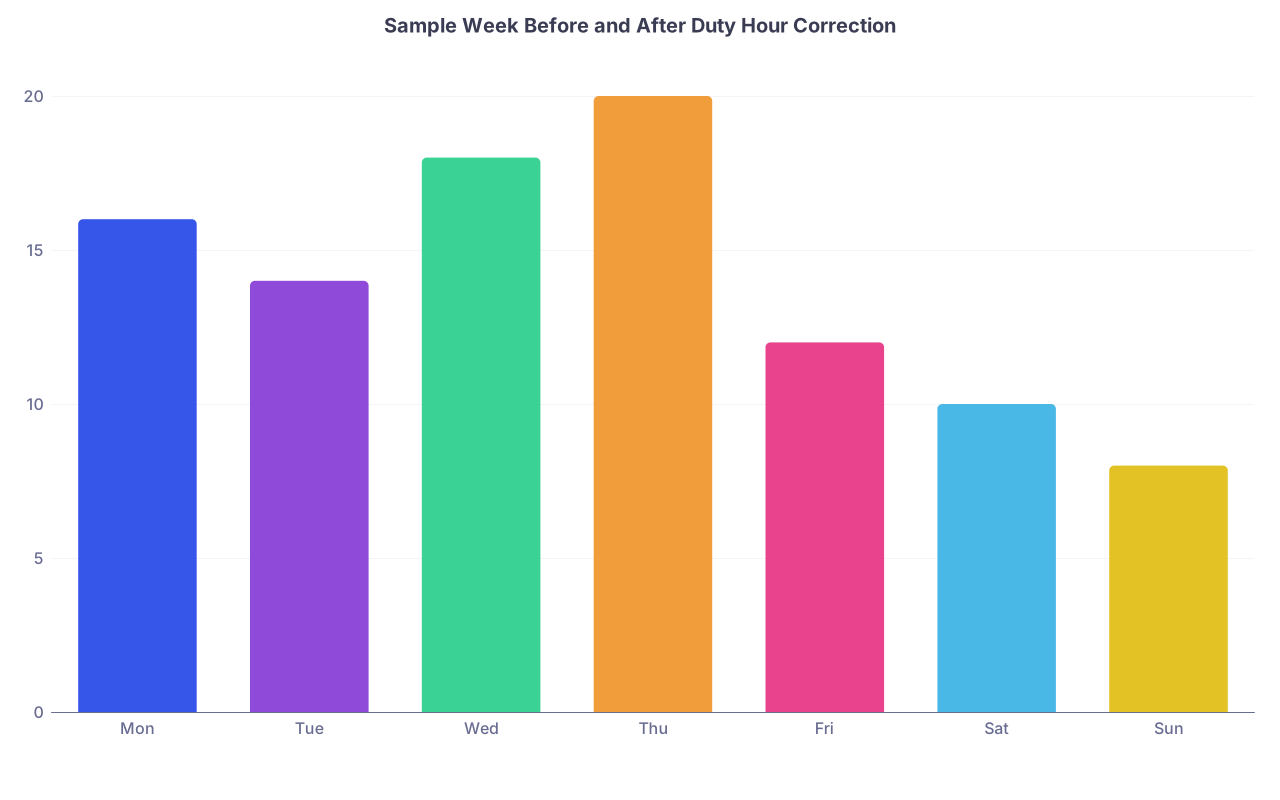
| Category | Value |
|---|---|
| Mon | 16 |
| Tue | 14 |
| Wed | 18 |
| Thu | 20 |
| Fri | 12 |
| Sat | 10 |
| Sun | 8 |
Now imagine that bar chart flattening closer to:
- 12–14 hours only on heavy days
- 8–10 hours on others
- One true 24‑hour off period
You want that shape. Not a wall of 16‑20 hour days.
3. Monitor the numbers every 2–3 days until back in range
Do not wait another month and “hope.”
Set a recurring task on your phone:
“Check duty hours: Mon, Thu at 9 pm.”
Each time:
- Log new hours precisely
- Look at rolling 4‑week average
- If you are not trending downward as planned, speak up again
Yes, it feels repetitive. That is how you avoid repeat violations.
Step 6: Build a Duty Hours Early‑Warning System
Once you survive the acute episode, you need a permanent system. Because programs are busy, rotations are often under‑staffed, and no one else is going to manage your hours for you.
1. Use a simple weekly tracking template
You do not need an app. The Notes app or a simple spreadsheet works.
Create:
- Columns: Date, Shift start, Shift end, Total hours, Comment (e.g., “call,” “post‑call,” “clinic”)
- At the bottom of each week, calculate:
- Weekly total
- Running 4‑week average
If you prefer automation, set up a small spreadsheet that automatically computes the 4‑week rolling average once you enter daily hours.
2. Set hard personal thresholds
You need bright lines where you act before you violate.
Examples:
- If your weekly total hits 75+ hours consistently → you notify chiefs and ask to review schedule.
- If you ever hit 24 hours continuous → you must leave within the 4‑hour transition window. Non‑negotiable.
- If you work 6 days in a row, you confirm with leadership when your 1‑in‑7 day off is occurring.
Do not be the resident who thinks, “It will probably even out next week.” That is fantasy thinking in July.
3. Standard scripts for resisting extra shifts
You will be asked.
You need phrases that are firm without being explosive:
- “I am already very close to an 80‑hour average over the last 4 weeks. If I pick up that shift, I will likely be out of compliance. Can we see if someone else is available or adjust another day for me?”
- “I want to help, but I am at [X] hours this week already. Is there a way to split this shift or get coverage for part of it?”
- “I can come in for the first half only; that keeps me within duty hours.”
You will feel selfish the first few times. Then you will realize this is baseline professionalism, not selfishness.
Step 7: Handle Toxic Responses Without Burning Yourself
Sometimes the response to duty hour concerns is supportive. Sometimes it is not.
You may hear:
- “We all did this; it is just how this rotation is.”
- “Do not log that, it will make the program look bad.”
- “If you cannot handle these hours, maybe this specialty is not for you.”
This is garbage. And it is also common.
1. Keep your response calm and repeat your line
You do not have to debate culture. You repeat the core:
“I am required to log actual duty hours and I want the program to be in compliance. I am asking for help adjusting the schedule so we can do that.”
If the person keeps pushing under‑reporting, document it for yourself:
- “On 7/12, [name] suggested I not log actual hours to avoid violations. I told them I would log accurately and involve chiefs to adjust future scheduling.”
Not for social media. For your records and, if necessary, for an honest conversation with the PD, GME office, or duty hour committee.
2. Use formal structures if informal ones fail
If chiefs and rotation directors are unhelpful:
- Email the PD with a clear, factual summary of the data and what you have already tried.
- Many institutions have a GME office, resident council, or anonymous reporting mechanism for duty hour violations. Use them. That is what they are for.
- Some programs hold regular “duty hour reviews” at CCC or PEC meetings. Ask for your concerns to be brought there if needed.
You are not the problem for pointing out violations. The broken system is.
Step 8: Protect Your Health and Safety in the Meantime
While you are working to fix the structure, you are still a human being who is exhausted right now. A few non‑negotiables:
1. Do not drive exhausted if you are unsafe
If you are nodding off on rounds, you should not be behind a wheel.
Options:
- Call a partner/friend/family member to pick you up.
- Many hospitals have taxi vouchers or ride‑share support for post‑call residents — ask security or GME.
- Use call rooms for a 60–90 minute nap before driving if that is the best you can do.
A car accident because your attending “needed” you to stay an extra 2 hours is not a badge of honor.
2. Strip your off‑time to actual rest for a few days
When you finally get some protected time to correct hours:
- Cancel non‑urgent social and extracurricular commitments for a weekend.
- Focus on three basics:
- Sleep
- Real meals
- One physical activity (even a 20‑minute walk)
No, this does not “fix burnout.” But it often prevents a full crash while you are sorting out your schedule with leadership.
Step 9: Post‑Mortem with Yourself and the Program
Once the immediate fire is out, do not just move on. You want to understand why you got surprised by the violation in the first place.
1. Ask: was this a one‑off or a pattern?
Some rotations are known disasters:
- ICUs with chronic understaffing
- Surgical services that routinely run past 10 pm
- EM + floor call combinations that blow up hours
If your overage happened on a “notoriously bad” rotation, that is a program‑level issue. Say that clearly to leadership:
“Multiple residents have had violations on this rotation over the last year. We need a structural change — caps, more APP coverage, or schedule redesign — not just individual ‘work harder’ advice.”
If it was an unusual cluster (flu outbreak, multiple residents on parental leave), the answer is different: better backup systems, clearer expectations around sick coverage, etc.
2. Improve your own dashboard
Ask yourself:
- Did I ignore early red flags?
- Did I assume “this is probably fine” without actually checking numbers?
- Did I consistently stay extra hours doing work that someone else could reasonably have done?
Then adjust your habits:
- Set reminders to check duty hours weekly for the next 6–12 weeks.
- Be more aggressive with handoffs at the end of shift.
- Protect post‑call and day‑off time like a hawk.
3. Push for concrete program changes
Bring very specific proposals, not vague complaints:
- “On wards, cap the list at 10–12 patients per intern for non‑ICU care.”
- “Stagger admission cutoffs so post‑call residents stop getting adds after 4 pm.”
- “Protect at least one mid‑week lighter day during heavy call blocks.”

| Step | Description |
|---|---|
| Step 1 | Notice you are near or over hours |
| Step 2 | Confirm numbers for 4 week window |
| Step 3 | Track weekly and reassess |
| Step 4 | Email chiefs and rotation director |
| Step 5 | Propose concrete schedule changes |
| Step 6 | Monitor hours twice weekly |
| Step 7 | Escalate to PD or GME |
| Step 8 | Violation confirmed? |
| Step 9 | Changes implemented? |
This is the loop you want ingrained. Notice early, quantify, escalate with a plan, follow through.
Final Thoughts: What Actually Matters
Three points to remember when your hours are already over:
You fix this with math and structure, not martyrdom. Count your hours precisely, forecast the next weeks, and cut or redistribute shifts so your 4‑week average comes back under 80. Wishing and under‑reporting do nothing.
You must log accurately and escalate early. That means clear, factual communication to chiefs and leadership with specific proposals, and refusing to be pressured into falsifying duty hours.
You build an early‑warning system so this never blindsides you again. Weekly tracking, hard personal thresholds, and ready‑made scripts for saying “no” to extra shifts put you back in control inside a broken system.
You are not weak for insisting on duty hour compliance. You are behaving like a responsible physician who wants to be safe, sane, and still standing when training ends.